
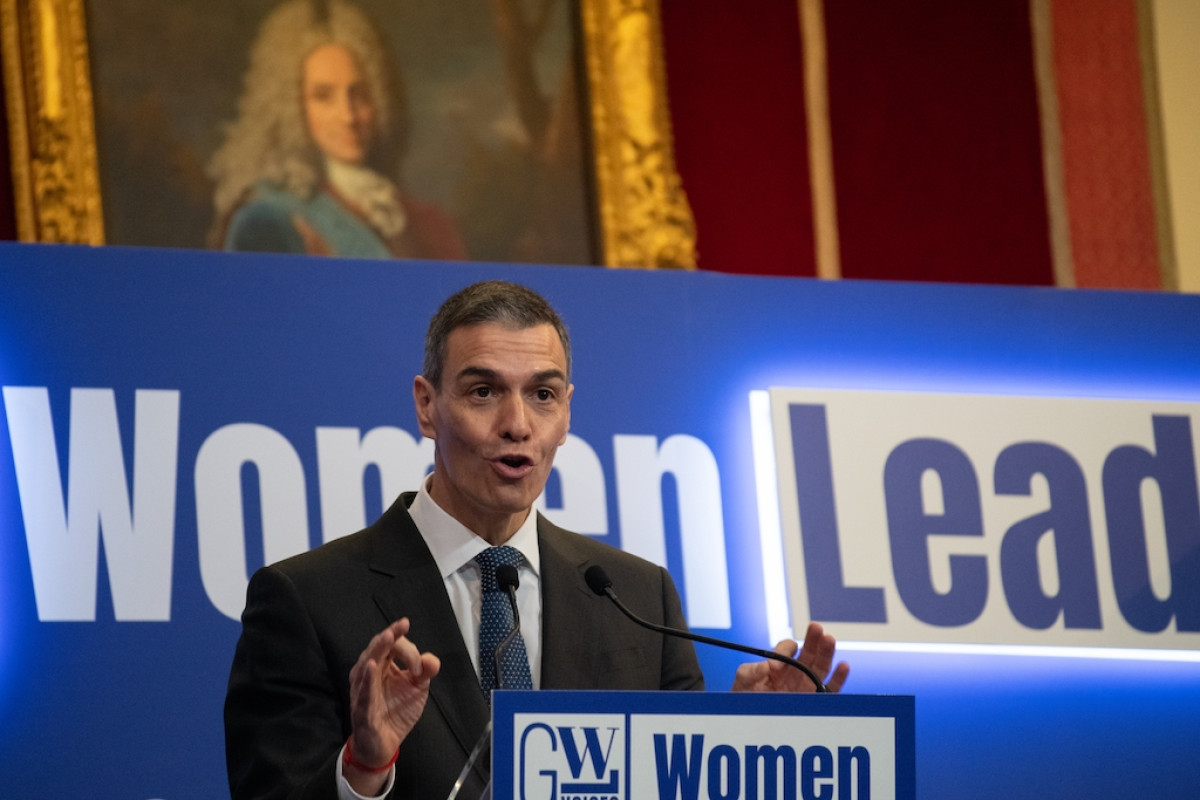
In Europe, invoking international law used to be the most predictable—and least controversial—gesture of a leader. Today it is a gamble. When the Prime Minister of the Spanish government, Pedro Sánchez, asserts the international legal order as the compass of his foreign policy, he does so in a world where rules contend with faits accomplis.
We reject the unilateral military action by the United States and Israel, which escalates and contributes to a more uncertain and hostile international order.
We also reject the actions of the Iranian regime and the Revolutionary Guards. We cannot afford another prolonged war, and…
— Pedro Sánchez (@sanchezcastejon) February 28, 2026
For some, statements like this in the face of the military offensive against Iran signal coherence. For others, it is a way of being poorly positioned on a board that rewards force and ambiguity.
The dilemma is not new. The middle powers — a category in which Spain sits comfortably — have historically thrived in regulated environments. Without the capacity to impose their will, they depend on rules that bind the strongest and on institutions that amplify their voice. The European bet after 1945 was exactly that: weaving a network of rules, courts, and alliances that turned interdependence into security. In that framework, invoking international law is not naïve; it is self-interested.
But it is undeniable that the context has changed. The Russian invasion of Ukraine, the conflict in Gaza, the US–China rivalry, and the return of bloc politics have eroded the illusion that the world would converge toward a stable liberal order. “The West is dead” recently asserted Mark Leonard, director of the European Council on Foreign Relations, in Agenda Pública. International legality still exists, but its application is selective and its observance depends on the balance of power. In that landscape, appealing to the norm can sound like moralism if it is not accompanied by power or solid coalitions.
“A country that stands out too much runs the risk of appearing to be losing influence”
There lies the first critique of Sánchez: the risk of asymmetry. If Spain emphasizes the primacy of international law in all forums, but its partners take more pragmatic stances, Madrid can appear out of step. In foreign policy, the perception of unity matters almost as much as the content. A country that overemphasizes its distinctiveness runs the risk of seeming to be losing influence.
However, the alternative is not obvious. Spain is not a nuclear power nor a player with structural veto power. Its room for maneuver depends on its insertion in the European Union and in NATO. And both the EU and the Atlantic Alliance legitimize themselves, at least rhetorically, in defending a rules-based order. Perhaps the question is not whether Spain should invoke international law, but how and with what consistency.
Consistency is the second delicate point. In a polarized environment, and with a European radical right that already acts as “strategic putty” for the MAGA movement, political opponents scrutinize every statement for contradictions. There is also a domestic calculation. In societies where foreign policy rarely decides elections, the cost of adopting normative positions used to seem low. That is changing. The war in Ukraine has affected energy prices; tensions in the Middle East influence security and social cohesion; the technological rivalry with China has industrial consequences. International decisions are no longer abstract. Advocating for international law can garner support among pro-European segments of the population but can also fuel the narrative of those who prioritize a more transactional view of interests.
Nevertheless, it is worth remembering that international law is not only ethics; it is infrastructure. It regulates the maritime trade on which the Spanish economy depends, protects investments in Latin America, structures fishing agreements, and defines frameworks for migratory cooperation. When Spain invokes international legality, it is not only speaking of distant wars; it defends an ecosystem that sustains its prosperity. Abandoning that narrative for being deemed less “realistic” would be to forget that the realism of a middle power consists precisely in safeguarding rules. Àlbert Guivernau stated recently: “What happens between Tehran and Washington—Tel Aviv will eventually affect the wallet of a small business in Cuenca or the budget of a family in Almería.”
“What happens between Tehran, Washington and Tel Aviv will eventually affect the wallet of a small business in Cuenca or the budget of a family in Almería”
The European Union offers an instructive laboratory. The community project is, essentially, a test of sovereignty shared on the basis of rules. If the Member States begin treating the law as an optional variable, the building will falter. From that perspective, Sánchez’s stance can be read as an investment in European political capital. Spain, which during its rotating presidency of the EU Council sought to project itself as a constructive actor, has incentives to present itself as coherent with multilateralism.
The risk, however, is the disconnect between rhetoric and capacity. Rules without instruments to support them blur and dilute. The defense of international law also requires contributing to its enforcement: backing sanctions when it is violated, investing in defense when deterrence fails, reinforcing courts and verification mechanisms. If rhetoric is not accompanied by resources, the critique of “poor positioning” gains traction.
There is also a broader strategic dimension. In a fragmented world, many Global South countries view Western selectivity with skepticism. Spain, given its history and ties with Latin America and the Mediterranean, could play a bridging role if its defense of international law is perceived as coherent and not instrumental. That is an opportunity: turning the norm into a mediation tool, not merely a declaration of principles.
Ultimately, the question is not whether advocating for international law is correct, but whether it is effective. For a middle power integrated into the EU and dependent on global trade, a rules-based order is a strategic asset. Defending it may entail tactical frictions, but renouncing it would be equivalent to accepting an environment in which Spain’s relative weight diminishes. The key lies in combining norm and power: rallying alliances, investing in capabilities, and maintaining consistency.
“The position of Sánchez may be uncomfortable for those who prioritize the short term, but it offers a clear narrative about Spain’s place in the world”
In times of uncertainty, the temptation is to shelter in ambiguity. Yet ambiguity also carries costs: it erodes credibility and makes it harder to build coalitions. Sánchez’s stance may be uncomfortable for those who prioritize the short term, but it offers a clear narrative about Spain’s place in the world. The alternative —pragmatism without a framework— risks turning every crisis into improvisation.
International law is not a guarantee of peace nor an infallible shield. It is an imperfect set of rules that require political will to sustain. For countries like Spain, its erosion is not an academic abstraction; it is a concrete threat to its ability to influence and prosper. Claiming it does not guarantee being well positioned, but abandoning it almost guarantees the opposite.
