
“Is this the world I imagined when I was younger? No.” When I was fifteen, I spent three months in France on a student exchange. I recall then believing that European countries would draw ever closer, that borders would blur not only on maps but also in the minds of people.
By the time I reached thirty, I witnessed the centering of European integration: the single market, the Maastricht Treaty, and enlargement. I believed in the possibility of a European Constitution. I believed then, and I still believe today, that the strength of European democracy rests on our ability to work from our differences. That only through the patient work of meeting and mutual translation can a shared political will emerge.
That idea is on the minds of millions who studied abroad through the Erasmus program or who now live in a European country other than the one where they were born. The notion of mutual translation — linguistic, cultural, political — is also at the heart of the thousands of students and researchers who have passed through the European University Institute. The European University Institute (EUI) is both the product and the pillar of the European project.
I want to take this moment to thank all of you for being here: representatives of European institutions and governments, ministers and policymakers, members of the diplomatic corps, professors and colleagues, alumni, researchers and students, and friends of the Institute.
Your presence reflects what the EUI has become over these fifty years: a place where Europe meets, contemplates, and imagines. I also wish to express our heartfelt gratitude to the EU institutions and to all the EUI member states for their steady support. A very special thanks goes to Italy —to Florence, Fiesole, and the Italian Government— for hosting the EUI, and especially to the Italian Government for providing these remarkable venues, including the latest addition, Palazzo Buontalenti.
We are deeply grateful for the extraordinary generosity of the Italian authorities and for their ongoing backing over fifty years: not only in financial terms but at the highest political level. Nearly every President of the Italian Republic has visited the EUI, among them Sandro Pertini, Carlo Azeglio Ciampi, Giorgio Napolitano, and Sergio Mattarella.
“Europe is not built solely through treaties or markets, but through knowledge, culture, memory and the capacity to think together”
The EUI was established, as both a university and an intergovernmental organization, by the six founding members of the European Community on the bold conviction that Europe does not advance solely through treaties or markets, but through knowledge, culture, memory and the ability to think together beyond the lines that would otherwise divide us. Today, on this anniversary, I renew that commitment.
Our founding charter calls us to —to quote— “contribute, through activities in higher education and research, to the development of Europe’s cultural and scientific heritage,” and to “stay connected with the great movements and institutions that have shaped its history and will shape its future.” Fifty years on, that mission remains more urgent. Not because we have all the answers to today’s problems, but because we remain one of the few European institutions devoted to asking questions that others, pressed by events or sheltered by conventions, have stopped asking. In a world that rewards certainty and punishes doubt, that is no small contribution.
In many ways, this is exactly what the EUI was created for and what it has accomplished over the past fifty years. I’m proud that these days of celebration are an opportunity to make that visible. And I believe our achievements will speak for themselves.
“Artificial intelligence also offers an opportunity: by automating data gathering, performance metrics and social-media clicks, it helps us return to the essential”
In an era when artificial intelligence is transforming the production of knowledge, we are often told that universities will become unrecognizable. Perhaps that will be true. Yet AI also presents an opportunity: by automating data collection, performance indicators and social-media engagement, it can help us refocus on the essential questions: what it means to think, to learn, to understand.
Beyond metrics and performance, experience remains. And that cannot be mechanized. The creation of self and world through the hands-on experience of thoughtful engagement, in dialogue with other ideas. The university as a shared space where ideas can be tested and developed, where learning is a transformative endeavor for those who participate, and where disagreement does not lead to exclusion, because the doubt is something we share more deeply.
Returning to Corrado’s question, the boy in the video: the world and Europe have not turned out the way I imagined during the heyday of European integration, when progress in an European manner seemed to open a bright path before us. But I’m not here to lament it. I’m here because what matters now is our ability to act in the present and shape what comes next.
I will not offer another inventory of contemporary crises. You know them. Instead, I want to highlight something less visible, but more decisive: a social, cultural and, in a sense, moral unease at the heart of the European project. The very idea of a shared future seems to be slipping away.
We cannot ignore the growing sense across the continent that, at some point along the way, we have become adept at treating symptoms while failing to articulate the deeper questions. Competitiveness and digital innovation, yes. But for what purpose and for whom? What kind of life do we want to make possible?
We have developed a routine crisis-management approach: quick fixes, technical answers to questions that were never purely technical. Far too often we prefer the language of goals and deliverables over the language of care and purpose. Aren’t we here, precisely, to imagine desirable futures and make them real?
“The energy case simultaneously reveals Europe’s strengths and weaknesses. Europe is a leader in technical and social energy innovation”
Take the energy example. It encompasses security, climate, competitiveness, social justice and democratic consent. The energy case, while highlighting Europe’s strengths as a leader in technical and social energy innovation, also reveals weaknesses. Yet policy fragmentation and overlapping competencies undermine industrial profitability and threaten the collective security of energy supply, as well as broader security. There exists a gap between the rhetoric of ideals and the ability to translate them into tangible benefits for European citizens and businesses. We need urgent, coordinated action and also imagination: the capacity to conceive a different energy system that brings together all sectors and levels of decision-making.
Europe is no longer a project still under construction. Many understand, perhaps more clearly than ever, why Europe matters: for security, for prosperity, for democracy. According to Eurobarometer, three out of four Europeans feel they are citizens of the Union. Seven in ten view the European Union as a anchor of stability in a turbulent world. The desire for Europe is stronger than it has been in decades.
Europe, as a way of life, is resilient. It is not a policy that can be reversed. In the current climate of anxiety and crisis, this is something to hold on to. And if we feel tempted to take it for granted, we need only look beyond our borders: to the young Ukrainians, Georgians and Moldovans who remind us what Europe stands for. They perhaps see more clearly than we do what is at stake and what we risk losing.
Let me recall a voice that speaks to all this and that deeply inspires me. I quote: “Without exaggeration, and without presenting Europe as a besieged citadel, we must show our fellow citizens every day that the European project, by pooling our resources, is essential if we want to survive and safeguard our independence”.
And it continues: “We will be better positioned to establish peaceful and balanced relations with other nations of the world and to strengthen our solidarity if we have shown our determination”.
These words were spoken by Simone Veil, the first woman president of the European Parliament, at the EUI in 1980. Veil warned against an Europe perceived as “an almost exclusively economic organization, run by technocrats”. And she called for a “second impulse”.
That second impulse that Simone Veil urged requires intellectual grounding, social imagination and the confidence to pose difficult questions. Because before acting we must see clearly. And before seeing clearly, we must find the courage to name what holds us back. We need sharper lenses to grasp the complexity of the world we inhabit.
What would strategic autonomy mean for Europe? Jean Monnet understood in the fifties that coal and steel were not mere economic resources, but engines of political transformation. Those who controlled them shaped the continent.
“Strategic autonomy is not a banner. It is a mesh, a system of decisions, institutions, technologies, and capabilities in which any weak link exposes the whole”
Today, similar questions arise. Strategic autonomy is not a banner. It is a mesh, a system of decisions, institutions, technologies and capabilities in which any weak link exposes the whole. The digital infrastructure has become our coal and steel, the backbone of our democratic life. The question is whether Europe can govern itself on its own terms or whether it will leave the essential infrastructure for citizens to deliberate and for younger generations to engage in the hands of others.
Much of our knowledge, data and security information are stored and managed today in large platforms located outside Europe. At the EUI we are working to imagine alternatives, including the development of the first truly European social media platform.
We also know that meeting Europe’s technological and security ambitions will require substantially more resources. By 2030, the investment gap is estimated at between 750 and 800 billion euros annually. If Europe wishes to stand on its own, it must be capable of mobilizing its own resources. These challenges are complex and cannot be tackled by public policy alone.
The EUI is now a necessity: a place where Europe can reflect on itself and begin to imagine desirable futures together with institutions and society at large.
At the official inauguration of 1976, the first president of the EUI, Max Kohnstamm, spoke of three crises: the crisis of the European Community, the crisis of universities, and the crisis of civilization. I quote: “Certainly, with our weak strength we cannot answer them. But if we do not run away from these questions, if we do not bury our heads in the sand, perhaps we can help discover and develop modes of thought and action suited to our era and its problems”.
This remains the foundation upon which we must build the future of the EUI. Let us be ambitious, not for ourselves, but for the younger generations who, like Corrado in the video, are already watching us.
Because we will be called to answer before the court of history. In fifty years, the youngest among us and those yet to come, who will pass through the EUI and shape Europe beyond it, will look back and judge our actions. And they will ask: Who were you? What did you build for us? What did you leave behind? These questions are already before us.
Let us ensure that the EUI remains what it was meant to be: a place where Europe contemplates itself in all its depth; an excellent research university; a social space of possibility; a diplomacy-driven force grounded in principles; and a shared act of imagination.
The EUI has come a long way in fifty years, and there is much more to come. Happy 50th anniversary to all of you, our great EUI family!
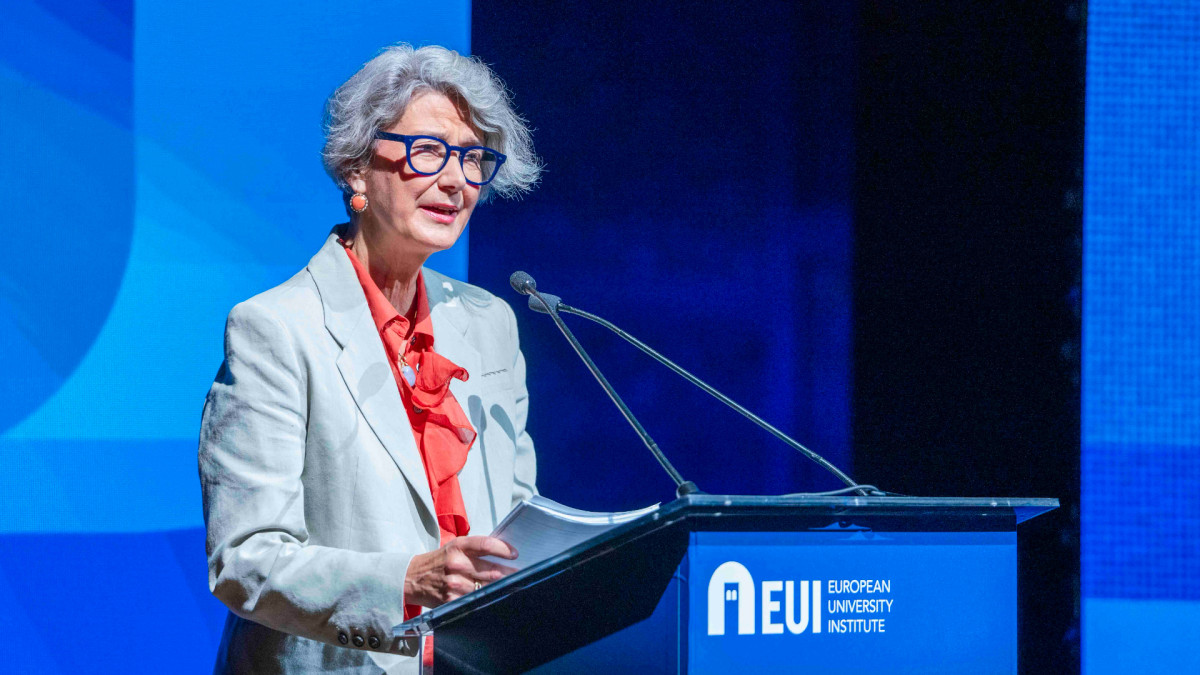
This is the speech, translated and slightly edited, given by the president of the EUI, Patrizia Nanz, at the institution’s 50th anniversary celebration in Florence. Agenda Publica is media partner in this gathering.
