
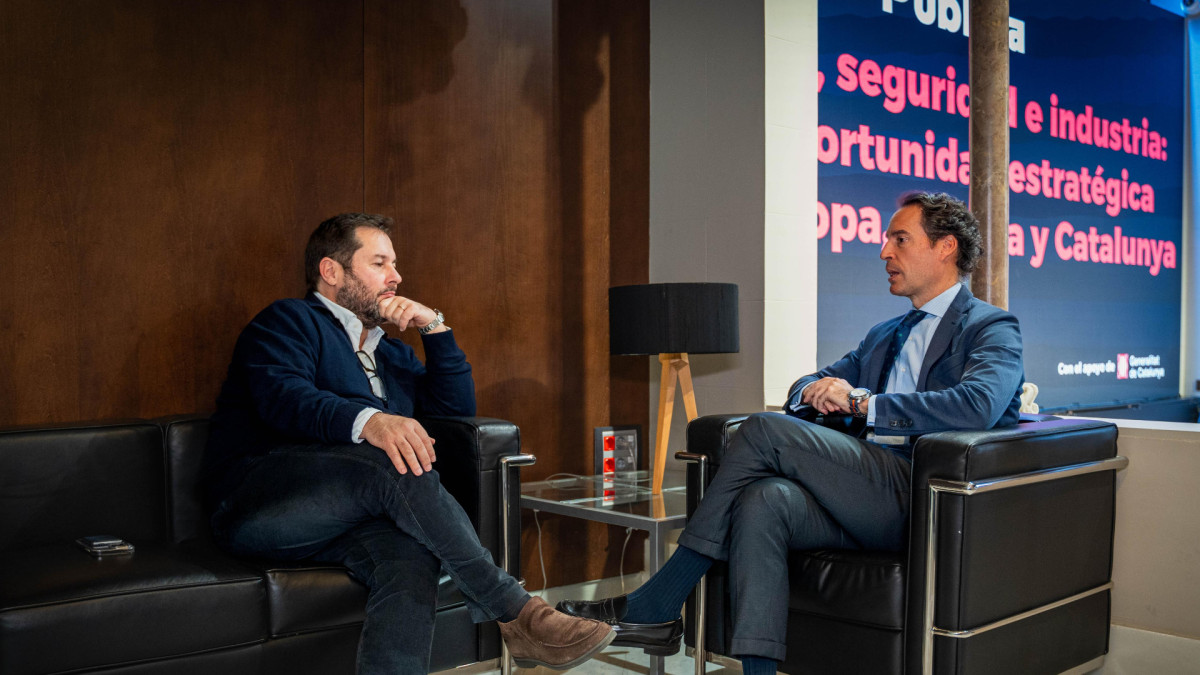
The European military autonomy clashes with a stark industrial reality on the battlefield. In this conversation with Javier Colomina, Deputy Secretary General of NATO and Special Representative for the Southern Neighborhood, the Spaniard lays out the continent’s shortcomings for its daily defense. Because despite the political and financial effort of recent years, the European Union still depends on the North American market for its day-to-day operations. That was also the starting point that brought the diplomat to Barcelona, where he took part in the micro-space organized by Agenda Pública entitled Defense, Security and Industry: a Strategic Opportunity for Europe, Spain and Catalonia.
The continental rearmament is unavoidable to rebalance the Western alliance. In the face of voices calling for alternatives, Colomina underlines that this advance must materialize “within the transatlantic framework”. This shared space offers unparalleled nuclear deterrence, also recalling that “96% of the population of the European Union lives in NATO member countries”. A complete disconnection is absolutely ruled out.
The community industry, which includes Spain and its autonomous communities, faces the urgent challenge of reducing its operational fragmentation to multiply domestic production. Currently, Europe acquires the “80% of its military equipment from outside” and continues to depend on Washington to sustain Kyiv. Facing this deficit of sovereign capacities, will the Twenty-Seven be able to build a genuine common defense and prevent resource shortages from ultimately compromising the security of the continent?
The Deputy Secretary General of NATO and Special Representative for the Southern Neighborhood, Javier Colomina. Photo: Agenda Pública / Tsun Ho
In the Middle East, NATO is conducting efforts to identify Iranian missiles. I consider this a clear demonstration of the organization’s importance and its defense and aid capabilities. How do you assess this from inside the Alliance?
NATO, in recent years, has in my view taken all the right decisions to enhance our deterrence capability and our collective defense capacity across all domains. We have approved regional plans with force allocations from that perspective, with a mobilization capacity of more than half a million soldiers within two or three weeks if needed, with the necessary command and control.
Security works this way: you have to be prepared for when something happens. And now that something has indeed happened: three missiles intercepted that came from Iran, with an absolutely firm and precise response. They were intercepted in minutes, located, and shot down.
“The Alliance is a defensive alliance that fundamentally invests in deterrence. But, if there is a need to react, it reacts”
That is NATO: it is something we have been arguing for many years, and in particular Spaniards, Italians and other allies, with a 360-degree vision, so that any threat has a decisive response. That does not alter the fact that the Alliance is a defensive alliance that fundamentally invests in deterrence. But, if there is a need to react, it reacts.
From Spain there may be a perception that NATO, for obvious and understandable reasons, is looking more toward the East. Do you think that, not only due to its responsibility but also because of the current Middle East conflict, a stage is opening in which two perspectives must be balanced and that 360-degree approach must truly be completed?
NATO remains firmly focused on strongly supporting Ukraine so that it can defend itself against Russian aggression. Supporting Ukraine has been a priority since 2014, but especially since February 2022. And it will not stop being so, because one of the two threats we have agreed upon, and the most direct, is Russia. The other threat is terrorism, which largely points us toward the South.
As I said, collective defense in recent years has clearly advanced toward that 360-degree concept that had not been fully established in the organization before. The organization has always looked eastward by inertia, since it arose after World War II and in opposition to the Warsaw Pact.
“What happens on the ground undoubtedly also shapes the political agendas of all our countries”
Now, in recent years progress has been made, for example, by allowing the approval of the Southern Neighborhood Action Plan at the Washington summit in 2024. Within days, I was appointed to implement that action plan. It is undeniable that what happens on the ground also shapes the political agendas of all our countries. The open conflict in the Middle East, especially following the terrorist attacks of October 2023; now the war in Iran; the situation in the Sahel… All of this brings focus to the many threats and challenges to security that we face in the South.
That is perfectly compatible with the fact that today one of the main priorities remains the Eastern front due to the war we have in Ukraine. But NATO does not have the option of choosing between threats: it must be able to respond to all of them.
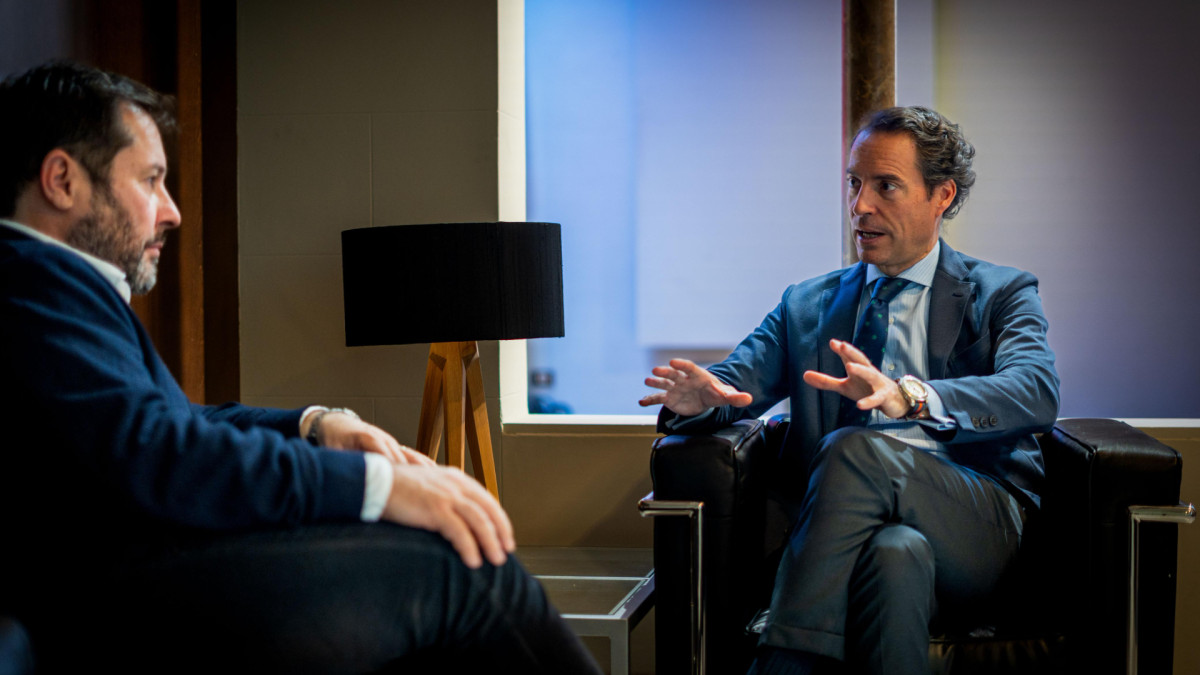
Plana and Colomina delve into NATO’s 360-degree approach. Photo: Agenda Pública / Tsun Ho
In that southern strategy, which are NATO’s partner countries and what is our relationship with them? Seen from Spain, it’s easy to think that many problems could also stem from the South. How is work being carried out now to prevent them? Not in purely economic terms, but in terms of relations and cooperation with those countries.
NATO has eleven partners in the South in addition to Iraq, where we have an advisory mission. This week, the Mission has withdrawn its physical presence in the country. It has relocated its personnel in Iraq to continue performing advisory activities from our Command in Naples. With other partners, in general, there is no operational presence: the relationship is more political.
Those partners range from Mauritania and the entire North Africa up to Egypt, Jordan, Israel and the four Gulf states, excluding Saudi Arabia and Oman. In addition to those partners, there are relations with other countries that are not formal partners but are political actors with whom we interact and whom, in some cases, we also invite to courses or partially open some of our activities.
With our partners there is a wide menu of practical cooperation and political dialogue. We work a lot with them in areas such as maritime security, counterterrorism, counter-drone warfare, interoperability — which is an essential element —, exercises, training and also in the education of military personnel at all levels, from ordinary staff to special operations.
We work at different levels, because not all of our partners receive the same: it depends a lot on what they want, their needs and also what they contribute.
“You have to protect your own security and, with that, shared security usually increases. That is the ultimate objective of what we do with all these countries”
Here the reading of everything we do is that our own security has to rise as a result of what we do. We always speak of shared security, because that must be the concept, but security is also, in itself, a somewhat self-interested concept. You have to protect your own security and, with that, shared security usually increases. That is the ultimate objective of what we do with all these countries.
There are different capacity-building packages. The more advanced partners are Jordan, Tunisia, Mauritania and Iraq, which has that advisory operation. The other countries advance more in some aspects than others, but the ultimate goal is that they become more capable of facing the shared security threats and, at the same time, contribute directly to our security through their participation in our operations and activities.
Occasionally, for example, Gulf countries or Morocco have notable capabilities in the defense industry. And there we are trying to identify synergies and real areas of cooperation. In particular, in counter-drone warfare or missile defense, the Gulf is tremendously capable.
Morocco deserves a specific question because it is our strategic neighbor, both for its relationship with Africa and with the Sahel. What is being worked on with Morocco within that collaboration?
Yes, Morocco is a vital partner in North Africa. It is an active country in foreign and security policy, with wide influence not only in the Maghreb but also in sub-Saharan Africa and the Sahel. For all this, it is a very important partner for us, as it is for Spain and for other countries around the Mediterranean basin.
“There are many areas in which we cooperate, but I believe the growth potential is high because it is a key country in North Africa”
It is a partner that, given how it has chosen to position itself in recent years, will increase in importance. It has a very good relation with many of the other Middle Eastern countries. There is a good overall relationship with the West. And it maintains a strong alignment with the Euro-Atlantic area and its principles. All of this makes cooperation with Morocco, which is already good, only grow in the coming years.
We work in many of the areas I mentioned earlier. They are interested in continuing to coordinate activities, from counterterrorism to maritime security. There are many areas in which we cooperate, but I think the growth potential is high because it is a key country in North Africa.

The Spanish diplomat has held his NATO post since 2024. Photo: Agenda Pública / Tsun Ho
European defense or greater weight of the European pillar within NATO?
The latter. There must be a clear growth of European defense. We are already seeing decisions being made by the European Union, largely driven by our own decisions and by the demands we have made to Europeans to take a more prominent role in European defense.
“The involvement of the EU and NATO is evident, and I think advancing within that transatlantic framework, however complex it may be at times, is how we should see things”
We have all heard what the U.S. asked for, that burden shifting. We believe that, indeed, the relationship was unbalanced and that, to rebalance it, more Europe is necessary, also more Canada, but above all more Europe. Europe must make decisions to grow in Europe’s defense, to have more weight and leadership, particularly in the continent’s conventional defense, but, in my view, it must all be done within the transatlantic framework.
First, because that framework gives us the capacity to manage that burden shifting, since within it we have absolute visibility on where American troops, equipment or enablers are, where changes or movements may occur and how they should be offset with greater European leadership.
And second, because it is sensible: Europeans should advance, grow, have many more capabilities and a greater ability to influence decision-making, but within a solid framework from which we benefit greatly.
The transatlantic framework offers an unparalleled nuclear deterrent, a collective military capacity of the 32 nations. We always talk about the U.S., but we must also mention the United Kingdom, Turkey or Norway, which are not part of the European Union. We mustn’t forget that 96% of the EU’s population lives in NATO countries. The involvement between the EU and NATO is evident, and I believe that advancing within that transatlantic framework, however complex it may be at times, is how we should view things.
More money equals more power? As NATO operates, can it be explained that if Europe puts more money on the table, it will also have greater decision-making capacity?
The way to explain it is another: more threats and a tougher strategic context have led us to the need for more money because more military capabilities are required. That is the general reflection, valid for the 32 NATO allies.
“The more Europeans invest, the more defense industry and more military capabilities they put on the table, the greater their decision-making power will be in many areas”
Now, within that reflection, it is undeniable that European countries were far below the investment needs in defense—ones we had defined to address those threats—and hence, the ones who needed to advance the most. And, with that, to also regain influence.
Indeed, the more Europeans invest, the more defense industry and more military capabilities they put on the table, the greater their decision-making power will be in many areas. NATO is an intergovernmental organization; it decides everything by consensus, and that will remain so.
But what exactly does it mean that everything is decided by consensus?
That everything is decided among the 32. There are no qualified majorities of any kind.
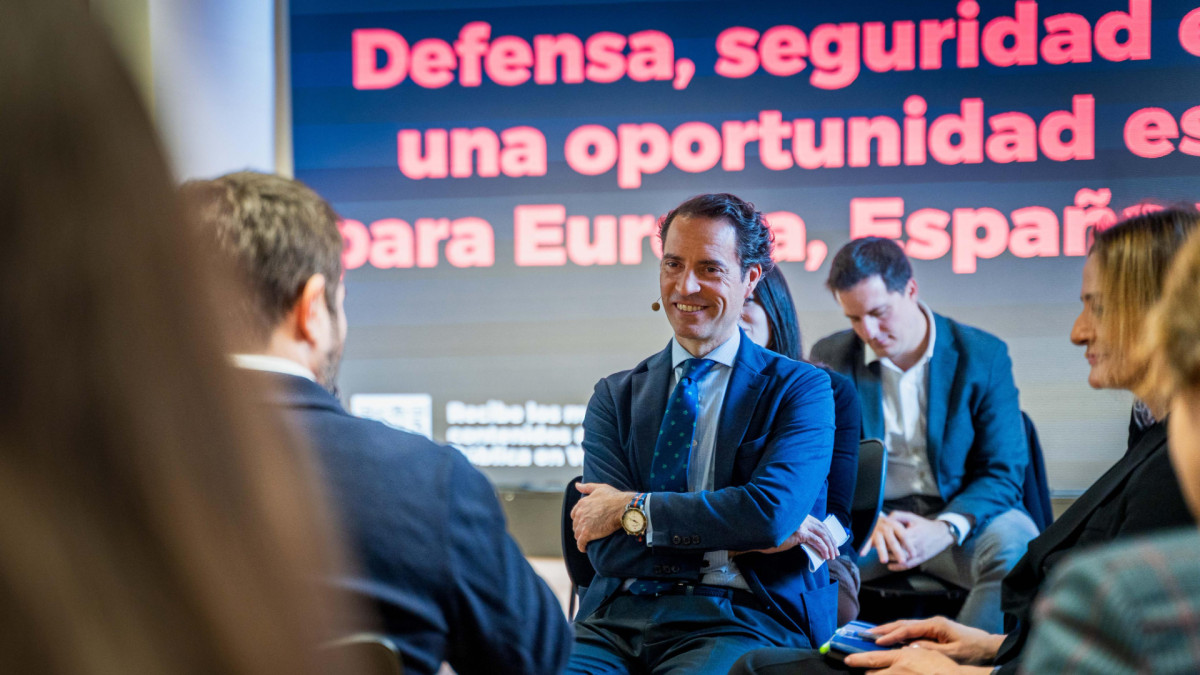
The conversation between López Plana and Colomina takes place after the micro-space organized by ‘Agenda Pública’. Photo: Agenda Pública / Tsun Ho
Do you not think that could change in the future?
No, I don’t think so. The strength of the organization is precisely that everything is decided by unanimity. And, while building those consents is very difficult, that is the strength of an organization that, unlike the European Union or others, speaks only of security and foreign policy, which are powerful sovereignty spaces.
In those spheres, the concept of solidarity only truly exists if there is unanimity in decision-making. Then, naturally, the real power of each ally is different, and that has an impact when negotiating. The fact that Europeans have doubled their defense investment and will produce more military capabilities, more quickly and in greater quantity, will also have an impact on their ability to influence.
In fact, last month the leadership for NATO’s various headquarters—the component commands as well as the joint commands—was announced. There was a key decision: the component commands — Sea and Land — will remain in American hands, while the joint commands, which until now were generally in American hands as well, will pass to European hands.
It is an evolution that shows we are moving toward decisions taken with greater balance.
One last question about the defense industry. Does putting more money mean producing more military material? What are the current numbers? When we talk about the US-Europe relationship, it’s worth laying out the figures.
Yes, it is essential. When we talk about seeking alternatives or continuing to work within a transatlantic framework, I always say that, in addition to the fact that this framework has served us very well for 76 years and has guaranteed a level of security that has allowed European prosperity, we must look at what the real alternatives to that framework are. Of course it has complexities and tensions, some of which we see today and others we have seen at other moments in history. The figures help to see it.
“In a European war, which borders several European Union and NATO countries […] 90% of the missiles currently used come from the North American market”
Today, Europe buys 80% of its military equipment outside the European Union and, of that external material, almost 70% comes from the United States. But I’ll give you a figure that, to me, is even more striking: today, Ukrainians, for their daily defense — and missile defense is one of its essential elements — rely on 90% of their missiles from the United States.
That is, in a European war, which borders several European Union and NATO countries, for missile defense, which is absolutely essential today, 90% of the missiles it currently needs come from the North American market.
Moreover, this occurs while Europeans have for four years clearly prioritized their foreign and security action on supporting Ukraine. Despite making correct political and financial decisions, they still need 90% of those missiles to come from North American stocks. Financed by Europeans, which clearly shows their commitment, but the desirable outcome would be for Europe to produce a substantial portion of what the Ukrainians need.
Precisely, a few days ago, President Zelenski said that the €90 billion loan still awaiting EU approval will be used to acquire, through the NATO-established system — PURL in its English acronym — the missiles Ukraine needs. Because today, Ukraine has no alternative, as the Ukrainian president himself added.
That puts into perspective all that Europe has to do.
The European Union has already done a lot, and it should be recognized, but from now on it will be less about the political and financial decision itself and more about the concrete outcome of the entire process. That outcome, in the realm of security and defense, translates essentially into a defense industry and real capacity to produce what is needed.
The European defense industry is powerful, though fragmented. Now it must begin to work to reduce that fragmentation and multiply its production capacity.
Thank you very much.

Natalie Foster
I’m a political writer focused on making complex issues clear, accessible, and worth engaging with. From local dynamics to national debates, I aim to connect facts with context so readers can form their own informed views. I believe strong journalism should challenge, question, and open space for thoughtful discussion rather than amplify noise.