
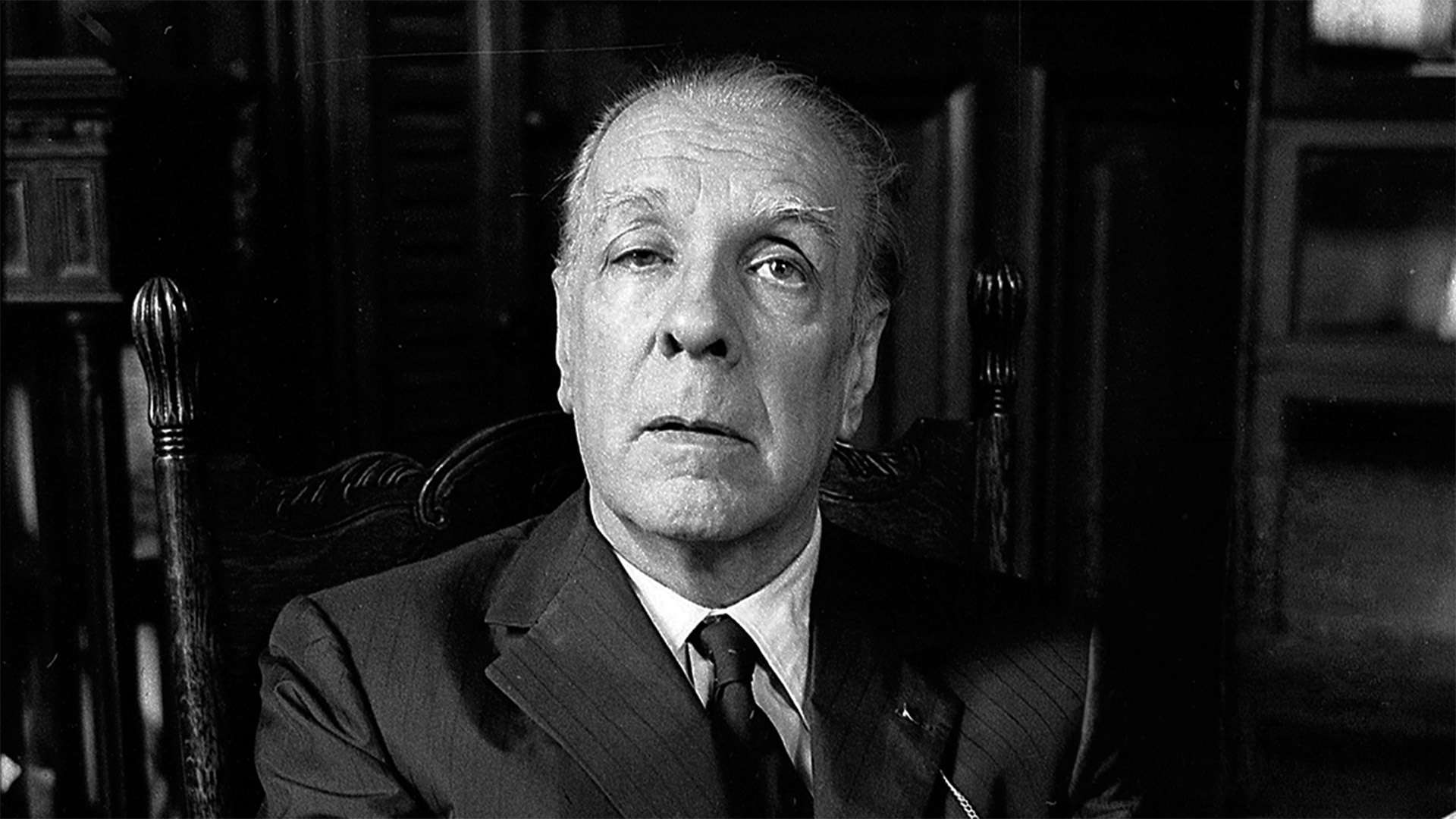
Freedom, literature, and politics in the work of Jorge Luis Borges
The December 2026 issue of Reason explores Argentine President Javier Milei’s accomplishments and what is yet to be done.

Jorge Luis Borges, the Argentine author of some of the 20th century’s most renowned short stories, was a harsh critic of authoritarianism. His views stemmed from a deep philosophical individualism. In a 1946 essay, Borges wrote that the “interference of the State with the acts of the individual” had become the “most urgent problem of our time.” He dreamed of a political party that would promise “a strict minimum of government.” He frequently invoked the 19th century libertarian Herbert Spencer: “I believe, like the tranquil anarchist Spencer, that one of our greatest evils, perhaps the greatest, is the preponderance of the State over the individual,” he wrote near the end of his life. “The individual is real; States are abstractions that are abused by politicians, with or without a uniform.”
Such ideas seeped into his fiction as well. Borges’ longest story, “The Congress,” captures many political abuses: governmental overexpansion, unfair rivalry, opportunistic flattery, and the burning of books. Probably because of his disappointment regarding the prospect or extent of political reform, in one short story—1974’s “A Weary Man’s Utopia”—Borges imagines a future in which governments “gradually fell into disuse. Elections were called, wars were declared, taxes were levied, fortunes were confiscated, arrests were ordered, and attempts were made at imposing censorship—but no one on the planet paid any attention.” He contrasts that with the present, a time haunted by “spectral collectives” and “crippled” politicians.
Borges’ philosophical individualism took inspiration from the achievements of Western civilization, rooted in Jewish, Greek, Roman, and Christian legacies. He also advocated the ideas of reason and order associated with those legacies. However, many scholars have seen a prevalence of unreality and chaos in Borges’ writing. They often quote “John Wilkins’ Analytical Language,” the 1942 essay in which Borges states that “there is no classification of the universe that is not arbitrary and speculative. The reason is quite simple: we do not know what the universe is.” But he soon adds that “the impossibility of penetrating the divine scheme of the universe cannot, however, stop us from planning human schemes, even though it is clear that they are provisional.” Reason and imagination can still explain the world, even if only partially and tentatively. The possibility of knowledge persists, even as we accept human cognitive limitations in the face of a complex universe. That recognition led him to reject the abuses of reason and to express skepticism toward collective entities and claims to absolute truth.
Borges’ philosophical individualism carries implications for the literary realm, where every person is capable of contributing something original to the world, even if that contribution is minimal. The 1927 essay “An Investigation of the Word” explores the infinite ways individuals connect words, concluding that language “is nourished not by original intuitions—there are few—but by variations, happenstance, mischief.” In 1932, similarly, he noted that every translation offers a novel approach, so much so that the “concept of the ‘definitive text’ corresponds only to religion or exhaustion.”
Since every individual can make an original contribution to the world, it follows that people should be left free to do so. Borges’ defense of individual liberty intensified from the 1930s onward, when he wrote several essays confronting nationalist, communist, and antisemitic ideas. The illiberal climate also inspired such stories as “The Lottery in Babylon,” about a “dizzying country” marked by a collectivist authoritarianism. One of the biggest global threats to liberty at the time was Nazism, which Borges said “suffers from unreality, like Erigena’s hells. It is uninhabitable; men can only die for it, lie for it, kill and wound for it.”
After Juan Perón became president of Argentina in 1946, Borges was forced from his position at a public library because of his opposition to Perón’s populist regime. “Dictatorships foster oppression, dictatorships foster servitude, dictatorships foster cruelty; more abominable is the fact that they foster idiocy,” he wrote shortly afterward. “Hotel clerks mumbling orders, effigies of caudillos, prearranged long lives and down withs, walls embellished with names, unanimous ceremonies, mere discipline substituting for lucidity. To combat such monotonies is among the writer’s many duties.”
When the military overthrew Perón in 1955, Borges was appointed director of the main national library. His work began to be widely translated, published, and read abroad, and his international reputation grew rapidly. Peronism returned to power in 1973, and Borges was forced out (again) from his position at the library. When another military coup brought down the Peronist government in 1976, Borges initially supported the new regime. But he distanced himself from the junta after its systematic violations of human rights became impossible to ignore, and he cosigned a public statement asking the government to provide information about the disappeared.
After the 1976 coup, Borges dismissed democracy as a “curious abuse of statistics.” He eventually reversed himself on that as well, declaring that his “disbelief in democracy lasted for a long time, but the Argentine people have proved me wrong.”
For Borges, a strong philosophical individualism underpinned a defense of literary creativity, individual freedom, and liberal democracy. The idea that each writer and reader can contribute a unique perspective, free from dogmas or mandates, paralleled his political conviction that human beings have the right to live freely without undue state interference. Those ideas informed not just his public political statements but also his literary works.
Among his fictions, one of the most celebrated pieces is “Tlön, Uqbar, Orbis Tertius,” a 1940 story describing a fictional planet marked by a perfectly ordered and “symmetrical” society. A postscript to the story warns that, in the real world, we should not be deceived by any political plan to implant symmetrical orders in society: “Spellbound by Tlön’s rigor, humanity has forgotten, and continues to forget, that it is the rigor of chess masters, not of angels.” That line remains as inspirational today as it was in Borges’ time.
