
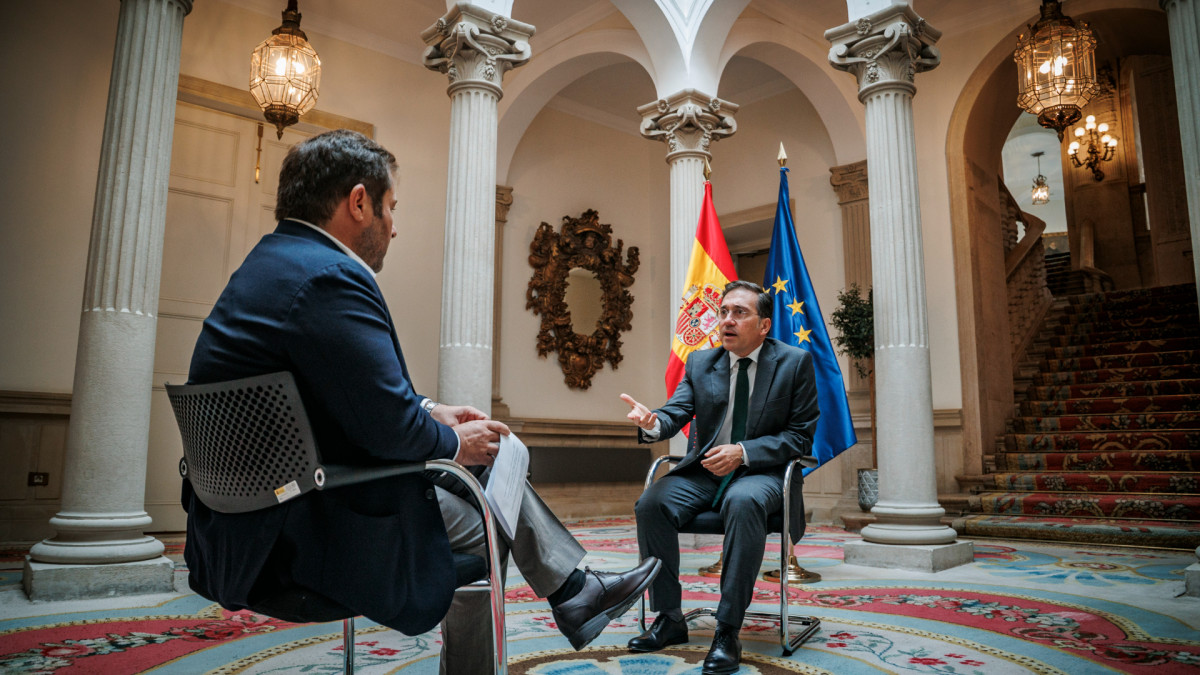
Albares provides a detailed tour of what Spain’s role as an international actor has been in recent years. From Ukraine to Palestine, where Spain maintains “a coherent position in line with its own identity,” moving through the era of Donald Trump in the United States or Spain’s standing in the world. He also had the opportunity to indirectly address the current debate about public perception of the transatlantic relationship. “There is a wide gap between the biased perception of some […] and the reality of what our relationship with the United States actually is,” the minister asserts.
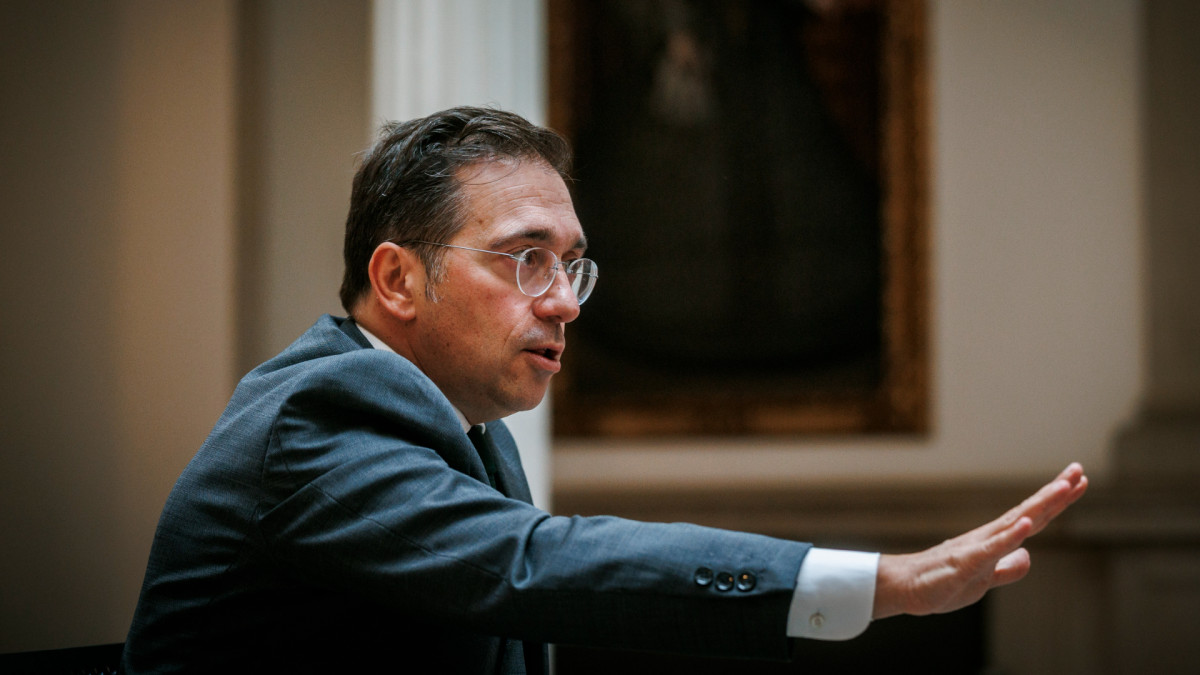
The Minister José Manuel Albares welcomed Agenda Pública to the Palace of Viana. Photo: Agenda Pública / Tania Sieira
Do you think that foreign policy has become a domestic political issue? Venezuela, Mexico, Argentina, and now defense. Do you believe foreign policy has become a domain that parties think they can win votes in?
That question has two vectors. One is evident: we are living in a moment —likely irreversible— in which there is nothing more interior than foreign policy. The major decisions that affect the lives of our citizens are not decided solely by the Government of Spain or in our Parliament. They are decided with others, with our closest partners in Brussels, at the WTO, in informal fora such as the coalition of the willing, or in the United Nations. Things as essential as the currency with which we pay, the vaccines with which we protect ourselves, or our own security, both in hard military terms and in a much wider sphere that includes climate change.”
“There are certain political parties that are using some concrete aspects of foreign policy as an additional wedge against the Government”
At the same time, there are certain political parties that are using some concrete aspects of foreign policy as an additional wedge against the Government. If you take Venezuela as an example, there has not been any government, none, that has done as much for Venezuela and the Venezuelans as ours. This is evident, for instance, if you look at the figures of Venezuelan citizens who have received a specific, unique status for them, from Venezuelans who pass through Barajas airport to Leopoldo López’s family. Or, for example, very recently, with the asylum status granted to Edmundo González. One cannot understand where the criticisms come from, among others, from the People’s Party. They should be backing the Government on this, yet they try to cast it in a completely different light. In the end, what they are doing is not supporting Venezuelans, but trying to hitch a ride on them to generate wear. But I will leave it as an anecdote.
On the one hand, we will continue pursuing the foreign policy that our citizens want, accompanying their sentiment. And on the other hand, I will not stop extending a hand to all parties. It is already too late for some issues, because some like the People’s Party told me no to recognizing the State of Palestine, or to the agreement reached with the Commission concerning Gibraltar, but there are other areas where we can still gain their support: with Spain’s official languages within the European Union, my hand will always be held out. And there were moments when we achieved the agreement, such as with the development cooperation law, which established for the first time a historical demand of our society — that 0.7% of our gross national income go toward development assistance.
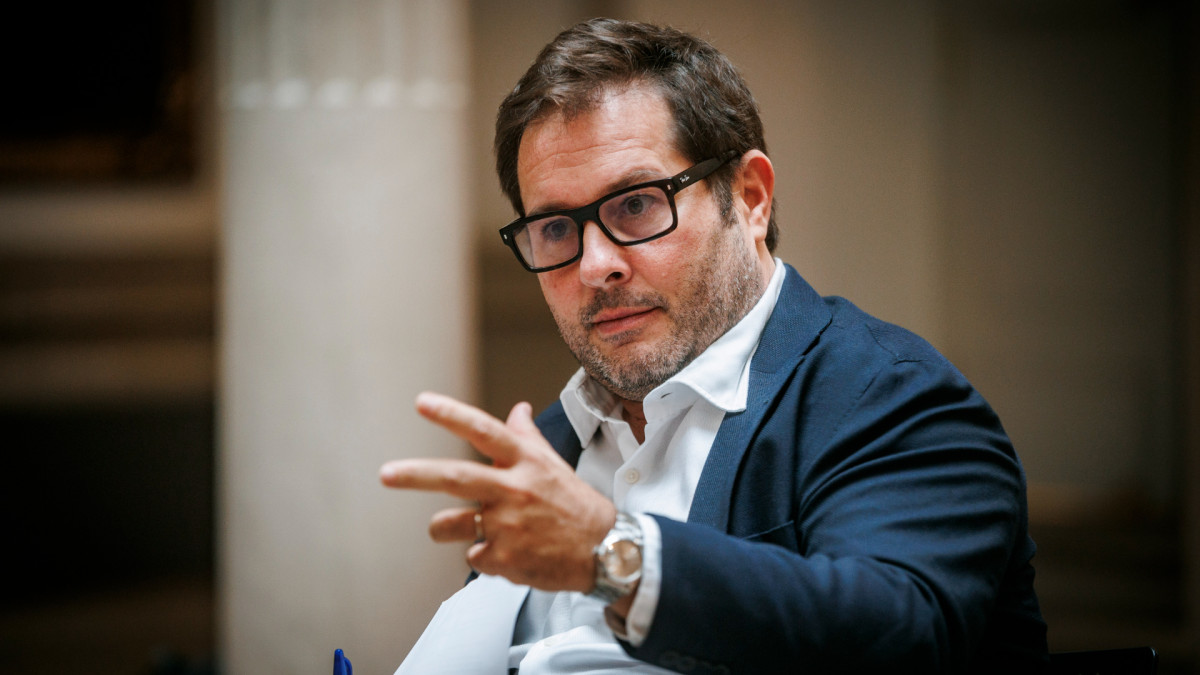
Marc López Plana asked the minister about achieving greater unity in the exterior realm. Photo: Agenda Pública / Tania Sieira
Do you not feel that this could weaken Spain’s position abroad? More unity in this field could give us more influence.
In the years I have served as Minister of Foreign Affairs, I have not seen any weakening. Spain, at this moment, has for the first time in democracy a global foreign policy that speaks in Washington, in Beijing, in Brussels; it is coherent, it speaks the same way about Ukraine and about Gaza, and it has a distinct identity based on the interests and values of the Spanish people.
We have faced international crises in which our leadership has been recognized. Clearly, the wave of recognition of the Palestinian State has been led by us, but also that principled position based on international law and international humanitarian law in Gaza. Moreover, we were among the first to say that we would support Ukraine for as long as necessary in its struggle for sovereignty. This, to name the two major crises at the moment. And we have managed to seal the Gibraltar agreement. Also pushing to have the best possible relationship with our neighbors.
“The wave of recognition of the Palestinian State has been led by us; moreover, we were among the first to say that we would support Ukraine for as long as necessary”
Everyone recognizes our stance in favor of official development assistance. Never before have there been so many Spaniards occupying such high positions: today we hold the highest post we have ever held in the European Commission, a first vice presidency [with Teresa Ribeira]. Also the President of the European Investment Bank [Nadia Calviño], an Under-Secretary-General of the United Nations [Pedro Manuel Moreno], or the Deputy Secretary-General and NATO Special Representative for the Southern Neighborhood [Javier Colomina], to mention a few of the most important organizations.
On the other hand, never before has Spain, in just four years, had all the major international engagements a country can have: a presidency of the European Union, a NATO summit, a United Nations conference, next year’s Ibero-American Summit, and the Feminist Foreign Policy Conference. Therefore, the context does not weaken, but it does pain me as a Spaniard and as Spain’s foreign minister that there should be a party like the People’s Party, which systematically seeks to project a negative image of Spain wherever it can, especially in the European Parliament. There, for example, the PP tries to bring in controversies that should be debated at the national level. I would like to count on the People’s Party in state foreign policy, and I insist: my hand will always be outstretched, even though I know they will reject it because they have never even wanted to meet with me in the European Parliament.
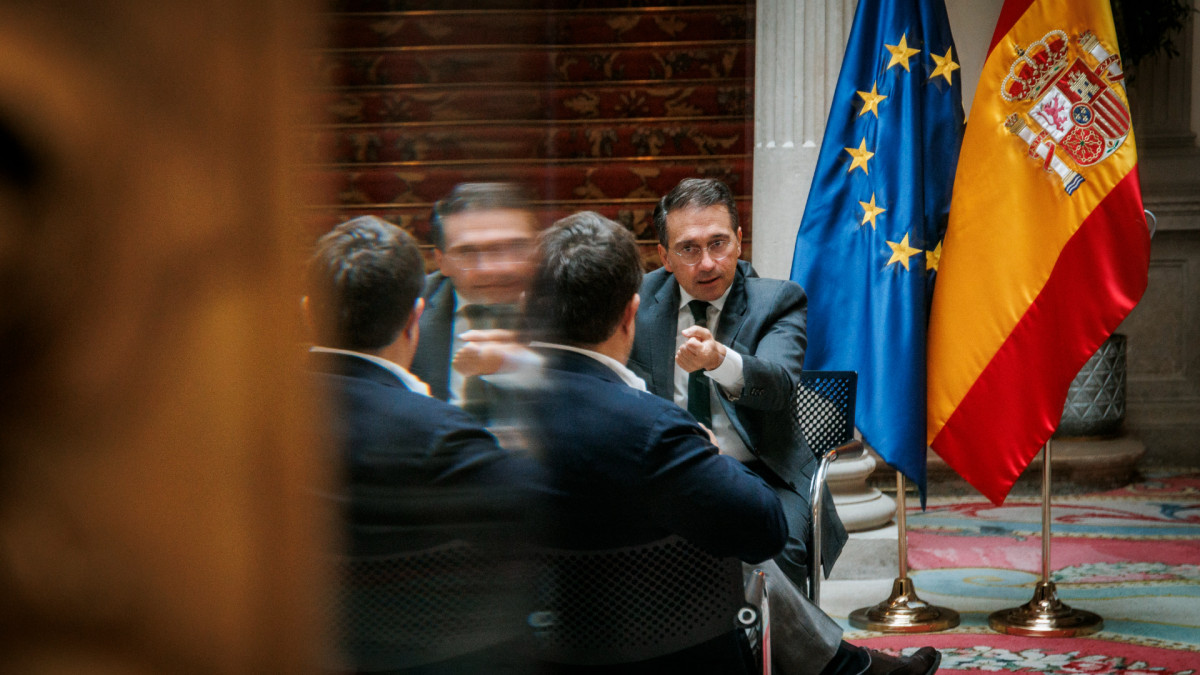
The minister highlighted that many Spaniards hold high-profile roles at the European and international level. Photo: Agenda Pública / Tania Sieira
In Agenda Pública we spend a lot of time trying to understand the figure of Donald Trump: and it is challenging for us. Why is it that he can claim to have achieved peace in Palestine, or that he might eventually do the same in Ukraine? Do you not think people wonder why Biden, for example, has not accomplished that yet?
Donald Trump is the President of the United States; he has been democratically elected and, therefore, he has every right to express the points of view he deems fit and to lay out the foreign policy line he considers for his country. In my view, there is almost an obsession with analyzing his comments, dissecting him and his psychology, when in fact the energy — at least the energy I bring as Spain’s Minister of Foreign Affairs — should be directed at what we can do ourselves: What can we do as Spaniards? What can we do as Europeans? Not so much what others do.
We must acknowledge that there is genuine interest on the part of the U.S. president to achieve peace in Ukraine and Gaza. In Gaza, he has achieved, together with, of course, other mediators, an agreement — which we staged in Sharm el-Sheikh — to free all the civilians who are alive and held, to hand over bodies, to release hundreds of Palestinians detained, and to allow a still early but some respite in the unjust bombardments of Israel on Gaza that would permit humanitarian aid to enter.
We are still far from peace. This is not merely a relaxation of war, nor even the absence of war: it is much more. And in Ukraine we do not even have a ceasefire. That is what we must accomplish. If the President of the United States mobilizes all of United States diplomacy to achieve it, welcome, and let us join that dynamic. Of course, contributing everything we can from our side and making clear what we understand by peace.
“Let us move toward a logic in which everyone can live in security, including Israelis and Palestinians, who also have the same right to have a state”
For us, a just peace in Ukraine is one that is enduring, not a pause between two wars, that respects Ukraine’s sovereignty and territorial integrity. And in Gaza, in the Middle East, that just peace will be one that establishes a Palestinian state, lived in good neighboring relations, ensuring security and mutual prosperity with a state of Israel recognized by all Arab League states. Therefore, let us move from a logic in which the only way for peoples in the Middle East to relate is through war, to a logic in which everyone can coexist in security, including Israelis and Palestinians: both have this right, just as they have the same right to have a state.
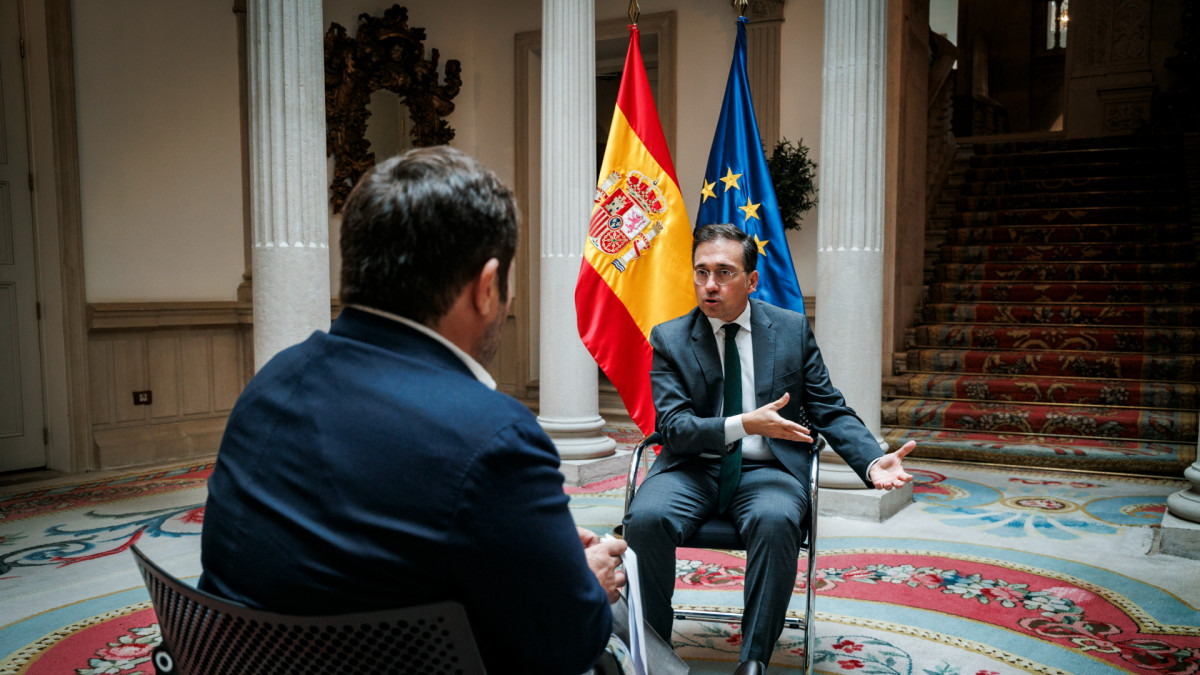
José Manuel Albares reiterated that peace in Gaza, like that in Ukraine, must rest on solid principles Photo: Agenda Pública / Tania Sieira
Beyond the noise we see in the media and on social networks, foreign policy and relations with the media are built on ongoing dialogue.
Indeed. I had a meeting with Marco Rubio at the State Department or a working breakfast in this very building with Secretary of the Treasury, Scott Bessent.
I would say they were cordial and constructive meetings, as must be between two allies. The United States is Spain’s and Europe’s natural historical ally, because we share values. When we talk about transatlantic security, this goes beyond a mere concept, for we share a worldview with the American people. We have interests that have been highly beneficial for both sides, such as transatlantic trade. And we want that relationship to stay on this track.
When the Prime Minister had a meeting with President Trump in Sharm el-Sheikh, it took place with total cordiality. What does not change, and will not change —because this is a matter that goes beyond governments— is that there is a natural relationship between American society and European societies, including ours.
The novelty for me is that there are people, Spanish citizens, who are interested in conveying that perception. But I insist, it is a perception. The reality of events is what it is: there are meetings at all levels, with a dense agenda and, above all, a reality between both societies. Both commercially and in security terms, and we advance positions together in those bodies where we participate. This demonstrates that, certainly, there is a wide gap between the biased perception of some due to that internal wear they think they will impose on the Government and the reality of our relationship with the United States.
The cordial greeting between Donald Trump and Pedro Sánchez is a reflection of the good relationship between the countries, explains the minister. Photo: Agenda Pública / Tania Sieira
One last question, Mr. Minister: Do you think we are below our potential in terms of the capacity of Spaniards to influence global public debate?
Spanish is a language and an absolutely vital element on which to build how Spaniards perceive themselves and how they project themselves to the world. It is a heritage that is given to us and that is utterly irreplaceable. We are fortunate to share a common language with another 600 million people, which makes it the second most widely spoken native language.
“Spanish is a language and a vital element upon which to build how we perceive ourselves: it is a heritage that is given and utterly irreplaceable”
One of my first decisions as foreign minister was to reinstate the Secretariat of State for Ibero-America, and within it, to create a General Directorate of Spanish in the World. And one of the things I promoted was signing agreements in favor of Spanish, and we have many with other Spanish-speaking countries to advance it. We want it to progress in international bodies or within the framework of new technological challenges, and we are having a lot of success in doing so.
Spanish is well positioned on social networks, on podcast platforms, being one of the most frequently used languages. But there are major challenges, yes: Spanish must be a tech language and a language of science, and it must also be represented in international organizations. Spanish is essential for our projection in the world.
That is so, first, because it complements very well the global foreign policy we have at this moment. There are very few global languages, and Spanish is one of them. This fact allows us to have — along with our history — a vast community on the other side of the Atlantic and to naturally adopt that global vision in the world.
I am deeply convinced, and I say this now as we head toward the Ibero-American Summit here in Madrid, that there is an Ibero-American way of being in the world, of understanding the world, and we can practice it also in Spanish. We did so recently during the United Nations development financing conference in Seville, where we took an Ibero-American stance. There is another language as well, Portuguese, which we share, a bilingual community. Very recently, at a breakfast of foreign ministers in New York, we issued a joint resolution for Haiti, and we can multiply this.
For all these reasons, promoting Spanish and promoting international action in Spanish and by Spanish-speakers is absolutely vital and one of the ministry’s top priorities.
Thank you very much, Mr. Albares.
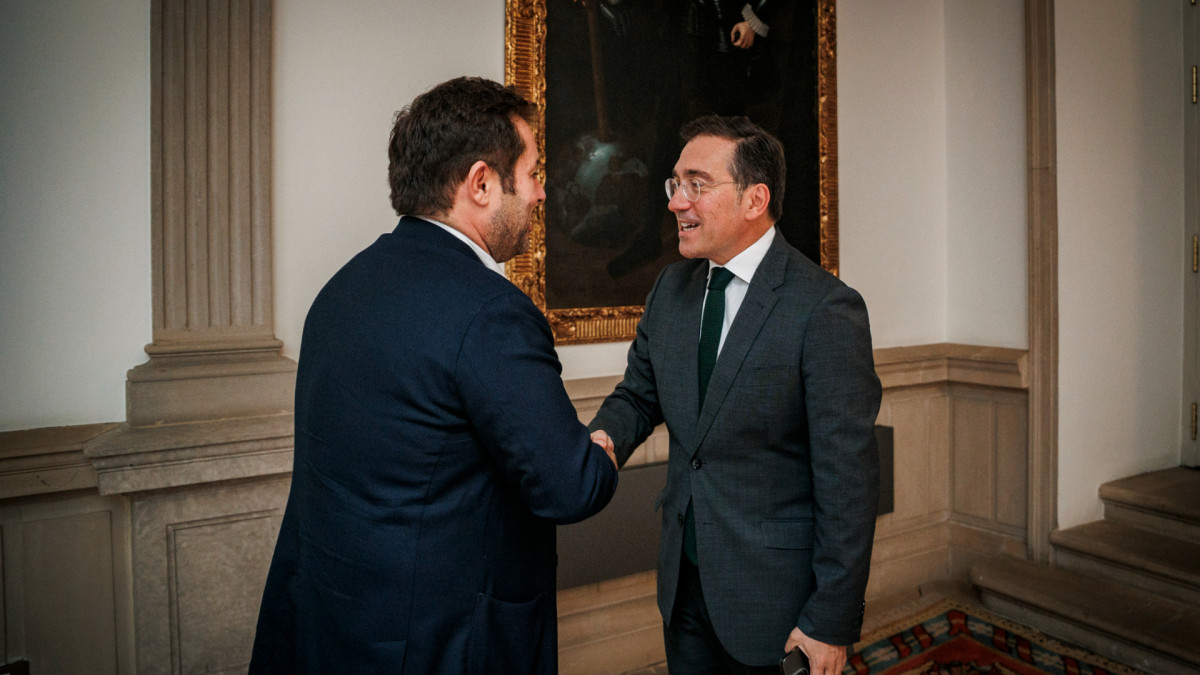
López Plana and Albares parted after an engaging conversation Photo: Agenda Pública / Tania Sieira
