
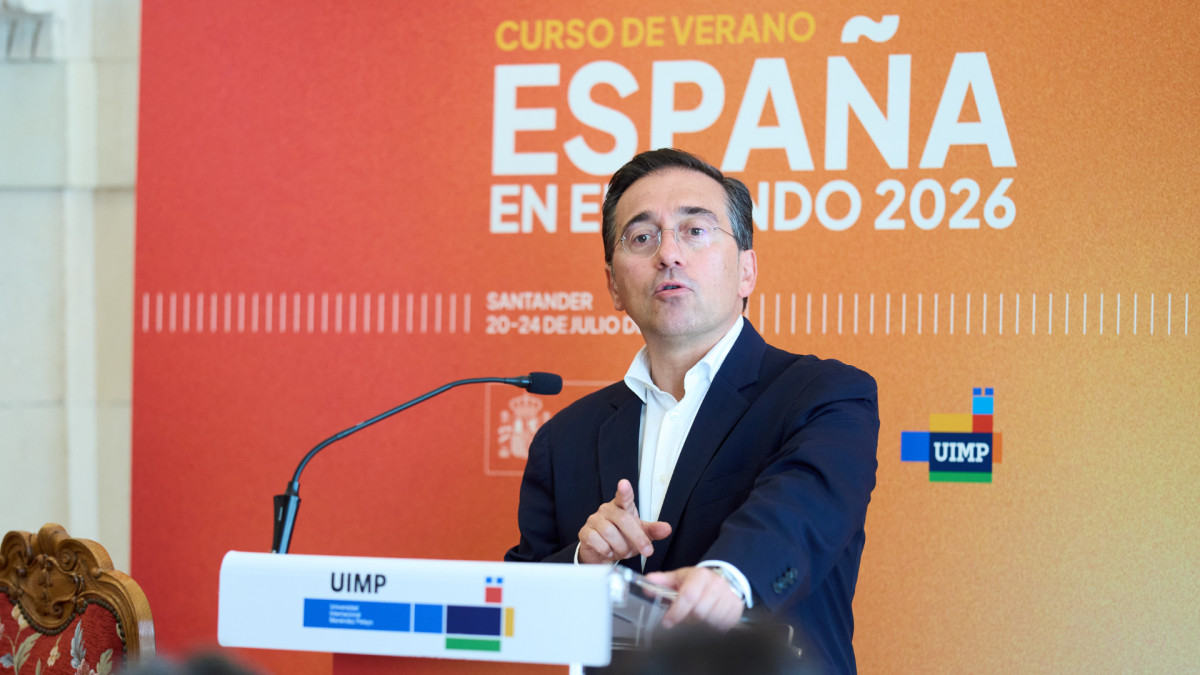
In a present characterized by considerable volatility and the sense of a changing world order, Ibero-America is one of the most important avenues Spain has to strengthen its external positioning. This is the idea that the Minister of Foreign Affairs, José Manuel Albares, has explained to the attendees of the fourth edition of the course Spain in the World. Before an audience that included a number of renowned international analysts, Albares acknowledged that the different items on the international agenda —with the invasion of Ukraine, which is already approaching its fifth year; the widening instability in Gaza, to which the Iran war has joined, and the constant hybrid and digital threats— call for thinking about a reform that strengthens the basic principles of multilateralism.
“What is at stake is whether we defend and build a rules-based order or whether we accept force and arbitrariness and its chaos”, he asserted, before insisting that peace must be the main objective of policy. Throughout his speech, the minister repeated the idea that these principles Spain defends in its foreign policy are “coherent” with the will of the citizenry and with the position it maintains on the various parts of the international arena. He listed Ukraine, Iran, Venezuela and Cuba in a sequence of examples that is by no means accidental.
From left to right: Andrés Allamand, José Manuel Albares and Carla Hobbs, director of ECFR’s Madrid office. Image provided
The reform of the international order
Tras este diagnóstico, el ministro se ha mostrado decidido a reformar las instituciones internacionales para reforzarlas a través de la cooperación y el multilateralismo. The proposal, which at the time was also voiced by the Prime Minister, Pedro Sánchez, and which caused some controversy, involves ceding or expanding the decision-making spaces beyond the West. In this vein, the minister has highlighted, for example, that it is hard to explain why the world’s most populous country (India) does not have a seat on the UN Security Council. The notion that a stable international landscape must reflect the new power balances has already been underscored in this edition. However, it remains interesting that the diagnosis is shared by at least a portion of the political sphere.
“What is at stake is whether we defend and build a rules-based order or whether we accept force and arbitrariness and its chaos”
Following this line, Albares has explained that he hopes Spain can help establish an order based on “dialogue and diplomacy” rather than surrendering to force. To this end, he noted that Ibero-America stands at a favorable juncture to push in this direction. Madrid will host next November the XXX Ibero-American Summit, and Albares, who was accompanied in a subsequent colloquium by the head of the Ibero-American General Secretariat, Andrés Allamand, has defended this “community” as an example of unity “above petty differences”.
Both agreed that the moment is ripe to take the Ibero-American relationship to the next level and, for this, Spain is more than necessary. Allamand, who served as Defense Minister during Sebastián Piñera’s government in Chile, identified three reasons why this union is urgent. First, the American abandonment of the international architecture that, together with Europe, built and sustained it for decades. Second, the qualitative and quantitative retreat that democracy is suffering globally. And third, the determined commitment by a substantial portion of the international community to reform and strengthen its institutions.
Reinforcing this diagnosis, Albares clarified the current context: “There is no dichotomy between an old order and a new order. It is order or disorder”, he reiterated. Within that updated order, he focused on Ibero-America and, especially, on Spain as a bridge between this community and Europe. “There is no region more euro-compatible than Latin America,” he summarized.
“The Trump 2.0 administration has acted as an accelerator of many pending processes”
A greater rapprochement with the region has been a long-standing demand, but the Trump 2.0 administration has acted as an accelerator of many pending processes. Regarding the Mercosur agreement, already approved by the European Council, and the signing of the modernized agreement with Mexico, Albares recalled that trade is a powerful tool to establish that rapprochement between blocs. Yet, as Allamand noted, there is still work to be done with other countries in the region and other pending challenges, such as investment. At present, more than 70% of Spanish investment in Latin America concentrates in Brazil and Mexico, compared with the other seventeen countries of the community.
Still, both agreed that Madrid has an advantage over other countries because it already knows how the region works. Reinforcing this view, Albares indicated that at the Ibero-American Summit he expects “concrete political results” and “to be felt in the life of the average citizen”, for instance through advances in student mobility, the drive of a social agenda focused on care, or the creation of a mechanism for cooperation in civil protection and disaster management. There will also be a positive message “thanks to the high number of heads of state who will attend and the message of Ibero-American unity that will be projected,” he added. What is at stake is not minor. In the words of the minister, “we are betting the future and all Spaniards and the entire Ibero-American community are accompanying us”.
