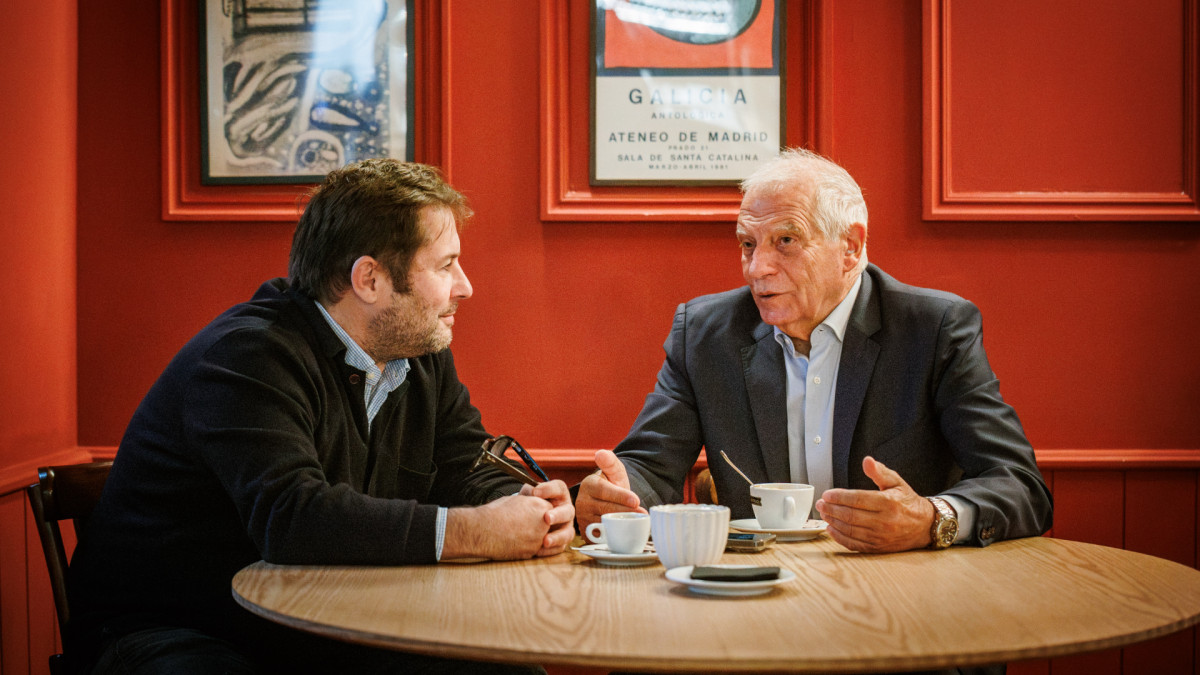
This week I spoke with Josep Borrell, one of the most prominent Spanish figures on the international stage. He is the current president of CIDOB and until 2024 served as the European Union’s High Representative for Foreign Affairs and Security Policy (HRVP). All this, together with his tenure as Spain’s Minister of Foreign Affairs, grants him a privileged view of the geopolitical balances of the present. In this conversation, the engineer and economist focuses on the collapse of the international order, discussing the war in Iran and Israel’s role in the Middle East. All of this is framed within a fundamental discussion about the future of the European Union.
To his mind, the present reveals the immense fragility of a paralyzed Europe, hostage to its own alliances. The recent offensive against Iran exposes a bloc where Washington still follows a government in Israel currently led by “true madmen”. Borrell dismantles the official narrative that justifies this preventive war, calling the supposed imminent Iranian nuclear bomb a falsehood and accusing the NATO secretary-general of acting as a “Trump’s vassal” to legitimize this stance before the global public opinion.
Far from projecting influence to slow this drift, the continent has woken up as a mere American “military protectorate”. At the same time, Donald Trump’s return to the White House symbolises the triumph of the “apostles of the dark Enlightenment”, an influential tech and financial elite convinced that democracy is incompatible with freedom. In view of this, any hint of European resistance appears sterile when the North American superpower can subdue and blackmail its continental allies under the lethal threat of “unplugging the satellites” of information and intelligence on the Ukrainian front.
This strategic vulnerability, as explained by the president of the Barcelona Centre for International Affairs, threatens to precipitate Ukraine’s capitulation and spell the irrelevance of the European project. To avoid sinking definitively into this new era of empires, he warns that an institutional reset is imperative to end the chaos of a European Commission determined to usurp the diplomatic competences of the member states to act illegally as a dangerous “shadow Pentagon”.
The conversation marks the start of a series of analyses and interviews with which Agenda Pública will echo the debate that will be driven by the meeting War and Peace in the 21st Century: Defending Europe without the United States?, the leading forum of security and geopolitics experts organized by CIDOB and which will be held in Barcelona next Saturday, April 11.
Josep Borrell converses with ‘Agenda Pública’. Photo: Agenda Pública / Tania Sieira
¿Qué ha cambiado desde el momento en que usted conoció los kibutz hasta el Israel de hoy?
Yes, I worked in a kibutz during the summer of 1969. Half a century has passed, a long time to change… After five years studying at the Polytechnic University of Madrid, at the School of Aeronautical Engineers, I was seeking a more vital experience. At that time, the kibutz were part of the collectivist imagination of the left-wing youth. It was a year after the Six-Day War, after May 1968; that’s already very far. But back then the kibutz was a symbol of communal living. Extremely communal. Children were educated together; everyone did all the chores in turn.
In that imagination, the Israeli occupation of Palestine was on the sidelines, though of course part of their reality. Yet, they were very progressive people. Many were fleeing from Europe, either themselves or their parents. And there I met my first wife. Life is a random walk.
Nowadays most kibutz have privatized and today they are agricultural production companies.
Many years have passed and Israel has changed a lot since then. What has happened?
It has changed immensely. First, the sociological makeup of Israeli society. It is no longer that society of progressive, left-wing people with an ideal that is sometimes romantic and sometimes biblical. Today it largely originates from Eastern Europe. The Shimon Peres era is gone and there is almost nothing left of the Labour Party.
Israel has become the regional gendarme, with an impressive military power, financed and massively supported by the United States. And now it no longer hides its willingness to expand territorially toward the Great Israel: they call the West Bank “Judea and Samaria”, they proclaim that the land was given to them by God and that they have a biblical right to it. Just listen to ministers Ben Gvir and Smotrich, true maniacs of the ethnonationalist far-right.
“We have built for ourselves the self-satisfied narrative that it was a desert, that there was no Palestinian people, that Palestinian identity did not exist”
That has nothing to do with the pioneers. Although, beyond the epic, the pioneers were also part of the colonial process. Whatever you call it, the fact remains that it was the arrival of a Jewish people to its historical ancestral homeland, but in it already lived another people, the Palestinian Arabs.
When Ursula von der Leyen said: “When you finally returned to your promised land, you made the desert bloom”… The problem is that the desert was inhabited. I wish it had been only a desert. We have built for ourselves the self-satisfied narrative that it was a desert, that there was no Palestinian people, the denial of Palestinian identity. At most four Bedouins, remnants of Ottoman occupation, but without political identity. It is a great falsification of history.
Borrell recounts his experience in Israel, where he spent part of 1969. Photo: Agenda Pública / Tania Sieira
There is a debate these days about whether it is Israel that forced the United States to intervene in Iran or whether the United States also wanted to do so. How do you explain it?
Some echoes reach me from my old functions. Probably hunger and appetite have come together. Netanyahu has managed to obtain from an American president what he has been wanting for twenty years: that the United States would forcibly topple the Ayatollah regime. But without a ground invasion, just bombing from the air, it is unlikely they will succeed. But they will destroy at least the maximum of their military capabilities, especially ballistic missiles.
From what we know, the Omani mediator flew to Washington days before the attack to keep pushing negotiations that, according to him, were not going badly. The negotiators scheduled a meeting on a Friday to reconvene the following Monday. And yet, they attacked on Saturday. That is: they set themselves up to continue negotiating twenty-four hours before launching a massive attack.
Very likely, and we will never know for sure, Israeli intelligence knew that around forty leaders would be gathered around the Iranian supreme leader at his own residence. They knew they were there and did not want to miss the opportunity to eliminate them.
“If the United States says, as Ronald Reagan did during the Lebanon War, ‘enough, it’s over; either you stop or tomorrow you will be cut off from funding and ammunition’, Israel stops”
They must have confronted the United States with the determined will to attack. The United States had two options: join from the start, participate and pretend to lead this new war; or join later, let Israel attack first and then support if necessary. But that second option would have placed it in a too obvious position of following.
There was a third option: to say no. And the United States has immensely powerful instruments of pressure over Israel. If Trump says, as Reagan did during the Lebanon War, “enough, it’s over; either you stop or tomorrow you will be cut off from funding and ammunition”, Israel stops. And then it stops. But Trump does not want to do that. Netanyahu has proven to have a strong sway over Trump.
Who will tell Trump that he has to stop? Saudi Arabia, Qatar, the United Arab Emirates…?
They are the first to be harmed, the most immediate. Not the only ones, nor probably the ones who will be hit the hardest in the medium term, but they are the first and, for now, the most affected.
The natural gas liquefaction facilities in Qatar have been destroyed, its exports halted, its cities bombarded. Far from the intensity with which Israelis and Americans bomb Iran and Lebanon, but the Gulf is affected. Tourism is practically at a standstill. Tourists want to leave, and certainly they will take a long time to return. The Gulf cities had become large tourism hubs, luxury, museums, artistic centers, beaches, desert, etc. This process stops with the war.
“Very far from the intensity with which Israelis and Americans bombard Iran and Lebanon, but the Gulf is affected. Tourism is practically halted”
And then there is China. Between Venezuela and the Gulf, China obtains around a quarter of the oil it imports, surely more. In gas, even more. The Gulf’s biggest gas customer today is not Europe; it is China and all of Southeast Asia. It places China in a delicate energy position; it will also factor into the balance of losses and gains. Not immediately, because Beijing has a lot of stock, knows what it is playing and has its back covered. But stocks do not renew themselves and they eventually run out.
We Europeans will suffer, we are already suffering, the consequences if this continues and the prices and availability of gas and oil rise again, as happened during the Ukraine war.
López Plana raises questions about the current Middle East conflict and its possible outcome Photo: Agenda Pública / Tania Sieira
Are you among those who think Iran could endure for a while and that this could be relatively long? What resilience capacity do you see in Tehran?
Iran does not have an air force. It does not have the atomic bomb and is far from having one. That is a false claim by the NATO secretary-general, putting on a Trump vassal hat, that the United States had to intervene because Iran was about to obtain the atomic weapon and bomb us with it; he knows it very well. And if he does not know it, even worse.
“Iran fulfilled that agreement until Trump came and in May 2018 kicked the board, saying that the agreement was a horror”
We must go back ten years, to 2015. Then, Obama and Europe managed to sign with Iran that agreement with the exotic name, the Joint Comprehensive Plan of Action, which cleverly masked its essence: Iran agreed not to develop military nuclear capabilities in exchange for sanctions relief. Iran fulfilled that agreement until Trump came and kicked the board in May 2018, saying that the agreement was a horror. Since then, we have not managed to revive it, although we tried.
We Europeans tried to keep it alive by telling our companies to continue trading with Iran, that we would protect them. But that did not work, because global companies, between risking U.S. sanctions or trusting a dubious European legal protection, folded their tents and left. Iran was left without market access again.
Despite that, Iran tried to keep the agreement alive and slowly advanced in developing its nuclear capabilities. I know this well because I have spent years speaking with Iranians; probably with no other country have I spoken so much. Through me, through our negotiator, the Spanish diplomat Enrique Mora, and through the American negotiator Rob Malley.
Iran advanced slowly in non-compliance, but never reached the point of having a bomb. And if it had something, we knew it from the reports of the International Atomic Energy Agency, headed by Rafael Grossi, about the number of centrifuges and how many kilograms of enriched uranium they possessed. It was a daily topic of conversation.
Sure, Iran would say: “If you do not fulfill your part, how can you demand that I fulfill mine?” And we demanded it of them just the same. Until the June 2025 bombings, after which Trump declared victory and said that everything had been completely destroyed. Probably Iran kept some amount of enriched uranium in gaseous form. Although they did not have a nuclear warhead with its proper delivery vector. So the argument of “we had to intervene because we were at imminent risk” does not correspond to reality.
Videos are circulating of U.S. senators like Elizabeth Warren emerging very surprised from intelligence briefings in the Senate. You have met Trump. What do you see there? There is a debate between those who say he is a man who does not know what he is doing and those who warn that we must not underestimate him.
Yes, I have had the honor of accompanying the king on an official visit to the White House. And if I have to classify world leaders by their intellectual capacity, I certainly would not place Trump first. Not at all.
Trump believes he is smarter than others, for sure, but he is not. Now, Trump is not alone. What is happening in the United States is not about one man. That man embodies, represents, and visualizes, with all his egocentric exaggeration, a deeper social current that gave him the majority in the electoral college. He is a pathological narcissist, yes. But if it were only that, we would not be where we are.
Around Trump there is a power machine that has an intellectual and political dimension that is truly dangerous. They are the apostles of the so-called dark Enlightenment, the ones who oppose our Enlightenment, our Lights, and seek to overturn the world of European philosophers: from Voltaire to Kant and the others. There are even drawings showing our philosophers fighting them, armed not with swords but with keyboards and computer screens.
“Human rights, the Enlightenment, freedoms… all that belongs to a world that, according to them, no longer exists”
Trump heavily critiques woke thinking, but there exists another thought, the one of darkness. Recently, one of his most notable representatives, Peter Thiel, gave a talk at the Academy of Moral and Political Sciences in France. I recommend reading it. The sheer amount of barbarities he could utter in an uninterrupted mix of biblical, mathematical, and historical references is remarkable.
The underlying message was that democracy is incompatible with freedom. So clear. For them, the world must be governed like a corporation by some kind of global emperor. Human rights, the Enlightenment, freedoms… all that belongs to a world that, according to them, no longer exists. You have to read that to understand that Trump is not just Trump. And these people use Trump more than Trump uses them.
López Plana and Borrell share concerns about certain American positions and their interests for Europe. Photo: Agenda Pública / Tania Sieira
What does that mean for Europe?
Trump has the immense power of the United States on his side. On one hand, the enormous power of the money of digital billionaires like Thiel, Palantir, Musk, and other lesser-known names. Then there is the power of information, or of disinformation, which is ultimately adulterated information. And finally, the massive military power of the United States.
We Europeans felt very comfortable under the protective umbrella of the United States. Let’s be clear: today we are, and have been for decades, a military protectorate. Germany, first, because it lost the war and had no choice. But the others as well. We have spent very little on defense. When the Cold War ended, we thought there would never be another war. The military seemed almost decorative.
Then the euro crisis hit, budgets had to be tightened and the first variable of cuts was military expenditure, before the social cuts but alongside. Since then, Europe, as a whole, has been disarming: fewer arsenals, fewer personnel, less training, less ammunition. In sum, why bother? The other one, NATO’s Article 5, would come into play if something happened; Big Brother would appear.
That Big Brother, in Obama’s time, used to go to the Baltic states and tell them that Tallinn’s security mattered as much as London’s. Today I doubt anyone would say that. With Trump, the story is over.
“When you have dependencies so large, you cannot afford to be very defiant. That’s why we accept certain trade agreements, to name them somehow”
Our dependencies on the United States have only grown. Before the Ukraine war we imported 40% of our gas from Russia; now we import 40% of our gas from the United States. It only takes for the cloud to be cut off, the famous cloud, for our photo album to collapse, but also the information system that makes our society and economy function. The same applies to social networks, transcontinental fiber-optic cables, intelligence satellites, or even arms supplies.
When you have dependencies so large, you cannot afford to be very stern either. That is why we accept certain trade agreements, so to speak, like Turnberry, where they raise tariffs and we lower them… You cannot win a commercial battle against the country that guarantees your military security. There are colleagues who say outright: “How could we tell them no? The immediate reaction would be to unplug the satellites that guide Ukrainian missiles.” That said, it is clear that appeasement does not work because Trump always asks for more, as happened with Greenland. It is necessary to put a stop to it.
How should we read the recent meeting between Friedrich Merz and Trump? It has been said that Merz is trying to embrace Trump so that Europe does not abandon Ukraine in the face of Russia.
That is exactly what all those who flatter Trump say, starting with Von der Leyen. The more to the east, the more convinced they are that this is necessary. They keep repeating that the United States remains our great ally, that we have disagreements, but that fundamentally we are united.
We live in a denial of reality.
Until we confront a situation I do not entirely dismiss: that Trump may leave us alone against Russia.
This fear, I would say that fear, dominates many Europeans today. The more to the east, the stronger the sense that we cannot allow Trump to be angry and leave us alone.
“The great financial and military backing of Ukraine is not the United States; it is Europe: the EU, its member states, the United Kingdom, Norway”
But in some way he has already done it. With Biden, the United States supplied arms to Ukraine; with Trump, he does not give anything, he sells it. “Do you want to arm Ukraine? Very well: I will produce them and you will buy them from me.” He no longer gives a single dollar in arms. And, so far, Europeans, quite apart from it, have increased what they put out of their own pockets and what they buy from the United States to deliver to Ukraine. As of today, the great financial and military backing of Ukraine is not the United States, it is Europe: the EU, its member states, the United Kingdom, Norway.
Fortunately, Washington maintains the satellite intelligence system, which is critical for the functioning of Ukrainian defense and which only the United States, and a bit of the United Kingdom, can provide. It keeps it because it knows that if it cut it off, Ukraine would be blind and could not guide its long-range missiles, which, by the way, are successfully destroying Russian refineries. But cutting it off would be akin to telling Ukraine: “Surrender.” And even Trump has to think twice about that.
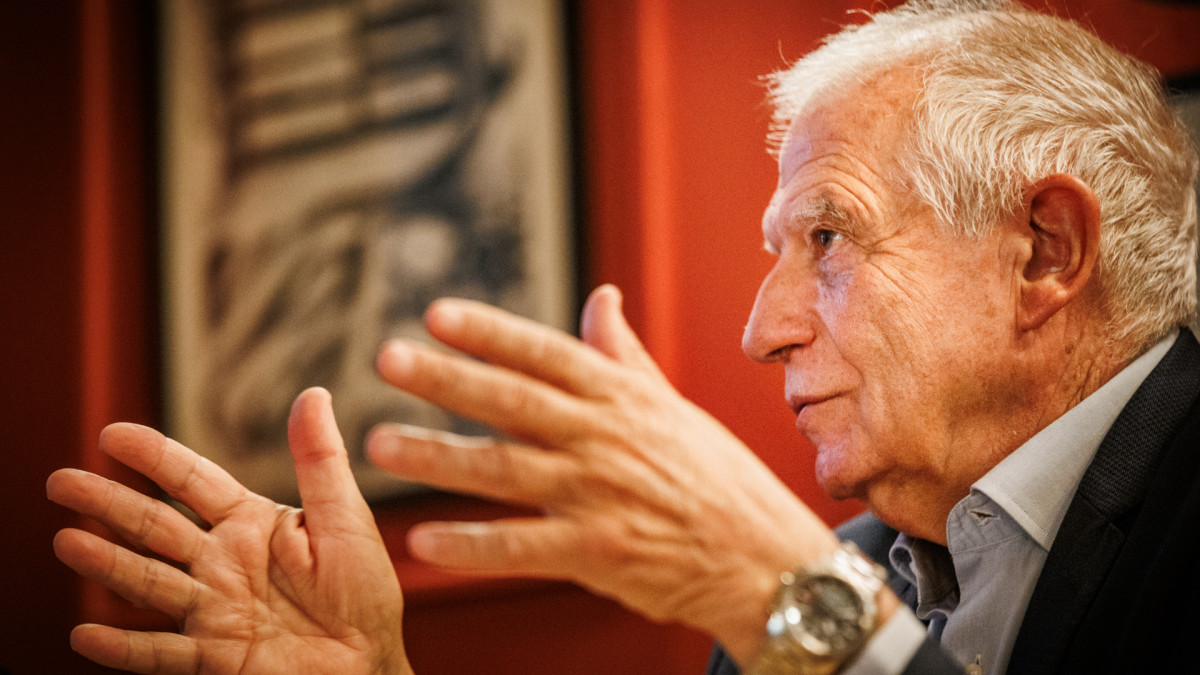
The former high representative leading European diplomacy in one of the most tumultuous periods for the European Union (2019 – 2024). Photo: Agenda Pública / Tania Sieira
Ben Hodges, former commander of the United States Army in Europe, once told me something very succinct: “I don’t know what there is between Trump and Putin, but I do know that everything Trump does is what Putin wants”.
That seems to be the case. We Europeans and the United States of Biden had aimed to diplomatically isolate Putin. He is an aggressor and had to be sanctioned, blocked, and isolated. But the rest of the world, especially the Global South, did not follow us, among other reasons because it has its own problems and plenty of Russia continues to sell it grain or energy.
However, Trump no longer isolates Putin; he has enthroned him. I have the impression — and it is only that — that Putin has won over Trump. Before that Alaska meeting, Trump said he would impose his terms or sanction him. He left Alaska and it was no longer the same. There, I fear, they forged an agreement. And Putin must have told him: “Now talk to your friends, prevent the Europeans from boycotting this agreement and tell Zelenski.”
Immediately afterward he calls Zelenski and invites him to the White House. The Europeans then instinctively come around the Ukrainian, in that photo that seemed humiliating to us. But at least that scene had one virtue: in front of everyone, Trump did not put on the table the hardest part of his agreement with Putin. If Zelenski had gone alone, he would have had to swallow it. Since everyone was there, he thought there would be a better moment.
That moment has arrived. As Zelenski says, there are things Ukraine can accept and others it cannot. It can accept a ceasefire, but not a peace treaty that includes territorial losses, including those Russia has not yet conquered. Putin and Trump call it a “territory exchange,” but that is essentially keeping the other’s portfolio without returning your own.
“Trump ultimately has the final capacity to end the war by Ukraine’s surrender: unplug the satellites and leave it in the dark”
That is where we stand. Russia does not advance decisively, and Ukraine destroys part of Russia’s oil-refining system, with an economy increasingly weakened. Russia tries to destroy Ukraine’s electrical grid to render the country uninhabitable, and Ukraine hits Russian refineries and energy infrastructures. Each side strikes the other’s weak point. How long can that last? They have four years of war, in which Russia is also paying a high price.
Trump ultimately has the final capacity to end the war by Ukraine’s surrender: unplug the satellites and leave it in the dark. Because we can buy arms from the United States, but we cannot buy what we do not have if he does not want to supply it.
What exactly is at stake for Europe in a good or bad agreement on Ukraine? Its own existence, its credibility?
Europe faces the serious risk of becoming a spectator to the fragmentation of the world. The world is reordering itself and we run the risk of simply watching others do it. What Trump has done in Venezuela is an example. He would like to do something similar in Iran, but that is more complicated.
The world is reorganizing around centers of power. There are two major centers of power: China and the United States. Russia is not a center of power. Russia is the troublemaker, a gas station with a nuclear bomb. Economically, that is not enough. But if Russia won the war in Ukraine, that is, if it managed to install in Kyiv a regime more or less equivalent to the one it has in Belarus, a puppet regime —which, by the way, is what Trump did with Delcy Rodríguez in Venezuela—, that would be winning the war.
In European public opinion there is a spectrum. Some would say: “Well, Ukraine is part of Russia, Crimea was always Russia, what do we have there to do?” Others would say: “We will be next.” And others hold that, as it is inevitable, what must be done is to arm ourselves to replace the American ally, because we can no longer trust him.
“Can a country that remains at war join the Union, or a war-state of sorts? And if it becomes a Russian submarine, more so than Hungary?”
But, as much as we arm ourselves, we cannot fully do without the American ally. So Europeans are trying to do both things at once: rearm themselves and not lose the friendship of the United States. As the current HRVP, Mrs. Kallas, has very clearly and accurately stated in a recent interview. Although we should also not underrate public opinion that thinks: “What does Donbas matter to us if that guarantees peace?” The problem is that it will not guarantee peace. Rewarding the aggressor simply invites new aggression in the future.
Then there is the promise to make Ukraine a member of the European Union. Where does that stand? Can a country that remains at war join the Union, or a war-state? And if it becomes a Russian submarine, even more so than Hungary? But it has been promised — especially by Von der Leyen — that it would be part of the Union in a very short time. Well: if the war ends in that way, it will not join if it’s still subjected to Russia.
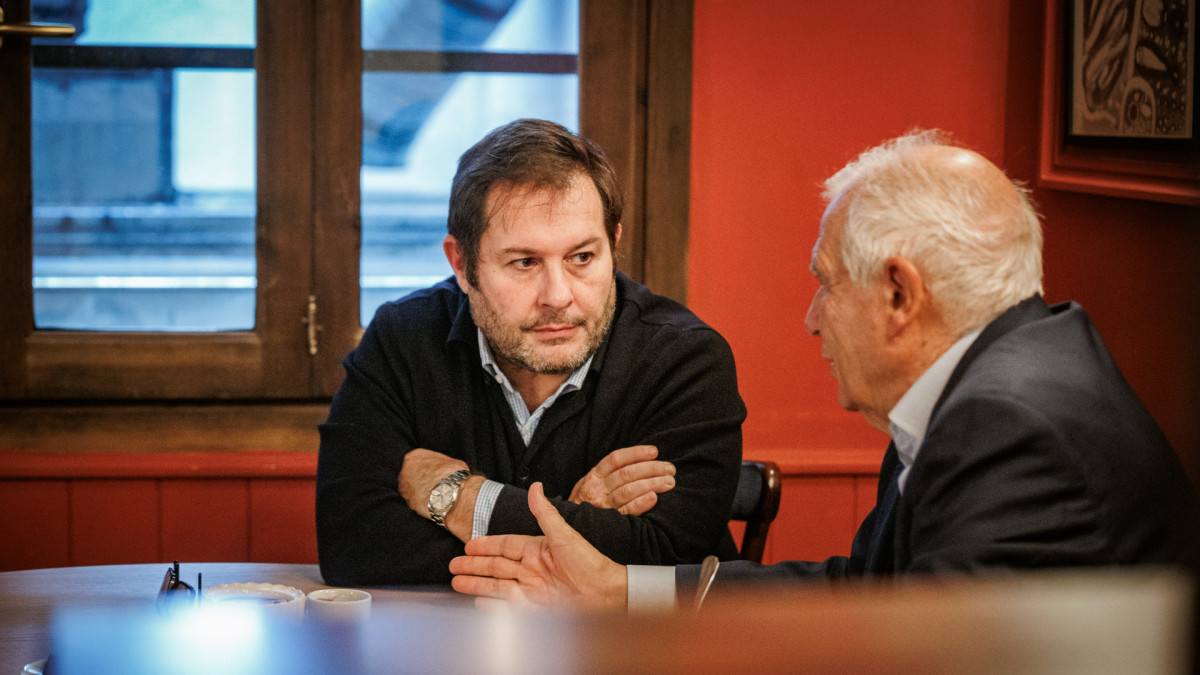
Borrell was one of the main European leaders at the early stages of the Ukraine war. Photo: Agenda Pública / Tania Sieira
All this is happening also at a moment of the greatest political fragmentation within Europe, with less capacity for unity. How does that internal fragmentation reconcile with the need to act in a world that is increasingly fragmented?
The fragmentation of the world begins at home, because the first fragmentation is that of the European Union itself. The Gaza war already showed it. The Iran situation even more so. There, positions polarize, and if we simplify we could say that, on one side, there is Spain and, on the other, Germany, representing the majority position.
In Gaza this was very clear. Spain asked Europe to act; Germany gave Israel a free hand. Spain, and I as HRVP, said that flagrant violations of humanitarian law could not be accepted. But that was a minority position. And now even more so, because it is no longer just about asking Europe to act, but to act yourself with the instruments you have. In the Spanish case, for example, the use of joint bases of the United States on our soil.
“The United States cannot threaten us commercially as if it did not know we are a customs union and that we have a common commercial policy”
This fragmentation and the fact that some countries have used the margin of action they had vis-à-vis the United States place us in unknown territory. The United States cannot threaten us commercially as if it did not know we are part of a customs union and a common commercial policy. It is not planned to expel anyone from NATO either. But if it seeks retaliation mechanisms, it will find them..
On Spain’s position. You were foreign minister. What do you weigh when making a decision in these matters? Because, for me, protecting Spain’s sovereignty today is protecting European sovereignty and, to some extent, also NATO itself.
We have moved from declaration to action. It is no longer just saying: “We must respect international law.” No, if you do not respect international law, I will not help you to do so. That is different.
If Spain were not a member of the European Union, it could not do what it is doing. This is what I call the inverse sovereignty theorem: the less formal sovereignty you have, the more real sovereignty you can exercise. In other words, the more sovereignty you have shared or transferred, the more capacity you have to act in a way that you could not otherwise.
If there were pesetas instead of the euro, we could not do what we do, because the peseta would be hypervalued in financial markets. It happened to the franc in the early 1980s, when Mitterrand tried to pursue a more expansionary policy and the currency was devalued three times until he yielded to budgetary discipline. We remember that well because a year later we Socialists were in government in Spain and had learned the French lesson: no deficit spending because the monetary sign could lose value.
“We have given up monetary and commercial sovereignty and, in exchange for being less sovereign formally, we can act with more independence”
Fortunately, we are in the euro and cannot devalue the Spanish currency. And if they do, it is with everyone. The same goes for trade matters. We do not have autonomous trade relations with the United States; the European Union does. It cannot conduct a solo trade boycott against Spain; if it does, it faces the whole. That is quite a heavy matter.
We have given up our monetary and trade sovereignty and, in exchange for being less sovereign formally, we can act with more independence. We are protected. How much is that protection worth? Very much. How long does it last? As long as the partners want it to. However, it is very difficult, if not impossible, to imagine breaking it in monetary terms. And in the trading sphere, breaking it would be almost the end of the European Union.
Now, however, opposing Trump so clearly, so distinctly, and on so many fronts — defense spending, migration policy, the Middle East — carries risks. I do not know exactly what Trump can do, but he has several geopolitical levers. We are where we are and we have the neighbours we have. One can imagine everything from forced migration surges to border problems. Although Spain also has leverage: it is not a republic of one and a half million inhabitants.
On the other hand there is historical experience. Aznar dragged us into the Iraq War. Zapatero pulled us out. And he pulled us out by picking up the phone, calling Washington and saying: “Tomorrow my soldiers leave.” The United States did not need our troops. The problem was not military. In Iraq it was shown that it knows how to start wars but not how to end them.
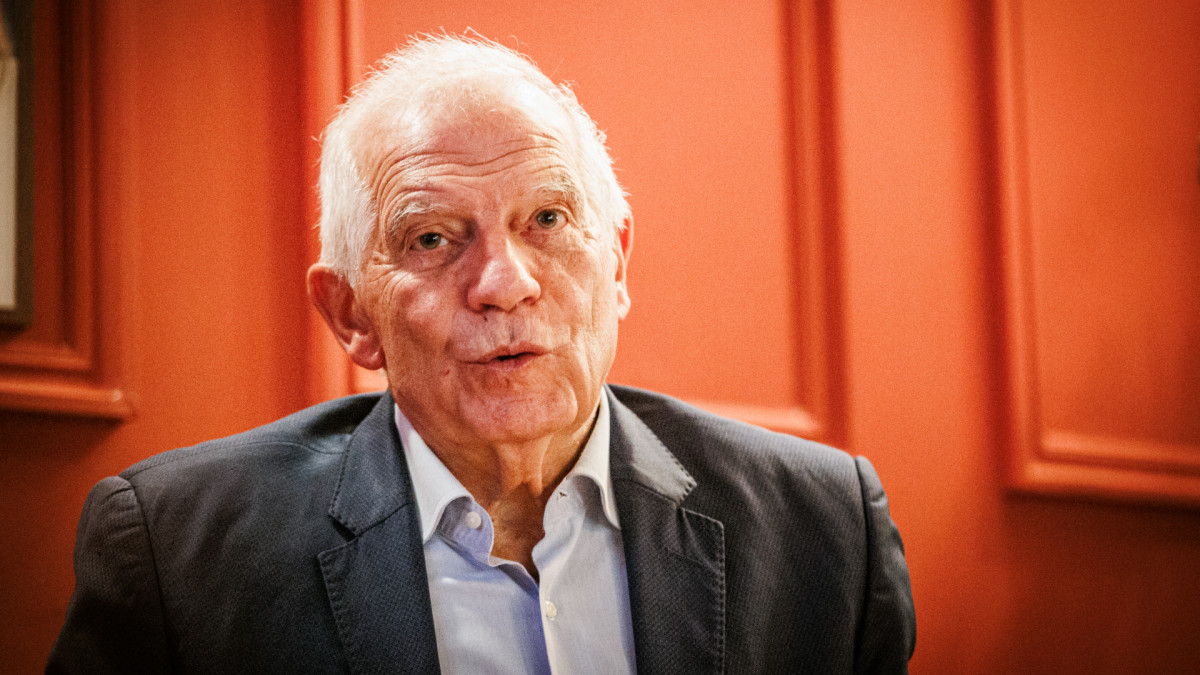
The political trajectory of the economist includes having served as minister under Felipe González or Pedro Sánchez. Photo: Agenda Pública / Tania Sieira
There is a current view that this European shared sovereignty is not incompatible with Spain strengthening its bilateral relations with other countries. Charles Powell, for example, proposed it that way. Has Spain given up bilateral foreign policy?
No. Spain’s foreign policy has not given up on that. Rather, I would say that it has made more efforts than others to maintain, for example with China, a positive relationship. I understand well what Charles Powell means, a very fine analyst and a great expert on the Anglo-Saxon reality. And indeed, it should not be incompatible.
Nor is it wise to underestimate the importance, for us economically, of the transatlantic relationship. Not only in military terms. Spanish companies obtain a substantial portion of their best profitability from investments in the United States. If you look at Spain’s outward investment portfolio, you see that it used to be very concentrated in Latin America and that now the United States occupies a central position. Moreover, we have a favorable trade balance.
No one underestimates that relationship. We must do everything possible so that a political stance on a conflict does not deteriorate a mutually beneficial economic relationship. But we live in a world where the economy has also become a weapon. The weaponization of the economy is seen in the most elementary way: tariffs have become the first go-to instrument to bend the head of anyone who does not behave as we want.
“If the relationship with the United States becomes more complicated, not only Spain, but Europe as a whole, will have to seek new friends and new markets”
That is why I fully agree that we must try to avoid that. And surely the Spanish government has it clear. Opening up to others is something that Spain has already done and has even received criticism for it. We cannot be asked to open up and then censor who we open up to, as has happened with China. We have been major advocates of the Mercosur agreement. We are willing to open up even sacrificing, relatively speaking, some of our own sectoral interests. So, yes: if the relationship with the United States becomes complicated, not only Spain, but Europe as a whole, will have to seek new friends and new markets. Also, in general, to sustain the multilateral order against the great powers with imperial temptations.
We have not talked about the European Commission —which you know well—. What problem do you see today in its functioning?
There is a serious institutional problem in Europe: the Commission aims to play the role that the Treaties assign to the HRVP. Structures, functions, and efforts are being duplicated. Portfolios are created for which the Commission does not have competence and there is a manifest will by the Commission president to act as if she, personally, and the Commission in general, were in charge of foreign and security policy. And that is absolutely contrary to the Treaties.
Article 17 of the Treaty on European Union says that the Commission does not represent the Union in matters of foreign and security policy. I merely ask: is this article still in force or not? Because, judging by the voices emanating from the Commission, it would seem that it represents the Union. And if it does not represent it and what it says are personal opinions highly debatable, like its position on Gaza and Iran, or now on the validity of International Law, then we are contributing to a great deal of confusion.
We saw this when Von der Leyen stated in the Financial Times that Europe was prepared to intervene in Ukraine and the German Defense Minister Pistorius replied that she was “incompetent in this matter and, moreover, not competent.” We cannot live like that permanently, because in the end the rest of the world asks: “Who is in charge here? Who sets the position?”.
Another example: when Von der Leyen goes to the European Parliament and solemnly says she will take measures against Israel, that she will sanction individuals and enforce the Association Agreement. First: the Commission will not sanction anyone, because the Commission does not have the capacity even to propose personal sanctions. Second: none of that was done afterwards. Nothing was proposed, and the Member States would not have even accepted it by qualified majority. It was all just a statement to bypass parliamentary debate. But the world does not understand that Europe functions like that.
“The European Union was not designed for today’s world. It’s an invention from another era, meant to solve problems of then”
The Americans used to ask: “What is Europe’s phone number?” Now they must be even more puzzled, because they listen to an institution that pontificates on foreign policy and defense and deduce that it must have something to say. Then the states arrive and respond: “Wait a moment, that policy is ours.” The Commission can have partial competencies in the defense industry, because after all it is industry. However, defense industry is one thing and defense itself is another. The Commission cannot pretend to be a kind of shadow Pentagon.
That leads to a broader conclusion: the European Union was not designed for today’s world. It is an invention from another era, conceived to solve the problems of then. It was designed to make peace among Europeans, and it has done that quite well. But it remains a very loose union among a growing and increasingly heterogeneous group of countries that share, at bottom, little. Some share a currency, we have made certain borders invisible, but otherwise ideological differences are increasingly pronounced.
Europe has more enemies today than ever, inside and outside. If we truly want a Union that faces today’s problems, especially those related to security in all senses, including military, then it must be redesigned. There must be a reset. Otherwise, we will keep twisting the treaties to make them say what they do not say and to do what they do not permit us to do, seeking convoluted interpretations of the Treaties, sometimes on the edge of lawfare, to bypass unanimities and push through what some want and others do not.
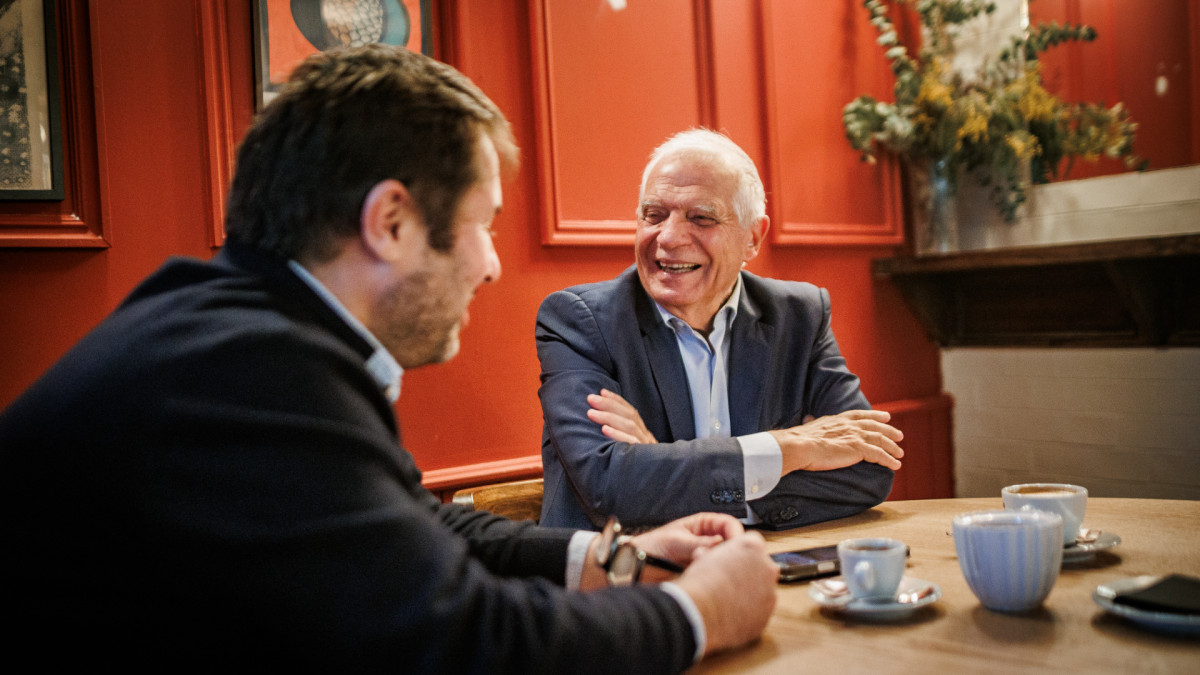
López Plana and Borrell discuss in Madrid what the current model of the European Union should be. Photo: Agenda Pública / Tania Sieira
Less expansion and more deepening? Two speeds?
Rather than speaking in generic terms of two speeds, I would go straight to the core of the issue. If Europeans believe they must unite to collectively ensure their defense, they should start by considering the creation of a European Union of Defense, with a new, ad hoc treaty, and among those who want to be part of it. Beginning with one condition: unanimity does not exist here. This could be combined with reinforced cooperation in taxation, Eurobonds, the internal market, also without a veto, forming a federal core.
Right now we can continue acting as if the institutional conflict inside the Union were a natural clash between a community executive and national political powers. The problem is that until now the parties agreed that the Union would do certain things, and now they no longer do. Now there is a tug-of-war between a community executive that wants to do what it cannot and states that do not recognize it, and that also cannot agree among themselves, twenty-seven, with Orbán and Fico sabotaging Ukraine aid and sanctions against Russia.
“The question is whether we should remain exactly the same to do what we have not yet decided to do”
That is why I say that if we continue as we have been, with an increasingly uneven mix of countries that are more and more different, it will be very difficult to do what we have not yet decided to do. We are who we are to do what we do today. The question is whether we should remain exactly the same to do what we have not yet decided to do.
If Europeans truly want to advance in defense, we will have to go much more directly to the heart of the matter. Otherwise, we will remain trapped in paralysis.
Thank you very much.
In alliance with