
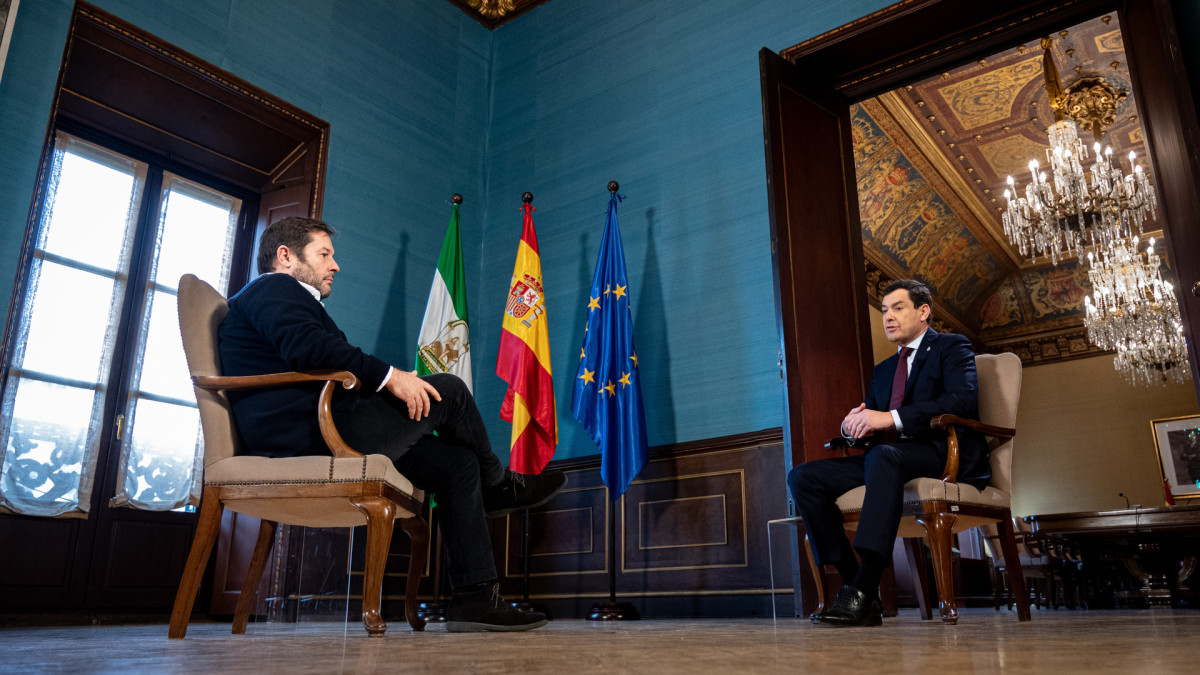
We kick off 2026 with a new in-depth conversation. The Andalusian president analyzes what has been happening in global politics in these weeks: “From Andalusia we observe, at times with surprise and at times with concern” the dynamics of international politics and a “European Union that does not always show the strength or the global role it deserves as an economic, historical, and social space.” He is also co-president of the Committee of the Regions of the European Union this legislature and shares from the Palacio de San Telmo, in Seville, his view of Spain and the world.
“Europe is also made up of cities and regions,” he warns, and anticipates the risk of a “recentralizing drift” of the Union in which member states design and implement European funds relegating regions and cities.” In economic terms, Moreno Bonilla notes that “Andalusia is growing its industry above the average, and we have attracted very important investments in a few years, largely due to clean and cheap energy. We have three hundred days of sunshine, leadership in photovoltaics and an opportunity to compete “against Portugal —which is faster at licensing— and Morocco, which is building a powerful grid and competes with very low prices.”
In the domain of Spanish politics he recalls that “sooner or later Vox will also have to take responsibility: it is not enough to point out problems; governing means facing up and being accountable“. Regarding the territorial debate, he emphasizes “to be clear, what interests me is that Catalonia does well, due to social and economic ties: if Catalonia is thriving, Andalusia sells more, and vice versa. What matters is that we all advance.” And he concludes on national politics that “Spain needs the PSOE” but “not a PSOE entrenched in the trenches.”
Moreno Bonilla addresses López Plana. Photo: Agenda Pública / Maya Balanyà
How does the president of Andalucía view the world today? He is a very active figure in European politics, and the days have been intense…
We observe international politics with concern. We are facing a reordering of the world that began after World War II with the United Nations and a framework based on mutual respect, sovereignty, and shared rules. In the last decade, populist and extreme phenomena have grown in highly influential countries, altering that order.
What is the consequence? The erosion of principles and rules that sustain peace and progress. From Andalusia we watch these changes with both surprise and worry, and also a European Union that does not always show the strength or global role that it should as a space of economy, history, and society.
What is his assessment of the European Commission’s proposed budget framework?
The European Union is facing difficulties in its position on the world stage. We face a clear threat from Russia after the invasion of Ukraine, and there is also a cooling of transatlantic relations with the United States. All of this has pushed Europe to reinforce its defensive capacity and, with it, its sovereignty: in energy, in technology, in cyber, and in security in a broad sense.
“The strengthening of Europe’s defensive capacity cannot be done at the expense of a central pillar of the European architecture: the cities and the regions”
But that reinforcement cannot come at the expense of a central pillar of the European architecture: the cities and the regions. Europe is also made up of cities and regions. We are the ones who have the reach and the capacity to convey the Union’s value and its policies to citizens.
And what role should regions play in building the European Union?
In the budget debate there are two risks. The first is a drift toward recentralization: that member states design and implement European funds relegating regions and cities. It would be a step backward. For that reason, the Committee of the Regions is staunchly opposed. I trust there will be a correction, because for decentralized countries like Spain it would not make sense.
The second risk is the cuts in key regional policies, such as cohesion funds or the Common Agricultural Policy. We understand the need to reinforce European security, but we must seek balance.
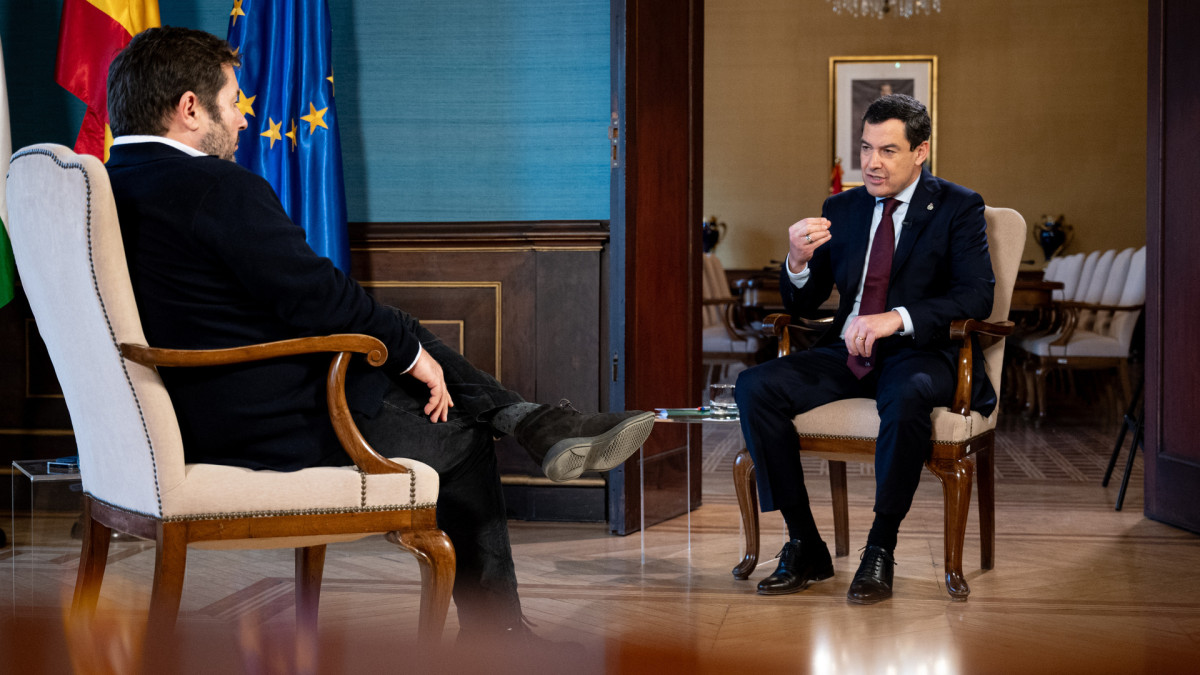
Moreno Bonilla is co-president of the Committee of the Regions of the European Union. Photo: Agenda Pública / Maya Balanyà
Why is it so difficult for the two major parties —the PP and the PSOE— to agree on strategic issues like European construction?
There is a structural factor: the electoral system. It does not favor stable majorities as in other countries with a second round or mechanisms that correct fragmentation. That means that, with the rise of populist forces, the big parties depend on minor parties and the relations between the PP and PSOE become tense. For me, the first major agreement should be an electoral reform that provides stability and prevents minority forces from condition the country’s course.
“The way President Sánchez conducts politics makes it hard to understand with the PP: he hasn’t sought bridges, but confrontation”
And then there is a political factor. The way President Sánchez conducts politics makes it hard to understand with the PP: he hasn’t sought bridges, but confrontation. I hope that in the future the PSOE will revert to a line closer to European social democracy, more centrist and with greater capacity for agreement. Spain needs the PSOE, but a European and center-left PSOE, not a PSOE entrenched in the trenches.
We have just witnessed a clear example of that way of doing politics by the Prime Minister, who negotiates alone with Oriol Junqueras a new financing model for all the autonomous communities. And the rest of the autonomous communities learn about it from Mr. Junqueras that there will be a proposal for a financing model. This is not serious and, moreover, it is disloyal on the part of Sánchez.
So, will we not have a new autonomous financing system?
The Spanish Government has been dithering for eight years on autonomous financing. It catches my attention that now, just months from elections in Andalucía, a model is announced: it seems hurried and with electoral interest. Besides, what we’ve seen with a bilateral meeting at the Moncloa with Mr. Junqueras does not please the rest of the communities, because it breaks multilateralism. If multilateralism in the world should be defended, and I agree with the Pedro Sánchez government on this, it must also be applied at home, in Spain.
There is no sense in giving exceptional treatment to a parliamentary ally without first convening the Council of Fiscal and Financial Policy or informing the rest. As it has started, I fear it is a dead letter.
What would be your proposal for a financing model?
The key is a model based on population, and Andalucía, as the most populous community, acknowledges that there should be corrective variables for territories with dispersion, aging, or low density. That is solidarity with the rest of Spaniards, because I remind you that the current minister, when she was Andalusia’s Finance Councillor, defended the criterion of real population rather than the adjusted population. In other words, she did not act in a solidaristic way. Andalucía defends a model primarily by population: we have almost nine million inhabitants. But we understand that other communities require adjustments. We are open to a mixed model, as long as no community ends up below.
“We want to sit down with a clear plan: all communities will have to concede something, and in addition, the Government will have to put more resources”
The problem with the 2009 model was that it left several communities below the average from the outset: Murcia, Comunidad Valenciana, Castilla-La Mancha and Andalucía. That gap has widened over time. We want to sit down with a clear plan: all communities will have to concede something and, moreover, the Government must inject more resources, because the model has become outdated. With an aging society and greater dependence, healthcare and social services cost a lot more. You cannot satisfy everyone with the same money. We need a stable, state-level model that does not change every few years to suit the current government’s pacts.
And very importantly: all communities must receive the same money per adjusted inhabitant. If that is not guaranteed, equality among Spaniards is broken.
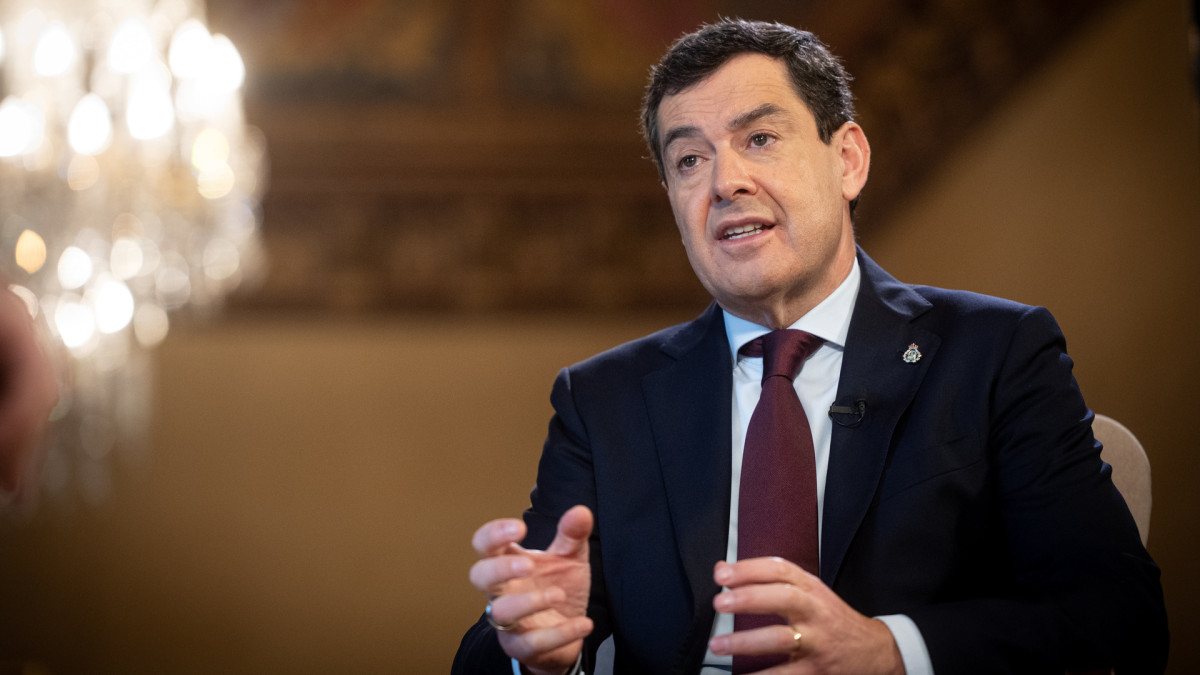
The Andalusian president during the conversation with ‘Agenda Pública’. Photo: Agenda Pública / Maya Balanyà
You will probably remain president of Andalucía after the next regional elections, and a possible scenario is that the next government president is Alberto Núñez Feijóo. But Feijóo could depend on Vox, just as Pedro Sánchez depends on other supports now. Could we be in a similar situation?
I wish the PP has a sufficient majority to govern, as we have done in Andalusia. Instability is not good: it shows when there are no budgets or legislative capacity, and that leads to electoral churns.
If Vox can condition after the next general elections, the agreements would have to be limited to what there is consensus on: a policy for the entire country and economic reforms to improve competitiveness. Then there will be issues where there will be no agreement. But someday Vox will also have to assume responsibilities: it is not enough to point out problems; governing means facing up and being accountable.
In any case, I return to the underlying idea: as long as we do not change the electoral system, it will be difficult to achieve stable majorities. That great agreement, which only PP and PSOE can reach, should be an electoral reform. Fragmentation is blocking municipalities, autonomous regions, and, in general, governance.
Personally, when I was Secretary of Local Policy in 2005-2006, I conveyed to the Socialist Party the proposal to reform the municipal electoral model so that there would be a premium when surpassing a percentage of votes, as it exists in the Italian model or in Greece. The idea was to start with municipalities, extend it to the autonomous level, and finally to the national level. The PSOE refused. And the problem is that as long as we have the electoral system we have, it is very hard to secure stable majorities, absolute majorities. And whenever we depend on forces that are smaller and more radical, we weaken coexistence and weaken the common framework of agreement that we should have between the two major political forces. The first major agreement we should reach in the future is an electoral regime agreement.
It is said that the Next Generation funds have been very important for Spain and Andalucía, but they have an end date. Have they been used to implement reforms?
From my point of view, no. We had to return funds and the European Union noted a lack of diligence in execution. Some interesting things have been done, but they have not been leveraged as they should have been. And again, it started from a wrong basis: the State concentrated control and left little room for the regions.
“With centralized control, many Next Generation funds are executed late and in a rush. And when they run out, Spain may suffer, because that injection has sustained part of the growth”
It would have been more efficient with real participation by the autonomous communities, which have decades of experience implementing European funds and know the productive fabric. In Andalucía, part of the expenditure has not been linked to the productive model or to a leap in competitiveness. In the end, with centralized control, many funds are executed late and in a hurry. And when they run out, Spain may suffer, because that injection has sustained part of the growth.
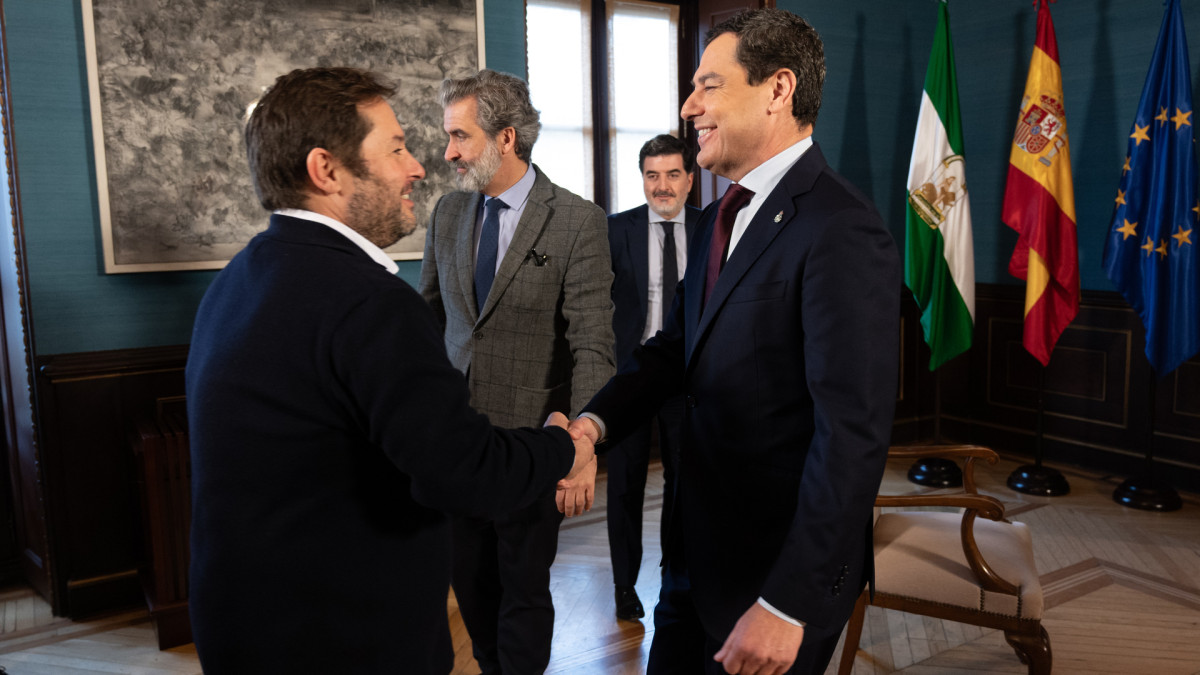
The editor and director of ‘Agenda Pública’, Marc López Plana, bids farewell to the Andalusian president. Photo: Agenda Pública / Maya Balanyà
Is this how you have lived it in Andalucía? Has stability helped?
Yes. Firms do not want political mess: they want security and to avoid being faced with problems. Stability helps them plan and execute. We have simplified procedures, reduced bureaucracy, lowered taxes, and strengthened legal certainty. That has contributed to record levels of foreign investment, to leading year-on-year job creation in absolute terms, and to expanding the business base.
And Andalucía has progressed in convergence: households have grown by 30%. We have begun to compete in exports with regions like Catalonia and Madrid. And let me be clear: I care that Catalonia does well, for social and economic ties: if Catalonia does well, Andalucía sells more, and vice versa. We want everyone to advance.
Finally, let’s talk about industry and renewable energies. How can Andalucía better harness sun and wind to attract companies and contribute to growth?
Andalucía is growing its industry above the average, and we have attracted very significant investments in a few years, largely thanks to clean and cheap energy. We enjoy three hundred days of sunshine, leadership in photovoltaics, and strong wind resources in places like the Alboran Sea or the Campo de Gibraltar. Additionally, green hydrogen opens a relevant opportunity, with projects already underway and substantial investments.
“Spain has a historic opportunity for reindustrialization thanks to renewables, but it needs a compatible grid”
The bottleneck is the electricity grid. We produce energy but cannot always evacuate it. Red Eléctrica has not kept pace with investment and growth. We believe it needs a change to be more efficient and not become a political instrument. Andalucía has received a very small share of new investments, despite being an energy power, and that slows industrial projects, especially in high-potential areas.
Spain has a historic opportunity for reindustrialization thanks to renewables, but it needs a grid that matches. If not, we will lose competitiveness against Portugal —which is quicker at licensing— and Morocco, which is building a powerful network and competes with very low prices. Either we step up, or we will have a problem.
Thank you very much, Mr. President.
