
Even as a George W. Bush–era appointee suggests the DHS rule could unleash devastating consequences, the government’s reasoning is described as remarkably flimsy.
Approximately a year earlier, the Department of Homeland Security (DHS) floated new visa limits for two groups: international students and journalists. The plan would cap student stays at four years and restrict journalists to 240 days, unless a discretionary extension is granted. DHS framed these caps as essential steps to curb visa fraud and safeguard national security. Yet during the 32-day window for public commentary, thousands challenged the rationale as illogical, and the disadvantages were clear: the measure would undercut press coverage and chill foreign student enrollment in U.S. universities, a crucial revenue stream for higher education and a key driver of economic growth.
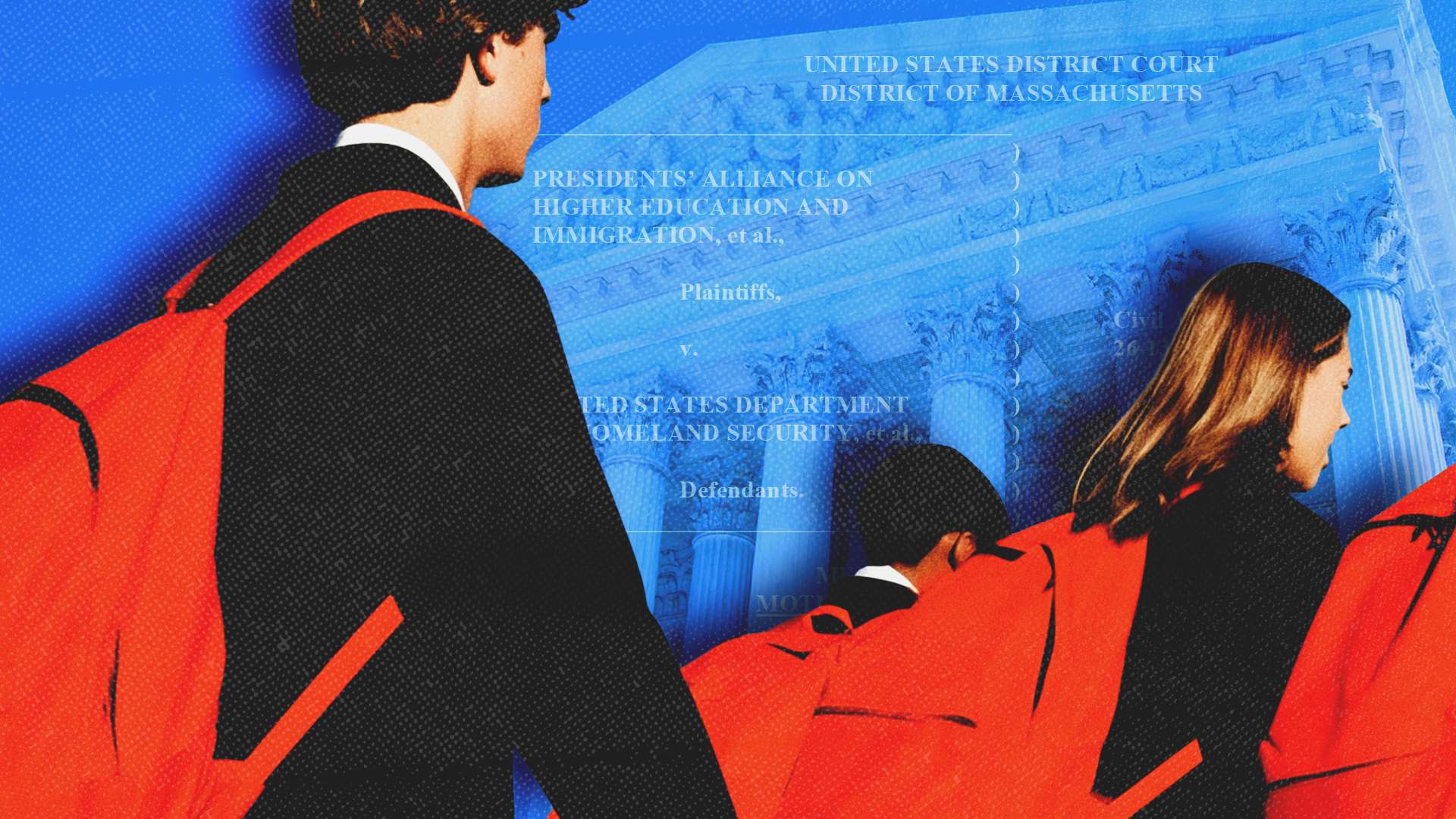
Presiding over the policy, DHS pressed ahead with the rule in July, undeterred by objections. What might look like routine federal procedure, however, was so irrational and disregardful that it triggered a preliminary injunction blocking enforcement while a lawsuit over the rule proceeds. In a sharply critical ruling issued this week, a federal judge in Massachusetts held that the DHS rule is “arbitrary and capricious” under the Administrative Procedure Act because the department failed to provide a plausible justification, to consider alternatives, to forecast costs consistently, or to respond in a meaningful way to the comments raised.
“The damage to the higher education system and to the economy of the United States is likely to be catastrophic,” wrote U.S. District Judge F. Dennis Saylor IV, a former George W. Bush appointee, in ruling on a suit brought by groups representing universities, educators, and journalists. “Notwithstanding the scale of the likely harm, the government’s rationales for the rule are exceptionally weak, and the link between the rule and the problems it purports to address is exceptionally attenuated.”
Even though the DHS estimated the rule would impose roughly $250 million in costs in the first year, the judge notes that the real costs would extend far beyond that figure. Under earlier rules, foreign students could stay in the United States until they completed their programs, including “authorized practical training after graduation.” For many students pursuing advanced degrees, the timeframe extends beyond four years. By disregarding that reality, the DHS rule would undercut the substantial scientific and economic benefits generated by international students.
A policy that is described as “flexible and welcoming” toward foreign learners has helped American higher education flourish, according to the plaintiffs, who argued to Saylor that education constitutes one of the nation’s top service exports. They contended that such openness has fed American innovation and productivity, as foreign students and scholars conduct frontier research while enrolled, and, if they choose to remain after graduation, contribute to leading American firms or even launch their own ventures.
Large research universities tend to host significant shares of international students, particularly at the graduate level; Saylor notes figures for MIT (40 percent), Harvard (38 percent), Northeastern (57 percent), and Boston University (28 percent). The policy DHS seeks to revoke has enabled tens of millions of foreign students and researchers to come to the United States, he observes, fueling groundbreaking research in science, medicine, and technology, driving substantial economic growth, and delivering numerous other advantages on a broad scale.
Students from other countries who study in the United States and graduate in fields such as science, technology, engineering, or mathematics (STEM) play an outsized role in the U.S. economy, including forming a quarter of billion-dollar startups. They also stand out in patenting activity and Nobel Prize awards. A study cited by the plaintiffs indicates that, from 1990 to 2010, the increase in productivity in U.S. cities driven by foreign STEM workers was large enough to account for roughly 30 to 50 percent of all aggregate productivity growth in the United States.
The four-year cap DHS advocates would disrupt this engine of discovery, innovation, progress, and prosperity. It would introduce a new layer of uncertainty for students who may not be confident they can finish within four years; if the deadline proves insufficient, they would need to apply for an extension.
“Any DHS decision to deny an extension request rests entirely in the agency’s discretion and is not subject to appeal, even within DHS itself,” Saylor notes. “In other words, a DHS official—guided by vague criteria and without any avenue for challenge—could curtail the academic, research, or teaching activities of any non-U.S. citizen for arbitrary reasons or for none at all.”
Consider an international student who is one credit short of graduation: they could be ordered to leave the United States without earning a degree and without recourse, Saylor writes. “That introduces, at a minimum, a high degree of uncertainty into the educational process, which will have a clear deterrent effect on student enrollment.”
In a 2025 Institute for Progress survey cited by the plaintiffs, 49 percent of current international students indicated they would not have enrolled under the new DHS policy, while 16 percent of prospective students said they would be less likely to enroll if the rule were enforced. Even by a conservative estimate of a 10 percent reduction in international student enrollment, the plaintiffs argued, the negative consequences for the U.S. economy could run into the tens of billions of dollars annually. George Mason University economist Michael Clemens estimated the annual loss could eventually reach as much as $145 billion.
The government’s response to these warnings was largely apathetic. While the DHS questioned the validity of calculations derived from survey data, it did not present contrary evidence, nor did it supply its own estimate of the policy’s economic impact.
The DHS “summarily rejected” the commenters’ criticisms, “dismissing their concerns as merely ‘speculative,’ based on mere ‘predictions,’ or ‘unquantifiable,’” Saylor notes. “In fact, because it asserted that the enrollment impact was unquantifiable, it effectively concluded that the cost of that impact was zero. And in support of its position, it offered almost entirely conclusory statements, non sequiturs, and assertions of belief without substantiating reasoning.”
Beyond economic worries, critics warned about the chilling effect of giving DHS officials broad authority to decide who can stay in the country after their initial visa periods expire. “It is not hard to imagine how that system could be used to punish those whose views or research are disfavored by the officials making the determination,” Saylor says, or to target “unfavored institutions.”
Commenters also worried that press visas “could be refused as retaliation for unfavorable reporting, thereby placing government officials in a position to penalize journalists for exercising their First Amendment rights.” Saylor concurs that the risk of abuse is substantial. He adds that it is highly likely that foreign journalists who criticize the government (or, more precisely, DHS authorities) will face nonrenewal of their visas.
The DHS response to that concern, much like its stance on the economic effects, fails to reassure. The department states that it does not intend for the rule to chill speech, to encourage censorship, or to foster viewpoint discrimination, and it claims it lacks data and cannot point to any historical precedent to quantify or monetize any potential chilling effect.
Nor did the DHS provide a credible projection of benefits that would compensate for costs it refused to acknowledge. The stated national-security justification for the four-year cap on student visas “borders on the absurd,” according to Saylor. “It rests almost entirely on a handful of anecdotes, each involving episodes that the new rule would do nothing to prevent or even mitigate.”
Three of those episodes involved Chinese students attempting to photograph military facilities, while the other two concerned an individual who overstayed his visa and a Russian intelligence operative who entered the United States with a student visa obtained under a fraudulent Brazilian identity.
The government “offers no real effort to explain how the four-year limit would eliminate or even reduce such incidents,” Saylor remarks. “Presumably, a foreign student intent on photographing military bases could do so within a four-year span—or even on a brief B-1 visa.”
The DHS likewise “failed to explain how a four-year cap would prevent people from obtaining visas through fraud,” and it offered no meaningful justification for how it would deter overstay compared with the current system. While the agency noted that some visa holders had spent more than ten years in student status, Saylor argues there is nothing inherently suspect about a decade-long education trajectory, especially at top-tier programs.
As for journalists, the DHS did not mount a serious defense of the rule on its merits. “It did not provide any national security or fraud-and-abuse evidence, nor did it deliver a thoughtful explanation at all.”
The official rationale for the measure is so weak that it hints at an ulterior motive. “The fragility of the link between the rule and its cited rationales raises legitimate questions about whether the real objective is not safeguarding national security and protecting borders, but pursuing other, undisclosed aims,” including greater government oversight over universities and the press, Saylor observes.
While he stresses that he is not judging the policy’s wisdom, Saylor concludes that DHS fell far short of complying with the Administrative Procedure Act’s requirements.
“DHS failed to perform a reasoned calculation of the costs and benefits of the Final Rule,” Saylor writes. “DHS failed entirely to entertain reasonable alternatives in a meaningful way.” It also “failed to provide thoughtful responses to substantial comments” and “failed to establish a rational connection between the Final Rule and its stated objectives.”
