
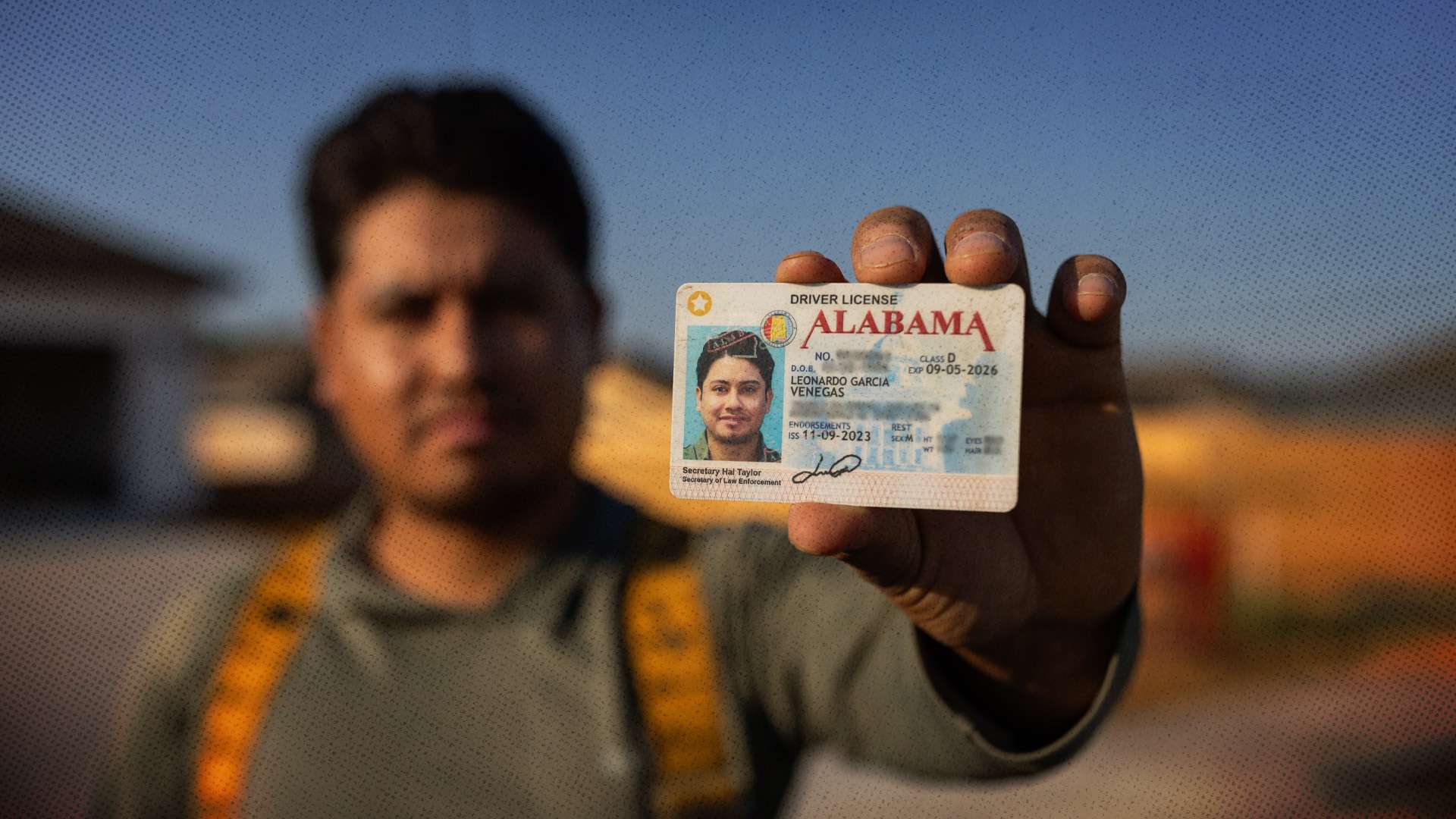
Being on a construction site does not automatically permit warrantless government intrusion, a federal judge ruled in a lawsuit brought by a worker who has been detained on three occasions by ICE.
A federal judge has temporarily blocked some DHS tactics used to conduct warrantless immigration raids at construction sites across southern Alabama, in response to a suit filed by a Latino construction worker who has been detained three times despite being a U.S. citizen.
U.S. District Judge Jeffrey Beaverstock granted a temporary injunction on Monday against several DHS policies that Leo Garcia Venegas—lead plaintiff in a class-action filed last October by the Institute for Justice, a public-interest law firm—contends facilitate dragnet raids. The lawsuit argues such raids target Latino construction workers without reasonable suspicion and continue detaining them even after they present proof of citizenship, in violation of the Fourth Amendment.
Venegas, an Alabama construction worker and citizen, has been detained and handcuffed by ICE officers three times, despite possessing a valid REAL ID on every occasion. In two cases, masked immigration officers entered private construction sites without a warrant and allegedly detained workers solely because of their apparent ethnicity. Venegas’ third detention occurred after the lawsuit was filed.
“For the first time in a long period, I will be able to go to work without fearing that I will be arrested for no reason,” Venegas said in a press release from the Institute for Justice after the court order. “Americans should not be stopped and held by law enforcement when they have done nothing wrong.”
Although the dispute is limited to several counties in southern Alabama, it raises major Fourth Amendment questions tied to the federal government’s nationwide surge in immigration enforcement: whether immigration officers may enter construction sites without a warrant, whether workers on such sites have a reasonable expectation of privacy, and whether officers can ignore valid IDs to continue an immigration stop.
On all these points, Beaverstock ruled in Venegas’s favor against the government. He stated that he was “not convinced that a construction site, by virtue of its visibility, is constitutionally inferior to other workplaces where privacy expectations exist.”
“As a result, the Court is convinced that Venegas, an employee working at his place of employment, has a reasonable expectation of privacy,” Beaverstock continued. “The nature of a worksite does not automatically permit broad, warrantless government intrusion, and there is no justification to enter a construction site that is not open to the public simply to effect a warrantless seizure.”
Nonetheless, Beaverstock did not grant the full preliminary injunction Venegas sought. Instead, he issued a more limited, temporary stay of DHS policies while the case is litigated. The order specifically blocks DHS policies that allow immigration officers to raid private construction sites without a warrant or consent, detain workers preemptively without a specific suspicion that they are illegal immigrants, and continue detaining workers after they have shown citizenship or lawful presence.
Jared McClain, a senior attorney at the Institute for Justice, described the order as “a significant setback to DHS’s unlawful enforcement practices.”
“The government stood in court and argued that warrants are unnecessary to enter private construction sites and round up all the workers, and that government-issued IDs cannot be trusted,” McClain said in a press release. “By setting aside those unconstitutional policies, the court has restored the rule of law. Construction workers like Leo can finally go to work in peace again.”
Institute for Justice attorneys argued that video footage of Venegas’ detentions, testimony from related cases across the country, and statements from the Trump administration indicate a targeting of the construction industry with warrantless searches and preemptive detention of anyone who appears Latino.
For instance, a North Carolina man filed a claim in August seeking damages from the federal government, alleging he was arrested last year by immigration officers despite holding a valid REAL ID, and then abandoned on the side of the road once the officers confirmed his citizenship.
Venegas testified at a May court hearing that he was detained during the first construction-site raid because he attempted to film his brother’s arrest.
“I was trying to record, and then one of the agents approached me because he disliked that I was filming, and he tried to take my phone,” Venegas testified. “I kept proclaiming that I was a citizen, and another agent came to help him, and they threw me to the ground. I yelled that I was a citizen, yet they still handcuffed me.”
“They pulled my wallet from my pants and pulled out my license,” Venegas continued. “They saw my license was a REAL ID, but they said it was fake.”
Department of Justice attorneys argued that the policies Venegas challenges do not exist—and that, even if they did, he would lack standing to challenge them because he neither owns nor controls the construction site, which is akin to an open field where immigration officers may enter without a warrant.
“As an initial matter, the Court is not persuaded by the Government’s position that a warrant is never needed to enter a construction site,” Beaverstock wrote, noting in a footnote that “this argument undercuts the Government’s claim that it does not have a policy of entering non-public areas of a construction site without a warrant or consent.”
The DHS has also argued in court filings and testimony that REAL IDs are not reliable confirmations of citizenship, even though federal law requires states to verify citizenship before issuing them, and even though the DHS is charged with ensuring state compliance with the law.
Although the government pointed to Justice Brett Kavanaugh’s concurring opinion in a ruling last year that allowed brief immigration stops based on factors such as ethnicity and occupation, Beaverstock wrote that Kavanaugh’s opinion actually supported Venegas, since his detention did not end promptly after he produced evidence of citizenship.
“The record also shows that Venegas was not promptly released after presenting his REAL ID to officers,” Beaverstock wrote. “Instead, the officers disregarded the truth of his documentation and continued to detain him. A policy permitting such action is likely to violate the Fourth Amendment.”
The DHS did not immediately respond to a request for comment.
In a previous statement provided to Reason, former DHS Assistant Secretary Tricia McLaughlin described Venegas’ lawsuit as “baseless” and labeled it as “race-baiting opportunism” contributing to an alleged 1,000 percent spike in assaults on ICE officers.
“Claims that DHS law enforcement officials engage in ‘racial profiling’ are repugnant, reckless, and categorically FALSE,” McLaughlin said. “What determines whether someone is targeted for immigration enforcement is whether they are illegally in the United States—NOT their skin color, race, or ethnicity. Under the Fourth Amendment, DHS law enforcement operates with ‘reasonable suspicion’ to justify arrests. There are no ‘indiscriminate stops’ taking place. The Supreme Court recently affirmed our position on this matter. DHS enforces federal immigration law without fear, favor, or prejudice.”
