
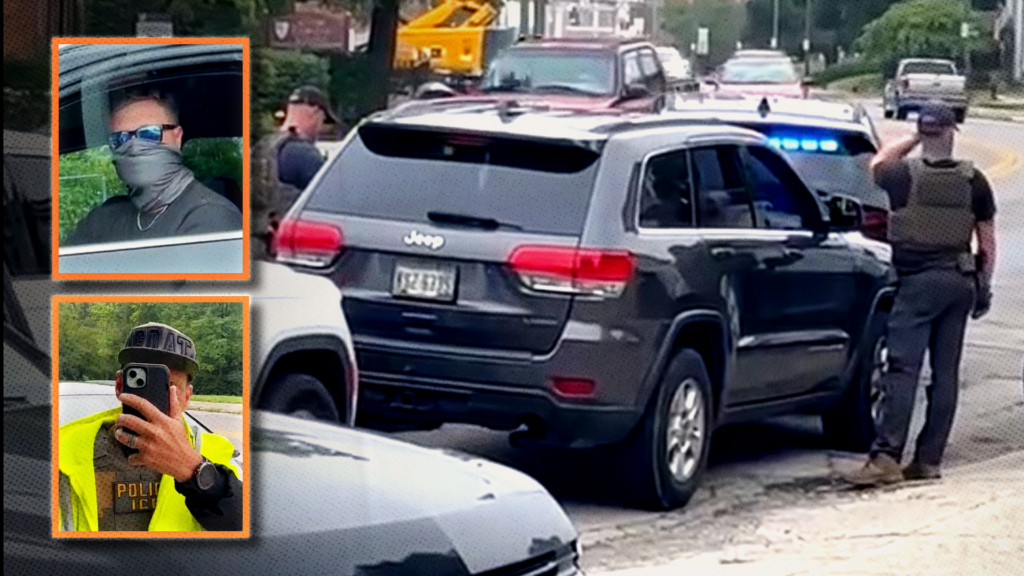
After an ICE watcher in Springfield won a temporary injunction against ICE in a First Amendment lawsuit, the agency moved the officers accused of harassing him out of town.
A federal judge granted a temporary restraining order (TRO) last Friday that prevents federal immigration officials from retaliating against a Springfield, Ohio, resident for filming them. Still, the government contends the man’s First Amendment suit should be dismissed because ICE has already reassigned most of the involved officers away from the area.
Sean Moorman filed suit last week, alleging that federal immigration officers have mounted an escalating campaign to intimidate him due to his practice of recording and observing ICE operations in Springfield, a city caught up in the Trump administration’s mass deportation emphasis because of its sizable Haitian community.
Moorman, who is backed by the American Civil Liberties Union (ACLU) of Ohio, is seeking the names of seven ICE personnel named as defendants. However, ICE has submitted court papers stating that six of those seven officers have already been moved out of Springfield.
The government argues this relocation undermines Moorman’s standing to pursue the case. “With six of those seven agents no longer working in the Springfield, Ohio area, Plaintiff falls far short of his burden to demonstrate that additional harm is ‘certainly impending,'” Justice Department lawyers wrote in a Wednesday court brief urging the judge to vacate the TRO.
The government also argues that allowing Moorman to discover the officers’ identities could put those officers at risk of serious harm.
The ACLU of Ohio says the government is trying to shield the officers from accountability, not retaliation.
“Sean Moorman has been subjected to an escalating campaign of intimidation by masked and anonymous ICE officers for exercising his First Amendment right to record their actions in public,” David Carey, the ACLU of Ohio’s managing legal director, said in a statement to Reason. “It is deeply disappointing to see that the government’s response is to try to help these officers evade accountability in court, by shuffling them to other cities and by continuing to shield their identities.”
Moorman volunteered to serve as an ICE observer in Springfield, but the suit alleges that within days of beginning his documentation, ICE vehicles began tailing him, swerving toward his car as if to ram him, aggressively boxing him in, and driving slowly past his home while photographing it.
Moorman’s case mirrors other claims nationwide of First Amendment retaliation by immigration officers. The ACLU of Tennessee filed a class-action suit in May against a federal law-enforcement task force in Memphis for harassing legal observers.
The Department of Homeland Security and immigration officers have repeatedly accused videographers and legal observers of obstruction of justice and “doxxing,” but civil-liberties advocates argue the DHS is wrong: every federal appellate court to consider the issue—nine so far—has firmly upheld the right to record law enforcement in public.
U.S. District Judge Michael J. Newman issued an order last Friday granting Moorman’s request for a temporary restraining order. Newman’s TRO bars all Springfield-area ICE officers for two weeks from engaging in any further threatening, intimidating, or retaliatory action against Moorman absent a legitimate law enforcement purpose connected to his First Amendment activities.
Newman found a clear link between Moorman’s filming of ICE officers and the retaliation that followed.
“Almost every interaction Moorman had with ICE officers was promptly followed by a retaliatory act,” Newman wrote in the order. “Each time Moorman filmed the officers, they quickly traveled to his home, shouted at him, attempted to ram his vehicle, or filmed him.”
Newman also noted that the government had not challenged Moorman’s assertion that he had simply recorded the officers peacefully and lawfully. The judge wrote in a footnote that an assistant U.S. attorney present at a September 2 hearing “could not offer a single reason to explain Defendants’ conduct.”
In the government’s brief requesting that Newman vacate the TRO, it characterizes the officers’ purported retaliatory acts as “a smattering of fluid, brief actions by individual officers over a handful of days in recent weeks,” none of which harmed Moorman or chilled his First Amendment rights.
“Even if the Court were to believe isolated incidents of retaliatory action occurred against the Plaintiff, there is no evidence or indication that the agency or its leadership directed, encouraged, coordinated, or was even aware of retaliatory actions against the Plaintiff or others,” the brief continues. “To the contrary, the evidence in this action shows that ICE maintains a policy prohibiting unlawful retaliation or harassment.”
The government brief also argues that Newman’s TRO is unworkable, overly vague, and runs afoul of the separation of powers.
