
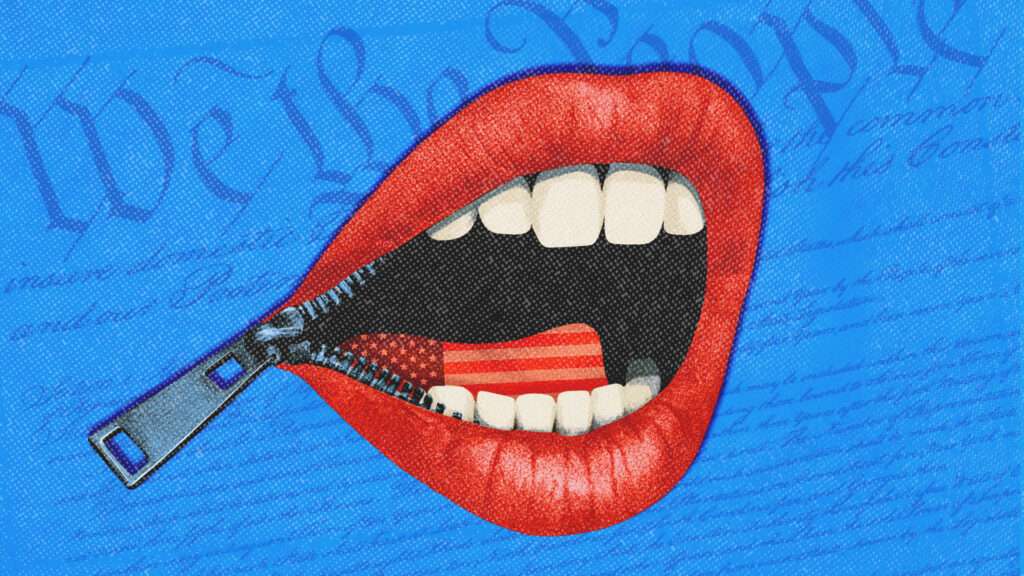
A court ruling invalidated the government’s tactic of weaponizing immigration law to threaten lawfully present noncitizens with removal for protected speech.
Since President Donald Trump’s return to the White House, the federal government has repeatedly weaponized immigration statutes to suppress speech. Lawful noncitizens have faced deportation threats for criticizing Israel and U.S. foreign policy, and a federal judge has declared this practice unconstitutional.
Last Friday, U.S. District Judge Noël Wise of the Northern District of California concluded that Secretary of State Marco Rubio’s employment of two provisions from the Immigration and Nationality Act (INA) of 1952 to target legal noncitizens violates the First and Fifth Amendments.
Under the first clause cited by Rubio, the secretary of state may initiate deportation proceedings against a noncitizen for protected speech if he personally determines that the speech undermines a compelling foreign policy interest. The second clause grants the secretary the discretionary power to revoke such visa or other documentation at any time. It was on these grounds that the administration pursued individuals it labeled as radical, including Mahmoud Khalil—a Columbia University student who holds a green card and was apprehended by U.S. immigration agents in 2025 after taking part in pro-Palestine demonstrations on campus.
In 2025, the Foundation for Individual Rights and Expression (FIRE) challenged Rubio’s use of the two INA provisions to deport lawful noncitizens. The suit, brought on behalf of The Stanford Daily, a student-run newspaper at Stanford University, and Jane Doe, a lawful noncitizen who engaged in pro-Palestine discourse, contended that Rubio and the Trump administration are “trying to convert the inalienable right to free speech into a privilege that depends on the whims of a federal bureaucrat, triggering deportation proceedings against noncitizens who reside lawfully here for their protected political speech concerning American and Israeli foreign policy.”
According to the suit, the threat of visa revocation silenced voices at The Stanford Daily. Contributors engaged in self-censorship, choosing not to cover Stanford’s pro-Palestine demonstrations, steering clear of topics related to the Middle East conflict, and seeking to remove their articles on such topics for fear of government reprisals. One editorial board member of The Stanford Daily, worried about “adverse immigration consequences,” requested the removal of an article about the Israeli Defense Forces from the site. Another staff writer, who had written pieces about Israeli and Palestinian officials, asked for her articles to be taken down for the same reason. The FIRE complaint notes that absent the “threat of visa revocation…and deportation,” noncitizen contributors at the newspaper would have continued to publish.
Wise ruled in favor of the plaintiffs, writing, “Stated plainly, in the United States, freedom of speech belongs to the people. It is not the government’s to take.”
“The government has issued a chilling message regarding protected speech,” she added. “Speak out against Israel or in support of Palestinians and we will revoke your visa and deport you. Behave. Noncitizen students heard the warning and heeded.”
The ruling reaffirmed that First Amendment rights do not hinge on a person’s immigration status, and that the government cannot weaponize the immigration system to silence protected speech it dislikes.
This is not a first for the courts in supporting immigrants’ free-speech rights. In Bridges v. Wixon (1945), the Supreme Court overturned the deportation of an Australian labor organizer, Harry Bridges, who had initially been accused of communist ties by the Roosevelt administration. “Freedom of speech and of the press is accorded aliens residing in this country,” the Court declared.
Crucially, in a concurring opinion to Bridges, Justice Frank Murphy stressed that the First, Fifth, and Fourteenth Amendments do not draw a line between citizens and resident aliens. He asserted that once an alien lawfully enters and resides in the United States, they acquire the constitutional rights guaranteed to all people within our borders, and that these “inalienable privileges” extend to every “person” and protect them against any encroachment by federal or state authorities.
The growing threat to freedom of expression is troubling. While the Trump administration’s deportation campaign might not be halted, Friday’s decision offers reassurance to lawful noncitizens. The Constitution makes the point plainly: freedom of speech is a right that applies to everyone on American soil, regardless of immigration status.
