
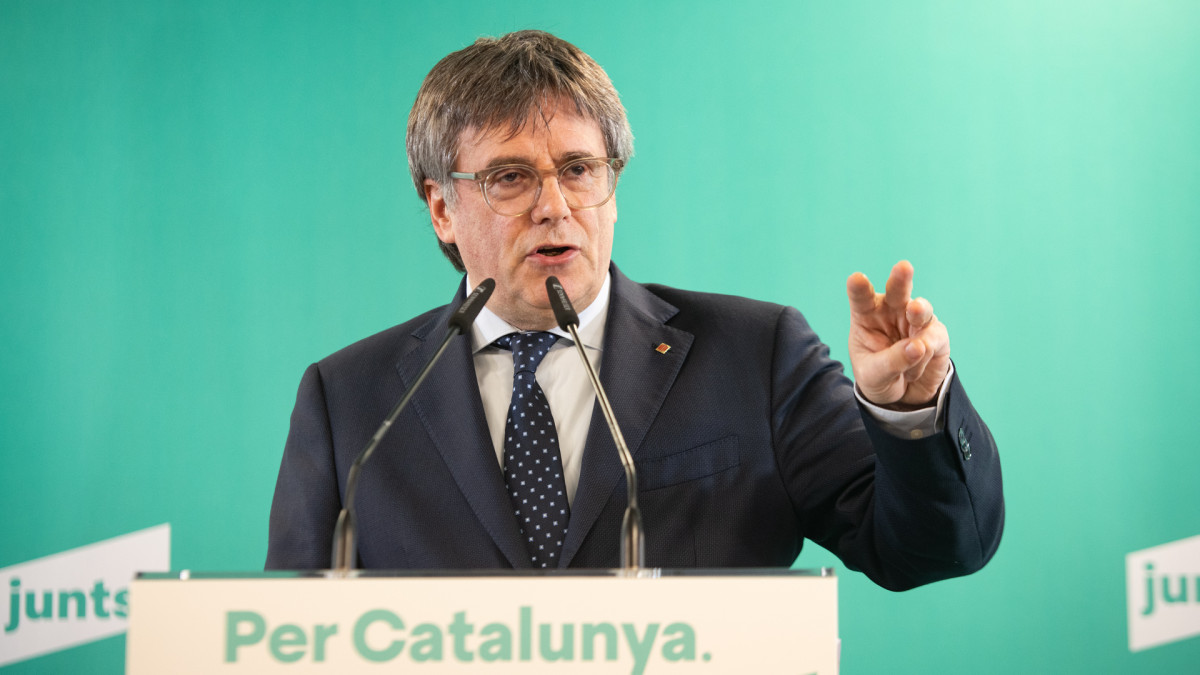
The decision by Junts per Catalunya to break —or, at the very least, to warn that it will not support future general budgets— with the current progressive government coalition of the State draws attention for many reasons. A lot is being said these days about Junts’ maneuver. Undoubtedly it is true that the threat from the radical Catalanist independence right Aliança Catalana, rising in all polls and capable of attracting one in five voters from Puigdemont’s party, has caused panic among its mayors, who view with concern the horizon of the 2027 municipal elections.
“Since the municipal elections of 2023 the party has endured internal tensions about whether to pursue a return to the convergent space and abandon the transversal political experiment”
This has been triggeringa ideological turn in Junts. Since the 2023 municipal elections, the party has faced deep internal tensions about whether to push for a return to the convergent space — especially after the success of former mayor Xavier Trias’s campaign in Barcelona — and to abandon the transversal independentist political experiment that was built with Junts to ride the wave of the procès and not be blurred by CiU’s corruption cases and the authentic independence of ERC and the CUP.
The First Formula for Junts’ Success
As some scholars recall, the CiU coalition, which had been the leading force in seats in all elections to the Parliament, disappeared. One of the parties that formed it, Convergència Democràtica de Catalunya (CDC), underwent various transformation processes to end up presenting itself in elections as JxCat and find here a stable form of coalition. In this process, the space radicalized its stance in favor of independence, while at the same time blurring its ideological traits and structured itself as a transversal project.
Junts managed to present itself to the Catalan public as a party that was neither left nor right, gaining support among the more leftist ideological groups while losing it on the right. That was the Junts that sat down to negotiate with the Sindicat de Llogateres and, with many caveats, voted in favor of the first rent regulation, the 2021 Catalan law. However, after the failure of theprocès, another line began to prevail. It involved gradually returning to the peix al cove pujolista as a way out of weariness with the independence movement and the entry of Catalan society into a phase of political fatigue. What no one expected is that a reactionary right would appear during this transition, capable of playing on the same identity axis as independence and on the same ideological axis as the Spanish-right.
“Today it is Orriols who determines the discourse of Puigdemont’s people. If Junts insists on being the extreme right, it will end up being replaced by it as the alpha party”
And here we arrive at today, where this threat is blowing apart Junts’ landing strategy in its return to political normalcy with the Spanish State. Yet, the leadership of Carles Puigdemont’s party has made a misguided bet to confront this hostile takeover of its bases, cadres, and councillors. Abandoning its ability as a transversal independentist political instrument to fit onto the right wing of the ideological board lacks authenticity —a rising value in modern politics— and resonates constantly in the frames of Silvia Orriols. Today it is Orriols who decides the discourse of Puigdemont’s people. If Junts persists in mimicking the far right, it will end up being replaced by it as the alpha party of the Catalanist right. It is what we have already seen in Europe and, increasingly, in the Spanish State with Vox capturing more than a million PP voters. Puigdemont’s people know they must talk about insecurity, immigration, tax cuts, or preserving Catalan identity, but insisting on doing so as Aliança only feeds this movement, blurring the own identity of the old Christian-democratic parties.
Furthermore, the strategy that seems likely only to worsen results in future general elections is incomprehensible. Junts may think that the national scene is of little interest to them, but anyone who follows Catalan politics closely cannot dismiss it. Since this government coalition began its term, Catalan politics has moved to Madrid. It is in Congress where the main dossiers of the Catalan agenda can be resolved such as the Amnesty Law, the reform of funding, or the promotion of Catalan in Europe.
The Direct Confrontation and the Territorial Axis
Insisting on the idea of a blockade and on positioning against the progressive government alongside the PP and Vox simply won’t work. Catalonia voted on 23J in a very clear manner: to prevent a PP-Vox government and to open a new framework for dialogue. And many independence voters also voted in that direction, including those from Junts. According to post-election data from the CIS, cross-referencing the memory of the regional vote with the 2023 general elections, up to 27% of Sumar voters in Catalonia came from the independence movement. A 27% voted for Sumar, and, as has been customary with dual voting, in the 2024 regional elections they returned to independence; almost 5% came from Junts. We also see how PSOE secured nearly 6% of Junts’ voters. Perhaps this is why Junts’ result in those elections was the worst for the party in a general election.
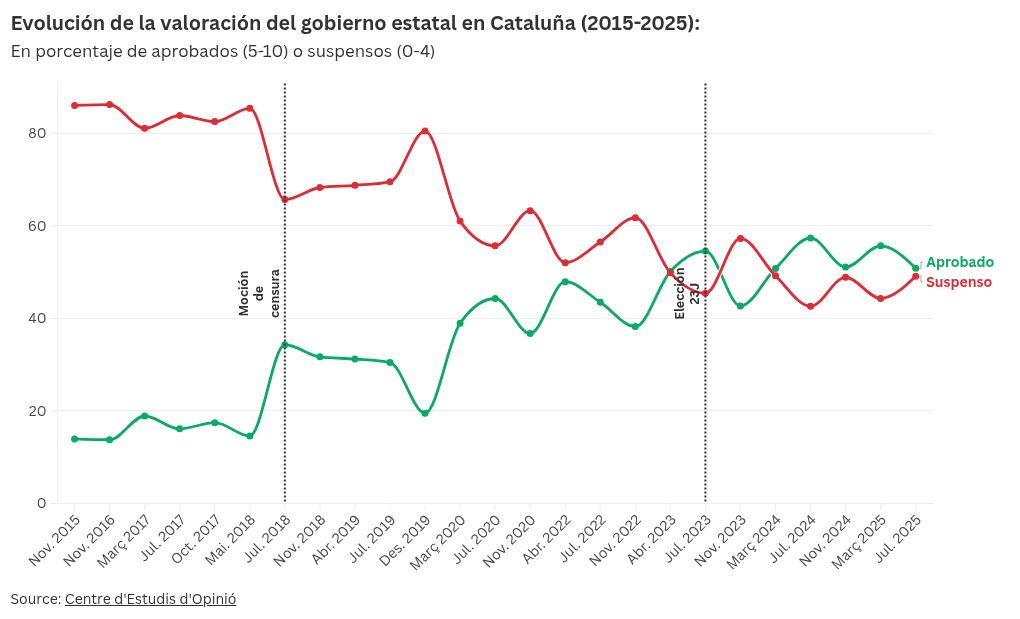
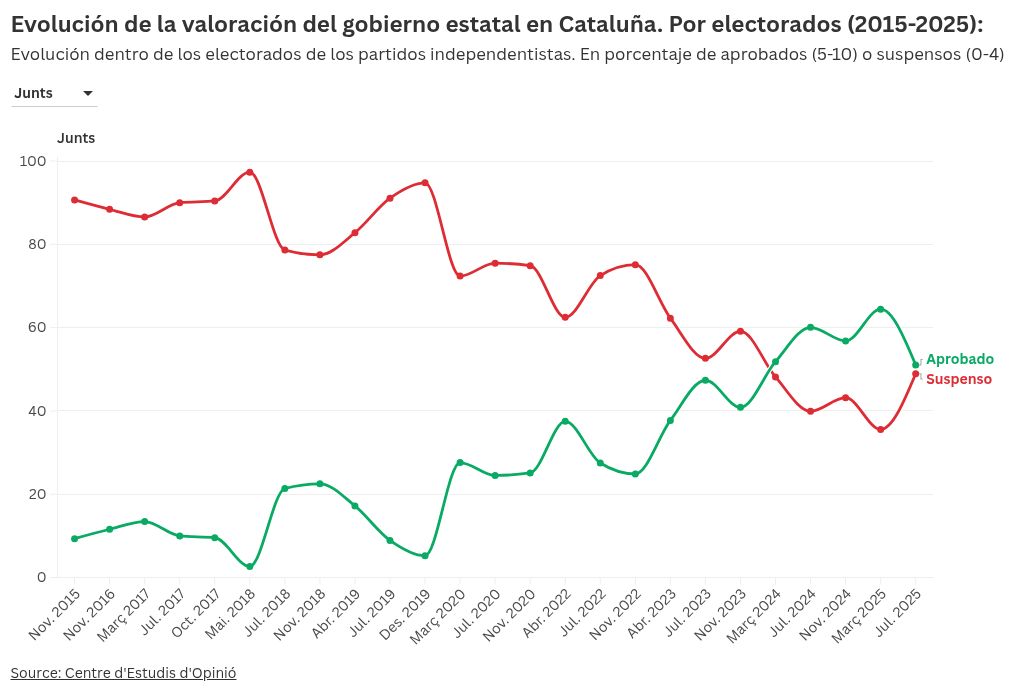
According to the data from the Barometer of the Centre d’Estudis d’Opinió (CEO), the rating of the State Government in Catalonia since the 2018 motion of censure has risen, consolidating after 2023 with a record number of approvals, remaining around 50% in recent months. This trend is also visible among the independence-leaning electorate: today more than half of Junts voters (52%) approve the progressive coalition government; 59% approve Pedro Sánchez and 55% Yolanda Díaz. It is evident that the Catalan society values the path opened by the executive, which has left repression behind and opened a new political era.
Who seems to have understood this is ERC. With a profile like Gabriel Rufián —now the highest-rated leader—there are signs he could grow to about ten seats in a general election, according to the latest GESOP. The microdata show that up to 13% of those who voted Junts in 2023 would now lean toward ERC, a further sign of Junts’ loss of transversal appeal, which used to receive a lot of borrowed republican votes.
Another factor Junts should bear in mind is that today in Spain the forces of the right, on a long-term reactionary drift, have long sought constitutional changes that would make a government like the current one, which they regard as a historical anomaly, impossible again. The new ideologue of a PP-Vox coalition government, Jesús Fernández-Villaverde, advocates the opening of a new Spanish political cycle in line with the new orientation of the United States and often reminds that in the Congress of Deputies “there are still four Carlist parties: PNV, Bildu, Junts and ERC.” In his explanation about the Carlist wars and the Vergara pact, the economics professor at the University of Pennsylvania suggested that neutralizing these parties remains an unfinished task that could not be completed in the past.
“The maintenance of the plurinationaI majority can guarantee something we have needed for a long time: a democratization of the structures and bodies of the State”
For this reason, only the maintenance of the plurinationaI majority of investiture can guarantee something we have needed for a long time and that has barely begun to be sketched out in this legislature: a democratization of the structures and bodies of the State. It is in this axis of democratic regeneration that Junts has a role to play, with the Amnesty Law as the ultimate example of this and with the judiciary in rebellion as the final focal point to target in alliance with the rest of the forces of the majority. This axis should have been the backbone of the current legislature, since it is where there is a clear majority.
This alliance is a necessary step to reform a State whose apparatuses and power centers survived almost intact from the transition from dictatorship, effectively delimiting the reach of democracy and preserving a veto power that still conditions the political game between majorities and minorities. Without a deep democratization of the State, the left and the peripheral nations will continue to occupy a subordinate position, forced to ask permission to exist within the framework of an order that never fully became democratic.
The Board Is Configured on Three Fronts
Today, both in Catalonia and across the State, we are heading toward parliaments divided into three clear blocs: a reactionary bloc formed by PP, Vox and Aliança Catalana; a plurinational but conservative bloc, where we find Junts and the PNV; and a third bloc, that of the plurinational left in all its diversity, represented by the PSOE, Sumar, Podemos, ERC, BNG, Bildu, the CUP or the Comuns. Only a tactical and situational alliance between the second and the third can guarantee real advances and a firm defense of rights and coexistence. It is the logic of the democratic cord promoted by the Unit Against Fascism and Racism (UCFR).
“In the poll data, a good portion of Junts’ electorate is not aligned with the ideological coordinates the party draws”
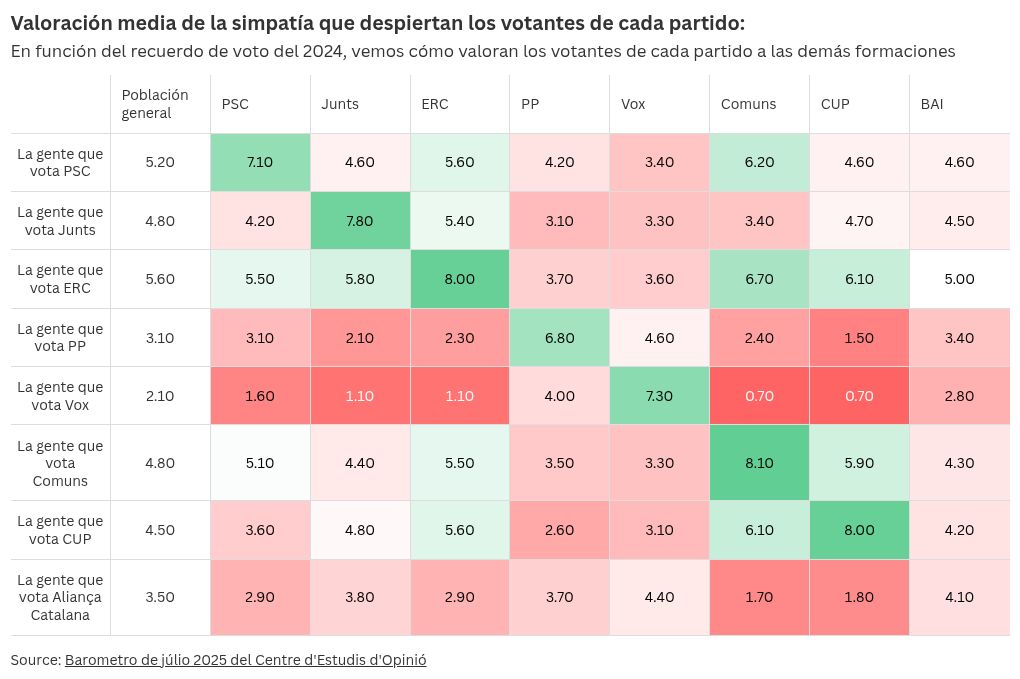
We need a democratic right. Replacing Junts with Aliança Catalana is bad news, and the party must understand that it needs its own agenda and a different way of talking about the issues that worry that portion of its electorate. In fact, in the polling data, a good portion of its own electorate is not in the ideological coordinates drawn by the party. A question recently added to the CEO barometer shows: Junts voters consider that the people who vote for PP (2.1) and Vox (1.1) are those who generate the most antipathy in them, followed closely by Aliança voters (3.8). By contrast, although they drop, the lefts of Comuns (4.4), CUP (4.8) or PSC (4.6) fare better. On the other hand, the strong rating of ERC (5.8) confirms the historical compatibility between its electorates.
In other words, this political space has the ingredients to develop alongside the investiture bloc. It could even be more productive and electorally profitable to do so than to propose blocking the government alongside the PP and Vox, in order to project a certain no-surrender independence profile in Catalonia in its contest with Aliança.
“What fuels Aliança is xenophobia: up to 27% of the potential electorate of Orriols says that immigration is the main problem in Catalonia”
Because what fuels Aliança is above all xenophobia. Evidence of this is that up to 27% of Orriols’ potential electorate say that immigration is Catalonia’s main problem, while the Catalonia-Spain relations that typically occupy independence voters’ concerns do not appear in the top 3 concerns of these voters. In fact, the only two motions presented in the Catalan Parliament during the year targeted the Islamic veil and mosque radicalization processes. The investigation by eldiario.es also shows the scant interventions dedicated to independence, the national question, or, even, the Catalan language by the party governing the Ripoll city council.
Therefore, Junts should stop trying to confront Aliança on those terms, which is what seems to underlie Puigdemont’s latest maneuver just eight years after the Parliament proclaimed the Unilateral Declaration of Independence. A maneuver that further undermines Junts’ power, blocks its landing in Spanish politics, and does not seem to help curb its drift toward the far right.
In short, Junts must decide on which side it stands: the side of the reactionary bloc or the democratic bloc. If it chooses the reactionary side, it will very likely be replaced by the radical right; if it opts for the democratic bloc, it can maintain decisive influence, preserve its transversal approach, and avoid becoming irrelevant in Madrid. The Catalan-right has historically been a key piece in Spanish governance. Renouncing that role could mean losing its raison d’être.
