
What can explain that gap?
Today Justice Cody Hiland stood before the Senate Judiciary Committee. Senator Durbin cited my blog post calling him unfit for the bench, then bungled the question entirely. Durbin labeled me a “conservative law professor,” revealing a parallel with the New York Times. Rather than probing why Hiland chose to reveal private conversations with law students, Durbin confined his inquiry to Hiland’s temperament.
None of the other senators pressed him with tough questions, not even a hint. It’s unfortunate, because he might have stumbled under more incisive scrutiny. This was among the most awkward circuit court nominees I’ve seen. In fact, Hiland made Todd Butler look like a seasoned pro. Is the process finished? I came across a post from the retired senior editor of the Arkansas Times:
Would news that a candidate for a federal judgeship twice failed the bar exam change the tenor of loud opinions on the exam rigging scandal?
Let’s take a closer look.
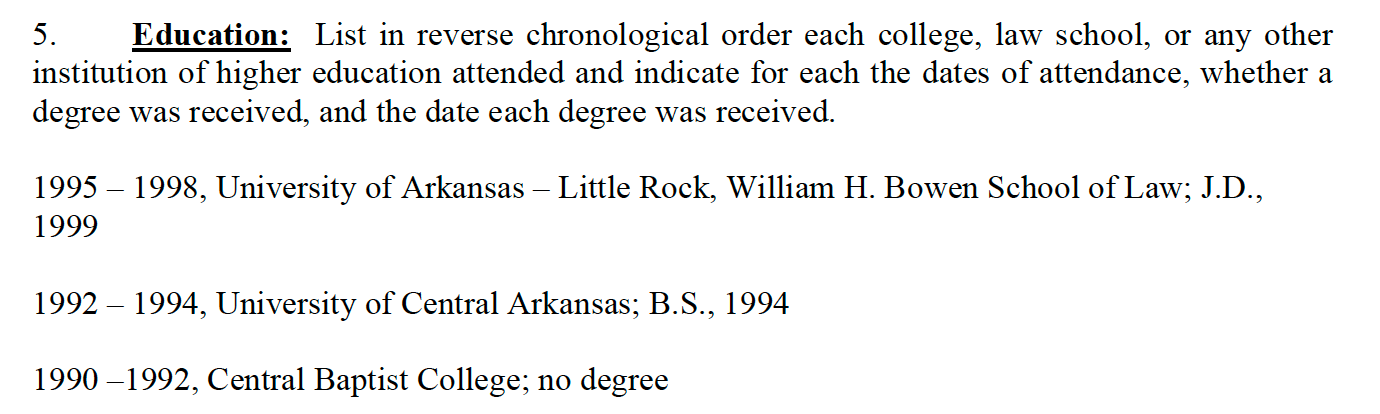
First, the date Hiland finished law school isn’t crystal clear. Here is the line from his questionnaire. Is it 1998 or 1999? The lone 1999 is odd. Perhaps he earned the JD in 1998 but needed some additional coursework to graduate?

According to the University of Arkansas Little Rock Bowen School of Law, Hiland earned his degree in 1998. Yet something about the timeline doesn’t add up.
According to his Senate Judiciary Committee Questionnaire, he was admitted to the bar in 2002, but there is no indication whether he sat for the July or February administration.
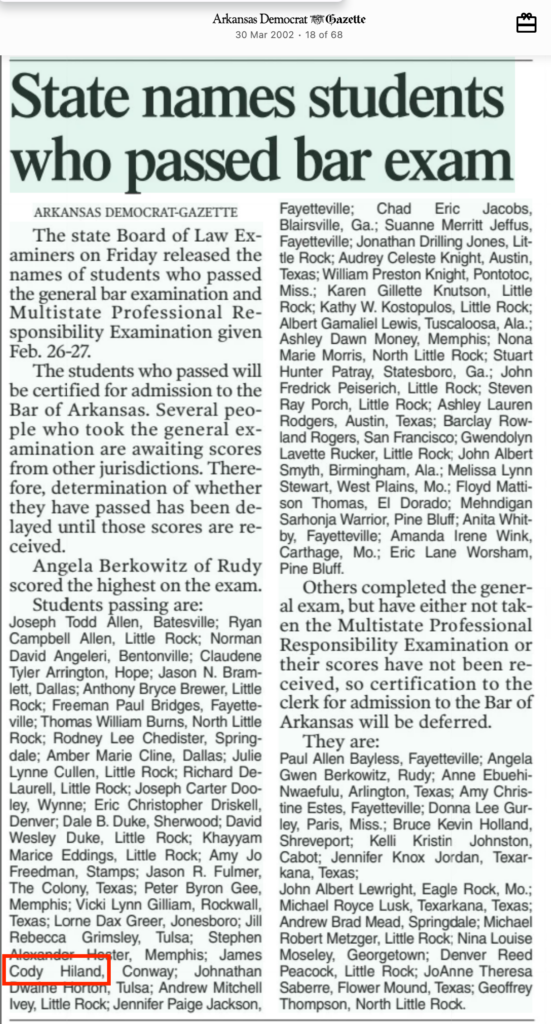
I located an Arkansas Democrat Gazette article from March 30, 2002 indicating that Hiland passed the February 2002 bar exam. In general, the February bar is chosen when a candidate has a conflict preventing the July examination or when the July attempt was unsuccessful.
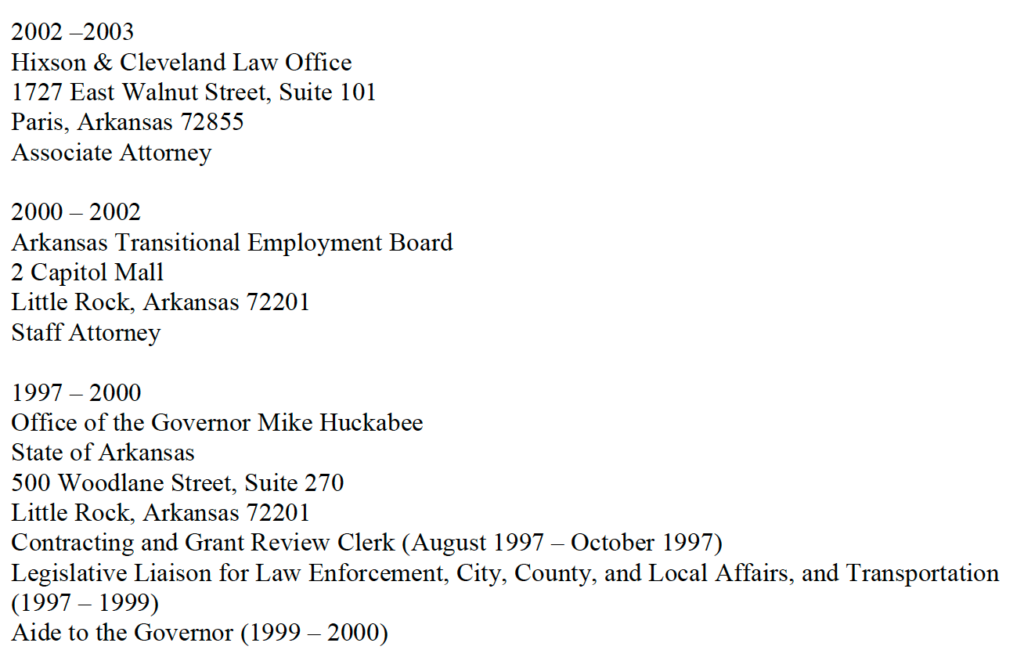
Between 1997 and 2000, Hiland held several positions in Governor Mike Huckabee’s office. None of these roles required a JD. From 2000 to 2002, he served as a Staff Attorney at the Arkansas Transitional Employment Board. It isn’t clear how he could be a Staff Attorney before being admitted to the bar. In 2002, after his admission to the bar, he began work as an associate at a Paris, Arkansas law firm.
Normally, graduates head straight to the bar exam after completing law school. Perhaps Hiland’s duties as an adviser to the governor kept him from taking it immediately. It’s possible his first attempt occurred in February 2002, two or three years after finishing law school.
If only President Trump had asked Katie Zacharia when she passed the bar. It might be worthwhile to ask Hiland about the total number of bar exams he has taken in a Question for the Record.
