
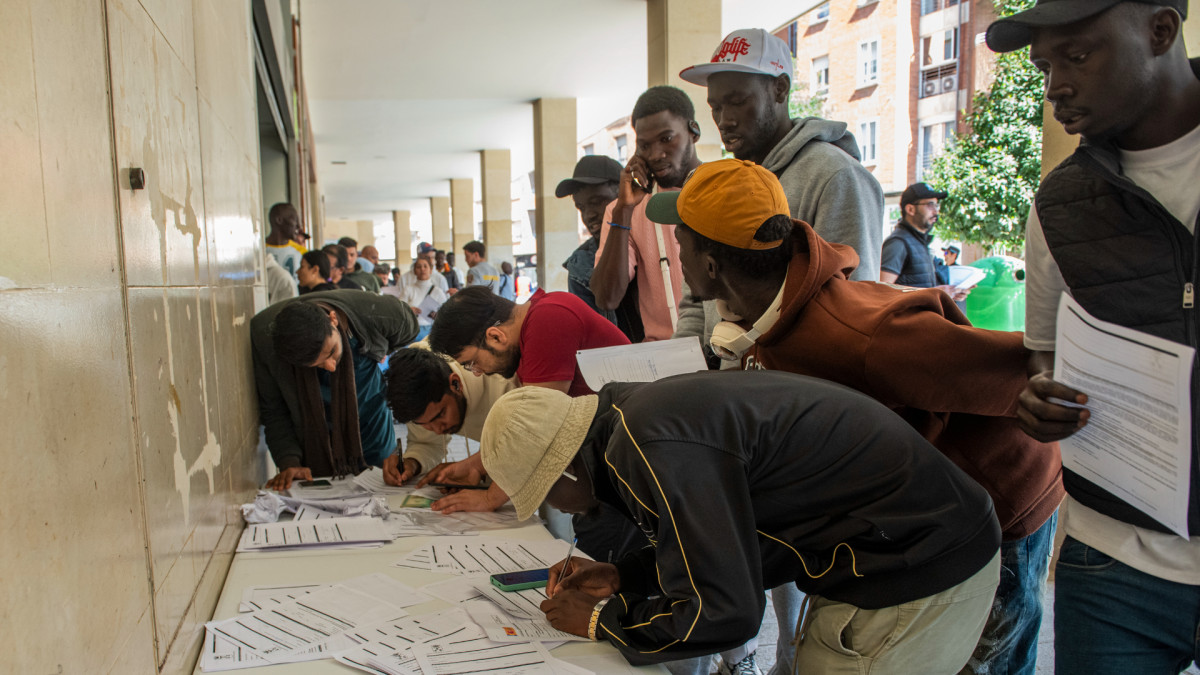
Regarding the political opportunity and the need for this regularization process, extensive writing and debate have already taken place. The extraordinary regularization promoted by the Government does not constitute an anomaly in the history of Spanish migratory governance and, in fact, confirms that regularization is not the event, but the symptom of a much deeper structural reality: the gap between current mobility dynamics and a governance system that remains unable to respond to them in an ordinary way. Moreover, the available evidence also confirms that this type of process does not generate a short- or medium-term pull effect, does not directly alter the electoral roll —which depends on nationality, not on residence— nor does it solve by itself the structural weaknesses of the Spanish labor market. What it does do is recognize rights and establish obligations for foreign nationals who already live in our country, allowing them to exit administrative irregularity and to contribute fully to the sustaining of the democratic welfare state through their work, their contributions, and a more active participation in social and community life.
The past June 30 ended the deadline for submitting applications. Equally decisive phases lie ahead, such as determining how many of those applications will be admitted and, ultimately, how many will be resolved in a favorable manner. But the data published at the close of the process already allow us to draw some initial conclusions.
“Regularization therefore represents an institutional recognition of their presence and of their economic and social contribution”
The applications submitted, 1,174,978 in total, make this process the largest regularization carried out to date in a member state of the European Union. This figure confirms a double Spanish exceptionalism. The first has been repeatedly observed in recent months: Spain is the European Union country that, on a regular basis, turns to extraordinary regularization programs to address irregular residency, despite also having ordinary mechanisms, such as the various forms of arraigo. Other member states also possess permanent regularization instruments, but they are far more reluctant to use extraordinary processes, in part because they prefer to avoid the political cost of acknowledging the existence of significant pools of irregular residency. The second exceptional aspect is less visible, but perhaps more relevant. Each extraordinary regularization obliges making visible a reality that often remains hidden: that hundreds of thousands of people already live, work, care for others, consume, pay indirect taxes, and sustain entire sectors of the economy without their administrative status reflecting that reality. Regularization, therefore, represents an institutional recognition of their presence and of their economic and social contribution. Faced with the temptation to invisibilize these trajectories or reduce them to a problem of migratory control, the process demands acknowledging that they are part of Spanish society and that the question is no longer whether they are here, but under what legal and social conditions they participate in it.
Precisely for that reason, the data that has generated the most debate —that the number of applications has almost doubled some initial estimates— deserves a different interpretation. The question is not whether the forecasts were overly optimistic or too conservative. Rather, we should focus on what that difference between what we thought we knew and the reality revealed by the process itself tells us. Rather than being surprised by the gap between the expected volume and the applications submitted, we should be concerned about the magnitude of an underground economy that remains partly invisible. In this sense, every regularization produces knowledge. It corrects an administrative situation and, above all, allows measuring a reality that until then remained partly hidden.
The demographic data point in that direction. 87% of applications come from people aged between 16 and 64, that is, the working-age population. Especially notable are the groups 25–34 years old (31.3%) and 35–44 years old (21.6%). It is hard to find more explicit evidence that the main attracting factor remains the labor market.
“Irregularity is not a matter of entry, but, above all, a matter of residence”
Also the national origin of applicants offers relevant information. It confirms a known, though not always acknowledged, reality: in Spain, as in much of the European Union, irregularity is not a matter of entry but, above all, a matter of residence. In other words, many people enter the territory regularly —as tourists, students, or holders of other temporary authorizations— and it is the expiration of the authorized stay or the difficulties in obtaining or maintaining a residence permit that ultimately generate administrative irregularity.
This aspect is especially important because both Spanish and European policy continue to devote a large share of their efforts to border control (especially maritime) as the main tool to combat irregular immigration. However, although irregular border arrivals are a central issue from the human rights perspective, they do not represent the main statistical origin of irregular residence. Rather, regular entries that subsequently lead to an administrative irregular situation explain a significant portion of the phenomenon.
In this context, it is logical that 67% of applications come from people originating in Latin America, a region whose nationals enjoy greater ease of access to Spanish territory, whether through visa-exemption regimes or entry procedures with much higher approval rates than visa applications from African countries. It is not by chance that four of the five top countries of origin for applications are Latin American, with Morocco the only non-Latin, non-EU country among the top five.
“That for many people it is faster and more viable to obtain a residence permit through extraordinary regularization evidences the limitations of the asylum system”
Another particularly relevant aspect has been the inclusion, in this regularization process, of people from the international protection system. One in five applications concerns people from the international protection system (the 20.4% of applications concern individuals applying for international protection, while the remaining 79.6% were submitted through the extraordinary regularization). This datum, in itself, raises concerns about the functioning of Spain’s asylum system. That for many people it is faster and more viable to obtain a residence permit through extraordinary regularization than through the ordinary international protection procedure evidences the limitations of the asylum system in our country.
On the other hand, it is worth pointing to the territorial distribution of applications. It largely reproduces the map of immigration and economic activity in Spain. Catalonia and the Community of Madrid clearly lead the number of applications, with more than 250,000 and 200,000 files respectively, followed by the Valencian Community and Andalusia.
Perhaps one of the most interesting data points is the educational level of applicants. Two out of three have post-compulsory education: 43% have completed high school or vocational training and 24% hold university degrees. Only one third have at most compulsory education. This profile challenges many of the stereotypes still present in the public debate on immigration and reminds us that much of the available human capital remains underutilized while people stay in irregular status.
One final note: in many ways, this has also been the regularization of digitization. 83.2% of applications were submitted digitally, compared with 16.8% submitted in person. This is a highly meaningful shift compared with earlier processes and reflects a significant administrative advance. Yet, it also poses a challenge: to prevent digitization from creating new dependencies on private intermediaries. In this context, it is worth recognizing the role played by the extensive network of social organizations, local entities, unions, and professionals who have supported thousands of people during the preparation and submission of their files.
“The extraordinary regularization ends up offering a much broader radiography than that of a simple administrative procedure”
This is the rapid snapshot of a process that has not yet concluded. It will be necessary to wait for final resolutions to know how many applications prosper and what happens to those who continue living in irregular status. But the underlying question goes far beyond this specific regularization. The extraordinary regularization ends up offering a broader radiography than that of a simple administrative procedure. It speaks to the functioning of the labor market, to the limitations of the asylum system, to the rigidity of ordinary mechanisms for access and maintenance of residence, and to the distance between the immigration we imagine and the one that actually exists.
Moreover, every extraordinary regularization constitutes recognition of a dysfunction in the migratory system itself. Correcting its effects is essential, but not sufficient. The real remaining task is to introduce structural reforms that reduce the production of administrative irregularity and make it unnecessary to periodically resort to exceptional processes like this.
“Cohabitation does not arise spontaneously: it is built through institutions and public policies”
Finally, there is a matter that it is worth not forgetting. Regularization does not end with the grant of a residence permit. It also requires equipping autonomous communities and municipalities with the resources necessary to manage a society that is increasingly numerous and plural. Population growth requires public services scaled to respond to that growth. And a more diverse society requires policies capable of incorporating that plurality into education, social services, health care, housing, or civic participation. Cohabitation does not arise spontaneously: it is built through institutions and public policies. If regularization recognizes rights and corrects a dysfunction of the migratory system, the management of demographic and social reality is the necessary condition to reinforce social cohesion and strengthen democratic coexistence in Spain.
