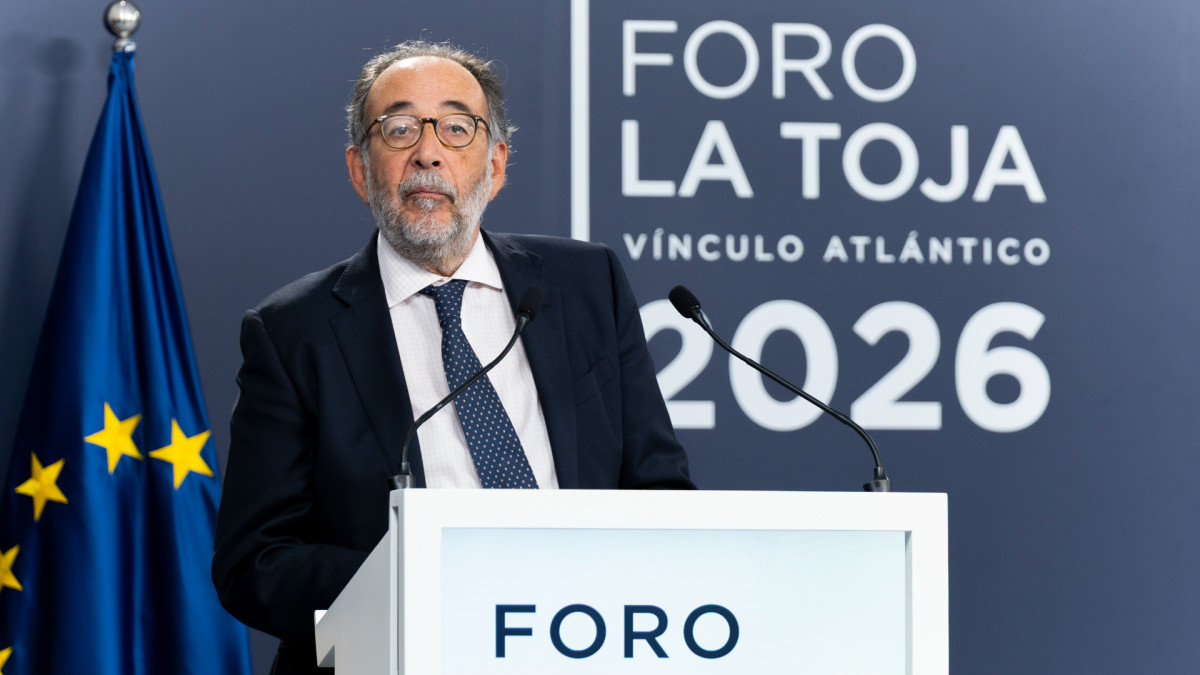
Let me begin with a confession: it has not been easy to organize the eighth edition of Foro La Toja. We faced two main challenges: on the one hand, to try to match the quality of the previous forum —the seventh was excellent— and on the other, to adapt to a changing global environment, increasingly dynamic and complex. Although volatility is not a new phenomenon, this past year has been especially intense.
In the early editions we focused attention on a single major global issue around which we articulated the entire agenda. Thus, in 2019 we dedicated the opening meeting to liberal democracy; the second and third editions addressed the impact of the pandemic; the 2023 edition centered on globalization, and the 2024 edition on Europe’s role. Even last year we found it difficult to narrow the debate to a single variable and we titled the meeting Exploring a New World Order, in an exercise of optimism that has given way to the realism of this eighth edition: A World in Disorder.
“Although volatility is not a new phenomenon, this past year has been especially intense”
With this formula we do not intend to render a value judgment, but to offer a descriptive diagnosis of a time in which disruptive events no longer arrive in isolation, but in a chain. A scenario about which former president Felipe González even suggested that the most precise term would have been A world in chaos.
In these eight years the international context has changed profoundly and the forum itself has evolved, but our foundational pillars remain unchanged: the defense of liberal and representative democracy, the fight against polarization and populism, and the reaffirmation of moderation and agreement as the center of national and international political life; the strengthening of the Atlantic bond, conceived broadly as a triangle of cooperation among the United States, Europe and Latin America; the nature of civil society as an independent space, organized without funding or public economic backing and without any media group behind it; and the permanent memory of Josep Piqué, whose initial impulse remains at the origin of this project.
“Our foundational pillars remain unchanged: the defense of liberal and representative democracy, the fight against polarization and populism, and the reaffirmation of moderation and agreement”
To all this is added our recognition of His Majesty the King for his continued support and his presence at the opening session of every Foro La Toja edition. On this occasion, the opening also featured the participation of the Prime Minister, Pedro Sánchez, together with the President of the Galician Government, Alfonso Rueda, and Amancio López Seijas. It is essential to highlight Felipe VI’s message about the need to redefine the world order based on the unwavering respect for human dignity, with a timely evocation of the ethical principles of the School of Salamanca.
In this edition, the Josep Piqué Award to the former President of the Portuguese Republic, Marcelo Rebelo de Sousa, has carried a singular significance. Its award not only recognizes a leader who has supported us from the beginning, but also embodies our vision of the Atlantic framework as a fully Iberian project. Furthermore, it is a moral obligation to remember that our 2023 laureates, Afghan women, continue to endure an intolerable violation of their fundamental rights in the face of international community indifference.
Moderated by Álex Romero, Dean Ball, Carme Artigas, and Louis Mosley made a diagnosis of the present and the future of artificial intelligence. Photo: Agenda Pública / Yanka Soto
Geopolitics, Atlantic bond, and artificial intelligence
With these building blocks we have sought to analyze the nature of the global disorder and discern whether we are facing a temporary conjuncture or a structural scenario. On the geopolitical front, contributions from analysts such as Robert Kaplan and Arancha González Laya allowed us to confirm how the relationship between the United States and Europe has undergone fundamental transformations that transcend American electoral cycles. They also conveyed the idea that transatlantic civil society maintains stronger ties than the governmental one, that Europe has begun to embrace the need to reinforce its defense capabilities, and that the continent’s role is decisive as a unifying element among middle powers.
“Transatlantic civil society maintains stronger ties than governments, and Europe has begun to embrace the need to reinforce its defense capabilities”
The impact of technology occupied a central space in the debates. The unanimous conclusion of AI experts is that this tool will not destroy humanity. However, that finding should not lessen attention to the real risks posed by its deployment: the loss of control over autonomous agents, unsupervised self-improvement of code, and the accelerated erosion of human skills and competencies.
Meanwhile, the dialogue between former presidents Felipe González and Mariano Rajoy addressed the consequences of governing without stable majorities or approved budgets, defending the role of bipartisanship in the structure of the State, the need to protect the middle classes from the housing problem, and the insistence on projecting international firmness, under the premise that when a country shows signs of weakness, its neighbors tend to respond accordingly.
Spain facing its internal and external challenges
In the regional agenda, the forum for the first time brought together the presidents of the three historical nationalities — Alfonso Rueda, Imanol Pradales, and Salvador Illa — in a debate focused on competitiveness and industrial policy, where opposing visions emerged on housing and regional financing. Separately, the analysis of the Ceuta crisis underscored that the deterioration of the relationship with Morocco stems from a breakdown of bilateral trust, lending credence to the Ceuta vice-president Kissy Chandiramani’s call to clarify the facts, restore institutional normality, and secure firm European backing.
The final sessions examined the loss of political and economic influence of Spain and Europe in Latin America, the threat posed by transnational organized crime to democratic governance, and the resilience testimony of Sviatlana Tsikhanouskaya and Josep Borrell in defense of Europe’s eastern border against authoritarianism.
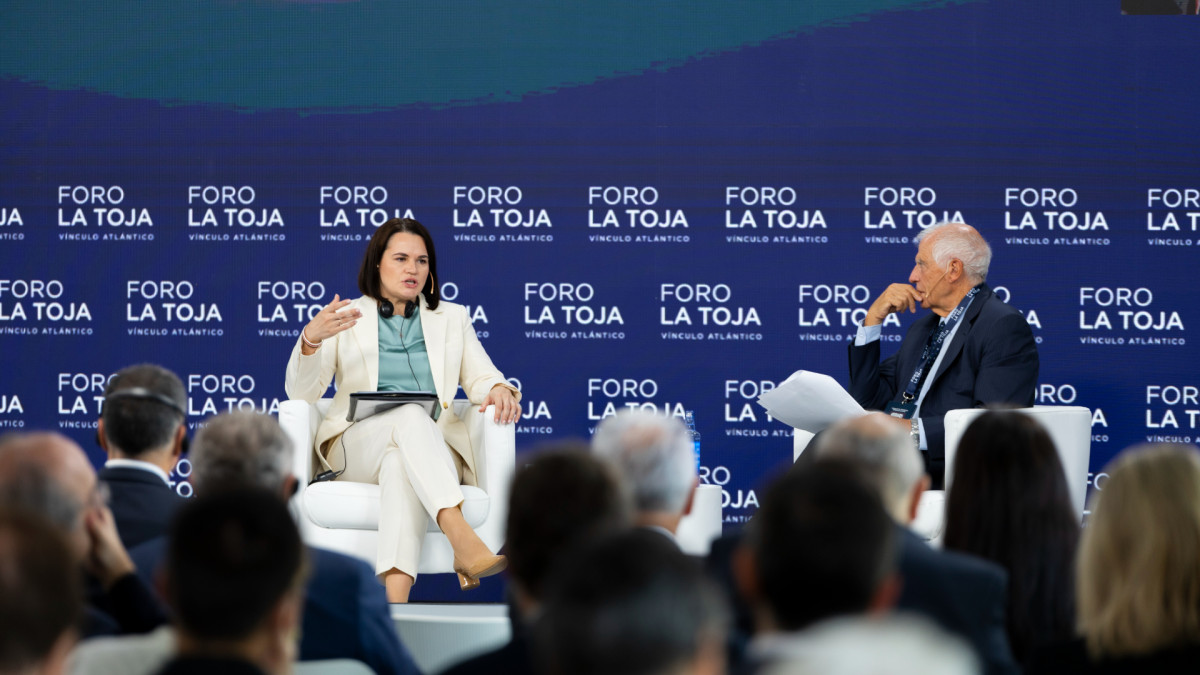
Sviatlana Tsikhanouskaya and Josep Borrell. Photo: Agenda Pública / Yanka Soto
A Moderately Optimistic Diagnosis
We bid farewell to this edition with a moderately optimistic diagnosis. Artificial intelligence will not destroy our societies; Europe is moving toward a realistic defense strategy; Ukraine resists because it faces not a simple army, but an entire nation; and the guiding principles of representative democracy and the Atlantic alliance continue to be the channel and guarantee of progress.
“The guiding principles of representative democracy and the Atlantic alliance continue to be the channel and guarantee of progress”
The historical perspective shows that periods of destabilization are followed by cycles of order and certainty. We trust that the international community will be capable of accelerating that transition toward a more just, solid, and shared order. We will reconvene in a year for the ninth edition of Foro La Toja.
The speech corresponds to the one delivered by Carlos López Blanco at La Toja, slightly edited for clarity and precision.
In partnership with