
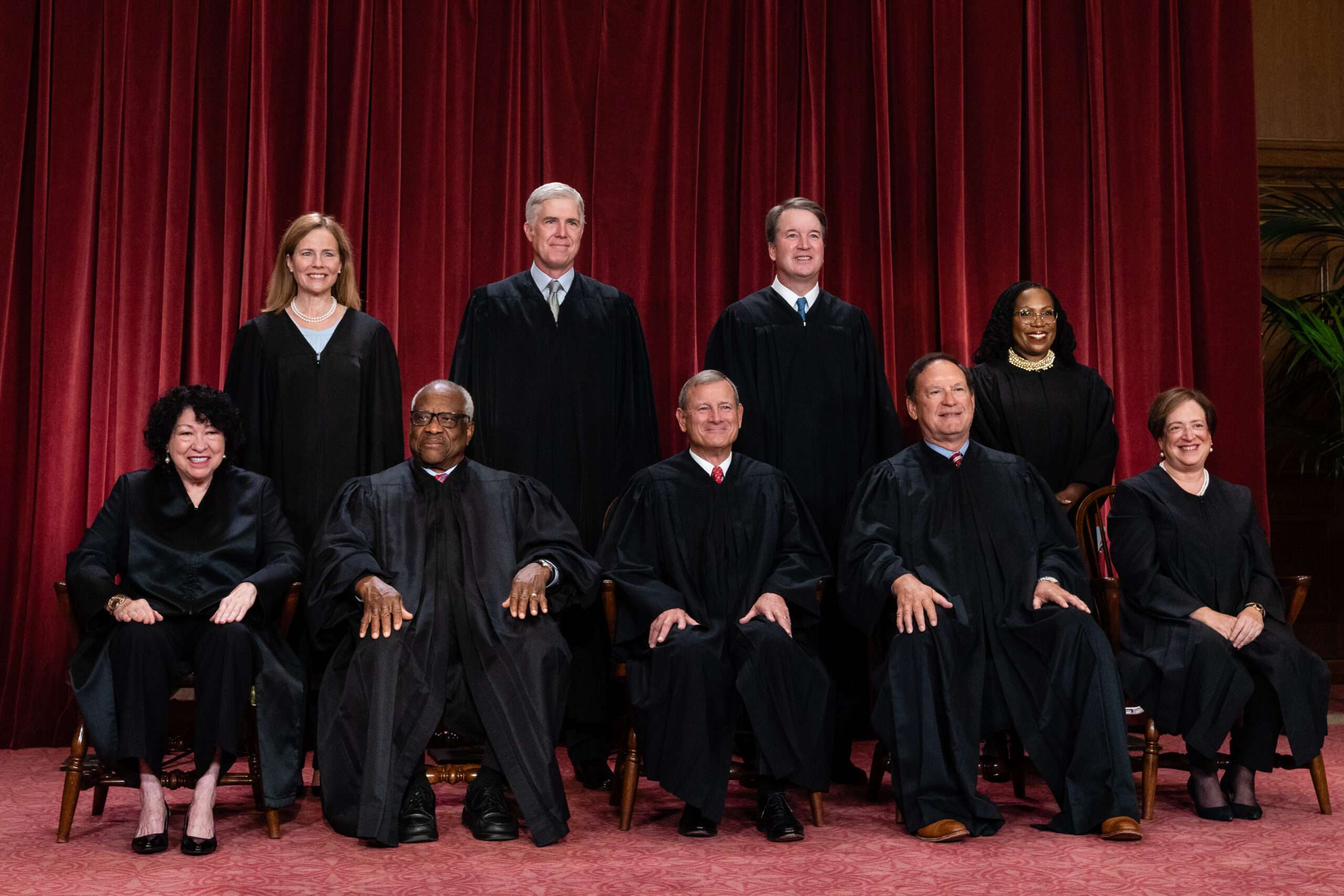
A detailed Marquette Law School poll shows public sentiment toward the Court as mildly negative, yet a large portion of its recent significant rulings enjoy majority public backing.

In May, I discussed survey results suggesting a modest uptick in the Court’s public standing, which may have been nudged by its February tariff ruling (a case I helped advocate). Since that time, the Court has handed down a number of important rulings across a range of topics—birthright citizenship, Second Amendment issues, the scope of executive removal power, and more. A new Marquette Law School survey assesses how the public views the Court after these decisions. It indicates that, overall, the Court remains only modestly disliked (47% approving, 53% disapproving), yet most of its notable recent rulings enjoy majority support. The Court’s popularity is slightly higher than just before the tariff decision and far above that of the other two branches of government. The poll also reveals additional intriguing findings, including how people view individual justices, about whom the public generally knows little.
As explained below, the Marquette survey does present a few methodological drawbacks. Nevertheless, it yields useful insights into how the public perceives the Court.
First, I should reiterate that the Court’s popularity (or lack of it) says little about the quality of its rulings. Survey data consistently show that most Americans have limited knowledge about the Constitution and the Court’s work, and a substantial portion cannot even name a single Supreme Court justice or know much about them (a point the Marquette poll reinforces). I do not claim that majority support for rulings I favor, including the tariff decision, proves those rulings are correct. It does not. But, for reasons to be explored, public opinion about the Court matters insofar as it helps safeguard the institution of judicial review from attacks from both the right and the left. It may also be of interest to scholars of the Court and of public opinion (myself included).
The Court’s 47% approval rating is slightly up from the 44% seen in the same poll in mid-to-late 2025, and roughly on par with the 46% recorded in May (following the tariff decision but before the other rulings). An April Marquette poll showed 42% approval. These figures align with other survey data suggesting a modest improvement in early 2026, potentially driven by the tariff decision. While the Marquette poll appears more stable than some others, swings between 42% and 47% could simply reflect sampling variation.
The Court also remains far more popular than the other two branches of government. The Marquette survey shows President Trump at a 38% favorability rating (60% view him unfavorably), and both Republican and Democratic members of Congress as well as the parties themselves are generally viewed unfavorably—likely more so than Trump. This pattern is consistent with earlier polls showing that the Court is viewed more favorably than either the legislative or executive branches.
Marquette also examined public attitudes toward 13 significant Court decisions from the past year. All but two of these rulings garnered majority support, and several were backed by sizeable margins:
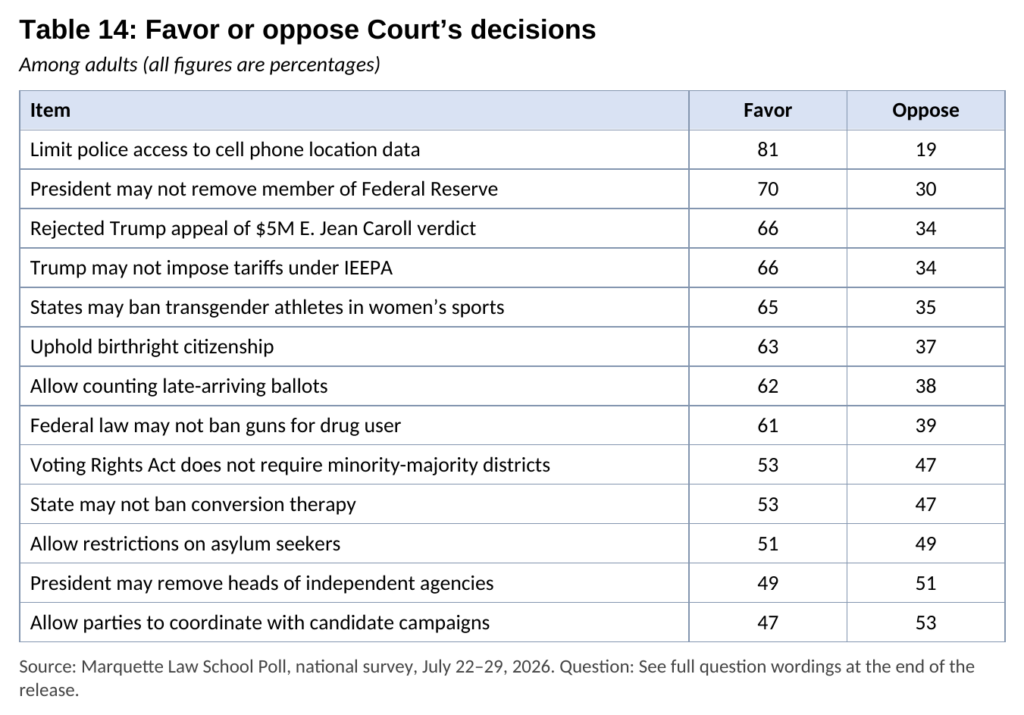
The tariff ruling (66% supported), the prohibition on transgender athletes from female events (65%), and Trump v. Cook—the decision safeguarding the independence of the Federal Reserve Board (70%)—are all especially popular. Louisiana v. Callais—the Voting Rights Act decision that provoked strong left-wing outrage—draws support from a slim majority (53%). The only two rulings without a majority agreement are Trump v. Slaughter (holding that the president can remove heads of most other independent agencies) and a ruling permitting coordination of campaign expenditures with campaigns. Even those two are only moderately unpopular, with 49% and 47% support respectively.
These results suggest that this year’s Court majority was far from out of step with public sentiment, contrary to some critics’ accusations. I acknowledge my own disagreement with certain outcomes the public supports. While I partially concur with the reasoning in Callais, I worry that the Court’s approach grants excessive latitude for racial gerrymandering by Republicans. I also have serious concerns about Trump v. Slaughter and how it relates to Trump v. Cook; reconciling those two rulings is, to put it mildly, difficult.
There are a few methodological caveats with this portion of the Marquette survey. The questions describe the rulings in fairly precise terms, which could pose comprehension challenges for respondents who lack familiarity with the issues involved (a large share likely falls into this category). Moreover, all questions employ a forced-choice format, leaving respondents without an option to indicate “don’t know” or “no opinion.” This means the survey may record opinions from people who do not hold meaningful views on the examined case.
In addition, the Court included one case that perhaps should not have been counted, and omitted at least one that should have been included. The Court did not adjudicate E. Jean Carroll’s lawsuit against Trump; it merely declined to review the lower court ruling in Carroll’s favor. That is not a precedent-setting decision and matters mainly to Trump and Carroll. By contrast, the survey excludes the Court’s troubling Haitian TPS ruling, which will have immediate and wide-reaching consequences for hundreds of thousands and could establish a troubling precedent for future executive immigration actions rooted in racial and ethnic bias.
Despite these caveats, it is evident that most of the Court’s recent major rulings enjoy majority public support, with several receiving especially strong backing, and none being widely reviled.
Marquette also measured public sentiment toward individual justices:
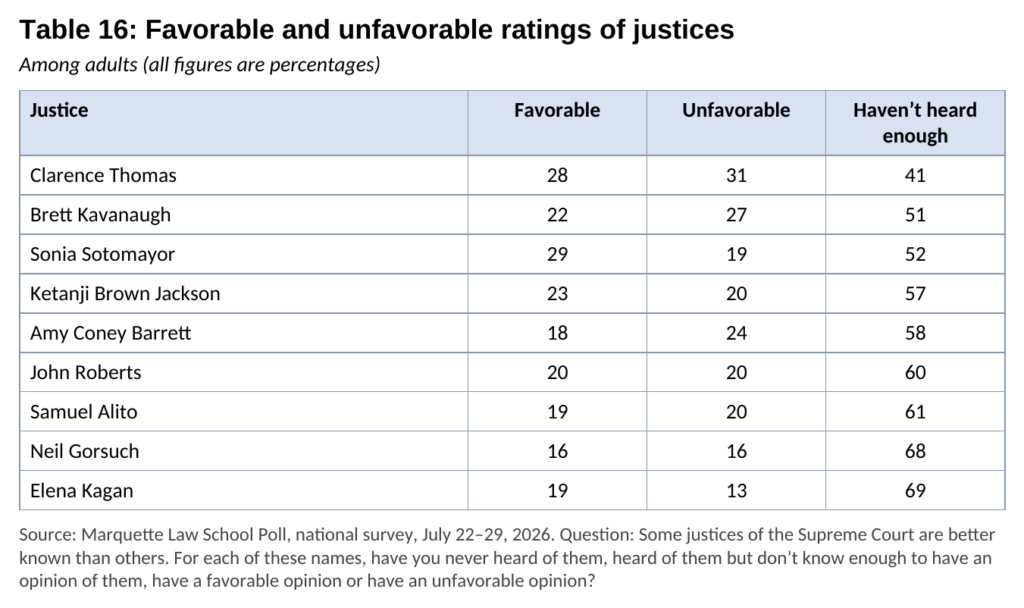
Remarkably, though unsurprisingly, Clarence Thomas is the only justice about whom a majority reports feeling sufficiently informed to have an opinion. This is likely a result of his long tenure, the notoriety of his confirmation hearings (which many older respondents remember), and the fact that he was the sole Black justice for most of his service (until Ketanji Brown Jackson’s confirmation in 2022).
That most Americans say they haven’t heard enough to form an opinion on most justices (including Chief Justice John Roberts) underscores a broad public lack of familiarity with the Court and its work. It’s also worth noting that those who do express opinions are not guaranteed to be well-informed. Studies show many respondents are willing to voice views on people and issues they know little about, rather than admit ignorance. Classic surveys even reveal people offering opinions on entirely fictional legislation, such as the “Metallic Metals Act.” A 2015 poll found that 30% of Republicans and 19% of Democrats supported bombing the fictional nation of Agrabah (a creation from Disney’s Aladdin), rather than admitting they lacked an opinion or knowledge about it.
A recent YouGov poll, which I analyzed in my previous post on the Court and public opinion, found a higher share willing to express opinions about the justices. Only 27% reported no opinion about Thomas, while those with no-opinion responses for the other justices ranged from 35% to 44%. The main difference with the Marquette results is that YouGov offered options for “slightly” or “very” favorable/unfavorable, in addition to just “favorable” or “unfavorable” (as Marquette did). I suspect many respondents with limited knowledge chose “slightly” favorable or unfavorable in YouGov, while in Marquette many were hesitant to commit to a stronger stance.
In both surveys, liberal justices tend to be more favored than conservative ones, and Sonia Sotomayor stands out as the most popular justice in both (29% favorable vs. 19% unfavorable in Marquette; 38–27 in YouGov). This could reflect a public preference for liberal jurisprudence. Yet this assumption is challenged by surveys of specific decisions, where several conservative rulings have enjoyed broad support (for example, rulings overturning affirmative action policies).
I suspect a larger factor is the growing “diploma divide” in American politics. Higher levels of education increasingly align with Democratic support, while Republicans draw most of their support from less educated regions. Education also correlates with political knowledge. Consequently, those with at least some substantial familiarity with the Supreme Court justices are disproportionately liberal Democrats, whereas those willing to admit they don’t know enough to have an opinion skew more conservative and Republican.
It’s important to note that none of the justices are acutely unpopular. Even Clarence Thomas—who registers the most negative ratings in both Marquette and YouGov—shows only mildly negative standings (-3 in Marquette, -9 in YouGov). Trump and Congress would likely envy ratings like these!
All told, the Court is only modestly unpopular, and its major recent rulings attract more support than opposition from the public.
As noted earlier, this does not by itself prove that the Court is performing well, either generally or in particular cases. Yet the findings do carry significance.
At present, judicial review faces possible threats from both ends of the political spectrum. Trump and many of his allies have flirted with defying rulings that run counter to them, sometimes ignoring lower court decisions or attempting to mislead judges. On the left, there is renewed momentum to undermine judicial review through court-packing (a topic I have documented and criticized here and here). To the extent that the Court and its rulings remain more popular (or less unpopular) than the other branches, it becomes harder for either side to erode judicial review.
I am far from an uncritical admirer of the Court and its current majority. They have, in my view, reached incorrect conclusions on some pivotal issues, including the Haitian TPS immigration case and the Pung property rights case from just last month. Still, a robust system of judicial review is preferable to lacking it, and overall the judiciary appears to be performing its duties more effectively than Congress or the executive branch at present. For these reasons, I hope the Court maintains its relative popularity and perhaps even grows it, at least modestly.
However, I would not want the justices to chase popularity at the expense of protecting the rights of unpopular minorities or ensuring constitutional limits on government power when politicians pursue popular—and potentially unlawful—policies. In an ideal world, the Court’s popularity would be a non-issue, perhaps only a topic for academic inquiry. But that is not the world we inhabit.
