
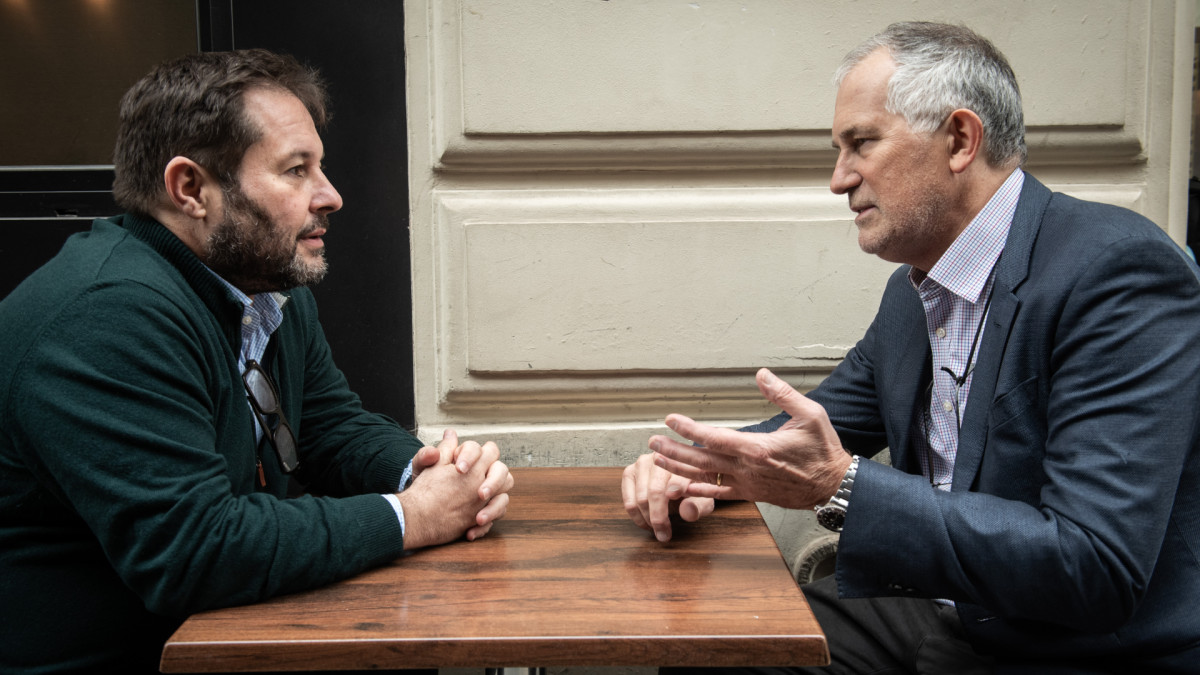
How has a party founded by former collaborators managed to become the preferred option for bakers, nurses, and young French people? Victor Mallet, a veteran correspondent and author of Far-Right France, explains in Paris the metamorphosis of the Rassemblement National. The key is no longer merely Marine Le Pen, but the rise of Jordan Bardella, a political phenomenon that has achieved what seemed impossible: normalizing extremism to the point of rendering it indistinguishable from legitimate popular discontent. “People are fed up with the current establishment (…) They see people who talk to them as equals and who understand their problems,” Mallet states, comparing this emotional connection to the one Donald Trump maintains with his base.
In this interview with Agenda Publica, Mallet debunks the prejudices of metropolitan elites who keep caricaturing RN voters as a skinhead. The reality is that the “de-demonization” has worked so well that even the traditionally hostile business elite has begun courting Le Pen and Bardella, accepting their victory as inevitable. Yet Mallet points to a generational rift within the duo: while Le Pen remains tethered to a old-school pro-Russian vision, Bardella, younger and more pragmatic, is trying to align the party with the West in the Ukraine war, aware that “most people from his generation do not share that view of Russia as a great Christian civilization.”
The conversation also touches on the dangerous parallel with the United States. Mallet warns that the barrier between liberal democracy and illiberalism is more fragile than we think. If Le Pen were to come to power, the question would not be only what she would do, but who would stop her. The great problem for Democrats and liberals is that they follow the rules while others do not, Mallet argues, suggesting France could follow the trajectory seen in Poland under PiS or Hungary under Orbán, but with a crucial difference: its potential to drag the entire continent down with it.
Victor Mallet is the author of ‘The French Radical Right: Le Pen, Bardella, and the Future of Europe’. Photo: Courtesy of Victor Mallet.
How would France look with a radical-right president?
If there were a radical-right president, France would be a very different country—provided, of course, that they also controlled the National Assembly. It could also unfold as it does now: the president, Macron, does not control the Chamber.
From that perspective, the inclusion of the Alternative for Germany (AfD) in government in Germany is not so far-fetched. If it is the most voted-for party, it can form a government, even in a coalition. With the French electoral system, it is much more difficult to reach the government and to control the legislature, especially if the other parties form a “front républicain” or a political cordon sanitaire against you. In Germany they call it a firewall. If that happens, it becomes very tricky. But if a new party or the radical-right party, the Rassemblement National (RN), manages to control the presidency and the National Assembly, it would wield almost all the power to do as it pleases. In that scenario, France would undergo a notable transformation.
In what direction would it change?
If they hold that political control, they would massively reduce immigration. They would try to repeal the right to be French merely by being born in France. They would call a constitutional referendum they could win, using it to effectively strip non-citizens of many rights. Egalité, liberté, fraternité would apply only to French citizens. It would be a profound transformation.
They would also seek to curb immigration. The broader impact, apart from migration—which has somewhat ceded centrality in French politics as most European governments are adopting hardline asylum and migrant policies, including left-leaning governments like the UK Labour—would be a blow to the European Union, leaving it severely weakened. The EU has long been a liberal internationalist, pro-democracy, pro-human rights, and pro-free trade bloc, and the arrival of the radical right to power in France would undermine all of that. If the AfD comes to power in Germany, it would be even more extreme, because those two countries are the two pillars of the European Union.
Then there are the unpredictable factors: what happens with Russia, with Trump. This historical moment is fascinating because the fate of the radical right in France depends, at least in part, on what happens with Trump and the Ukraine war. Marine Le Pen was very pro-Russian and anti-Ukraine until 2022, when Russia launched its large-scale invasion and attempted to take Kyiv. Until then, she supported Russia keeping Crimea. She and her party even financed themselves with Russian money, in political terms.
Aside from immigration and non-citizen rights, it is not clear that there would be drastic changes in how the French economy is managed, because in France there is a cross-partisan consensus—from the far left to the radical right—that the country needs a well-funded welfare state that takes care of its people, with social security. The French radical right is not challenging that as it stands in the United States. They are not like the Trumpists in that respect. They are much more statist. They are a statist party. In France, no major political formation is economically liberal in the sense of a “every man for himself” or unbridled capitalism. In this regard, they fit within the framework of almost all French parties.
What is the ideological relationship between Bardella and Le Pen? Marine may not be the presidential candidate.
It’s noteworthy because she was his mentor and he her protégé. Le Pen positioned him there because she saw him as a political phenomenon capable of making things work. He has had enormous success. There are rumors she is jealous and holds some resentment, but if she is disqualified, he remains the party’s real hope of reaching the presidency. With that in mind, she cannot afford to attack him.
The interesting part is their political differences. He has been much more assertive in backing Ukraine and condemning Russia.
 Victor Mallet explores the reality of the French radical right and the split between Bardella and Le Pen. Photo: Agenda Pública / Bruno Arbesu
Is the split in this area that deep?
Yes, it is a significant difference. He belongs to a younger generation. Most people of his generation do not share that view of Russia as a great Christian, white, Eurasiatic civilization that should dominate the continent—an idea that was characteristic of Jean-Marie Le Pen as well as of his daughter. He is not like that. His stance is: “Russia invaded, Ukraine is a sovereign nation; what is happening?” That matters.
“Bardella starts from the idea that if they are already dediabolisés (normalised), a way to normalise even more is to align with centrist-right voters, with Republican voters who might join”
The other major difference is that he is far more open to a merger with the center-right or the traditional French right. He says the party should open up to those people. It has already happened with Éric Ciotti. In a sense, it is already happening. It will happen more quickly with Bardella than with Le Pen, who remains cautious. She wants to keep the RN as RN, not as a big right-wing bloc. Bardella, by contrast, starts from the idea that if they are already dediabolisés—if they have removed the Nazi symbolism of the past, if they have stopped being ruled as fascists and have normalized—as a way to normalize further, they should ally with the center-right voters, with Republican voters who may join.
Will we see that alliance in the short term?
It is already happening. Sixteen deputies from a splintered group of Les Républicains are fully aligned with Marine Le Pen. That is underway and it has significantly weakened the center-right: one faction thinks “let’s go with Le Pen and Bardella to return to power”; another faction answers “they are too far to the right, too extreme, we want nothing to do with them.” The center-right is split.
Could Bardella represent a different European direction for the French radical right?
I don’t see much difference with Le Pen in their European policy. Marine Le Pen and Bardella have always had a nationalist and strongly anti-federalist view of Europe. Le Pen pivoted dramatically: she had advocated leaving the European Union and the euro, then retreated because it was very unpopular with French voters. Bardella has more or less adopted the same line. The core is the nation-state: they won’t leave the euro or the EU, but the nation-state takes precedence, and they do not want a European federal oversight of environmental regulations and the rest.
Moreover, Europe is already changing: the European Parliament is increasingly controlled by the radical right. Le Pen and Bardella’s party is the largest individual party in the European Parliament, ahead of the German CDU. They have many allies, not only in Hungary. There are many relevant far-right parties in the European Parliament. When they come together—especially with conservatives—the liberal and internationalist line of the Commission is substantially diluted, in areas like environmental regulation and trade.
How does RN compare with Meloni?
The answer is that Meloni changes, and so does Marine Le Pen. Both are very pragmatic: if something does not work, they change it. The idea of leaving the euro did not please voters, and Le Pen abandoned it. Her stance on Russia stopped pleasing some voters, and she shifted when Russia invaded.
The difference is that Meloni governs in a coalition. If Marine Le Pen or Bardella fully control the Élysée and the National Assembly, they would not be in a coalition. Meloni has accepted 400,000 new migrants—with the understanding that they should arrive through legal channels because Italy needs those workers—and that flexibility may not exist in France with the RN. It depends on circumstances.
“The question is to what extent a radical-right government in France would be constrained by French reality, just as Donald Trump does not seem to be constrained by American reality”
I’m not sure you’ve read Marine Le Pen présidente – Dystopie politique 2026-2029. Thierry Pech imagines Marine Le Pen in the Élysée; he wrote it before the trial. It’s very amusing because, in that satirical scenario—actually three authors—the hospital system begins to collapse and tourism spirals out of control because there are no immigrant workers to do the jobs. Without migrants, there are no workers for hospitals. In the end, the economy collapses and they have to go to Germany for help. Marine Le Pen appears and goes to see Friedrich Merz to say: “You have to rescue us.” The book ends with her asking what to do.
The question is to what extent a radical-right government in France would be constrained by French reality, just as Donald Trump does not seem constrained by American reality.
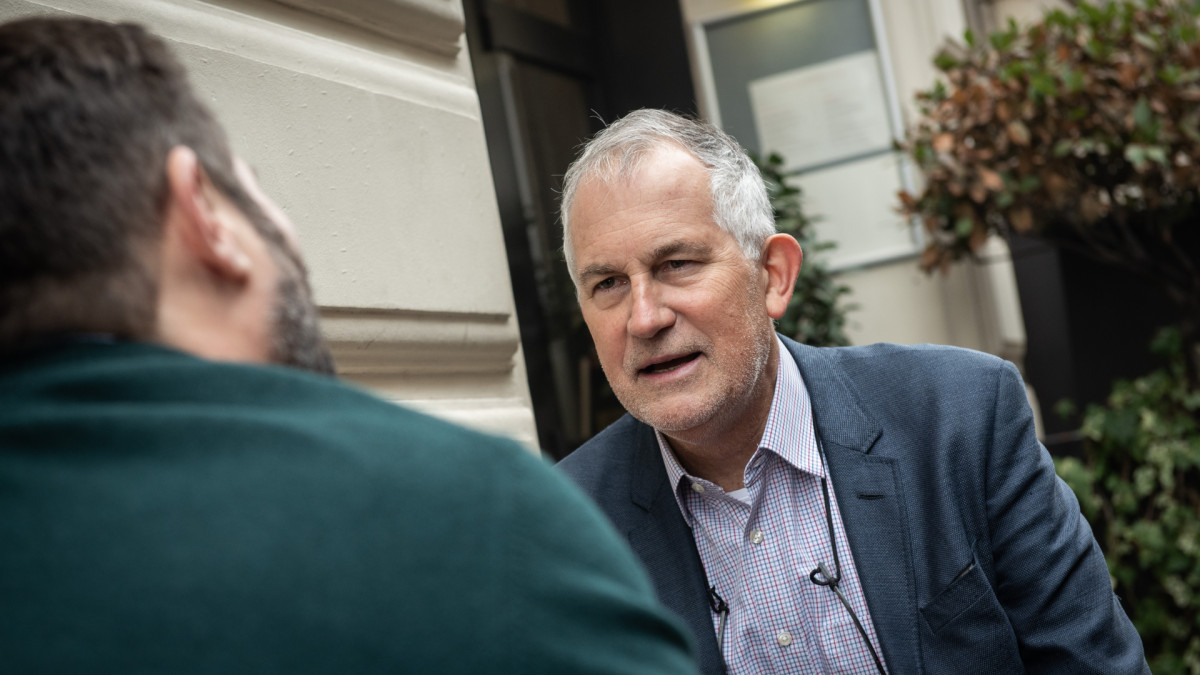 Mallet explains to López Plana the different approaches of the radical right to immigration. Photo: Agenda Pública / Bruno Arbesu
Could Bardella or Le Pen do what ICE is doing now in the United States? Or would there be massive protests?
France has a tradition of massive protests. I don’t have a definitive answer. They could be forced to act pragmatically, or they could trample over the law as Trump has done. It’s not entirely clear, but my guess is that in France it would be harder than in the United States. It also seemed inconceivable that in the United States it would be so easy for Trump to do what he did.
Who or what explains the success of Marine Le Pen or Bardella?
When I conceived the book a couple of years ago, besides Meloni, the French radical right was rather isolated. In the last two years, a lot has happened: Vox in Spain, AfD in Germany, Reform UK reemerged, and Trump was elected again. Across Europe and the world there is a trend. It has been analyzed extensively, and I agree with the basic idea: society is incredibly divided. There is resentment toward the elites, toward metropolitan elites. Those metropolitan elites—liberal, left-leaning, people who live in Paris or Barcelona or Washington, D.C.—have not predicted what would happen. In 2016 I thought Trump would not be elected: I told others, “no woman will vote for Trump after his grabbing pussy comments.” Fifty percent of American women voted for him. I was wrong. I also didn’t think anyone in the United Kingdom would seriously back Brexit: it seemed like a terrible idea… and it happened.
When someone says “Bardella will be elected because he’s too young and too foolish,” I answer: “That’s exactly what people said about Trump: too abrasive, too foolish. And he was elected.”
What is the secret of their success? That is the subject of the book. I go out and talk to people, and it’s very interesting. People are tired of the current establishment. It’s not just that they are anti-establishment; it’s not only that they are anti-Macron or anti-socialists. They like what they hear when they hear Bardella and Le Pen. They see people who talk to them as equals and who understand their problems.
“Their focus is the economy: how hard it is to make ends meet, prices, taxes, burdens, the cost of electricity, regulations affecting farmers, etc. That is what they talk about, and that is what people want to hear”
It’s worth understanding one thing: I went to Bardella’s New Year press conference, and immigration was barely mentioned. In 2022, Marine Le Pen skimmed over the topic. It was the COVID period. There weren’t many voters then. Now immigration is not as central a topic. Their focus is the economy: how hard it is to make ends meet, prices, taxes, burdens, the cost of electricity, and the regulations affecting farmers. That is what they talk about and what people want to hear. Do not see them as a party obsessed solely with migration. They are obsessed with getting to power, like any effective party.
When you meet people from southern France, northern France… from liberal circles, from Paris or Barcelona, they sometimes imagineRN voters to be skinheads, bald heads with leather jackets and Nazi tattoos. It is not the case. Perhaps forty years ago it was, but not anymore. They are firefighters, nurses, accountants, shopkeepers, bakers, butchers. I have interviewed many people who believe Le Pen and Bardella represent change.
A large part has to do with the idea that they represent common sense and that they understand “ordinary people”: middle class in the United States, working class in Europe. On the left there is much self-criticism: “what did we do wrong? why did Kamala Harris fail?” It wasn’t only that. There is talk of “too much woke culture,” but that is not the main reason for their defeat. The main reason is that Trump won. There is a positive attraction that is hard to see from the outside. Trump positively attracts many voters. Marine Le Pen does as well. People like them. They like Bardella. He has millions of followers on TikTok and other networks. He is a star among the young; she is a star to others. They have a powerful rhetoric.
In polls, they are far ahead of everyone else. Le Monde recently published its annual poll, asking whether people share the ideas of the radical right. Before the 2022 elections, 29% said yes; now it’s around 41% or 42%. The jump is enormous. In that election, Marine Le Pen got almost 42% in the second round. She would need only eight more points to win if she runs again… or Bardella could. In current polling for the presidential elections, they are already in the low-to-mid 30s.
And what about a second round?
Yes. For the first time, there are discussions that Bardella could win in a second round against any other candidate currently available.
 López Plana asks about the scenario that could end a RN representative in the French Élysée. Photo: Agenda Pública / Bruno Arbesu
Do you think an explanation is that many people in our liberal democracies feel the system does not respond?
There are two things here. One is the rule of law. Europe, Japan, and a few other countries seem to be the only ones still defending international rule of law. In the United States, the national rule of law has collapsed or is on the path to collapse. Neither the United States, nor China, nor Russia respect international law. Europe is the last “superpower” that does respect it.
“When these parties come to power, another question arises: if they do a bad job, how long will people wait to want them out?”
Then there is what happens inside countries: the radical right finds it very easy to promise it will solve all the problems in France: they have not governed. If Bardella had become prime minister, as I thought he would after the 2024 elections, that would have been very bad for the radical right in France. He would have spent two or three years with nothing to show, because in a blocked system that is what prime ministers face. Other parties kept them out of power. Now they come to elections with clean hands: no one can say, “he did nothing when he was prime minister.”
When these parties come to power, another question arises: if they do it badly, how long will people wait to want to throw them out? The problem is that if they act like Trump, he does not want to be ousted. He does not believe in elections that do not favor him. If a government is capable of bypassing the democratic process to the point of blocking elections, as in Turkey, then that is a problem. Even when people realize and lament that the radical right is not the miraculous solution to everything, as will inevitably happen at some point, because that is how politics works.
Do you think it is necessary for the radical right to come to power to normalize itself so people evaluate it as “normal” politicians?
That tests democracy. It is an eternal dilemma in politics. In Algeria, when the Islamists were about to take power, they were kept out. The result was undemocratic. Many people said, “it would have been better to let them govern and for them to fail.” The dilemma is always: you let them govern and then they do not relinquish power, as has happened with many authoritarian regimes around the world, whether right-wing, left-wing, Islamist, or whatever they are.
That is the challenge: A) expose them to the reality of power and have them mismanage it; B) maintain a system in which they can be defeated or expelled in subsequent elections. It is very difficult. In many countries, that failed.
In France, the runoff is designed to prevent this. But that method of preventing radical-right from reaching the presidency can generate more support. Avoiding reality can be dangerous for democracy.
There is a truth to accept: if Marine Le Pen respects the laws, behaves in a republican manner and wins, she wins. The great problem for Democrats and liberals is that they follow the rules while others do not. Look at Poland: Law and Justice (PiS) has preserved, so to speak, the political gains it achieved through somewhat irregular means, making life difficult for Donald Tusk. A liberal-democratic government would not have acted that way, because it would go against democratic values and legal norms. You are automatically at a disadvantage just as a Democratic government could not “stack” the US Supreme Court with judges: they thought they could do it and then realized, “this is not right,” while Trump has no qualms about doing something completely wrong.
On the runoff system: the French system is quite interesting. There is a famous phrase: in the first round, the voter chooses whom they want; in the second, they vote against whom they hate. In the last two presidential elections, Jean-Luc Mélenchon on the far left came within two points of making the second round. That is where the system can fail: if Bardella faced Mélenchon, Bardella would win because more people hate the far left than hate the radical right. If, however, the second-round candidate against Bardella or Le Pen were a strong centrist with left and right Republican support, it would be a different story.
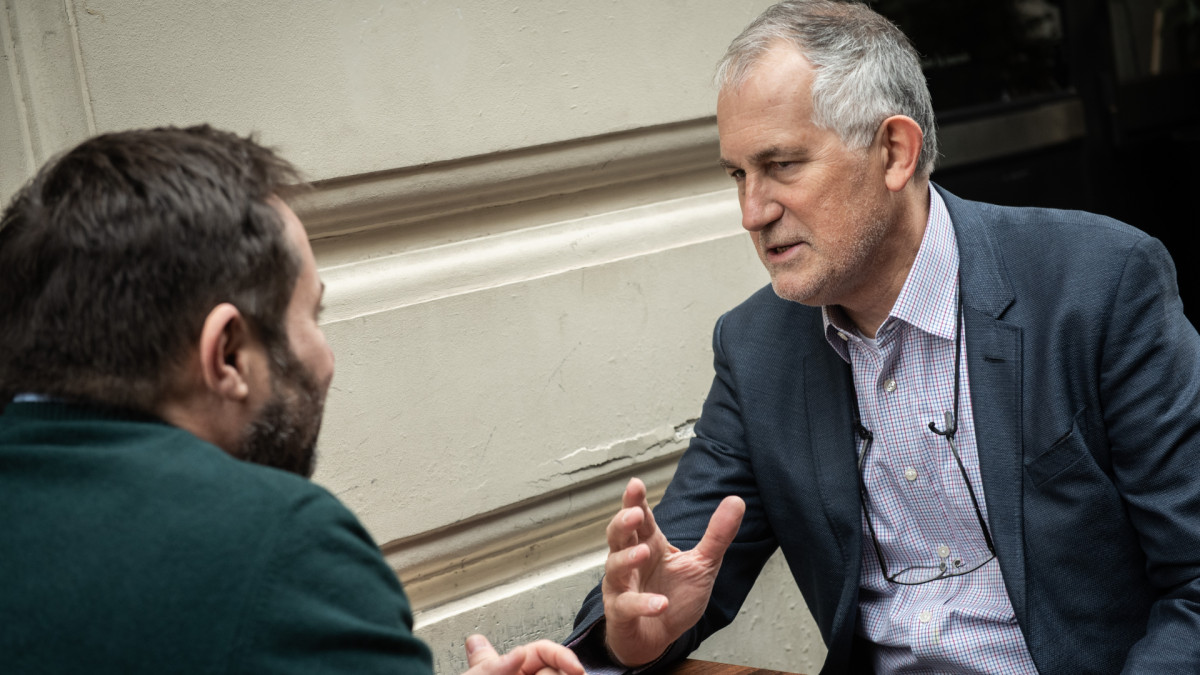 In double-ballot elections, Mallet explains, rejection of a particular candidate is a fundamental variable. Photo: Agenda Pública / Bruno Arbesu
Let’s talk about Macron. He dismantled the traditional party system to create a “third way” and reach the presidency as a pro-European centrist. By dismantling the system, was his first victory the first step toward a radical-right presidency?
Macron was both symptom and cause. He could do what he did because the traditional right and left parties were weakened and essentially collapsed. In the latest presidential elections, Valérie Pécresse, from the center-right, got less than 5%. The socialist candidate, heir to a party that had occupied the Élysée with Mitterrand, received around 1.7%. Less than 2%.
Blaming Macron for that is unfair. He capitalized on it successfully to be elected, as any politician would have done, and it worked. The criticism is that he did not build from there a genuinely strong centrist liberal party. That is the problem in many European countries. In Spain, an attempt to create a liberal party went nowhere.
“Macron’s responsibility lies in not having built a stronger center”
Macron should have built a stronger centrist party.
Politically, his responsibility lies in not having built a more solid center. Governing France is very difficult. All parties want lower taxes and more social services. That cannot be. Politics is about making tough decisions.
Macron tried to do difficult things and voters prevented him. Look at the pension reform: given demographics and what neighboring countries have done, it’s clear that the retirement age must rise. Economically and demographically it is obvious. But people do not want it.
The classic problem is not telling voters the truth. The greatest weakness of the RN when it governs—if it governs—will be the economy. They are not good at economics and do not understand trade-offs: if they help fishermen, they cut help elsewhere; if they lower retirement age, they raise taxes somewhere else. I recently read Bardella’s book (What French people want or Ce que cherchent les Français) and at no point does it suggest there is a need to choose. It’s all yes. That is not leadership: it’s a disaster. Macron, in practice, ended up yielding because he had to politically. Result: the budget deficit has surged.
Regarding the capacity of Bardella’s and Le Pen’s party to govern: are they prepared? Do they have a team, officials ready to cooperate?
Ten years ago the answer would have been categorical: they did not have people prepared for the posts, and no one would have wanted to work with them. That has changed in recent years because they have achieved more success. Now, big business and corporate organizations meet with Bardella and Le Pen, because business interests operate that way: a businessman needs to get along with whoever is going to govern. That implies they think they can govern.
“Now, the major business leaders and business organizations are meeting with Bardella and Le Pen, because business works that way”
Multimillionaires are trying to move closer. Some already support them. The big business world says, “we must deal with them, we must take them seriously.” Five or ten years ago they would not have done so: “we don’t want to be associated with Nazis.” That has changed completely. Even so, there remains a lack of high-quality ministerial material, which is why I asked Le Pen that question. I told her: “even if you reach the position, everyone knows you don’t master the economy. What will you do?” Her answer struck me as good: “the finance minister does not necessarily have to be RN; I can bring in people from the center-right.” To be ministers, especially in Finance.
In essence, she suggested there could be a government of national unity. That is interesting because many centrists would want to participate. Everyone wants to be in government: to save France and to have a good job. That has also changed in ten years. Ten years ago it would have been very hard to find someone: “we don’t want to associate with this fascist government.” Now, not so much.
Today Mélenchon would be the one who would have trouble recruiting people.
 In the view of the editor at the Financial Times, the economic elite today is willing to cooperate with the radical right. Photo: Agenda Pública / Bruno Arbesu
Let me ask you about what Le Pen said regarding Maduro’s capture. Let’s talk about the relationship between Trump and Le Pen.
Le Pen and Bardella are very careful with what they say about Trump. In France—especially among Gaullists, but across left and right—there has always been suspicion toward American imperialism. It’s been a very cross-cutting French stance.
“You can’t forget the episode when Bardella was going to speak at CPAC, the American right conference. He decided not to speak because Steve Bannon gave a Nazi salute.”
I have a chapter on Trump in the book. It’s fascinating how the various European parties have responded. There is that odd relationship between Meloni and Musk, and how Meloni becomes “Trump’s whisperer.” Macron tried to be so during his first term and was as successful as anyone attempting to tame the beast. The European radical right does not want to get too close to Trump for two reasons. First, Trump is anti-European, and in Europe everyone is European. He openly says he hates Europeans. Even the European radical right will not say, “I’m also anti-European.”
On the other hand, you cannot ignore the CPAC episode. Bardella decided to cancel his participation saying Steve Bannon had given a Nazi salute. That contradiction defines contemporary politics: flexible principles. And after Trump’s reelection, Bardella himself stated: “It’s fantastic, he’s expelling migrants; we should do the same in France.”
This brings me to another question: What about Trump’s imperialism?
It is very unpopular in Europe.
In Spain, Pedro Sánchez is leveraging that imperialism…
No. Pedro Sánchez is the bravest European leader right now. Not my opinion alone.
What does Trump’s imperialism represent for the French radical right?
What they share is nationalism and the nation-state: “our nation is great.” Make America Great Again, Make France Great Again. That is their common ground.
But defending France is not compatible with defending the United States.
Exactly. That’s an irony: that is why the Patriots group in the European Parliament struggles. By definition, a nationalist party does not want to cooperate with other countries because “my nation is best.” They say: “everyone should run their own country and not control anything else.” Unless something catastrophic happens, everything reduces to economics, as in the United States. U.S. voters will not oust Trump over Venezuela; they will oust him over the price of gasoline or milk, or because they cannot pay, because healthcare is more expensive. In France, it’s the same.
“If Trump stays with Greenland, do people in France care about Greenland? I don’t know. What matters more is whether they can pay their bills at the end of the month.”
Ukraine matters. If it escalates, it changes everything. But if Trump stays with Greenland, do people in France care about Greenland? I’m not sure. What matters much more is whether they can pay their monthly bills. Le Pen and Bardella talk about this all the time. Read their speeches: it works. I’ve met voters who say, “I don’t agree with them on racism and immigration, but I agree on the economy.”
But if there is a peace agreement that fast-tracks Ukraine’s entry into the EU, could that be a economic problem for the European Union and for France?
Radical-right French policy has always framed the issue as economic. They focus on energy prices: “Russia should not have invaded Ukraine, but we must keep buying Russian gas or gas is too expensive.” “Ukraine does not want to be invaded, but we don’t want it to be in the EU because it is a huge agricultural exporter.” For France, the last thing it wants is another major agricultural exporter in the EU that would receive subsidies that used to go to France. That is their viewpoint. They do not pay much attention to international law or a state’s right to exist. It’s about how it affects their pockets. It has to do with EU contributions, a major topic for Bardella and Le Pen. And, above all, with agricultural exports. Wheat, in particular. Ukraine is a very productive agricultural country; France is too, and France does not want to see its preeminence challenged. For years, France has captured a large share of the budget for the Common Agricultural Policy.
What Le Pen and the RN have done is to simulate: they pretend not to want to leave by saying they are willing to stay, but only if the EU fundamentally changesWhat Le Pen would say is: “we do not care if Ukraine remains a member of the EU if the EU becomes the institution we want”: a collection of nation-states that meet from time to time to discuss foreign policy, but without shared regulation, perhaps without shared markets, without shared environmental rules. In other words, a weakened European Union. She would not mind because she would stop being a meaningful organization. That is what she aspires to: without leaving the EU, to reshape it into a hollow shell with little power or control. A sum of states that call themselves a “Union,” like the African Union: something similar, almost powerless.
Is there a radical right that wants to reform Europe and another that wants to leave?
Marine Le Pen and Bardella have always wanted to leave Europe, in the sense of the EU. Macron once said something quite funny about Brexit, speaking with Boris Johnson at the Élysée: “you can leave the European Union, but you can never leave Europe.”
What is the case with Le Pen and the RN is that they have masked themselves: they pretended not to want to leave, saying they are willing to stay, but only if the EU changes fundamentally. In practice, they want to leave. There are two ways to leave: withdraw from the existing institution or remain in a transformed institution that has the same effect. There they are. They want to leave the current system. The path now, increasingly possible with more radical-right parties taking control, is to reshape the Union until it becomes unrecognizable compared to the European Union we know today.
Thank you very much.
