
“The Vatican has decided that its foreign policy for 2026 will be that of an open border by divine mandate”
In his meeting, the Pope highlighted an ethical contradiction between religion and the identity card. While a substantial portion of the Spanish political spectrum —with Vox at the forefront and sectors of the PP watching the polls from the sidelines— bets on closing ranks around its own resources, the Vatican has decided that its foreign policy for 2026 will be that of an open border by divine mandate. Note, because one of the Pope’s visits to Spain will take place in the Canary Islands, where he will visit immigrant centers.
Unmasking Popular Populism
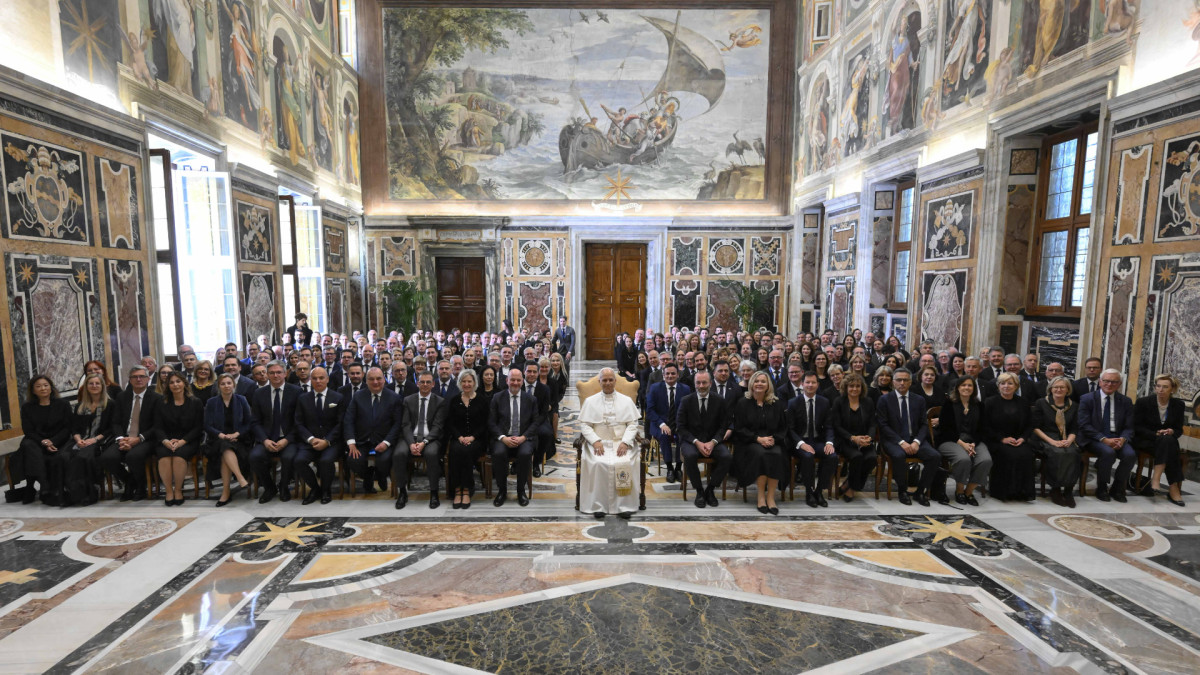
Before the leadership of the EPP, the most powerful political family in the European Union, Leo XIV distinguished the wheat from the chaff and stated that a “popular” policy is one that serves the people without excluding them; “populism,” in contrast, is the degeneration that uses the people as a weapon against the “other.”
This message is a direct response to the rising rhetoric in member states such as Spain, where housing shortages, persistent inflation, and the saturation of public services have provided fertile ground for proposals that subordinate human rights to administrative nationality. “It must also address the root causes of migration, care for those who suffer, taking into account the real capacities to welcome and integrate migrants into society,” he noted, adding that “being a Christian committed to politics also means investing in freedom; not a trivialized freedom reduced to mere personal preferences, but one based on truth, which safeguards religious freedom as well as freedom of thought and conscience in all places and circumstances. At the same time, to foster a ‘short circuit’ of the ‘human rights’ must be avoided, because it ends up yielding to force and oppression”.
“If the party wants to be the reference for moderation in Spain, it cannot embrace the ‘national priority’ without entering into a clear contradiction with the Vatican”
For the PP and Feijóo, these words are a reminder that their adherence to Christian values cannot be a menu à la carte. If the party wants to be the reference for moderation in Spain, it cannot embrace the “national priority” without entering a clear contradiction with the Vatican.
Put Our Own First?
In Spain, the debate over the “national priority” has shifted from a marginal proposal of the hard right to the central axis of public discourse. The premise is simple and seductive for a tired and inflamed electorate: that a Spaniard should have automatic preference over a legal immigrant when accessing social housing or on a waiting list for dependent assistance.
Vox has made this idea its rallying banner for the coming general elections. Its argument rests on a strict interpretation of the “social contract”: the State must primarily serve those who have contributed to it for the longest period. Yet this approach has clashed head-on with an actor not typically so belligerent on social policy issues: The Spanish Episcopal Conference (CEE).
“To whoever seeks to ‘annul, exclude, eliminate the other’, the Church ‘is not, nor can be, nor will ever be'”
Ahead of the papal speech by only twenty-four hours, the bishops’ spokesperson, Francisco César García Magán, was unusually direct. By proposing a “priority of the Gospel” over nationalism, the Spanish Church was following Rome’s orders, but it also drew a moral red line. For the CEE, human rights are universal and indivisible and, therefore, before anyone who wants to “annul, exclude the other,” the Church “is not, nor can be, nor will ever be.”
In this context, Spain finds itself divided into two ways of understanding social protection. On one side, a right appealing to the protection of its own welfare in a world of finite resources (nationalist realism). On the other, a humanist-Christian vision that warns that if Europe loses its capacity to welcome, its very raison d’être will depart with it.
The Legal Labyrinth and the Ghost of Unconstitutionality
Beyond morality, the debate over the national priority faces a legal barrier: the 1978 Spanish Constitution. Article 14, which enshrines equality before the law so that no discrimination can prevail on grounds of birth or race, is the principal hurdle. But not the only one.
“The success of this narrative lies not in its applicability, but in its ability to mobilize”
The European non-discrimination framework and the human rights treaties to which Spain is a party mean that any attempt to legislate the national priority is, in practice, a legal pipe dream that would end up blocked by the Constitutional Court or the European Court of Human Rights in Strasbourg. Still, the success of this narrative does not lie in its applicability, but in its ability to mobilize. By proposing the impossible, one points to the institution that blocks it (the EU or the judicial system) as the enemy of the people.
Towards a Definitive Break?
What Leo XIV has done in Rome is to withdraw the ‘imprimatur’ of religion from the policies of closed national identity. Therefore, one can see that the Spanish centre-right is at a crossroads. Either it aligns with the vision of a Europe of universal Christian values —which entails accepting solidarity with the migrant as an ethical duty— or drifts toward nationalist-populism that moves it further away from Rome’s orthodoxy.
“If it rejects the national priority, Vox will accuse it of being a ‘cowardly right’ who abandons the Spaniards”
The risk for the PP, as is often the case, is to be left in the middle. If it rejects the national priority, Vox will accuse it of being a “cowardly right” who abandons the Spaniards. If it accepts it, it will have to explain why it ignores the Pope’s direct warnings.
In 2026, Spanish politics will be decided at the Madrid-Vatican axis. The battle for the soul of the right has begun, and this time, the Pope has stepped into the arena to fight exclusion with words. The debate over the “national priority” is only the first onslaught of a contest that defines the social cohesion of Spain and Europe.
