
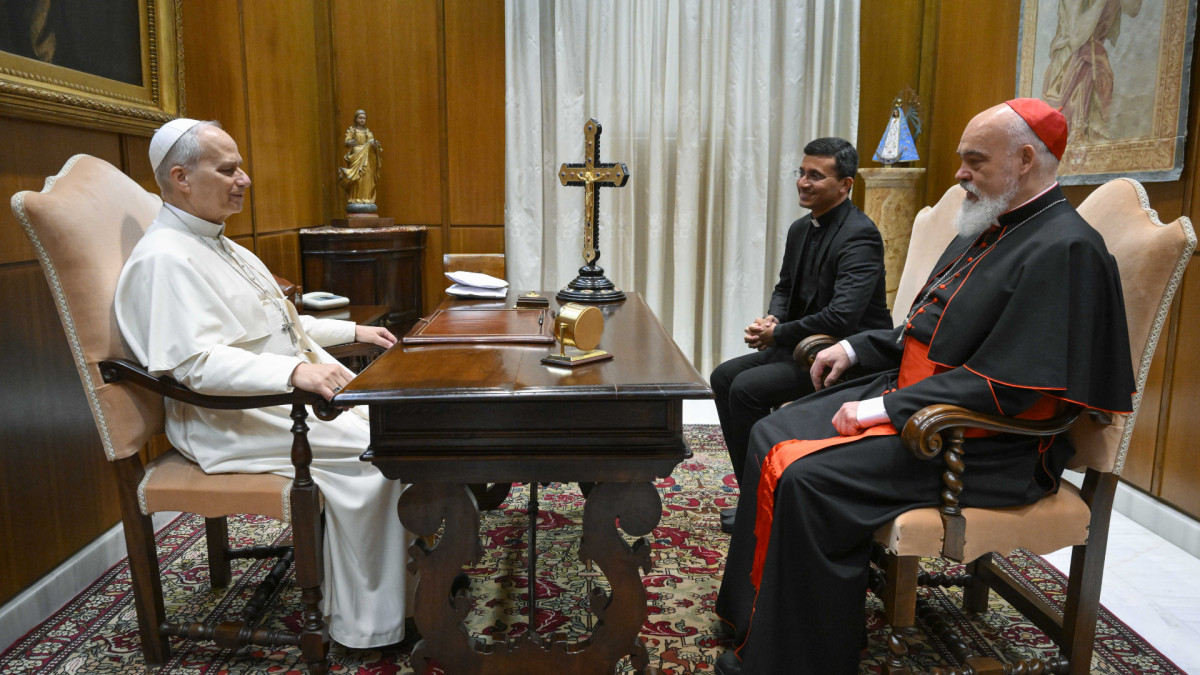
The Holy See has not remained indifferent to the war between Iran and the United States–Israel, the first major diplomatic test for Pope Leo XIV. While the Pope has also engaged from the outset of his pontificate as a mediator in Russia’s invasion of Ukraine —including multiple receptions of Zelenski—, in this conflict he has had to be more forceful due to the historical presence of Christian communities in Iran, though especially in Lebanon.
The Holy Father spoke for the first time more in condemnation than in prayer after the death, caused by an Israeli projectile, of the Maronite Catholic priest Pierre El Raii:
“The Bishop of Rome set aside neutrality to accompany the Lebanese Catholics in an event that stirred both outrage and solidarity”
“Today in Lebanon the funeral of Father Pierre El Raii, Maronite parish priest of one of the Christian towns that these days are once again living the drama of war, is being held. I am close to the entire Lebanese people in this moment of grave testing. Father Pierre was a true pastor; as soon as he learned that some of his parishioners had been wounded in a bombing, he rushed to help them without hesitation. May the Lord grant that his spilled blood become a seed of peace for beloved Lebanon”.
Without directly blaming Israel, the Bishop of Rome set aside neutrality to accompany the Lebanese Catholics in an event that generated indignation as well as solidarity among the inhabitants of the small Lebanese town of Qlayaa.
Last week, Cardinal Secretary of State, Pietro Parolin, had already conveyed the official position of the Holy See regarding the unilateral war started by the United States and Israel against the Islamic Republic of Iran. Here are some of Parolin’s most relevant remarks:
“The peoples of the Middle East — including the already fragile Christian communities — have been once again cast into the horror of war, which brutally destroys lives, brings destruction and drags entire nations into spirals of violence.”
“A diplomacy that promotes dialogue and seeks consensus among all is being replaced by a diplomacy of force, by individuals or groups of allies, and people think that peace can be pursued through weapons.”
“If states were recognized a right to preventive war, according to their own criteria and without a supranational legal framework, the whole world would be at risk of being set aflame”.
“The desire to act freely, to impose one’s own order on others […] A multipolarism marked by the primacy of power and self-referentiality is dangerously taking shape”.
“Unfortunately, principles such asthe self-determination of peoples, territorial sovereignty and the rules governing war itself are being questioned again […] A violation of law somewhere is felt everywhere”.
“There are no first-class and second-class dead, nor people who have more right to live than others simply because they were born in one continent rather than another, or in a given country. The Holy See reiterates with strength its condemnation of all Civilian involvement and of civilian structures, such as homes, schools, hospitals and places of worship, in military operations”.
“He does not directly cite Israel or the United States, but the references are evident when condemning the idea of ‘preventive war’
Athough it was not an official statement but an interview given to Vatican News —the Vatican’s media conglomerate—, the Cardinal Secretary of State is authorized by the Pope when expressing such positions and measures each word carefully. Therefore, it can be taken as Pope Leo XIV’s official stance regarding the conflict. Again, he does not directly cite Israel or the United States, but the references are evident when condemning the idea of the “preventive war” promoted by both aggressor nations.
Even Parolin appears to reject the Peace Junta initiative, led by Trump, when he speaks of “diplomacy of individuals or groups of allies” . The Holy See declined to join the organization because it regards its private nature as contrary to the spirit of the United Nations.
A Review of the Relations Between the Holy See and Iran
It should be clarified that the states that do so maintain diplomatic relations with the Holy See, not with the State of Vatican City —a common confusion. The Holy See is a subject with its own international legal personality that is not tied to the territory of the City of the Vatican State. In other words, Vatican diplomacy existed for centuries before the State governed by the Pope was created in the Lateran Pacts.
The Holy See and Iran established diplomatic relations in 1954, during the pontificate of Pius XII and the reign of Shah Mohammad Reza Pahlavi. Since then, relations have remained uninterrupted, even after the Iranian Revolution and the establishment of the Islamic Republic.
The first speech in the Holy See’s public archive is that delivered by Pope John XXIII on December 1, 1958, in gratitude for the shah Mohammad Reza Pahlavi’s visit to the Vatican during his early months as pontiff and in memory of the meeting he held with Pius XII a decade earlier. This means that the shah and Pius XII had already met prior to the establishment of diplomatic relations.
On December 1, 1966 Pope Paul VI received the new ambassador of the Imperial State of Iran. In his speech, he thanks the shah for sending delegations for the opening and closing of the Second Vatican Council. The pontiff also underscores the respect for all beliefs that exists in Iran and thanks God that the Church can carry out its educational and charitable activities.
In April 1977 it was again Paul VI who spoke to the Iranian representative before the Holy See to highlight that the Iranian people and Catholicism are united by a belief in a monotheistic faith. As in previous speeches, the Pope acknowledges that Iran is a welcoming country for religious minorities and “in particular, for Christian communities”. This was the last known speech of a pope before a representative of Imperial Iran.
Pope Paul VI is received by Shah Mohammad Reza Pahlavi in Tehran, undated and of unknown author, circa 1960
The first meeting a Pope held with a representative of the Islamic Republic of Iran was in 1981 and was led by John Paul II, during the acceptance of credentials from the extraordinary and plenipotentiary ambassador. The Polish Pope’s speech is remarkably astute, for, despite the regime change, he asserts that the Iranian people are essentially the same and that Catholics are therefore an integral part of that people, deserving respect. He calls for Muslims in Iran to be granted “full rights to the nation” and “full religious freedom.” In return, the pope acknowledges the new regime without hesitation and invokes “the blessings of Almighty God and merciful” for Ayatollah Khomeini.
The next speech (October 16, 1986), also by John Paul II, occurred within the context of the Iran–Iraq War. Essentially all of its content centers on the search for peace in a conflict that had by then been developing for half a decade. John Paul II condemns the failure to respect the laws that govern war. The Pope calls for the use of dialogue and diplomacy for “the disputes between nations and peoples”. Finally, he asks for special protection for the Catholic community affected by the war, particularly for priests and consecrated persons. Notably, in this discourse Pope John Paul II conveys greetings to Ali Khamenei, former president of Iran, but not to the Supreme Leader.
“Ali Khamenei became Iran’s Supreme Leader in 1989, which makes it noteworthy that the pontiff overlooked the event in his message”The Gulf War was the reason for the next speech delivered by John Paul II, in June 1991. This message again focuses on the search for peace, although for the first time it emphasizes that a fraternal dialogue between Christians and Muslims should be permanently established. Ali Khamenei became Iran’s Supreme Leader in 1989, so it is striking that the pontiff ignores the event in his message.
In his next reception of an Iranian ambassador, in May 1997, John Paul II uses for the first time the concept of respect for international law. His speech again centers on interreligious dialogue between Christians and Muslims, emphasizing belief in the same God. As in speeches of earlier popes, the Pope advocates for the protection of the Catholic minority and states that they have been in Iran “since the early centuries of the Christian era”, thus forming an integral part of the nation. Again, the Pope salutes only the Iranian president and not the Supreme Leader, which seems to mark a trend in Vatican diplomacy to distinguish interlocution between presidents and Khomeini.
In what is likely his most enthusiastic address, John Paul II celebrated in January 2001 the cooperation between the Islamic Republic of Iran and the Holy See to promote interreligious dialogue at a global level, especially between Christians and Muslims. He speaks of two concrete conferences held first in Rome and then in Tehran. The speech came three years after the first visit of a president of the Islamic Republic to the Vatican, Mohammad Khatami, who was also at that time president of the Organization of the Islamic Conference. As in previous speeches, the Pope deliberately avoids naming Khamenei.
In his last speech (October 2004) as pope to an Iranian ambassador and just months before his death, John Paul II recalls the half-century of relations between the Holy See and Iran. The Pope calls for a fight against terrorism from the United Nations. For the first time, a pope speaks in a speech to an Iranian ambassador of multilateralism and commitment to no nuclear proliferation. Once again, the Pope celebrates the frequent dialogue between Christians and Muslims, one of his priorities as Pope. In this speech, John Paul II sends regards to the president, but not to Khamenei.
“The line defended by the pontiff was no different from that of his predecessors, with commonplaces in defense of Christian communities in the Middle East”
Benedict XVI received Mohammad Jatami as former president of Iran in May 2007 to promote interreligious dialogue. The line defended by the pontiff was no different from that of his predecessors, with commonplaces such as “respect for international law”, “a dialogue between cultures for peace” and the defense of Christian communities in the Middle East. The visit was considered high level, as Jatami also met with then-powerful Cardinal Secretary of State Tarcisio Bertone. It is worth noting that the meeting occurred in the context of the Iraq War.
In 2009, upon receiving a new extraordinary and plenipotentiary ambassador of the Islamic Republic, Benedict XVI conveyed his greetings to President Mahmoud Ahmadinejad, not to Khamenei. The German Pope praised the “spiritual tradition and religious sensitivity” of the Iranian people. He also urged his government to join efforts for freedom of religion as the foundation of other freedoms. In the same vein as his predecessor, Benedict XVI encourages interreligious dialogue between Muslims and Christians. As with all previous popes, the Pope calls for protection for Catholics and priests in Iran.
The Arrival of Pope Francis and the Change in Relations with the Islamic Republic
The “Francis era” signaled a break, as in almost everything related to the governance of the Catholic Church. After nearly twenty years of the Islamic Republic’s president not visiting the Vatican, in 2016 Hasán Rouhani met the Argentine Pope. The meeting occurred within the context of the Joint Comprehensive Plan of Action (JCPOA) among Germany, China, France, the United States, the United Kingdom, Russia, the European Union and Iran to limit uranium enrichment in the latter country in exchange for sanctions relief.
Interreligious dialogue, cultural tolerance, and peace returned as recurring themes in the meeting between Francis and Rouhani. The Vatican stressed that the Holy See and Iran share “common spiritual values.”
In 2022, in a visit that was not a state visit but a spiritual one, Francis met with Ayatollah Ali Al-Arafi, one of Iran’s most prominent clerics. Al-Arafi has served as president of the International Al-Mustafa University in Qom, responsible for training the most prestigious jurists and theologians of Shiite Islam. He is also a member of the Assembly of Experts, the Guardian Council and, after the assassination of Khamenei, a member of the Interim Leadership Council. His name had been a strong candidate to become Iran’s next Supreme Leader before the announcement of Mojtaba Khamenei’s ascent.
“The Grand Ayatollah is, in a sense, Francisco’s spiritual counterpart as the supreme leader of one of the two major factions of Shi’ism”
According to Iranian official agencies, during that meeting, Pope Francis accepted “all matters raised by Grand Ayatollah Khamenei.” This statement was not confirmed by any official Vatican source or other Western media, though it would not be surprising, given that the Grand Ayatollah is, in a sense, his spiritual counterpart as the supreme leader of one of Shi’ism’s two major factions.
During the historic visit of Pope Francis to Iraq in 2021, the first by a pope, he met with the other major Shiite leadership, Grand Ayatollah Ali Al-Sistani. Twelver Shi’ism — in very broad terms — divides between the Qom school (Iran) and the Najaf school (Iraq). While the former advocates clerical governance, Al-Sistani’s current faction holds that clerics should be shepherds, not hold partisan or political office.
The theology behind this is somewhat more complex. Twelver Shi’ism has a dogma that holds that the spiritual authority of Muhammad was transmitted to twelve Imams, the last of whom is Muhammad al-Mahdi, who was occulted by God’s will. The Imam never died, he has remained hidden since 941 and will return at the “End of Times.” According to Shiite Islam, he is the Mahdi, a figure akin to the Messiah, who will reappear to govern the world with perfect justice. Indeed, some traditions hold that Jesus will accompany him on his return.
The split within Shi’ism arises over who should rule the people while the hidden Imam reappears. The so-called Nayaf Shiite quietism holds that jurists and clerics should guide the people through moral and even political influence, but without ruling. By contrast, the Qom school believes in the government of jurists in anticipation of the Imam’s appearance. This is the central foundation of Iran’s theocracy.
How Can the Good Relations Between the Holy See and Iran Be Explained?
The Holy See and the Islamic Republic of Iran are the only two electable theocracies in the world. While the former is absolute, and the Pope exercises both the spiritual government of the Church and the Vatican’s political leadership, the latter is hybrid, being controlled by the Assembly of Experts, renewed periodically through elections. In contrast, the College of Cardinals is appointed directly by the Pope, and among its duties is the election of the successor of Saint Peter. They are relatively similar systems, save for differences in tradition.
“In theory the Pope of Rome holds more absolute power, but in practice the Supreme Leader of Iran wields it far more decisively”
It is paradoxical that in theory the Pope of Rome holds greater absolute power, but in practice the Supreme Leader of Iran wields it with much greater force. Yet, while the Holy Father opts for moral and spiritual authority through a universal Church, the Supreme Leader directly controls the Iranian State as head of government (including the judiciary) and of its Armed Forces, particularly the Islamic Revolutionary Guard Corps.
The modern papacy, for its part, renounced waging war on other States and its international influence is expressed through diplomacy and the promotion of values such as peace, care for the environment, and human rights, as well as charitable works, schools, universities, hospitals, and, of course, the priests present in virtually every country in the world.
An indisputable point of convergence is . While the Catholic Church abandoned ultramontanism, it still aspires to influence certain policies, such as abortion, euthanasia, gender identity and same-sex marriage.
“Shi’ism also has degrees of scholarship and responsibility, from the grand ayatollah to clerics renowned for their theology and jurisprudence”
Where Shiite Islam and Catholicism seem almost like distant cousins is in that both entrust their governance to a caste of clerics. It would be crude to draw an analogy with priests, bishops and cardinals, but Shi’ism also has degrees of scholarship and responsibility, from the grand ayatollah to clerics renowned for their theology and jurisprudence. Another sociological similarity is that both Shi’ism and Catholicism admit popular veneration of saints and greatly prize martyrdom.
As a sign of mutual respect, on March 12, an influential ayatollah, Mostafa Mohaghegh Damad, wrote a public letter to Pope Leo XIV requesting his intervention to curb attacks on Iran. The ayatollah treats the Pontiff as “Most Holy” and maintains that they share a belief in God’s will, the Sacred Scriptures, and monotheism.
The ayatollah calls Christ “the prophet of mercy, friendship and love”. Finally, he begs the intercession of Pope Leo XIV so that the UN Charter, the Geneva Conventions, and humanitarian law may be upheld. An ayatollah is not a mere cleric, but one who has been elevated and distinguished by his theological virtues, and whose teachings carry greater weight, making the significance of this letter no small matter.
As days pass, the uncertainty about the war’s duration grows. Leo XIV has been compelled to take a stance in light of the displacement and massacre of Christians in the Middle East. History shows that two actors who initially seem far apart, the Holy See and the Islamic Republic of Iran, share far more than a mere façade of being the world’s last two theocracies. It is no coincidence that their relations have endured longer than those between the Holy See and the United States, established thirty years after Iran.
