
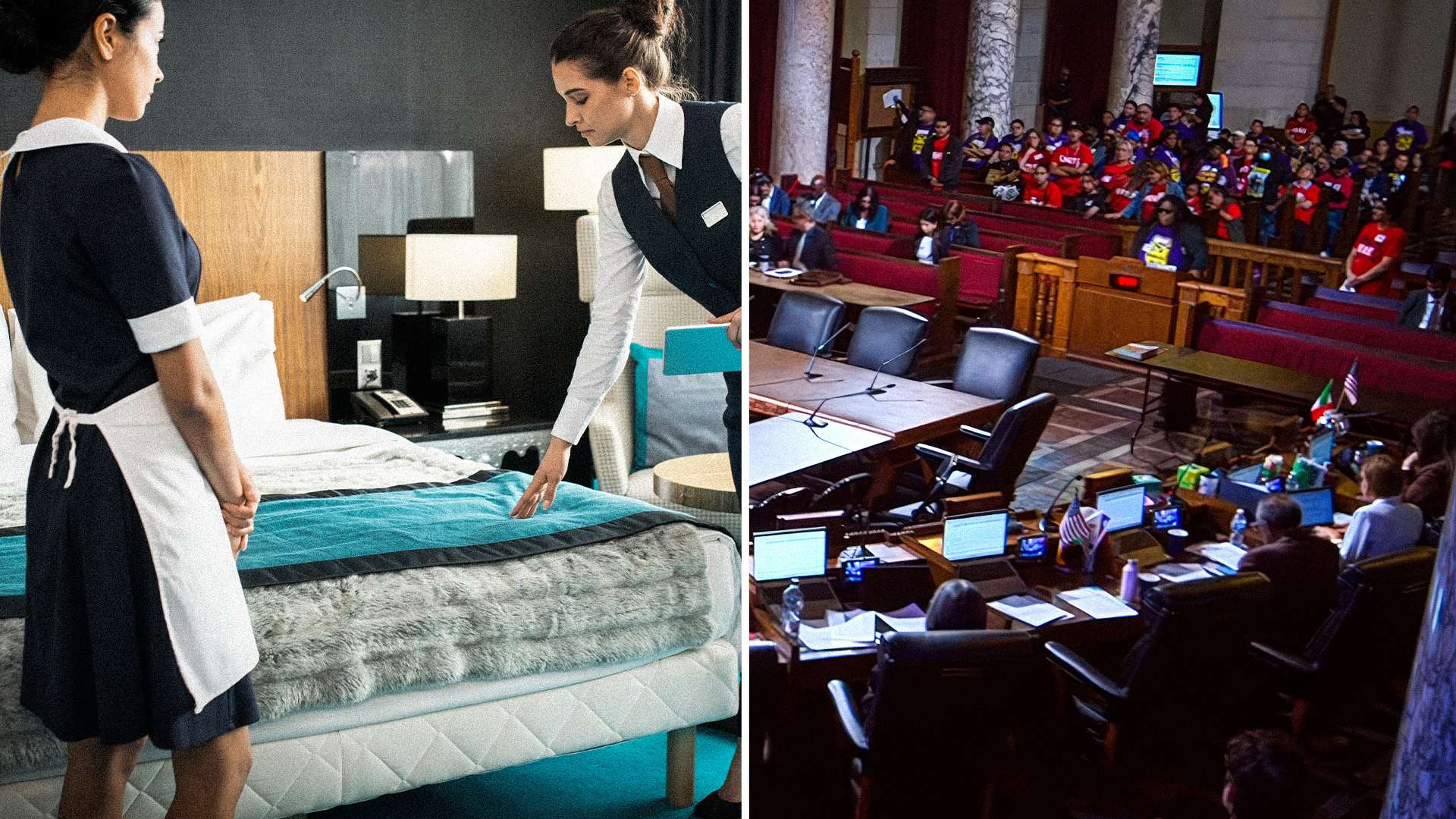
This moment offers a short-lived relief to an industry long plagued by difficulties. Yet the fight is far from finished.
In May last year, the Los Angeles City Council approved raising the hotel workers’ minimum wage to $30 per hour, with a deadline of 2028. This move capped more than a decade of hotel-specific minimum wage increases in the city, which have weighed on the industry and constrained hiring.
But recently, at the final moment, the council decided to push back the $30 wage by two years to 2030, providing a temporary lifeline for the hotel sector. While a postponement is better than nothing, Los Angeles—and progressive leaders nationwide—should draw lessons from this episode to reassess their wage policies entirely.
The saga over L.A.’s hotel minimum wage began in 2015, when the city instituted a $15.37 floor for the lodging sector. The wage was indexed to inflation, meaning it rose gradually over time, topping just over $21 an hour by 2025. By comparison, L.A.’s regular minimum wage stood at $10.50 in 2016 and stands at $17.87 today, with a scheduled increase to $18.42 on July 1.
The effects of L.A.’s elevated hotel wage have been tangible. Year-over-year employment growth in the hotel sector has slowed since 2015, dropping from 6.2 percent growth in 2014 to 0.2 percent in 2024. It declined to -1.7 percent in December 2025, marking the largest year-over-year dip in a decade. (The industry did experience rapid job growth from 2021 through 2023, driven largely by a rebound after the tourism downturn of 2020—the first year of the COVID-19 pandemic.)
Despite this economic reality, the city council doubling down. Last May, the council approved an even larger hotel minimum wage. Referred to as the “Olympic wage”—since it was aligned with Los Angeles hosting the 2028 Olympics—the council voted to raise hotel wages to $30 an hour by 2028.
Business owners in the sector quickly warned about the potential consequences of such a drastic wage hike, arriving just as the city anticipated a major tourist surge. A 2023 analysis by Oxford Economics predicted that a $30 hotel wage would result in roughly 15,000 lost jobs in the Los Angeles economy.
A January 2026 survey from the American Hotel and Lodging Association found that 88 percent of Los Angeles hotels had laid off workers or cut hours in the prior year — coinciding with the city council’s May 2025 approval of the new wage hike. This implies that employers were already taking steps to trim labor costs ahead of the planned increases.
One prominent hotel owner, whose company began considering exiting the L.A. hotel market, noted it was hard to find buyers for hotel properties given the city’s aggressive wage stance. Another operator reported increasing the use of AI—through robotic cleaning and AI-based guest services—to offset rising labor costs.
In response, the hotel and tourism sector chose to fight fire with fire. A broad coalition of trade associations and travel companies—from the Asian American Hotel Owners Association to Delta Airlines—managed to qualify a ballot measure for the November 2026 election to repeal Los Angeles’s gross receipts tax. That move would deprive L.A. of more than $800 million annually, potentially triggering a fiscal crisis for the city.
“Thousands of layoffs would be required,” warned Matthew Szabo, Los Angeles’s city administrative officer, at a May city council meeting. “The city would be forced to implement austerity measures far worse than those seen during the Great Recession or the COVID-19 pandemic.” Szabo also forecast the firing of about 2,000 police officers, which would put Los Angeles’ Olympic preparations “in severe jeopardy.”
The backers of the ballot measure offered to withdraw it if the city council agreed to delay the hotel wage hike. Facing this potentially catastrophic threat, the council backed down. Last month, it voted to push the Olympic wage to 2030, sparing the hotel industry for a few more years. (The increase will still unfold in phases with stepwise annual increases.)
But even with this temporary reprieve in L.A., the concept of steep hotel-specific minimum wages is clearly spreading. A number of other California cities have followed L.A.’s example, with Santa Monica, Long Beach, and San Diego enacting their own hotel wages. Anaheim considered a similar proposal but ultimately rejected it.
And it isn’t only California. New York City is weighing a citywide $30 minimum wage, while UNITE HERE Local 11, a prominent local labor union that backed L.A.’s Olympic wage for hotels, has urged extending the $30 standard to all workers in the city.
Rather than persisting with clearly harmful wage hikes, Los Angeles—and progressives more broadly—should use the Olympic wage experiment to reconsider the push for a $30 minimum across the board.
