
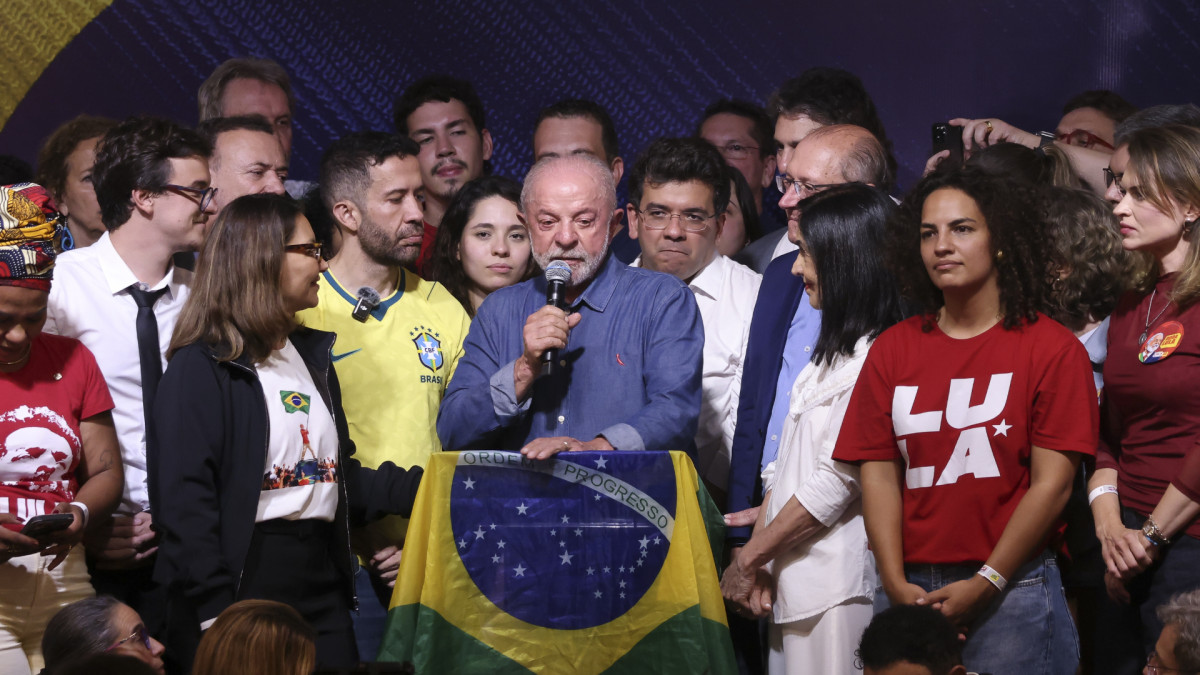
Brazil, after an epic and fiercely contested electoral battle that will go down in history, now has a reelected president: Lula da Silva. Yes, the historic labor leader, for the fourth time.
October began and the “giant of South America” arrived at the elections as one does when facing certain storms: aware that they will strike, but unable to predict where the first bolt will fall. For months, the country lived split between two irreconcilable halves. On one side, Luiz Inácio Lula da Silva, the historic labor leader who had left prison, reclaimed his political rights, and portrayed a resurrection that years ago would have been impossible to imagine. On the other, Flávio Bolsonaro, son of former president Jair Bolsonaro, who dared to challenge everything, to wield a firm hand, and to attempt a coup. Flávio’s mission was to preserve —in a more updated version— the family political legacy. In short, these elections were a referendum on two ways of imagining Brazil, a country that, as we have argued in Public Agenda, is very difficult to understand from outside.
“October began and the ‘giant of South America’ arrived at the elections as one arrives at certain storms: knowing they will strike, but unable to predict where the first lightning will strike”
But in the end, after an intense campaign and in the runoff, Lula triumphed. He did so with 51.79% of the votes, a margin sufficient to win the contest. His campaign was built on a simple and powerful idea: nostalgia. He did not promise a new country; he promised to recover what had been lost. His spots recalled the years in which millions of Brazilians rose socially, traveled by plane for the first time, gained access to university, or could consume as they had never imagined. His rhetoric was aimed at those who feel that inflation and insecurity are the result of unnecessary institutional erosion. And in the face of that outlook, Lula appeared as a survivor. His mere presence was already a political narrative; he was a metalworker, a unionist, a president, a prisoner, and, when no one would have thought so, a candidate again. And he won.
Bolsonaro, by contrast, ran a campaign with his father’s tone: combative. His narrative, like that of any far-right faction, was defined by the idea that the return of the left would, in short, be a threat. He traversed evangelical churches (one of his power bases and spheres of influence), symbolic barracks, and held mass rallies where he made clear that Brazil’s freedom was at stake in those elections —something very much in the vein of Milei or Trump. His strategy was less about broadening his base than about consolidating an almost identity-based loyalty. Every criticism from the press, every unfavorable poll, every forecast of defeat was presented as a proof of his battle against political, judicial, and media elites.
“Bolsonaro’s strategy consisted less in widening support than in consolidating an almost identity-based loyalty”
In the first round, held Sunday, October 4, Flávio Bolsonaro won the election, but not with the percentage needed to consolidate the victory. From there, twenty days passed with him seen as the favorite to win or, at least, with the relative edge that first step had given him. But he made a mistake that, perhaps, cost him the presidency. The debates between the two candidates became a perfect stage for polarization; accusations of corruption, personal attacks, and insults were exchanged, but the candidate from the Liberal Party crossed a line that should not be crossed: the line of respect. In one debate he referred to Lula’s “nine fingers”, a demeaning reference to the workplace accident Lula suffered as a young man in a metal factory that cost him a finger.
In response to that unnecessary attack, Lula did not hesitate to speak with conviction and demand an apology from his political rival, because if he had lost that finger, it was due to the exhausting working conditions that broke all safety protocols. “I worked more than the permitted hours, and I did it to be able to eat. I was working when I did not have to. I will not allow you to call me that way,” he insisted, with the moral authority he possessed. Bolsonaro apologized and said his intention was not to offend him. Yes, apologies arrived, but, as is often the case, they arrived late.
Thus, a physical wound became a political symbol: for some it was a reason for ridicule; for others, proof of a fighting trajectory. In the wake of that incident, Lula said he was a working man and that Flávio Bolsonaro had never worked in his life. Beyond the phrase or the idea, there stood the photograph of two ways of understanding Brazil, two irreconcilable paths: the realm of privilege, ostentation, and excess, versus that of the underprivileged, the people who work under unimaginable conditions.
“A physical wound became a political symbol: for some it was a cause for ridicule; for others, proof of a fighting trajectory”
Moreover, there were episodes of tension that showed how far Brazilian politics had become an emotional contest. During the campaign there were skirmishes between supporters of both sides, threats, and, in general, a climate of radicalization that even worried international observers. Social media amplified rumors and conspiracy theories. The names Donald Trump and Elon Musk eclipsed the idea of transparency in the electoral process. Yet, to this day, no direct interference by American elites in the Brazilian elections has been proven.
Brazil is of an inescapable complexity. In every sense. Each campaign, each political version seemed worthy of a different country. The debate was not about who should govern, but about what was true and what was not. Then came the runoff and, with it, a razor-thin victory. Yet it carried something historic and epic: it was the first time a candidate who had finished second in the first round ended up winning the second. It was also the maintenance in the Planalto Palace of a leader whom many had considered politically finished. But politics has that quality, a sense of surprise, that anything is possible, and Brazil was no exception.
Now Lula has a new mission beyond governing: to try to unite what seems broken from the foundations, to build a discursive bridge for those two versions of the same country that hardly recognize each other. His victory, after all, was too close to defend the idea that “all Brazilians” decided it.
Containment of the regional far right
The victory of Lula da Silva over Flávio Bolsonaro not only redefines Brazil’s political balance: it also reconfigures the power map in Latin America.
In recent years, radical right forces managed to position themselves in various countries of the region as part of the global rise of Trumpism. Argentina, Colombia, Chile, El Salvador, etc. Therefore, the defeat of Bolsonaro’s political heir means preserving a pole of resistance against a continental right that sought to dominate Latin America’s largest economy.
Obviously, this is not a minor matter. Brazil accounts for roughly half of the region’s population and GDP. Whoever governs from the Planalto Palace wields influence that transcends its borders and forces regional debate on trade, integration, the environment, migration, and, incidentally, the region’s role on the international map. Bolsonaro’s victory would have meant Brazil’s return to the political orbit inaugurated by his father, aligned with the ideology (and praxis) of Trump’s political universe. Lula’s continuity, at least for now, closes that possibility.
“The defeat of Bolsonaro’s political heir preserves a pole of resistance against the continental right that sought to control Latin America’s largest economy”
So, what does the regional political map look like now? The axis formed by Mexico and Brazil will likely gain singular relevance. They are the two largest economies in Latin America, home to more than 340 million people, and they possess a level of regional interlocution unmatched by any other country in their continental orbit. Both Sheinbaum and Lula will prioritize strategic autonomy and a foreign policy less tethered to Washington. The two countries have undoubtedly become the main counterweights to the expansion of ultra-conservative currents aligned with the most radical form of Trumpism.
The dispute also crosses borders. In a world shaped by fierce competition among China, the United States, and other rising powers, Lula’s persistence preserves a multipolar vision of international relations. Brazil, as one would expect, continues to champion spaces like the BRICS, to promote South-South cooperation, and to pursue a diplomacy that seeks to widen maneuvering room rather than center on a single great power—economically or politically. This stance, with its nuances, finds echoes in Mexican foreign policy and stands in contrast to the vision and ideology defended by Bolsonaroism.
Nevertheless, these results, this victory, and this campaign deliver a warning: the razor-thin gap between the two candidates shows that the Brazilian right is far from disappearing. Millions of citizens voted for Bolsonaro’s heir, confirming that nationalist, conservative, and ultraliberal currents still possess a formidable mobilization capacity (and interests to defend). Lula’s victory can only be understood as a brake on that advance whose epicenter lies in Washington, but it is not a definitive defeat of the rival political project. Rather, it inaugurates a new phase in the struggle for hegemonic influence in Latin America.
“Lula’s victory can only be understood as a brake on that advance centered in Washington, but not a definitive defeat of the rival political project”
In the end, what was at stake was more than the presidency of the country; what was at stake was the answer to the question about the direction (or directions) the region would take in the coming years. Should one lean toward aligning with Trumpist doctrine, or maintain an autonomous agenda without the non-negotiable conditions set by Washington? Lula’s victory does not yet answer that question, but it does ensure that the answer will continue to be a matter of contention.
