
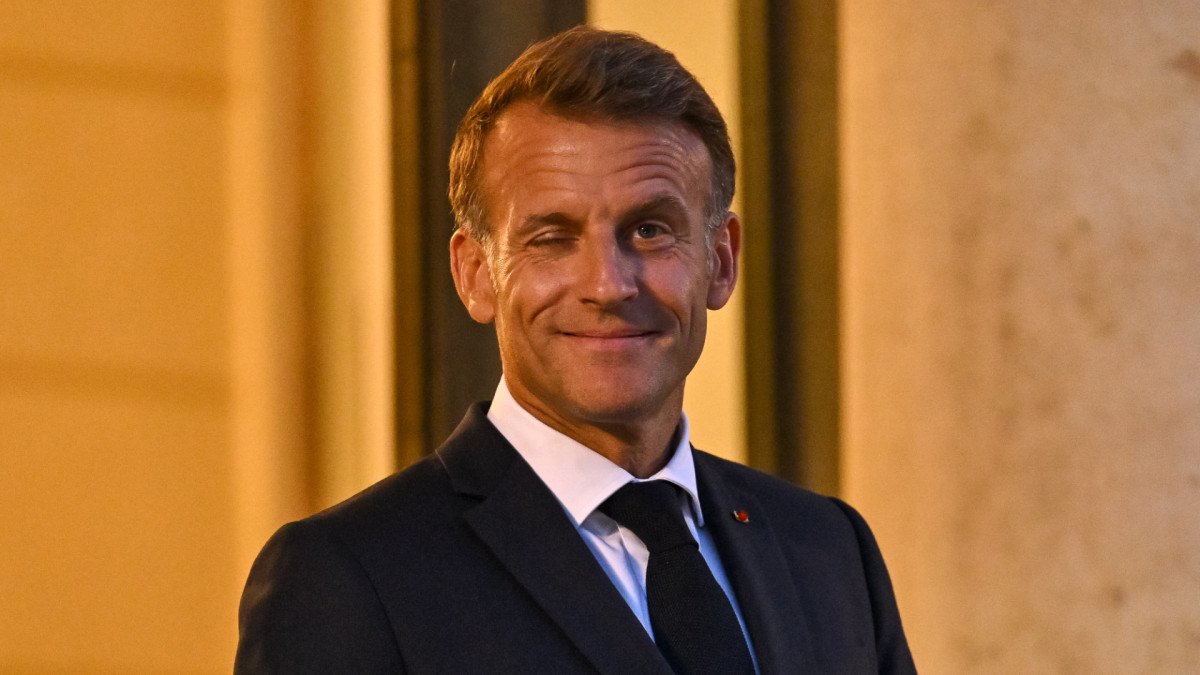
Emmanuel Macron did this week something that deserves scrutiny from Madrid. He summoned at the Élysée Palace the leading French political figures and potential successors to the presidency in 2027 to explain to them the deterioration of the international situation. Russia, Ukraine, the Middle East, energy, foreign interference, cyberattacks and the protection of critical infrastructure were part of a discussion that had a distinctive feature: alongside the president and the prime minister, high-ranking military and intelligence officials participated.
It was not a meeting aimed at reaching a political agreement. It was a national security briefing. Macron framed its purpose as a transparency exercise: to provide those who may govern France after the 2027 elections with access to a portion of the information the president uses to make decisions. The idea seems straightforward, yet it carries an enormous democratic significance. Who aspires to govern must know. Afterwards they can dissent.
Macron informed the political leaders that the hybrid Russian threat against France and Europe has intensified in recent weeks and announced that he has tasked the government with a specific plan to safeguard France’s critical infrastructures, including measures against foreign interference and cyberattacks. He also warned that Russian actions against European countries would not go unchallenged, although he recalled one of the essential rules of deterrence: precisely for it to work, a state should not publicly disclose how it will respond.
“Macron informed the political leaders that the hybrid Russian threat against France and Europe has intensified in recent weeks”
But perhaps the most interesting moment occurred when the meeting ended. Raphaël Glucksmann left convinced that the situation may endure and that France must prepare. Édouard Philippe spoke of the increase in the level of threats and risks facing the country. Marine Tondelier explicitly praised the transparency exercise and voiced concern for the security of the entire European continent. Olivier Faure concluded that there is no immediate de-escalation scenario, though he urged France to prepare without ruling through fear.
Then the disagreements began. Fabien Roussel called for a rapid political and diplomatic exit from the Ukraine war. Jordan Bardella, Éric Ciotti and Bruno Retailleau focused part of their remarks on the impact of energy prices and fuels. Manuel Bompard pressed on the social emergency and urged for an immediate peace message. Other leaders emphasized Russia, Ukraine or the economic consequences of an international crisis that could endure. In other words: they left the Élysée not sharing the same view, but knowing more about the same reality. That is the true interest of Macron’s method. And it is precisely what Spain should study.
Rather than declassifying Spanish intelligence reports, Pedro Sánchez should convene a similar meeting with the main Spanish parties to address the new security scenario. Not to ask them to align with the Government’s policy. Not to manufacture an artificial photo of national unity. And not to withdraw foreign and defense policy from the democratic debate. To ensure that those who may govern Spain in the coming years share a sufficient understanding of the threats facing the country.
Since this summer there is one more reason to do so, and it is named Ceuta. Perhaps if Feijóo had access to greater information about what Morocco represents in terms of intelligence for Spain and for Europe, he would not have pointed at Morocco. And with this I do not mean to say that the neighboring country was not involved actively or passively, but we are talking about what the next prime minister should be informed of and how that could condition his statements.
The conversation that remained pending
Spain was close to starting that conversation eight months ago. On January 14, in we published “The six security and defense topics that Sánchez and Feijóo must address.” Five days later, the prime minister and the opposition leader were set to meet at La Moncloa to discuss, among other things, Ukraine, European defense and the new international scenario.
The meeting did not take place. The reason was clear. The Adamuz railway accident forced a reshuffling of the political agenda. Feijóo proposed postponing the meeting and Sánchez agreed. La Moncloa announced that a new date would be sought. It never arrived. Adamuz, indeed, does not explain why that conversation has still not occurred eight months later.
Especially because the world did not wait for Spanish politics to fit into the agenda. When that meeting was proposed, the center of gravity of European security was essentially in the East. Ukraine, Russia, the transformation of the transatlantic relationship, European defense, military capabilities and rising expenditure required Spain to consider decisions that transcend a single legislature. All those issues remain on the table, but now the South has been added.
Ceuta changes the map
What happened in Ceuta on July 30 and 31 forces a reconsideration of how Spain thinks about its security. The Prime Minister himself described the crisis as a violation and an attack on Spain’s territorial integrity. Subsequently, the Council of Ministers declared for the first time in democracy a situation of national security interest in Ceuta. Europe has also revised the lens through which it interprets what happened.
“Ukraine, Russia, the transformation of the transatlantic relationship, European defense, military capabilities and the increase in spending forced Spain to consider decisions that transcend a single legislature”
The European Parliament has deemed the instrumentalization of irregular migration as a tool of hybrid war against the territorial integrity of a member state and has urged to strengthen the protection of the EU’s outer borders—land and sea—in Ceuta.
Ursula von der Leyen was even more explicit in the European Parliament: “Ceuta’s border is a European border”. This assertion should have strategic consequences far beyond a simple show of solidarity. For years, Eastern European countries have asked Spain to understand that the Polish border, the Baltic states or the Suwałki corridor are part of our security as well. Spain, Italy or Greece have likewise urged Warsaw, Helsinki or Tallinn to recognize that the Mediterranean is also a European strategic border.
Perhaps the fundamental change that European security needs is to stop treating these two geographies as separate. Narva and Ceuta belong to the same map. And if Spain wants to convince its partners of this, it should start by building at home a political conversation capable of sustaining that position for more than one legislature.
First information, then politics
Here lies the main takeaway from the French gathering. Macron did not manage to make Glucksmann and Bardella leave with the same thinking. Nor did he manage to get Tondelier, Philippe, Faure, Roussel or Bompard to share a single policy toward Russia. Nor did he try. He achieved something else beforehand. He allowed them to hear information and assessments from the French state before they formed their own responses.
Spain should explore a mechanism similar in spirit, adapted to our institutions. The president could convene the principal parties represented in parliament and allow the ministries of Defense, the Interior and Foreign Affairs, the European Union and Cooperation, the National Security Department and the CNI to present their assessment of the strategic scenario.
“The president could gather the main parties and allow several ministers, the National Security Department, and the CNI to present their assessment”
A national security briefing does not make the opposition co-responsible for the government’s decisions. It does not remove its obligation to scrutinize the Government. Nor does it prevent investigating what happened in Ceuta, what information existed beforehand, what worked, what failed or what political responsibilities may arise.
It means accepting that threats endure beyond governments.
An agenda that can no longer wait
The discussion should begin with Ceuta, but not end there. Russia and Ukraine. The Sahel. Morocco and Algeria. The Strait. The Canary Islands. NATO’s evolution. The relationship with the United States. Air defense and drones. Submarine cables and critical infrastructure. Cybersecurity. Disinformation. Technological dependency. Energy security. Defense industry.
And now also something the French gathering has brought to the foreground: the link between external security and economic security. And the citizenry, already bearing the burden of rising inflation in Spain, is acutely aware of this.
“National security in the twenty-first century is discussed also when talking about energy, technology, ports, power networks, telecommunications, raw materials and industrial capacity”
Macron spoke to the French political parties about the effects of wars on energy prices, the closing of the Strait of Hormuz, strategic reserves, protection of supply chains and the need to reduce dependence on hydrocarbons through electrification.
National security in the twenty-first century is no longer debated solely among military and diplomatic circles. It is debated also in terms of energy, technology, ports, power networks, telecommunications, raw materials and industrial capacity. A migration crisis can become a matter of national security. A drone can have military, industrial and political implications. An energy infrastructure can become a target of a hybrid operation. A disinformation campaign can accompany border pressure. Ceuta embodies that new reality.
A pact about how we disagree
Spain does not need a pact in which the PP and PSOE promise to stop arguing about security, defense or foreign policy. We need something more modest and perhaps more important. We need a pact about how we disagree.
In January we defined it in Agenda Pública as a “minimum pact about how decisions are made.” Spain will have to adopt in the coming years strategic decisions whose effects will outlive the governments that implement them. For them to be sustainable, they require democratic legitimacy and certain institutional continuity. Eight months later, that need is greater.
Macron has just demonstrated that a president can bring together leaders who sharply disagree in the same room, share with them sensitive information about the threats facing the country, and then let each one craft their own responses.
That does not weaken democracy. On the contrary, it makes it more mature. Gather everyone!
