
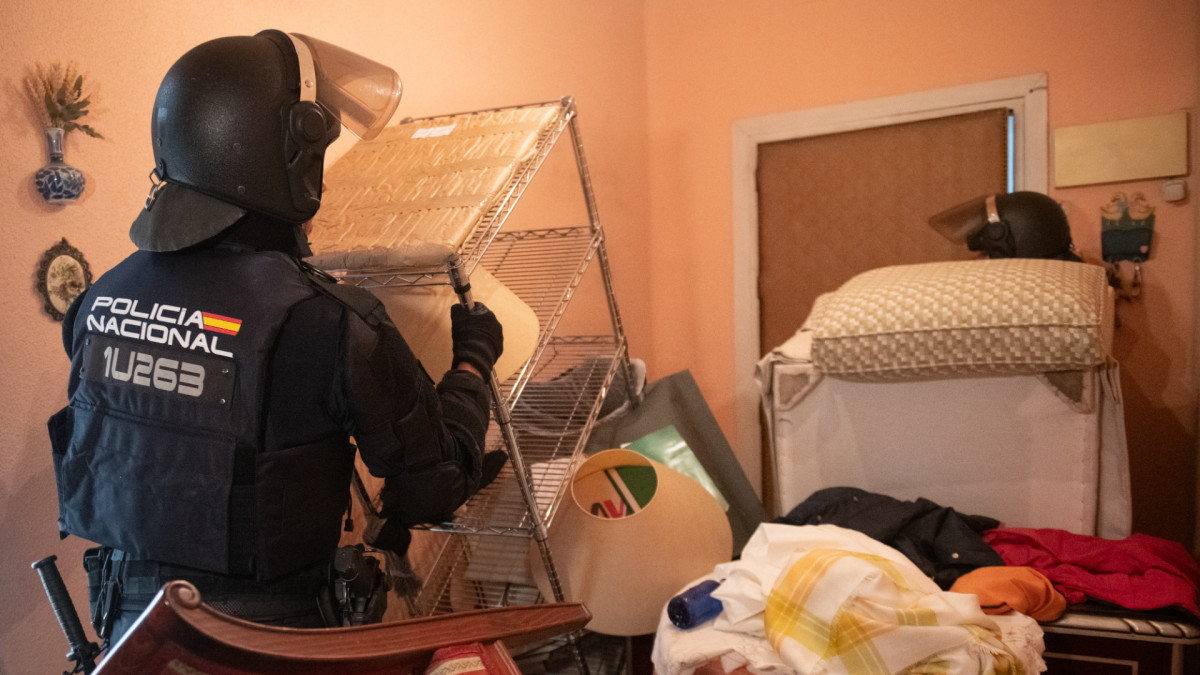
These days we have lived with stupefaction at the eviction of Maricarmen, an 87-year-old woman with a 50% disability, who was removed last Wednesday, September 23, for being unable to meet the rent increase demanded by the investment company that owns the building. Maricarmen’s case has it all as a case study.
A first element is that Maricarmen was a tenant in a 92-square-meter apartment in the well-to-do Retiro district, in central Madrid. But for that flat she paid only 500 euros. The market rent in that location is three to four times higher. How is it possible? Maricarmen lived in the house as a tenant under a contract that belonged to the regime known as old rent: leases signed under a law of the Franco dictatorship. In particular, a law in force during the period 1964-1985. The elders will remember a very aggressive rent regulation, the total rent freeze (and forced extension of contracts) that ended with the Boyer Decree of 1985. That legislation emptied the rental market in Spain, because owners disappeared. Nobody finds it profitable to rent an apartment in such a market. The rental market did not recover until after the real estate bubble, and for a bad reason, because property access was blocked.
“A bad law generates in its beneficiaries the incentive to take advantage of it. The problem is not Maricarmen’s family; it is the law”
Maricarmen’s old-rent lease was signed back in the day by her father. After the father’s death, his wife took his place as tenant; and, when she died in 2005, the contract passed to her daughter Maricarmen. As is logical, Maricarmen’s family has sought to take advantage of that old rent as much as possible. And they have done well. A bad law generates in its beneficiaries the incentive to take advantage of it. The problem is not Maricarmen’s family, it is the law. At this point a curious match occurs. A portion of the left defends rent regulation and forced renewal of contracts as a measure for the current market. A law that Franco already made and that he did not invent (if you want to know the history of rent controls, read Konstantin Kholodilin). A portion of the radical right has recalled with “nostalgia” that Francoist law. Returning to that “with Franco life was better” that has sunk into some of our young people. Any economic researcher would tell you that it is fortunate that very few of these old rents remain, that law was an aberration. Maricarmen’s old rent was very exceptional.
The second element is that Maricarmen has been evicted by Urbagestión Desarrollo e Inversión SL. A company. The owners say they are a small company, but various associations and activists say it is a “vulture” fund. It does not matter. For two reasons.
The first is that only 8% of rental homes in the market are owned by companies (the percentage rises to 12% in some large cities like Madrid and Barcelona). No, companies or investment funds are not the sole culprits of Spain’s housing problem. But it is very tempting (and profitable) to look for external enemies, especially if the main enemy is inside. The second reason is that we should ask why the private investor who owned Maricarmen’s flat sold it in 2018. I’ll give you the answer: he was tired of losing money and would not have the money or the stomach for the four legal proceedings Urbagestión has faced to have a judge declare that the second succession of the old rent was no longer legal. In any case, I’m not sure the rent the company will obtain from now on will offset the damage to its image. I think he hasn’t properly weighed his actions, not even economically.
In fact, the evidence is that the company has proposed, albeit belatedly, an alternative. Incorporate the property into the Reviva program, which is promoted by Madrid’s city council to reactivate the rental market. You’ll see in a few lines why that is smart. One of the first things I learned about the housing market is that housing is at once a consumer good and an investment. The solution to the housing market should not be to let those who see it as an investment behave as socially we would like. Some will do so, since social values yield more than many companies think, but there will also be those who do not. In any case, even if some persist in living in a parallel reality, the presence of companies in the rental market is very small: housing is predominantly in the hands of private owners with two, three, or four homes. In this, too, Maricarmen’s case is exceptional.
“The presence of companies in the rental market is very small: housing is predominantly in the hands of private individuals with two, three, or four homes”
A third element is the intergenerational gap that Maricarmen’s case hides. While Maricarmen paid 500 euros for 90 square meters near Retiro, a young person pays today 550 euros for a room in Madrid. For 71 years Maricarmen has been protected by a law that today has left her stranded. No law currently protects the young person who wants to become independent. In Maricarmen’s generation, almost 60% of households own more than one property; barely 37% of those under 35 own a home. The pensioners’ income today is over 40% higher than that of those under 29.
Maricarmen is an island in her generation, an island for which we must find a housing solution. Among the young, access to housing is a generational problem. It is the end of the social elevator in Spain. And again, it is not the fault of our elders, who even help as they can by anticipating inheritances and gifts to their children and grandchildren. The fault lies in bad economic policies that protect those who already have before those who are coming. It is possible that a major involuntary contribution from Maricarmen is to quell a generational conflict that had been brewing for some time on social networks and in some media. The famous “boomers’ life” of property owners at the expense of young tenants. Also in this, Maricarmen is an exception.
The fourth element, however, is not exceptional. The sky is blue, the water is wet, and the Maricarmen case again exposes our public sector. Fortunately, thanks to a continuously growing economy, the evolution of evictions in Spain is very positive. From nearly 70,000 per year during the financial crisis, today we have 24,540 evictions (the technical term is lanzamiento, which is the actual enforcement of a court order of eviction), 18,317 of which were due to rent arrears, 4,346 for mortgage arrears and 1,877 for other causes. A 0.1% of the housing stock. Quantitatively it is not a problem. But behind each of them there is a personal drama. And the housing response in these cases is the State’s responsibility (whether an autonomous community, the central Government, or a city council).
However, our State, which mouths grandiose phrases such as “the housing legislature,” “the third pillar of the welfare state,” slogans like “fewer and fewer people want to own property” or the all-too-used “we are putting all the means to solve the housing problem,” dedicates — you will be surprised by what follows — only one of every hundred euros of public budget to housing policy. If you are right-wing, sticking to the classics, I would tell you we dedicate twice as much to culture. If you are left-wing, I’ll also stick to the classics and say we dedicate twice as much to defense. There are countless budget items prioritized over housing.
“Our State, which mouths grandiose phrases like ‘the housing legislature’, dedicates only one in a hundred euros of public budget to housing policy”
For our rulers, housing has never been a priority. In fact, it is the budget item that has grown the least in the last ten years. No matter what they are told, it remains so. Thus, it explains that only 1.2 of every 100 homes are social housing. This is how regulations are explained, shifting responsibilities onto owners, and the reproaches and slogans from both sides to buy time. And that is why, even if belated, the Urbagestión move is smart. I suppose they thought that by shifting the problem to the Public Administration, it would not be solved and they would improve their image. Slow but smart. Because that housing could have been purchased using the right of first refusal or by buying a package of homes from investment funds, as Ireland does, to devote it to social housing. But of course all of that requires budget. It requires prioritizing real housing. With actions.
We need a 180-degree turn in our housing policy. Do you know who the big beneficiaries of not building are? The only ones who can afford to pay high prices. The rich and the investment funds. Eliminating scarcity is the only way to reduce prices and rents. The only way for our young people to live near their opportunities. The Bank of Spain raised last week the housing deficit for 2028 to one million! We continue to do nothing to facilitate construction. A part of the left remains in a kind of existential incongruity. It calls for accessibility for the young and vulnerable and to welcome immigrants and but it does not facilitate access or reception. Welcome where? Access to what? A large part of this construction must be social housing. Do you know who are the only ones harmed by not having a stock of social housing? The vulnerable like Maricarmen. We must ensure that we care as much about social values in Urbagestión, because the solution is in our hands.
“Do you know who the big beneficiaries of not building are? The only ones who can afford to pay the high prices. The rich and the investment funds”
We must think through policies further. No matter how good it sounds to prevent evictions, who will rent to the vulnerable with that risk? We help those who are there to harm those who arrive. Aren’t we at risk of more homes leaving an already scarce rental market? Not to mention those voices calling for expropriation. Who would rent out their home in a market where it can be expropriated? Housing policies must have long horizons. Short-sighted policies leave us in the dark. Protecting the vulnerable is not a headline or a quick decree to silence the street. Protecting the vulnerable means providing them with a housing alternative. It means guaranteeing affordable housing.
