
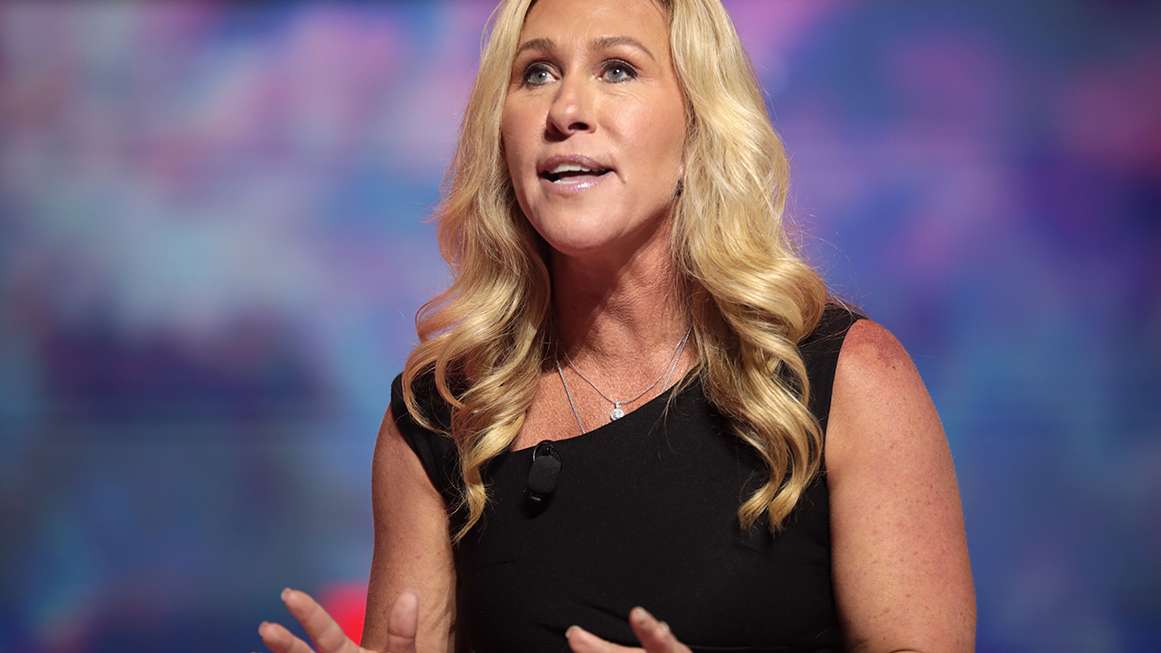
“For five years I lived with the deepest anger imaginable, despising every bit of it,” the former congresswoman tells Reason‘s Robby Soave.
Former Rep. Marjorie Taylor Greene (R–Ga.) sat down with Robby Soave of Free Media in June to talk about her friendship with Rep. Thomas Massie (R–Ky.), her break with Trump-era politics, and why she believes both major parties are letting ordinary Americans down. Greene says she once believed President Donald Trump could help topple the system. Today she argues that the two-party structure itself is the problem, and that Americans have not yet mobilized enough to defeat it.
Q: Can you describe your ideological evolution? You arrived in Washington as a fervent supporter of Trump, MAGA, and MAHA. By the end of your time in Washington, you were ideologically and personally close with Massie, who drew Trump’s ire for many of the same reasons you later found yourself at odds with the administration. Massie has viewed himself as a libertarian or friendly to libertarianism. Do you feel a stronger kinship with Massie and with the philosophy and movement he’s involved in?
A: That’s actually a misconception. Throughout my entire tenure in Congress, I aligned with Thomas Massie, and our voting records were very similar. He was one of my closest allies and best friends during the whole period I served. We collaborated on many issues, and that was before Trump was elected in 2024. I stood with both sides, I would say.
I was never deeply rooted in the Republican Party. I had never even attended my county GOP meetings before winning in 2020. I didn’t know anyone there. When I first ran for Congress, I was angry at Republicans and I attacked them relentlessly. I didn’t align with Democrats either, so I attacked them as well. I was naive about the whole political process because I had no real experience in it. But I was furious, utterly furious at the government. Once I became a member of Congress, I spent five years of my life the most furious I could be because I despised every part of it. I loathed it completely.
I was misled, like many others. I was also a rallygoer—a Trump rally attendee. I bought into his rhetoric. I believed his promises about ending foreign wars, draining the swamp, and accountability with lines like “lock her up.” He claimed to be my retribution. I believed in crashing the system and thought Trump would be the vehicle to accomplish that—though, in hindsight, I was mistaken. I spent five years in Washington trying every possible avenue to block what I saw as destroying America. Yet that destruction felt nearly unstoppable.
Q: The two-party system is brutal. You’re frustrated, and I’m frustrated, that the Trump administration isn’t prioritizing some of its campaign promises. It isn’t making it easier to start a business or to build a home or to prosper in the country, and it’s heavily focused on foreign conflicts. Yet stepping away from the Republican Party helps the opposition, and they’re veering toward a socialist path. Or consider someone like California Governor Gavin Newsom and his backers, who aim to seize wealth from our most successful tech entrepreneurs—the people trying to simplify life and boost the economy. Those moves would suppress all of that innovation. No matter what you choose, it seems you’re faced with poor options.
A: Exactly. It’s government overreach from both ends of the spectrum, in multiple directions. The choices feel non-existent now. The Republican and Democrat two-party system constitutes what you might call a political–industrial complex. Right now, it feels unbeatable. I tried to challenge it. I joined it and thought, “I’ll hold them accountable.” I wanted to hold Republicans to the promises they made on the campaign trail and to oppose Democrats for threats I believed they posed. But as things stand, the system remains extraordinarily powerful.
Let me reverse course: it is possible to beat it. It simply requires the American people to engage fully. At present, that level of engagement just isn’t there.
This interview has been condensed and edited for style and clarity.
