
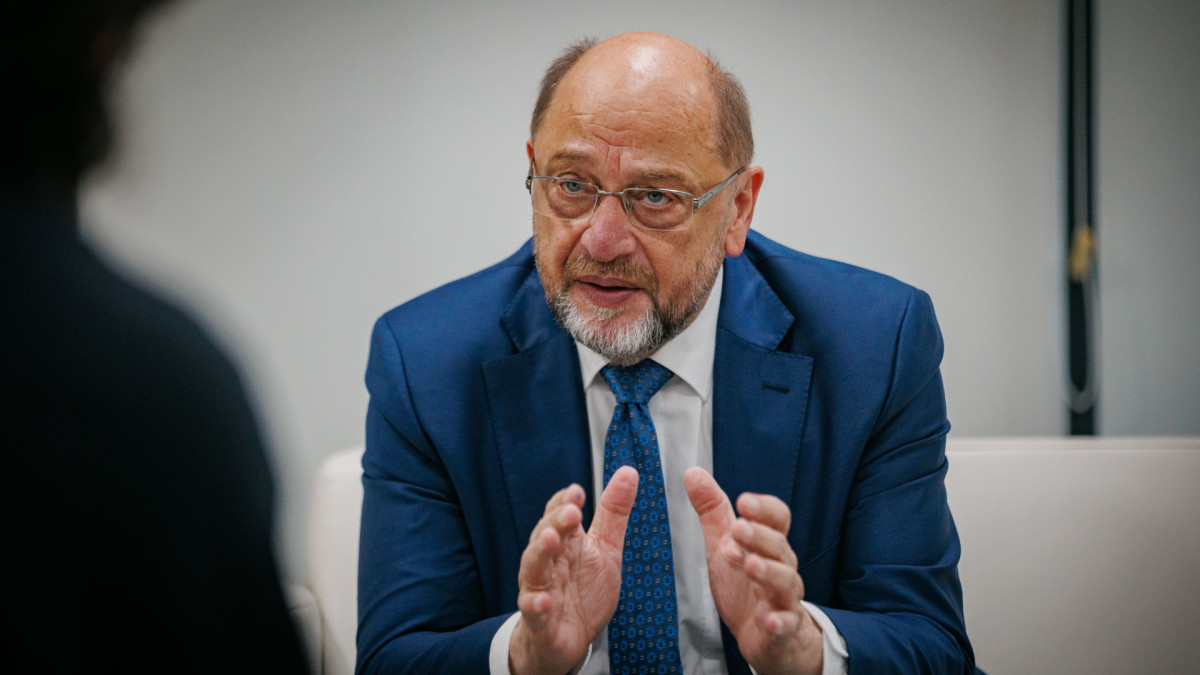
“Russia will not win and Ukraine will not lose”. Martin Schulz sums up the moment of a war in which he does not believe Europe can simply wait. “If we want to end the war, we will have to talk to Russia”, he argues. The president of the Friedrich Ebert Foundation speaks with us here with ease and candor. He has spent more than thirty years defending many of the ideas he presents in this conversation and combines strong oratory with the measured calm that comes from decades in politics.
The war is not the only front that concerns Schulz. In Germany, the AfD is gaining traction while parts of the CDU adopt some of its positions. The former president of the European Parliament believes that the answer lies in a combination of defense and diplomacy, but also in ensuring that German rearmament does not take place outside a European security framework. “History shows the disasters that can follow” a Germany that turns its central position into military power.
At a moment of sharply heightened electoral tension, the man who was Angela Merkel’s principal rival also addresses the crisis of social democracy and the future of the Union. Schulz argues that the radical right can block progress in integration, though it will struggle to undo what already exists. “It’s not so easy to dismantle the Union,” he says. He also tackles antisemitism and the relationship with Israel: “I share the broadly held critical stance toward Netanyahu“, he explains, but he also says he feels “a duty toward the State of Israel and its democracy.”
Martin Schulz, with the support of an interpreter, converses with Ruth Ferrero and Jorge de Diego. Photo: Agenda Pública / Tania Sieira
Ruth Ferrero (R. F.): We’ve been at war in Ukraine for almost five years. Are we closer to the end or entering a new phase of the conflict?
It is very hard to predict whether we are near the end of the war. I believe we are in a situation where Russia will not win and Ukraine will not lose. The conflict has stalled. Russia has intensified the war against civilians because it knows it cannot defeat Ukraine by military means.
The danger is hybrid warfare unleashed against us—from Poland, Germany, and the Baltic states. Its aim is to break our solidarity with Ukraine. We must prevent Russia from winning by allowing us to stop backing Ukraine. Yet at the same time I defend keeping channels open for dialogue with Russia: if we want to end the war, we will have to talk to Russia.
R. F.: Do you see a possible partition of Ukraine, then?
It is difficult to say because, in fact, Ukraine is already divided. Part of its territory is occupied and annexed by Russia. The Russians will not be able to occupy and subjugate all of Ukraine, but there is currently no military possibility to recover Donetsk and Luhansk. We are talking about a front line that is quite stagnant and, in effect, divides the country.
R. F.: But that situation endangers the process of European enlargement negotiations. If talks are conducted with the non-occupied part of Ukraine, will Europe have to accept that partition?
It is not yet time to debate that. But surely, as the accession process unfolds, there will be solutions.
R. F.: You advocate keeping dialogue channels with Moscow open. Yet the European Union seems to be outside the negotiations between the United States and Russia. What dialogue avenues does Europe have?
I believe the European Union will play a decisive role in the negotiations. Right now we have the sense that only the United States and Russia are speaking, and that Ukraine is not being taken into account. But it is not exactly the case. There is the E3 format, with Germany, the United Kingdom, and France, which is seeking avenues for dialogue, of course with Ukraine, but also with Russia.
“The Russians will not be able to occupy and subjugate all of Ukraine, but there is also no military possibility to recover Donetsk and Luhansk”
Some European countries, and also certain individuals, can play a significant role. For example, the Finnish president Alexander Stubb. Also the UN secretary-general, who maintains contacts in all directions.
But before that we must resolve a question: dialogue with Russia. Everyone says Europe must sit down at the table, so we will also have to negotiate with Russia.
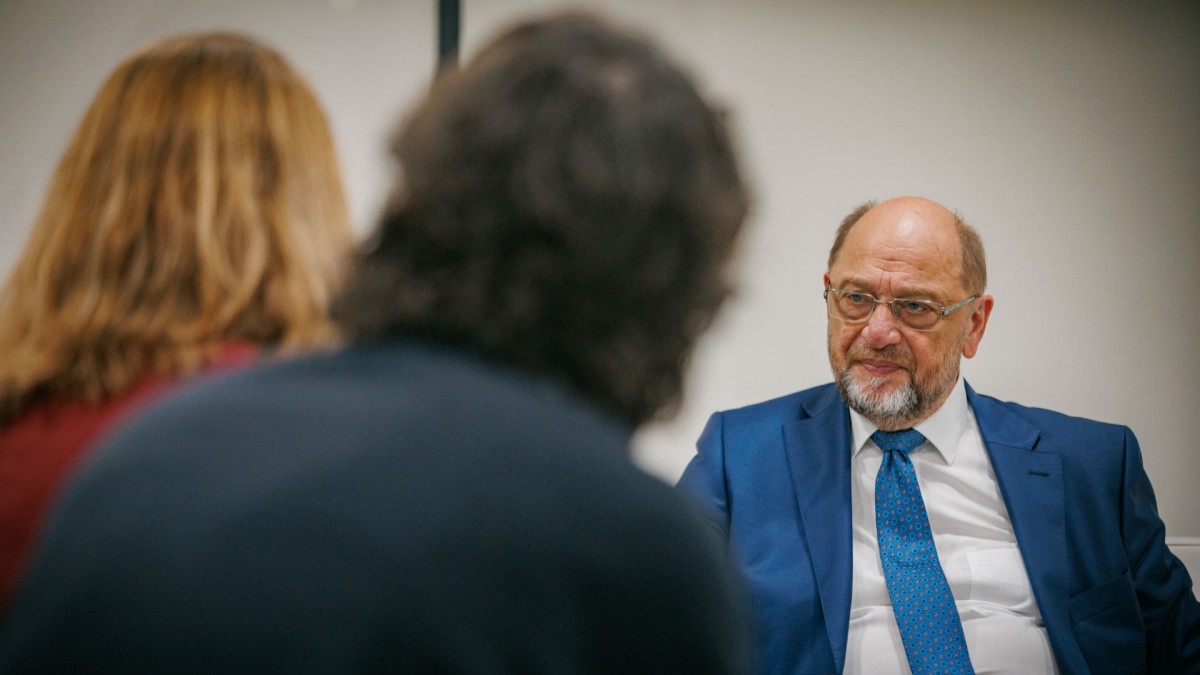
Martin Schulz converses with Ruth Ferrero and Jorge de Diego about the war in Ukraine and relations with Russia. Photo: Agenda Pública / Tania Sieira
Jorge de Diego (J. de D.): The intensification of Russian actions in Europe coincides with the strengthening of parties that many see as Kremlin-aligned, such as AfD or Marine Le Pen’s National Rally. How do you assess this situation?
It is a worrying development. When I hear AfD or Le Pen’s rhetoric, I recognize elements of Russian propaganda. I think we must take it very seriously.
“When I hear the rhetoric of AfD or Le Pen, I recognize elements of Russian propaganda”
The Germans face a particular problem: a portion of our country belonged for forty years to the Warsaw Pact. The perception of Russia in eastern Germany is, in part, different from that in the west. Still, the vast majority of Germans supports backing Ukraine. We need a dual strategy: be strong to defend ourselves in case of attack and keep diplomatic channels open. Willy Brandt and Helmut Schmidt saw dialogue as an effective way to resolve conflicts. But we must not forget: in their era Germany spent a larger share of its GDP on defense than today; it often exceeded 3%. We must be ready to defend ourselves and, at the same time, pursue the diplomatic path. There is a military need, but also a diplomatic logic.
J. de D.: Given its history, doesn’t the possibility of Germany returning to be a major military power raise concerns?
We are a nation that must live with its past and its central position in the continent. Germany is a geographic bridge between the west, north, south, and east of Europe. Within this territory lies Europe’s largest economy. If that country were to become a military power, the issue would become dangerous. History shows the disasters that can be caused when Germany turns its continental centrality into the exercise of military power.
“If we again have a strong army, we must ensure that it is anchored in a European security system”
If we again have a strong army, we must ensure that it is anchored in a European security system that makes it impossible for Germany to follow a special path [“sonderweg” in German]. Imagine a scenario in which ultranationalists govern in Warsaw and Paris and AfD in Germany, and the European Union has fractured. We would be back to the first half of the 20th century.
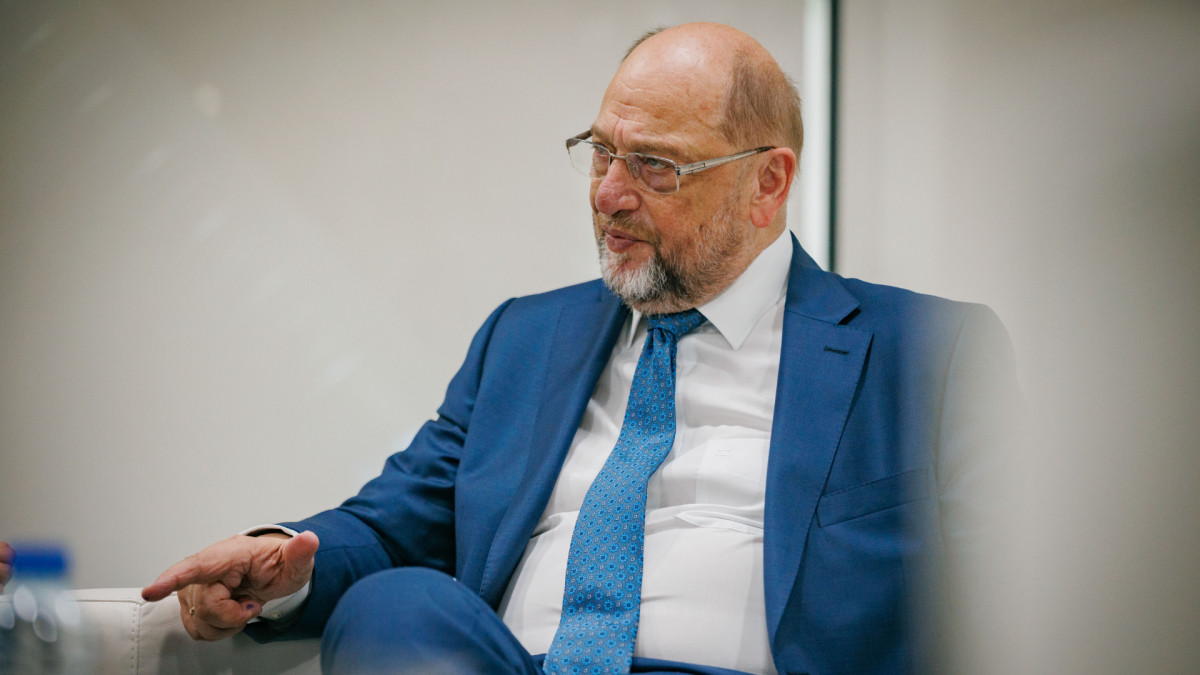
Schulz reflects on German rearmament and the need to integrate it into a European security framework. Photo: Agenda Pública / Tania Sieira
R. F.: However, there is a push for national-based rearmament in Germany. Wouldn’t European military integration block the scenario you just described?
Germany will not become a military power. And the European Union exists. Marine Le Pen will not be able to destroy it either. Notice how her rhetoric is starting to shift: we don’t like it, but she’ll do the same as Meloni. And, moreover, I think she will lose the elections.
R. F.: What is more dangerous for German democracy: allowing AfD to govern or the CDU gradually adopting its positions to prevent it from coming to power?
Parts of the CDU are already adopting those positions, and they will fail with them. It will also happen in Spain: if Feijóo governs with Abascal, Abascal will come out ahead. The mainstream right will never be able to satisfy the demands of the far right.
“Also in Spain: if Feijóo governs with Abascal, the winner will be Abascal. The mainstream right will never satisfy the demands of the far right”
There may be a number of CDU deputies who would be willing to form a coalition with AfD tomorrow. Yet at the same time, the CDU maintains coalitions with the Greens in North Rhine–Westphalia, Baden-Württemberg, and Schleswig-Holstein. Those coalitions would break apart immediately if the CDU shifted ideologically toward the far right. The coalitions with us, the Social Democrats, would also end promptly.
If that path is kept, the CDU will crater. It was the fate of Berlusconi’s party in Italy and of the Gaullists in France.
R. F.: The SPD is currently polling around 14%. What is happening with the Social Democrats?
My thesis is that Germany is undergoing something now that other European countries have already experienced. The big question is whether a democracy can go through this process, with the radical right gaining influence, without the system collapsing.
Let’s think of the Netherlands: they have had a government conditioned by the far right, but this can lose elections and leave power; the Netherlands remains a democracy. Kaczyński also lost elections in Poland. In Sweden, the Sweden Democrats have conditioned the government without joining it. That is a far-right strategy: you don’t need to be formally in government to influence how it is governed.
“That is a strategy of the far right: you don’t need to be formally in government to influence how it is governed”
In Germany we must pay special attention to AfD. It has a particular radicalism tied to our history. They are so extreme that even Le Pen does not want to share a parliamentary group with them. Alexander Gauland once called the Third Reich a “bird’s waste” in German history, meaning it was not particularly important. And there is something even more important: we must prevent the CDU from collapsing.
Returning to the SPD: after our worst electoral defeat since the 19th century, we formed a coalition with our main opponent. Why? To prevent the Republic from falling into the hands of the far right. Without that coalition, the alternative would have been a CDU–AfD coalition.
Our opportunity lies in being a stable force in Germany. That is why I mentioned that 14% in the polls. For the first time we are rising again: slowly, modestly, but steadily.
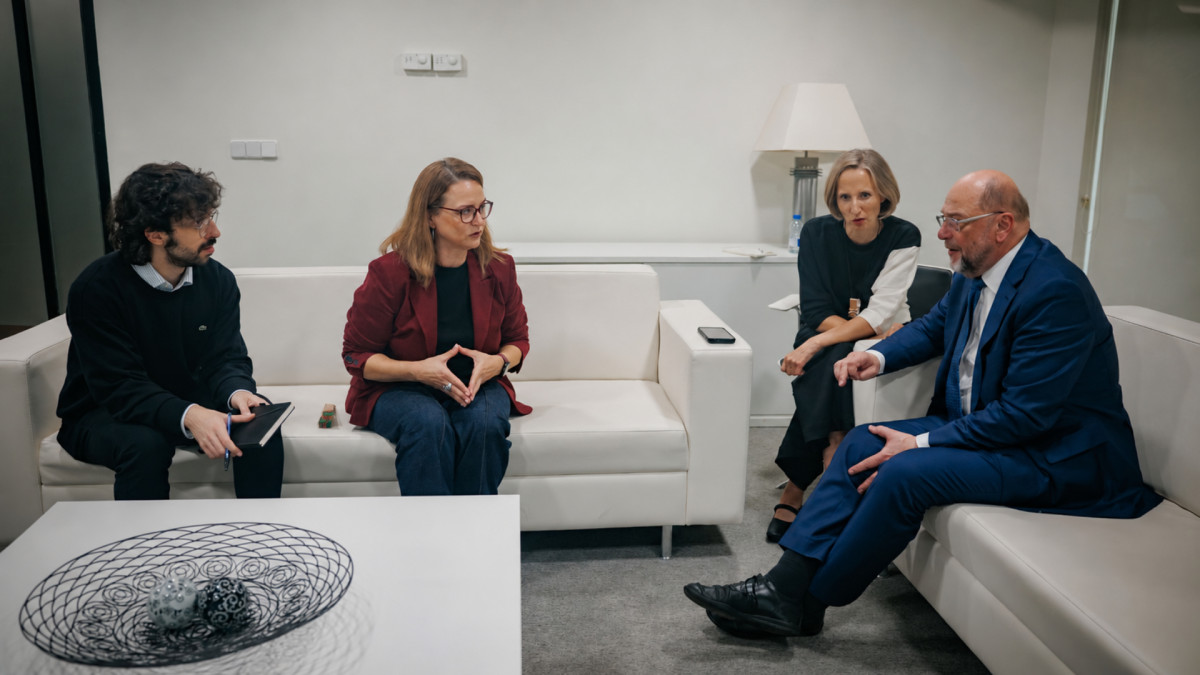
Ferrero and De Diego listen to Schulz. Photo: Agenda Pública / Tania Sieira
J. de D.: If AfD draws voters away from the CDU/CSU and Die Linke does the same with the SPD, is there a left-of-center alternative?
Yes, certainly. And this isn’t new either. In France we have another example, though, thankfully the German left is different from Mélenchon, who resembles Sahra Wagenknecht more. Die Linke is more rational. But there is a desire to develop a more radical and more clearly defined left-wing policy.
And that has its logic: when the Social Democrats form a coalition with the CDU and must reach common positions, a portion of the left-leaning electorate loses patience. We can explain to them that if we didn’t do this, we would be opening the door to the far right. Some would say: “You’re right, but I’ll still vote for Die Linke.”
“When the Social Democrats form a coalition with the CDU and have to reach common positions, a portion of the left-wing electorate loses patience”
Die Linke, however, also has a very large problem, akin to what the British Labour Party faced and, today, the British Greens face: antisemitism. In Germany this issue carries explosive weight because of our history. Here we cannot be indifferent to Israel.
I share the widely held critical stance toward Netanyahu, but I am a German politician and feel an obligation toward the State of Israel and toward its democracy.
I believe that in no other country is the challenge of reconciling the fight against antisemitism with support for the Palestinians as dramatic as in Germany. But both positions are compatible. We can criticize Netanyahu, support the Palestinians, combat antisemitism, and defend Israel at the same time. That is why I think Europeans should revive dialogue with progressive Israeli forces; this is something we also work on with the Friedrich Ebert Foundation in Tel Aviv and Jerusalem. Before October 7 there were massive demonstrations against Netanyahu for 38 consecutive weekends. There is a very strong democratic civil society. We cannot equate Israel with Netanyahu.
R. F.: Imagine a scenario with a right-wing and far-right government in Spain, a conservative government in France, the return of Law and Justice in Poland, Meloni’s strength in Italy, and the progressive unraveling of the “cordon sanitaire” in Germany. How can Social Democratic forces respond to such a deep crisis of the left and of the European integration project?
You have just described a serious danger. Those parties and those possible governments say they want to change the European Union. To me, that would be folly. Everyone knows—even Feijóo—that the economic strength of Spain, Italy, Germany, and France depends on the European single market and on its ability to resist unfair competition, for example from the United States or China.
“Everyone knows —including Feijóo— that the economic strength of Spain, Italy, Germany and France depends on the European single market and its ability to resist unfair competition”
Meloni spoke out against the European Union until European funds began reaching Rome. There is a force of facts: how can they destroy the European project without destroying their own economic base?
Until now, these parties have been able to block advances in integration. But they will not manage to undo what already exists, because to roll back fundamental aspects they would need unanimity, and there are enough states that would never accept changes of that kind.
R. F.: But these political forces do not question the common market. What they aim to stop is the advancement of European political integration. They know their own economic sustenance depends on the single market.
That is what I just said. The EU treaties already exist and we know we would have to deepen them. We cannot do so while far-right governments are able to block it. But those governments also cannot abolish the treaties, nor the common foreign and security policy, nor the multiannual budget, nor the powers of the European Commission. Reversing course would also require treaty changes.
Germany would never approve such a change. The Benelux countries would vote against, and many others would veto. It is not so easy to dismantle the Union.
“But they will not manage to undo what already exists, because to roll back fundamental aspects they would need unanimity”
Nevertheless, the debate with the far right should be conducted firmly. One could tell Abascal, Le Pen, and Weidel: “Listen carefully. You can say what you want, but you will not change the European Union as you promise. To do so you would have to amend the treaties, and you will not manage it. You can keep telling people you will tear down Brussels, but that will not come to pass.”
They talk very loudly and promise to destroy the European Union. We can respond that they are blowhards and that they will not succeed. Look at Meloni: she spoke a lot, but when the money started flowing, she changed her position.
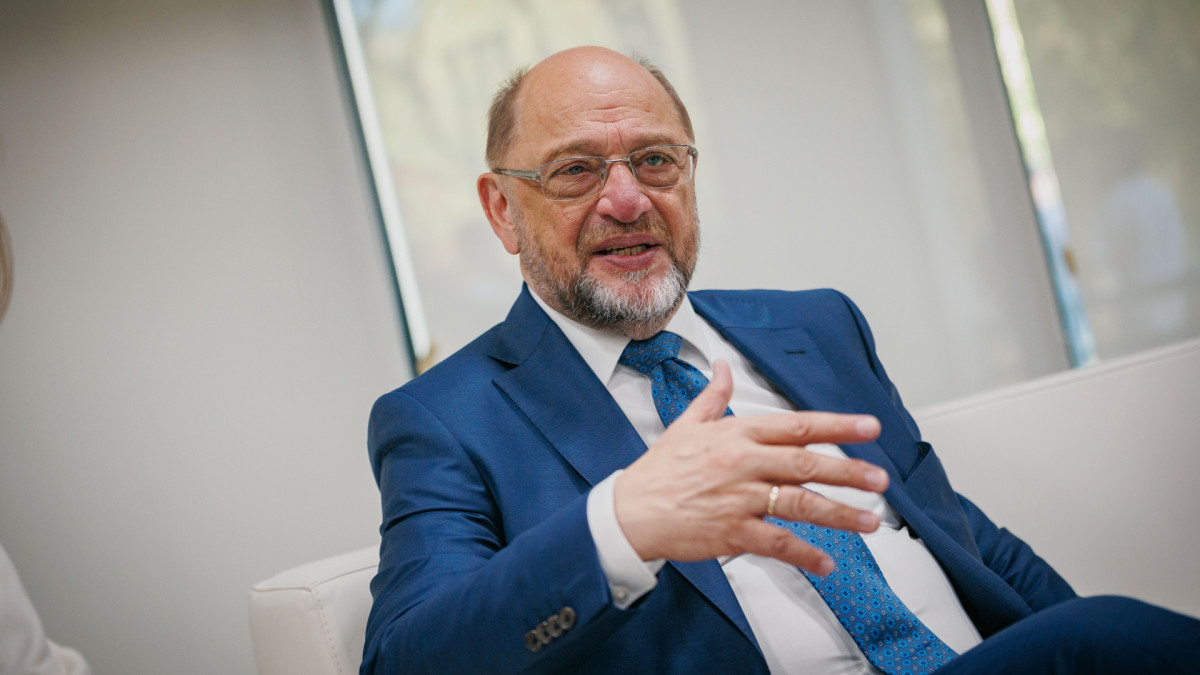
The former president of the European Parliament addresses the limits of the far-right agenda against European integration. Photo: Agenda Pública / Tania Sieira
R. F.: How significant are the upcoming Spanish elections in this European context? If the Partido Popular wins, do you think the European Union’s political balance could endure, even with a possible deal with Vox?
Spain is a pro-European country. If there were a strong anti-European party here, it would be a catastrophe. But I don’t think Feijóo can pursue an anti-European policy. When the moment comes, he’ll have to tell Abascal to keep quiet on European matters, and Abascal will end up doing so. I don’t think we’ll see Spain truly questioning the European project.
Beyond that, I believe Pedro Sánchez and the PSOE will win the elections.
Both: Thank you very much.
