
Giorgia Meloni’s long‑term plan to overhaul the Italian constitutional order from top to bottom—judicial reform, the premierate, differential regionalism, and electoral reform—fell short after her defeat in the March 2026 referendum, leaving her to settle for a goal that, while less sweeping, remained pivotal for the parties: the electoral project. Meloni wanted to push this reform through at any cost because, with the current law (November 3, 2017, no. 165, commonly known in political reporting as the Rosato law for its proposer), she did not feel she had full confidence in victory, since whereas in 2022 the opposition stood divided, this time it appeared determined to unite, which would threaten the present majority. The reform process was long (it began in the summer of 2025 and required three parliamentary votes—two in the Chamber of Deputies—the final closing vote—and one in the Senate) and complicated by the hesitations of several coalition partners on the right, but Meloni ultimately forced them to accept her project under the threat of early elections using the previous formula.
The opposition demanded a secret ballot in the hope that defectors might emerge (in July around fifty dissenters broke away), but in the third reading in the lower house there were no surprises, hence the final approval of the Bignami law (named after its rapporteur) (October 9, 2026, no. 180) with 227 deputies in favor and 164 against. The threat of early elections had an impact within the right‑wing coalition because Meloni asserted that, if the law was not passed, the government would resign and would almost certainly hasten an immediate electoral call. In that scenario, several deputies for whom this would be their first term would have forfeited their parliamentary pension because eligibility requires four years and six months in office.
“The electoral law Meloni wants is proportional, but with a strong majority prize if a certain quorum is reached”
The previous mixed system (61% proportional by list and 37% proportional in single‑member districts) is scrapped and one of the likely effects of the new law will be a reduction in the number of women in Parliament, since the obligation for gender parity is almost eliminated (under the Rosato law no gender could occupy more than 60% of candidacies) and only in the listone of the potential majority prize would the 60/40 rule apply now. For Meloni, this law will allow voters to choose a party, a coalition, a program, a premier candidate and parliamentarians, and will reinforce stability, an argument immediately endorsed by Antonio Tajani of Forza Italia to back her.
Thus, for the right, this law would mark a step toward the Third Republic, a claim that is misleading given that 1) since 1994 there have been numerous alternations, previously impossible under the Christian Democratic regime, and 2) the Meloni government has enjoyed enviable stability and has set records for staying in power. The reality is that the government’s most harmed ally by the new law is Matteo Salvini’s Lega, which is deeply worried by the constant rise of Roberto Vannacci’s Futuro Nazionale, hence its reluctance to see early elections. Meloni herself is aware that she will very likely need Vannacci to reassemble a governing majority, making him an awkward ally.
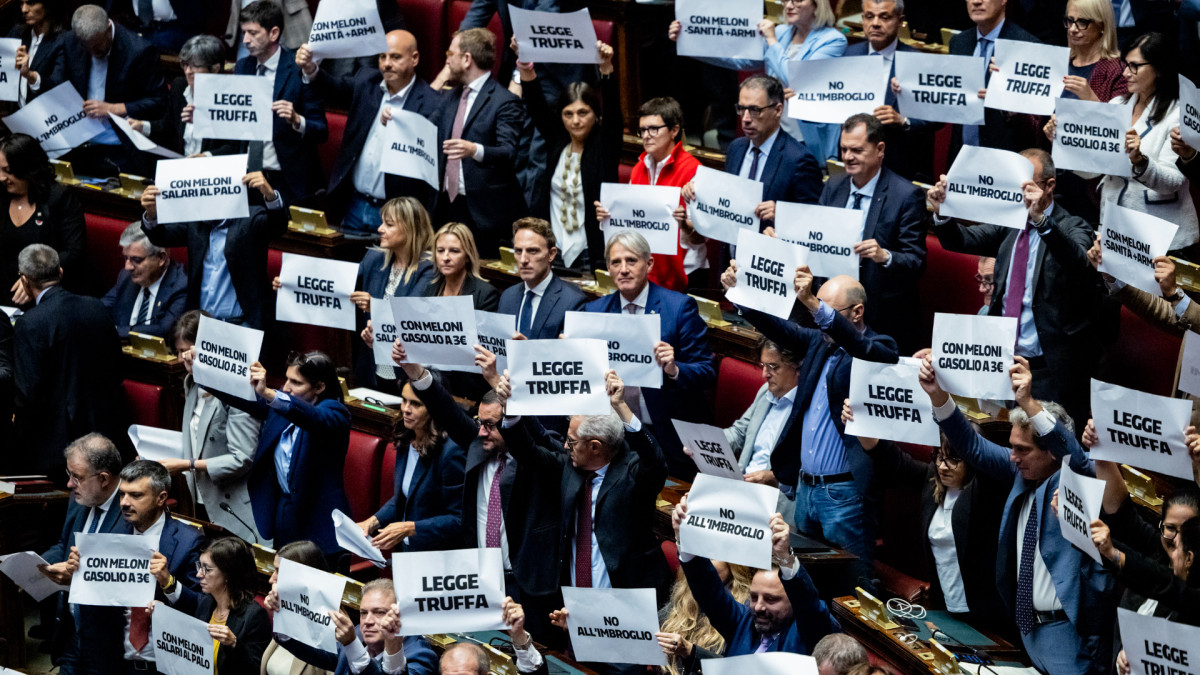
The opposition has unequivocally rejected the new law, calling it a truffa (trick) and an imbroglio (mess), and has denounced it as a move reminiscent of Alcide De Gasperi’s failed 1953 electoral reform, which would have granted about 65% of the deputies to the list or coalition that exceeded 50% plus one of the votes, but narrowly missed it and thus toppled his leadership. For Elly Schlein (Partito Democratico), Giuseppe Conte (Movimento 5 Stelle) and Alleanza Verdi Sinistra, this law is simply unconstitutional. The renowned political scientist Gianfranco Pasquino, speaking as an expert in the Chamber of Deputies Constitutional Affairs Committee on May 5, 2026, noted that in no electoral system do citizens directly elect the Government; in parliamentary regimes governments depend on Parliament, and in any democracy that cares about its legitimacy it is essential to respect the genuine representation of voters and maintain the separation of powers.
Consequently, this is a flawed law and, worse, partisanly driven because the top‑of‑the‑list candidates are blocked and the preferential vote is reduced to 20% of the following candidates.
“For Elly Schlein (Partito Democratico), Giuseppe Conte (Movimento 5 Stelle) and Alleanza Verdi Sinistra, this law is simply unconstitutional.”
This law introduces many and highly controversial innovations: 1) it increases the number of signatures required to run for office (except for those who already have a parliamentary group by December 31, 2025) and new candidates will need 6,000 endorsements (previously 1,500).
2) It will be mandatory for coalitions and parties contesting alone to name their premier candidate, even though that name will not appear on the ballot because, in effect, it is a prerogative of the President of the Republic. Thus, it seems to be a deceptive maneuver to introduce indirectly a kind of “semi‑premier” role, and this requirement could create problems for the opposition since primaries would be needed to decide whether their coalition would be led by Schlein or Conte (Andrea Carugati: “Conte vs. Schlein: the PD primaries race begins in Italy,” Sin Permiso, October 11, 2026).
3) The top‑of‑the‑list candidates (those almost guaranteed to win) are blocked and, since there is no planned gender rotation, it could happen that almost all of them are men (all forecasts point to a drop in the share of women from the current 33% to about 20% under the new law) and the only exception would be the listone if the majority prize applies, in which case the 60/40 rule would be triggered.
4) The preferential vote is reintroduced, but only three per district (20%), and it should be recalled that past experiences are not very satisfactory because in 1991 there was a referendum to reduce preferences from three to one due to clientelistic use, especially in the Mezzogiorno.
5) The majority prize stipulates that if a coalition reaches 42% of the votes in both chambers it will obtain 70 deputies and 35 senators more, though no coalition could have more than 220 deputies and 113 senators to safeguard the thresholds for a qualified majority (presidential election or constitutional reform). If no coalition reaches 42%, the system would revert to pure proportional representation—that is, the so‑called First Republic model and the outsized leverage of the partitini—or to unlikely grand coalitions or technocratic governments that Italy has known well.
6) The exclusion threshold is set at 3% for parties contesting alone and at 10% for coalitions.
This law will be challenged before the Constitutional Court and it is worth recalling that in 2017 the Court voided many provisions of Matteo Renzi’s political reform that never took effect, and it is likely that this high court will scrutinize several points:
1) The large majority prize on the grounds that it could distort representation by enabling governments not supported by the majority of citizens.
2) It is questionable whether the blocking of top‑of‑the‑list candidates will be accepted and whether gender parity will be disregarded in this respect.
3) The idea of raising the signature threshold from 1,500 to 6,000 seems excessive because it imposes a disproportionate burden on new parties.
4) Forcing parties to specify their premier candidate appears inconsistent with interfering in the prerogatives of the President of the Republic.
5) The national tally for the Senate seems to clash with Article 57 of the Constitution, which envisions regional counting.
“In 2017 the TC struck down numerous provisions of Matteo Renzi’s electoral reform that never came into effect.”
YouTrend polls on this law reveal a significant lack of civic knowledge (44% say they know it little and 32% almost nothing), show that the majority supports restoring the preferential vote (62%), but 39% oppose the majority prize, 20% oppose abolishing single‑member districts, and 56% reject the top‑of‑the‑list blocking. In this context, a debate has opened on whether early elections would be advisable: 67% of center‑right and right voters are against and prefer completing the legislature by October 2027 (though 67% of Vannacci supporters favor an early vote), while 68% of center‑left and left voters want an early election. The decision will wait for the Constitutional Court ruling (expected in February 2027) and could be aligned with spring local elections.
Polls (YouTrend/Sky TG24) show that the right without Vannacci hovers around 40% and only with him would reach 48%, while the center‑left would stand at around 44% if it manages to add small centrist parties (Renzi’s Italia Viva or +Europa, with Calenda’s Azione much less likely to join); within the coalitions, Fratelli d’Italia leads on one side (27%) and the Partito Democratico on the other (20%). In short, Meloni could be making the same mistake as Renzi with his electoral law, since the Constitutional Court has toppled it in its essential parts and now its verdict must be awaited.
