
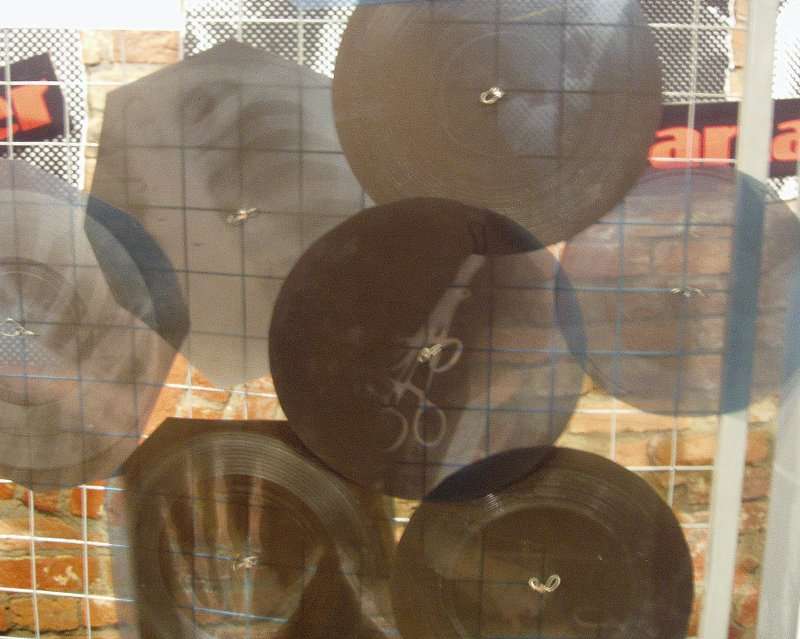
According to Wikipedia, a photograph by Dmitry Rozhkov depicts “Rock on Bones” displayed at the Vinzavod Gallery in Moscow, 2008.
My father Vladimir was recalling yesterday a relic from his youth in the USSR: people craved Western sounds—jazz and rock—but the authorities barred their distribution. Occasionally one could catch foreign shortwave broadcasts, yet capturing them proved difficult. And if a smuggled foreign LP happened to appear, duplicating it posed another challenge. Commercial tape recorders were not commonly accessible. People owned turntables, and some managed to assemble makeshift recording devices for LPs. But vinyl itself, the usual medium, remained out of reach for ordinary citizens.
So individuals found a workaround by making recordings on used X-ray films, such as the ones shown above. The tale has traveled to the West for years, and there is a recent book on the topic, Bone Music: Soviet X-Ray Audio, accompanied by a dedicated website. Here is an excerpt from that site:
The bootleggers’ first technical problem, that of obtaining a machine to record with was relatively straightforward. Literature existed explaining audio recording techniques (say in case a righteous citizen wanted to copy the speeches of Comrade Stalin) and various recording machines had been brought back from Germany as trophies after the second world war. These could be adapted or copied, but a further problem existed. The State completely controlled the means of manufacturing records. You couldn’t just go and buy the vinyl or shellac or lacquer needed in a store somewhere.
But at some point, some enterprising music lover hit on a genius idea. An alternative source of raw materials was available – used X-ray plates obtained from local hospitals. And that is where this story really begins. For many older people in Russia remember seeing and hearing strange vinyl type discs when they were young.
The discs had partial images of skeletons on them and were called ‘Bones’ or ‘Ribs’ and they contained wonderful music, music that was forbidden. The practice of copying and recording music onto X-rays really got going in St Petersburg, a port where it was … easier to obtain illicit records from abroad. But it spread, first to Moscow and then to most major conurbations throughout the states of the Soviet Union.
The term “Roentgenizdat” is of course cognate to “samizdat.” “Samizdat” was a combination of “self-” (“sam”) and the first two syllables of “publishing house” (“izdatel’stvo”). The “sam” was replaced by “Рентген,” often anglicized as “Roentgen,” which is the root for all things X-ray in Russian (after the discoverer of X-rays, Wilhelm Conrad Röntgen).
