
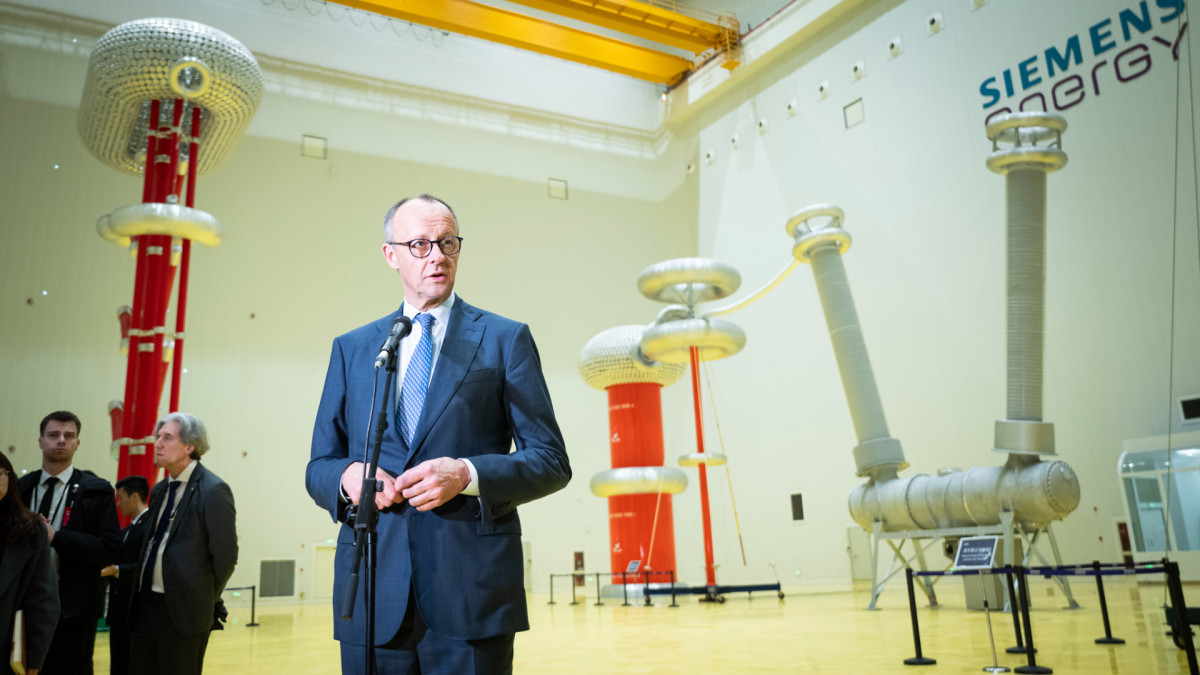
Friedrich Merz, the German chancellor, has contended that Germany needs “to work more and, above all, more efficiently”, and he ties that idea to growth, to the shortage of labor, and to the pressure of an aging population, in a context where his government wants to encourage retirees to stay active and tighten some mechanisms of the labor market.
The argument nearly verges on populism, since it rests on a simple intuition: if an economy stalls, you must work more. But it is risky to conclude that the German problem consists, in and of itself, merely in its workers putting in fewer hours at their jobs. And all of this without weighing whether citizens should be free to want to work less.
When Germany is compared with the twenty-one countries of the euro area, we do not see a lazy Germany, but a Germany with a different labor structure compared to its European partners. The issue is not only how many hours Germans work, but what results that model yields and to what extent the euro area average helps or misleads when we try to interpret the problem.
The broader picture seems to back Merz
If one looks solely at the overall average of usual weekly hours, Merz’s thesis gains immediate traction. In 2024, Germany records 35 hours per week, well below the euro-area average of 38 hours, and also clearly below Spain (37.6). Within the analyzed group, only the Netherlands has a lower average. Germany thus appears toward the lower end of the distribution.
“The political message being conveyed is that, if Germany wants to sustain its prosperity, its citizens need to work longer”
The historical comparison does not erase that impression. In 2008, Germany stood at 35.9 hours and in 2024 at 35.0. The drop is not huge, but it reinforces a persistently low position. One could therefore say that the German “laziness” is not new. Spain, in the same period, falls from 39.3 to 37.6 hours. In other words, it reduces its weekly average more, but it still remains above Germany. The average of the twenty-one countries considered falls from 38.9 to 38.0. Germany is below Spain, and also well below the bloc’s average reference.
Added to this is the concern about aging, generational replacement, and the forthcoming shortage of labor. The political message that emerges is that, if Germany wants to sustain its prosperity, it needs its citizens to work longer and for more years. Yet an aggregated average does not clearly distinguish between a country where full-time workers put in relatively little time and one where part-time employment carries a lot of weight.
When full-time and part-time hours are separated, the diagnosis changes
In full-time employment, Germany does not diverge far from the rest. In 2024 it reaches 40.2 hours per week, practically the same as Spain—also 40.2—and very close to the twenty-one-country euro zone average, 40.4. In 2008, Germany was even slightly above that average. Therefore, no German anomaly is observed in full-time work. If the full-time worker in Germany puts in a workday very similar to the Spanish one and close to the group’s average, then the low overall mean cannot be explained mainly by a lower intensity of full-time employment.
In 2024, the weekly hours of part-time employment in Germany rise to 22.2. Spain sits at 20.5 and the euro-area average at 21.7. Here Germany exceeds the group average. Moreover, between 2008 and 2024, the hours for part-time work rise strongly, from 18.5 to 22.2, far surpassing the growth of the average for the considered countries and also above Spain.
“The German peculiarity lies in the structure of total employment, in the mix between full-time and part-time employment, and in the weight that this structure has on the national average”
Therefore, the distinctive German trait does not seem to be that part-time workers have particularly short hours. In fact, compared with Spain, German part-time workers put in more hours. The German peculiarity lies, rather, in the structure of total employment, in the mix between full-time and part-time employment, and in the weight that this structure has on the national average.
Spain as a useful contrast
Spain proves especially useful to understand this point because it nearly represents the opposite case. In the total average, Spain remains above Germany. In 2024, 37.6 versus 35. But when full-time hours are considered, the gap disappears entirely, since both countries record 40.2 hours. That means that the difference between Germany and Spain is not in the length of the typical full-time workday.
Nevertheless, Spain shows a lower average for part-time hours: 20.5 hours, versus 22.2 in Germany, and moreover its decline in total weekly hours since 2008 has been greater. Spain works more weekly hours on average than Germany, but that does not automatically make it a more robust, more productive, or less vulnerable economy.
“If two countries have virtually the same full-time hours, but one shows fewer total hours, the question cannot be reduced to individuals’ willingness to work”
Furthermore, the Spain–Germany comparison makes us wary of moralistic readings about effort. If two countries have nearly the same full-time hours, but one shows fewer total hours, the issue cannot be reduced to individual will to work. There are institutional, sectoral, demographic, and social-organization factors that weigh more than any sermon about effort.
Finally, it should be emphasized that the German average being lower does not automatically equal failure. It may reflect a particular way of distributing work, balancing employment and leisure, or sustaining more flexible career trajectories. That organization can generate fiscal pressures and labor-supply concerns, certainly, but it also reflects social and institutional choices that are not well understood if they are reduced to mere lack of dedication.
The real German problem is not about hours
Therefore, Merz conveys a half-truth with an excessive simplification. It is true that Germany needs to bolster its aggregate capacity to work. It is currently an economy in stagnation, facing a labor shortage and pressure from the retirement of the baby boom generation, justifying attempts to incentivize pensioners to work and to raise labor-force participation.
The simplification comes when that objective is turned into a broad appeal to “work more”. The data do not show an anomalous Germany in full-time employment. The overall hours average masks the importance of the composition of employment between total and part-time.
If the principal problem were that full-time workers in Germany devote too few hours to their jobs, a reasonable response would be to lengthen the workday, but the data do not seem to indicate that. If the central issue is structural, then the remedies are different, such as facilitating voluntary extension of hours in some segments, revising incentives that cement part-time work, improving the availability of services for caregiving for dependents to raise the active population, retaining senior workers and, all of it, while maintaining productivity. Because an economy is strengthened not merely by stacking up hours, but also by making each hour produce more value.
On another plane, the Spanish economy may exhibit more hours on average, but that does not free it from known problems, such as weak productivity, inherited casualization, sectoral mismatches, and highly unequal job quality. Therefore, taking the difference in hours as definitive proof of virtue or failure leads to a shallow comparison. More hours do not automatically translate into better economic performance, just as fewer hours do not automatically equate to decline.
“Germany does not need so much a pedagogy of sacrifice as a strategy to reorganize and expand its labor supply efficiently”
The conclusion should be less moralizing and more economic. Germany does not need so much a pedagogy of sacrifice as a strategy to reorganize and expand its labor supply efficiently. And Spain should not complacently assume that simply working more hours will solve anything. When we move away from slogans and into structural analysis, the question stops being whether Germany works little. The question becomes what kind of economy allows a country to sustain prosperity, social cohesion, and competitiveness when demographics tighten and the production model needs redefining.
