
Miami Beach detectives questioned Raquel Pacheco at her house over her pro-Palestine Facebook comments. A judge ruled several key claims in her First Amendment lawsuit against the city can proceed.
A federal judge allowed portions of a First Amendment lawsuit brought by a Miami Beach woman against the city, its mayor, and the police chief to move forward, finding that she had plausibly alleged a city policy and practice of singling out criticism of Israel.
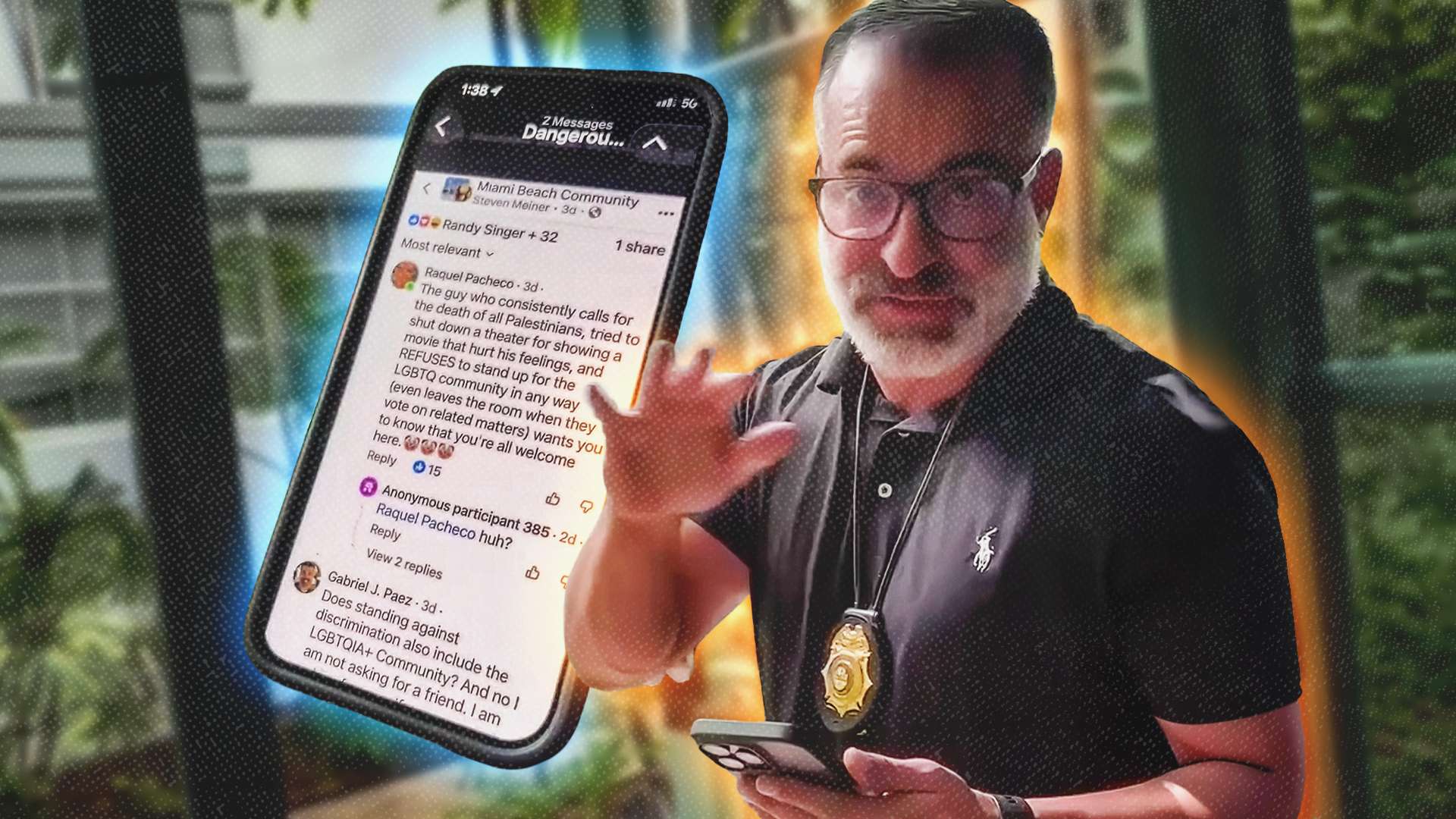
Raquel Pacheco, represented by the American-Arab Anti-Discrimination Committee (ADC), filed a civil rights suit in March naming Miami Beach Mayor Steven Meiner, Miami Beach Police Chief Wayne Jones, a member of the city council, and the municipality itself, asserting that her First Amendment rights were violated when two Miami Beach Police Department detectives were dispatched to her home to question her after a Facebook comment criticizing Meiner’s position on the Israel-Palestine conflict.
Chief U.S. District Judge Cecilia M. Altonaga granted the city’s motion to dismiss Pacheco’s lawsuit in part, striking several of her claims. Yet she ruled that Pacheco had sufficiently shown at this preliminary stage that her critique of Israel motivated Meiner to send officers to her residence and that the city had adopted a policy that discriminatorily disfavors pro-Palestine expression.
In a press release, Jenin Younes, ADC president and national legal director, called the ruling “a significant victory for Raquel Pacheco, for the First Amendment, and for all Americans who care about the right to free speech and dissent.”
“The City [of Miami Beach] downplayed what happened to Ms. Pacheco as a routine police visit,” Younes said. “The Court disagreed, recognizing that sending police to someone’s home to question and intimidate them over their protected political speech can itself violate the First Amendment.”
Video taken by Raquel Pacheco showed two Miami Beach Police Department detectives visiting her home on January 12 to question her about a Facebook comment that claimed Meiner “consistently calls for the death of all Palestinians.”
The detectives asked if she posted the comment, which appeared under a Facebook post by Meiner, who is Jewish, claiming that Miami Beach is a “safe haven for everyone.” The detectives warned that the comment could potentially “incite somebody to do something radical.”
“This is freedom of speech. This is America, right? I’m a veteran,” Pacheco told the officers.
“And I agree with you 100 percent,” one officer responded. “We’re just trying to see if it’s you, because if we’re not talking to the right person, we want to go see who the right person is.”
“We’re just trying to prevent someone else from getting agitated or agreeing with the statement,” one of the detectives told Pacheco. “We’re not saying it’s true or not.”
Pacheco refused to further answer the detectives’ questions.
After Pacheco’s video of the encounter went viral, Jones, the Miami Beach police chief, released a statement defending his decision to send the officers to her home, saying that “given the real, ongoing national and international concerns surrounding antisemitic attacks and recent rhetoric that has led to violence against political figures,” he had “serious concerns that her remarks could trigger physical action by others.”
However, there is a high First Amendment bar to clear to meet the legal standard for incitement. Under the test that the Supreme Court established in the landmark First Amendment case Brandenburg v. Ohio, the government must prove that the rhetoric incited violence or threats of violence and that the incitement was imminent, likely, and intentional.
The Foundation for Individual Rights and Expression (FIRE), a free speech group, sent a letter to Jones condemning the visit.
“The purpose of their visit was not to investigate a crime,” Aaron Terr, FIRE’s director of public advocacy, wrote. “It had no purpose other than to pressure Pacheco to cease engaging in protected political expression over concern about how others might react to it. This blatant overreach is offensive to the First Amendment.”
And it was the second time in recent months that Meiner and Miami Beach had drawn national criticism over allegations of First Amendment retaliation, and both cases involved Israel and Palestine.
Last year, Meiner tried to terminate the lease of a movie theater for screening an Oscar-winning documentary about the Israel-Hamas conflict. Meiner withdrew the bill after intense national and local criticism from free speech advocates.
Pacheco’s lawsuit pointed to the movie theater incident as evidence of a broader city policy targeting criticism of Israel.
“We’re in Miami, not Cuba,” Younes said. “The government does not have to arrest you, prosecute you, or formally censor you to violate the First Amendment. The chilling effect of these actions is obvious.”
The city of Miami Beach did not immediately respond to a request for comment.
