
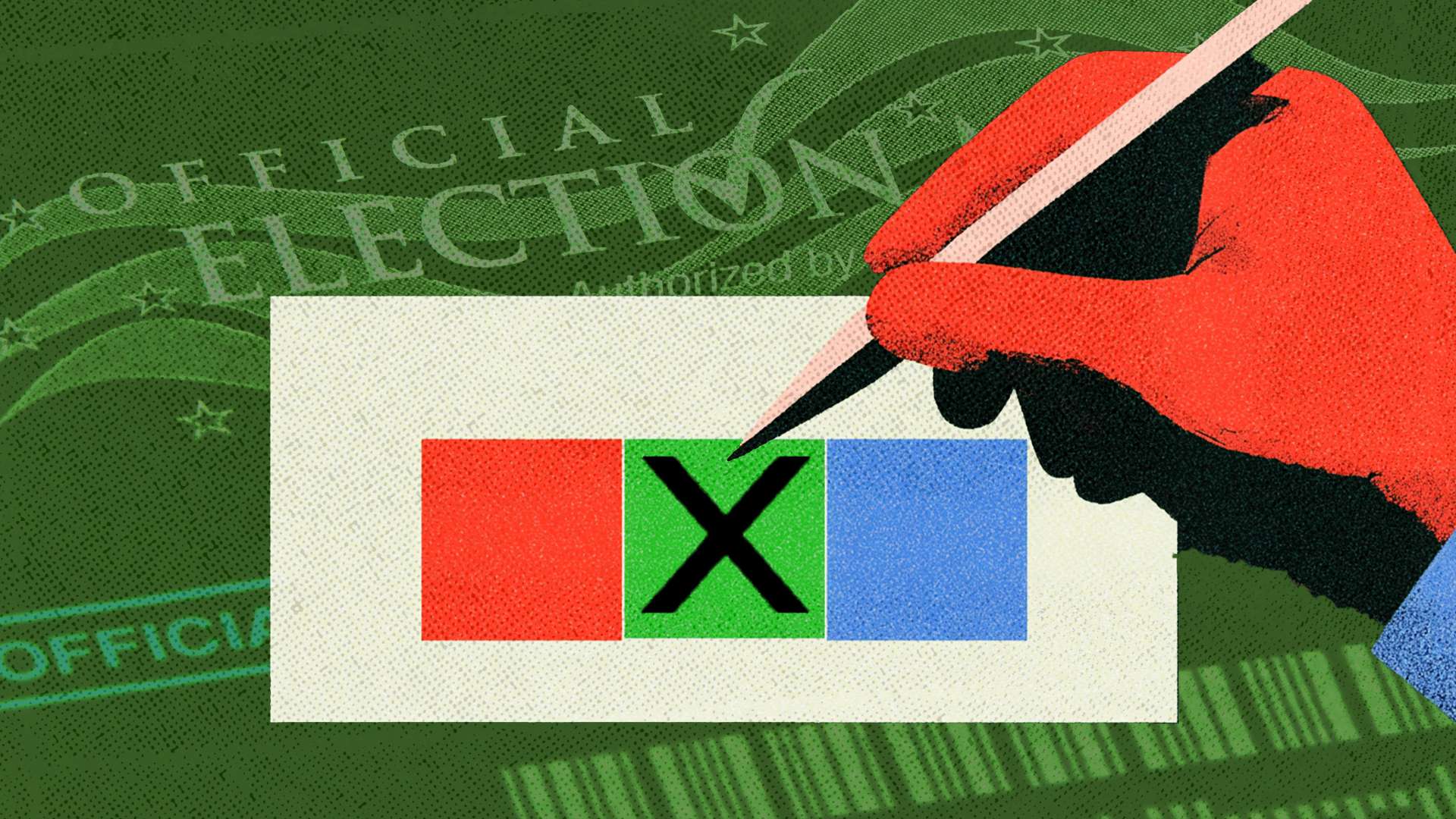
To the extent that polling can be trusted, the smart money suggests Democrats will win the forthcoming midterm elections, potentially seizing the House and perhaps the Senate. Regardless of whether that turns out to be correct, the result is likely to reflect a rejection of the losers more than an embrace of the winners. For years, American politics has grown driven less by enthusiasm for one party and more by hostility toward the other, especially among independents who decide elections. With support for the two major parties continuing to dwindle for decades, the midterms are likely to hinge on widespread revulsion rather than exuberant support.
Voters Are Motivated More by Opposition to the Other Party Than by Support for Their Own
According to Pew Research’s Steven Shepard, more than half of Americans still identify as either Republicans or Democrats. These steadfast partisans say they label themselves this way because they view their own party’s policies as beneficial for the country and see the other party’s policies as harmful.
“But many Americans don’t consider themselves Republicans or Democrats,” he added. “Instead, these Americans identify as independents (or with some other party) and many ‘lean’ toward one of the two major parties. For these Americans, opposition to the other party’s policies is more of a motivating factor than support for the policies of the party they lean toward.”
While 72 percent of Republicans and 67 percent of Democrats support their chosen party because they believe its policies help the country, slightly larger shares of each group—73 percent of Republicans and 75 percent of Democrats—say the opposing party’s policies are harmful for the country.
For independents who lean toward one party, opposition to the other side’s policies is the dominant driver.
Growing Ranks of Independents Mostly Motivated by Dislike
“Majorities of Republican leaners (56%) and Democratic leaners (64%) say a major reason they lean toward their preferred party is that the other party’s policies are harmful,” adds Shepard. “Relatively few Republican leaners (34%) and Democratic leaners (27%) say a major reason they lean toward their preferred party is the perceived good of its policies.”
That distinction matters significantly for elections and campaigning, because although supporters of the two major parties still form a majority of the electorate, that majority is slim.
“A record-high 45% of U.S. adults identified as political independents in 2025, surpassing the 43% measured in 2014, 2023 and 2024,” Gallup’s Jeffrey M. Jones noted in January of the firm’s ongoing surveys. “Meanwhile, equal shares of U.S. adults — 27% each — identified as either Democrats or Republicans.” Two decades earlier, Democrats and independents each accounted for 34% of the electorate, and 30% favored Republicans. In 1988, the first year for which data are available, Democrats stood at 36%, independents at 33%, and Republicans at 31%.
With independents making their choices largely on a basis of hostility toward one party or the other, even as they grow in number, elections are increasingly decided by rejecting disliked candidates rather than by backing those who win. The rise of negative, affect-driven polarization has been a long-running trend in politics.
The Rise of Politics Powered by Animosity
“While previously polarization was primarily seen only in issue-based terms, a new type of division has emerged in the mass public in recent years: Ordinary Americans increasingly dislike and distrust those from the other party,” states a 2019 paper in the Annual Review of Political Science. “Democrats and Republicans both say that the other party’s members are hypocritical, selfish, and closed-minded, and they are unwilling to socialize across party lines. This phenomenon of animosity between the parties is known as affective polarization.”
We observe this in practice when partisan Republicans and Democrats report being more motivated by hostility to the other party’s positions than by affection for their own, as Pew has found. It becomes even more evident as the ranks of independents grow, with motivation driven largely by such dislike.
In a 2019 analysis of American politics, Daniel Schlozman of Johns Hopkins University and Sam Rosenfeld of Colgate University argued that “today’s parties are hollow parties” and that “more than any positive affinity or party spirit, fear and loathing of the other side fuels parties and structures politics for most voters.”
Such hostility has fostered geographic sorting as people relocate to places where they feel politically aligned. In 2024, The New York Times reported that when Americans move, “Republicans choose neighborhoods Donald J. Trump won by an average of 19 percentage points in 2020, while Democrats select neighborhoods President Biden won by the opposite margin (also 19 points).”
Americans make these tribal migrations in an atmosphere dominated by repulsion rather than attraction. In May, Pew found that 58 percent of U.S. adults view the Republican Party unfavorably and 59 percent dislike the Democratic Party. At 26 percent, “the share of the public holding unfavorable views of both parties is higher than it was several years ago.”
The Spoils Will Go to the Non-Loser
Affective polarization—choices informed by hostility—has undoubtedly intensified the divide between partisans of the two major parties. Yet it is perhaps even more influential among the plurality of voters who do not identify with either party but sway elections by strongly disfavoring one side over the other. Given that the battleground centers on which group has voters driven by intense distaste, campaigns increasingly rely on negative messaging and demonization to persuade those voters.
“We are, and have been for quite some time, at the point where the two opposing entities are systematically and intentionally undermining each other’s legitimacy,” warned Syracuse University political science professor Johanna Dunaway last year.
After the midterms, either Democrats or Republicans will declare themselves the winners. Yet the outcome will be less about voters embracing the victors than about their rejection of the losers. The party that gains more seats will claim a mandate for its policies, but the underlying reality is that Americans merely dislike that side a little less than the alternative.
