
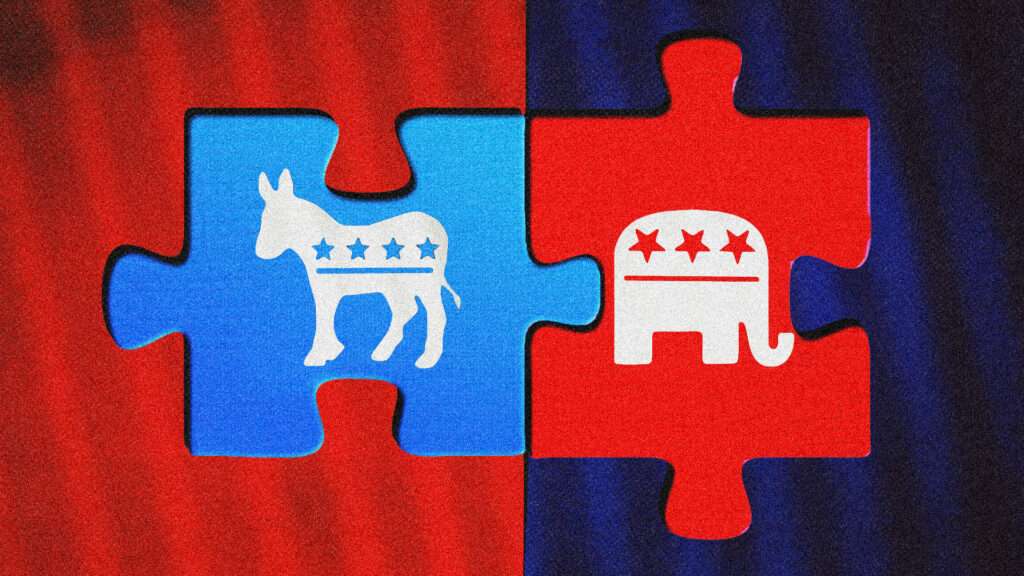
Democrats openly embrace socialist ideas as the GOP pushes for greater state direction of the economy.
In a country often cited as home to the world’s most successful market-based system, it isn’t unreasonable to hope that at least one major party will champion a framework grounded in relatively free and voluntary exchanges. Yet the midterm elections present Americans with a choice between a party that openly labels itself as socialist and another that increasingly endorses government-led economic activity in pursuit of nationalist aims. Not every candidate running as a Democrat or Republican subscribes to their party’s statist shift, and there are certainly other issues separating the two dominant factions. But if you’re seeking steady advocacy for economic liberty, you won’t find it in either of the two big parties.
You are reading The Rattler from J.D. Tuccille and Reason. Get more of J.D.’s commentary on government overreach and threats to everyday liberty.
Open Socialism versus Nationalist Economic Control
The shift in the Democratic Party’s policy preferences from a heavily regulated market economy to outright government control has been well chronicled, but it is useful to call attention to Eric Bradner’s August CNN piece about “a growing list of victories by democratic socialists who are a prominent part of the Democratic Party’s left-wing insurgency.”
Before winning the office of mayor of New York City, Zohran Mamdani urged “seizing the means of production,” a stance echoed by congressional candidate Darializa Avila Chevalier. The Democratic Socialists of America (DSA), which backs many of the newer generation of officeholders and campaigns and coordinates their insurgency, touts its alignment with the totalitarian regimes in Cuba and Venezuela. Just a year earlier, it dispatched “a delegation of 40 DSA elected leaders and rank-and-file members” to Havana to learn “about the achievements and challenges of Cuban socialism.”
With 65 percent support for socialism in Gallup polling, more Democrats favor a state-directed economy than back capitalism (35 percent)—though the seemingly odd tie in favorability toward free enterprise (also 65 percent, but on the decline) suggests the public’s understanding of these ideas could be improved by better education.
Republicans publicly advocate quite different economic preferences, with only 14 percent endorsing socialism, while 86 percent support free enterprise and 75 percent view capitalism positively. Yet when CNBC’s All-America Economic Survey asked whether the government should own stakes in private companies, “66% of Democrats found it inappropriate for the U.S. to take equity stakes in American companies, while only 34% of Republicans agreed.”
That stance likely reflects the Trump era, during which the federal government has been snatching a share of the action from tech and natural-resource firms—about 40 companies so far—and party stalwarts are inclined to go along as long as the very word “socialism” isn’t used to describe the arrangement. Instead, it is presented as a top-down push to nurture domestic jobs and manufacturing.
Two Parties With a Similar Taste for Government Economic Intervention
“American political leaders on the left and right are rebelling against the market-first consensus that dominated Washington for four decades,” concluded Axios writers Courtenay Brown and Neil Irwin in July. “It shows up in everything from the Trump administration’s government stakes in dozens of private companies to socialist candidates winning Democratic primaries who pledge a more active role for the government in the economy.”
A glimpse of a socialist future appears not only in the rising cadre of openly socialist Democrats, but also in the GOP’s emerging figurehead and Vice President J.D. Vance’s repeated critique of free-market economic thinking and its emphasis on private choice.
“Do we serve pure, unfettered commercial freedom?” he asked in First Things in 2019. “Or do we pursue something higher? And are we willing to use political power to actually accomplish those things?”
In a June interview with The Daily Wire’s Michael Knowles, Vance returned to the theme, criticizing economist Milton Friedman’s market-centric ideas and calling for a state-directed and Christian-infused “American developmentalist” approach to break free from a hyper-globalized economy.
“The policies supported by both major parties signal a growing embrace of state ownership of the economy,” warns economist Daniel J. Smith for the American Institute for Economic Research. “The Overton Window—the spectrum of what is considered acceptable policy—has shifted toward greater government direction of the economy, with some conservatives and voters now treating partial state ownership as a tolerable function of government.”
Smith notes that economist F.A. Hayek observed such tendencies among both right- and left-wing authoritarians in the 1930s. This is part of why Hayek dedicated The Road to Serfdom “to the socialists of all parties.”
Rejecting Free Markets Means Losing Liberty and Prosperity
Why this matters is underscored by Smith’s recent research into the link, or sometimes the lack thereof, between socialism and political liberty: “The record, going back to 1789, is clear. High levels of political freedom do not endure alongside extensive state ownership of the economy.”
The point is reinforced by the prominent socialist author Robert Heilbroner’s admission in his 1986 book, The Nature and Logic of Capitalism, that “political freedom in modern times…has only appeared in capitalist states.” He added that “democratic liberties have not yet appeared, except fleetingly, in any nation that has declared itself fundamentally anti-capitalist.”
Additionally, as Fraser Institute’s recent Economic Freedom of the World: 2026 report emphasizes, “economic freedom tends to be linked with better outcomes.” The report notes strong correlations between free-market economies and higher GDP per capita, greater average income for the bottom 10 percent, lower poverty, longer life expectancy, and lower infant mortality. As with the other sources cited, it finds that personal freedoms—speech, assembly, and religion—are highly correlated with economic freedoms.
Thus the benefits of having a major political party that believes in free markets with minimal government interference extend beyond broader electoral choice to policies that foster liberty, prosperity, and well-being. Unfortunately, both the Democratic and Republican parties are retreating from economic liberty and embracing government control over how we produce, work, own, buy, and sell. Democrats’ explicit embrace of socialism, and Republicans’ preference for state management and ownership over free markets, portend a future of diminished freedom and reduced wealth.
Perhaps Americans would vote against socialism—both the open kind and its nationalist variant—if they had a real choice. But finding a true free-market option on the ballot has become increasingly difficult.
