
“I think courts are going to be very suspicious of how broad this is,” one Minnesota lawyer tells Reason.
On the morning federal immigration agents opened fire on Alex Pretti from behind, Emmanuel Mauleón, a law professor at the University of Minnesota, was on a ladder outside his house taking down his holiday decorations. That moment triggered a cascade of alerts on his phone. Pretti’s death would rapidly become a nationwide news item, happening not long after the killing of Renée Good and marking the second time in less than a month that federal officers in Minneapolis had shot an American citizen on a public street. The outcry pushed the Trump administration to rethink its aggressive deportation program, led to a reshuffling of people in charge of those efforts, and sparked congressional hearings and investigations that are still ongoing. Before video of Pretti’s death circulated widely on social media and across outlets worldwide, many residents of the Twin Cities learned of it the same way Mauleón did: through urgent notifications on their phones. For weeks, a sprawling, informal network of group chats—primarily using the encrypted messaging app Signal—played a crucial role in public response to what the Trump administration termed “Operation Metro Surge.” The operation deployed thousands of ICE officers and other federal law-enforcement personnel, assigned to apprehend and deport undocumented immigrants. Their tactics were blunt and aggressive, as warrant requirements were often ignored and accusations of racial profiling and unlawful arrests surfaced.
In response, those decentralized Signal chats turned ordinary Minnesotans into modern-day Paul Reveres. Participants shared tips about ICE activity, warned local businesses about possible raids, helped track agents and vehicles around the city, and organized legal assistance for detainees. On January 24, those networks lit up with footage showing federal agents pepper spraying, tackling, and shooting Pretti multiple times. “My phone started blowing up with videos from Signal and then finally the news,” Mauleón recalls. “I remember being stunned and standing on the top [of the ladder] for too long, worried about my footing.” It has been more than seven months since Pretti’s death and nearly as long since Operation Metro Surge ended. Across Minneapolis, however, it can feel as though little time has passed. Many bars, restaurants, and coffee shops post notices telling ICE agents they are unwelcome. Some signs explicitly require a warrant. Anti-ICE messages dot front lawns and sidewalks. Mauleón calls it “the residue of resistance.” The chats are part of that residue as well. A friend opens Signal and scrolls through several active chats while we watch a soccer game at a bar on Nicollet Mall in late June. The federal occupation remains a topic of the present tense. Those same chats now lie at the center of another story.
In a 94-page indictment filed in June, the Department of Justice charged 15 protesters with participating in a conspiracy to disrupt federal immigration enforcement and law-enforcement operations. The alleged conspiracy was coordinated through “social media, text messaging, and encrypted messaging applications, such as Signal,” the indictment explains, “with the goal of preventing, hindering, delaying, and impeding the enforcement of federal immigration law.” The defendants have pleaded not guilty. Has the Trump administration finally brought antifa to justice? In a statement, the White House called the indictment “a crushing blow” to the “domestic terrorist organization.” Those who took part in or supported the protests against immigration enforcement during Operation Metro Surge describe it differently: a chilling crackdown on Americans’ First Amendment rights to speak and organize with neighbors, friends, and coworkers against the federal government’s violent behavior.
More Than a Few ‘Far-Left Agitators’ The week before Pretti’s death, Border Patrol Commander Gregory Bovino was asked about the response he had seen to ICE’s operations in the Twin Cities. Operation Metro Surge was the latest in a string of similar efforts that had played out in several American cities during Donald Trump’s first year back in office. Bovino had been a principal actor in planning and executing them. He clearly relished his role as the public face of the operations. Bovino strode through snowy Minneapolis in a leather trench coat and clashed with protesters—in one widely circulated clip, he hurls a tear-gas canister into a jeering crowd. “We’ve been in many cities, as you know. We’ve been in Los Angeles and Chicago, Charlotte, New Orleans, and now, obviously, Minneapolis,” Bovino told reporters. “What we’ve seen that’s a bit different here is the organization of some of the groups. The groups are a bit better organized.” Months later, Luis Argueta, the communications director for Unidos MN, a nonprofit that played a pivotal role in organizing protests and resistance in Minnesota, recalls feeling proud when he heard that line. “It was the height of compliments,” he says. Beginning last year, Unidos MN and a sister organization, Monarca, began offering what they call “legal observer trainings.” The trainings focused on informing people of their rights and the rights of anyone targeted by immigration enforcement, as well as what law enforcement is and isn’t allowed to do. By the time Operation Metro Surge began in December, the groups had already hosted about 40 formal events at schools, churches, and other community venues, explains Mike Urbanski, who helps lead Monarca’s legal-observer trainings. Attendance ranged from dozens to hundreds. Interest surged after the federal crackdown started. Urbanski says the group held around 90 additional trainings between December and March, reaching about 15,000 people. One Roseville event, a small city right next to Minneapolis, drew more than 1,300 people. Throughout the trainings, Monarca stressed “the nonviolent nature of this work and our right to do it.” Those trainings were also where many Signal groups and other chats took root. “As the surge began and the incredible local organizing went into overdrive, we realized we were getting a lot of people at our events who were trying to figure out how and where to plug in,” Urbanski notes. “So we also added more information about other ways to be involved, and how to get connected” to local group chats. These networks were messy, informal, decentralized—and effective. “There were a bunch of broad chats, and then there were heavily localized chats for each neighborhood in South Minneapolis,” says Jack Nobles, a stage manager who lives near Powderhorn Park, not far from where Good and Pretti were shot. “It’s been the only way we can communicate,” Nobles says. He adds that social media platforms like Facebook and X have become “worthless” for organizing protests because of recent changes. When Good was shot in the face at close range, the neighborhood chat lit up. Nobles was on the scene within minutes. Thousands of others showed up as well. But the protests were effective not only as a reaction to the killings and other abuses by federal immigration agents. Unlike the demonstrations in June 2020 after George Floyd’s death, these protests did not devolve into mob violence. Networks that formed after those protests were reactivated and strengthened. A Human Rights Watch report published in June highlighted how people mobilized school-safety patrols, grocery-delivery services, ridesharing and accompaniment to work, school, and medical appointments, and rental and other financial support for those who had lost income. It also highlighted more spontaneous acts: a church opening its doors to pepper-sprayed neighbors to help flush their eyes; a trauma therapist offering a home visit to a neighbor whose car window had been smashed by federal agents; a bar owner encouraging patrons to support a neighboring cafe whose sales had dropped after Operation Metro Surge began. Residents took on different roles. Some actively tracked ICE agents and other federal personnel, sharing license-plate information of unmarked cars and sounding the alarm when agents gathered for a raid. Others joined mass protests in downtown Minneapolis and at the Bishop Henry Whipple Federal Building, a sturdy cinder-block structure near the Minneapolis–St. Paul International Airport where detainees were held during Operation Metro Surge. “I think people’s understanding of and willingness to trust government narratives were certainly out the window,” Mauleón says. “I think even people who might have been more critical of local policing understood that this was a different type of force, more indiscriminate.” Without this level of organization—no “observer” trainings, no Signal chats, no neighborhood networks—the killings of Good and Pretti might not have been broadcast to the world so quickly. In that alternate reality, the administration’s lies about those incidents might have gone unchallenged. The Trump administration had previously swept through Chicago, Los Angeles, and other cities, but Bovino wasn’t the only one who recognized something different about Minneapolis. When Vice President J.D. Vance visited the city on January 22, two days before Pretti was killed, he remarked on the “very unique, very Minneapolis-specific reaction to our enforcement of federal immigration laws.” Vance blamed “a few very far-left agitators” for that reaction and pledged to stay the course. In the following weeks, the effectiveness of Minnesota’s anti-ICE protests became clearer. Bovino was reassigned, while Homeland Security Secretary Kristi Noem, who had championed the tactics used in Minnesota and elsewhere during the first year of Trump’s second term, was sidelined. Soon after taking Bovino’s place, Tom Homan, the administration’s border czar, ended Operation Metro Surge. The Department of Homeland Security claimed to have made 4,000 arrests (three-quarters of them without criminal records). Two people were killed. The price was steep, but the federal pushback receded.
Where Is the Puppet Master? There is a romantic version of this story in which the group chats sprang up spontaneously as a neighborly response to a siege—the product of people in the Twin Cities, where the cold and the culture mix—creating a network capable of moving thousands into the streets to protest a federal crackdown on immigration without violence. Argueta chuckles at that narrative, which has appeared in some national coverage. But the truth is more layered. This took organized effort. “We worked in coalition with faith groups, with unions, with other community groups,” he says of Unidos MN and Monarca’s efforts. Without that coalition-building, his staff of 20 could not have been so effective. The underdog story is therefore more intricate than it appears at first glance. According to its latest tax filings, dating to 2024, Unidos MN is largely funded by Tending the Soil, a left-leaning grantmaking organization that supports various economic and social-justice programs. The New York Post has accused it of taking money from “left-wing billionaire donors” determined to undermine Trump. Some of Unidos MN’s funding comes from the state of Minnesota: Tending the Soil and Unidos MN received $9 million via a state grant approved in 2024. Asked about that, Argueta emphasizes that Unidos MN is not funded with federal dollars—an important distinction in an era when many leftist organizations recently lost federal funding. “We have a sustainable membership model, where regular people donate, and we’re able to fund ourselves through the contributions of regular Minnesotans,” he says. Political realities aside, the Twin Cities are a strongly blue, highly educated, and unionized place with a sizable immigrant population. It isn’t illegal for like-minded individuals to organize. Yet the Trump administration has aimed to turn such organizing into a crime. In January, federal authorities launched “Operation Puppet Master,” a sweeping investigation into groups—mostly unions and left-leaning nonprofits, including Monarca—that were trying to mobilize Minnesotans in response to the federal crackdown. Defense lawyers for the so-called Minnesota 15 obtained information and filed briefs showing that undercover agents posing as protesters spied on meetings at churches, parks, libraries, schools, and union halls. They infiltrated Signal group chats and built a database of Minnesotans who had committed no crimes. In one case described in court documents, “agents captured license plate information of attendees during a meeting of anti-ICE protesters and activists,” then used that information to obtain names, social media accounts, and other personal details—all of which is now “memorialized in a [Department of Homeland Security] dossier.” (The Roseville church meeting, which may have been the Monarca training that drew 1,300 people, cannot be confirmed from publicly available information.) Much of this appears to have been done on orders that originated at the top. Mauleón recalls the Trump administration labeling Good and Pretti “domestic terrorists” within moments of their deaths, before any investigation could begin. He also remembers FBI Director Kash Patel telling a conservative podcaster, Benny Johnson, in January that the agency would be investigating the group chats and community organizing efforts based in Minneapolis—publicly identifying them as investigative targets before any wrongdoing had been established. In a memo first reported by The New York Times in March, senior Department of Justice officials were told to “go big and go loud” in investigating protesters in Minnesota. Prosecutors were advised to employ National Security Presidential Memorandum 7, the document signed by Trump in September 2025 that authorizes federal law enforcement to target groups engaged in “domestic terrorism and organized political violence”—and, specifically, antifa. In short, multiple federal agencies and departments were mobilized to secretly surveil Americans, at the urging of senior administration officials, in response to those Americans exercising their constitutional right to protest.
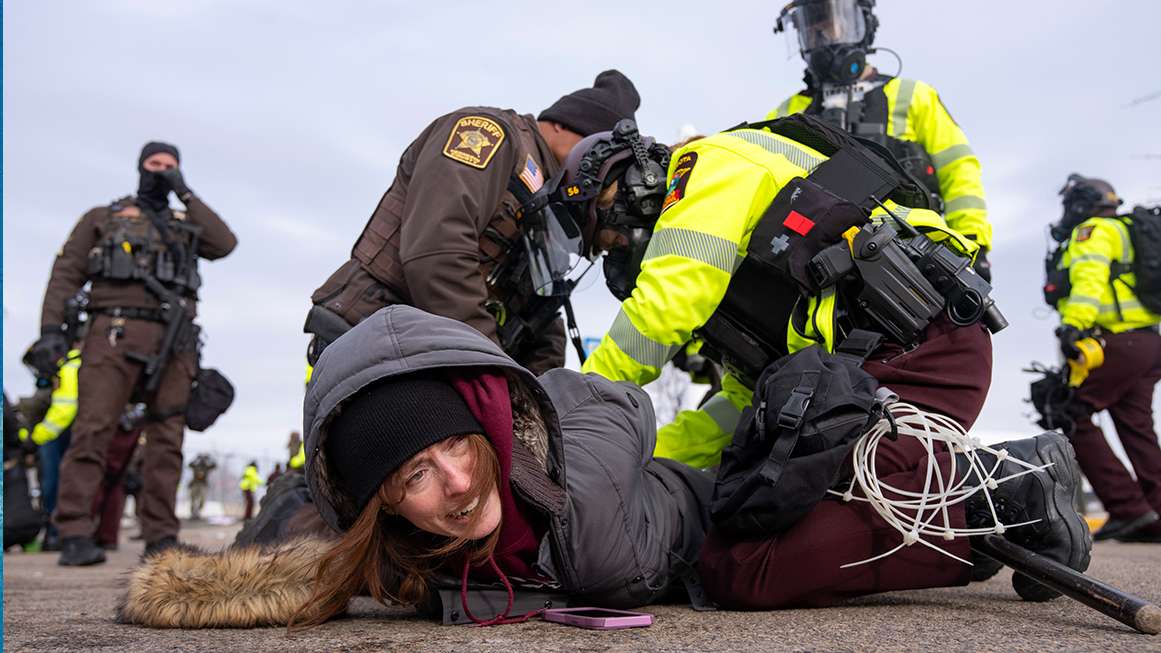
If the feds are chasing a conspiracy, they may be aiming in the wrong direction. The photograph of a protester detained by Border Patrol agents in Minneapolis on January 8, 2026, captured by Michael Nigro/Sipa/A.P., underscores the stakes. The investigation seems to have led directly to the charges filed in June. Yet despite how the Trump administration framed it, the 94-page indictment does not reveal a frightening domestic-terrorist operation—antifa or otherwise. In fact, the indictment contains few examples of violence that might be described as actual acts. Two of the 15 named individuals are charged with assaulting a federal officer. One of them, William Morgan, is also charged with “destruction of government property”—for kicking and denting a pickup truck. Other targets face charges of making threats against federal officers (based on extensive material drawn from Signal chats and other electronic communications), stalking, and participating in a “conspiracy” to disrupt federal immigration operations. Eleven of the 15 defendants face nothing more serious than conspiracy charges. Prosecutors allege that these 15 individuals engaged in “coordinated violence targeting federal law enforcement officers in an effort to cause chaos and impede law enforcement operations,” mostly around the Whipple building. The indictment contains few concrete examples of violence. The protesters coordinated “anti-law enforcement action,” used counter-surveillance techniques, and practiced “counter-surveillance tactics” by identifying and following vehicles used by ICE agents and other immigration-enforcement personnel. It’s worth noting, in light of the “Operation Puppet Master” disclosures, that officers who spied on protesters—let alone those who shot Good and Pretti—have faced little accountability for their actions. Even the assault charges appear questionable. During the press conference announcing the charges, U.S. Attorney Daniel Rosen was asked whether any federal officers were injured during the alleged assaults. He declined to answer. He also struggled to explain how prosecutors linked the protesters to antifa. “I seem to be indicted for holding meetings,” one defendant told the judge during a pretrial hearing, according to The New York Times. As The Verge summarized the indictment, “the DOJ is trying to punish people for trailing ICE officers—and if it succeeds, other activists could be next.” The potential penalties are severe. Those convicted of the conspiracy charges could face six years in prison. The two protesters charged with assault could receive more than a decade behind bars. The Trump administration has used a similar playbook in other cities where protesters clashed with immigration enforcement agents, with mixed results. In Chicago, felony conspiracy charges were brought against six protesters before a judge dismissed the case for prosecutorial misconduct. Elsewhere, protesters have been convicted and sentenced to years, and in some cases decades, in prison. In Minnesota, Rosen’s office has drawn criticism for rushing to indict protesters and for failing to hold immigration agents accountable. In January, for example, Rosen quickly charged Julio Sosa-Celis, who was accused of assaulting an ICE officer before being shot by that officer. Noem called it “an attempted murder of federal law enforcement.” When video of the incident surfaced, it contradicted much of the official account. Rosen dropped the charges against Sosa-Celis but initially refused to charge the ICE officer who fired the shot and misled investigators. (The agent, Christian Castro, was charged with assault and falsely reporting a crime by Minnesota prosecutors. He was arrested in Texas in May and released in August after Texan authorities declined to extradite him to Minnesota.) Acts of violence deserve punishment in the criminal justice system, of course. But allegations of violence also deserve substantial skepticism. The Trump administration seems determined to indict protesters while turning a blind eye—or even giving a nod—to violence carried out by immigration officials. Are the feds interested in upholding the law, or simply in silencing dissent? That’s How They Get You. There are two ways to view the indictments, Mauleón notes, as we sit outside Wildflyer Coffee, another Minneapolis spot whose front door still bears the marks of the anti-ICE protests. From a strictly criminal-justice perspective, the indictment appears “incredibly padded.” As with any conspiracy case, the prosecutors have to do a lot of “narrative work….You have to suggest that there’s this broad conspiracy against the government and you rely on the chats and the communication and coordinated planning. And then it results in some sort of action, or it’s supposed to result in some action.” “The most generous way I can put it is that [the indictment] has the appearance of political motivation,” Mauleón says. Nobles is less charitable. “That’s how they get you,” he says. “Conspiracy charges are hard to beat.” Then there is the political angle. The indictment is “the latest attempt by the Trump administration to criminalize its opponents,” wrote Elizabeth Weill-Greenberg in The Appeal, a publication covering criminal justice and civil-liberties issues. “The case tests how far prosecutors can go to manufacture a criminal conspiracy based on group chats, social media posts, discussions of protest tactics, and anti-surveillance precautions.” The Foundation for Individual Rights and Expression (FIRE) has noted that even aggressive forms of speech—“like crowds telling ICE agents to kill themselves in the heat of a protest”—are constitutionally protected. The Trump administration “really wanted to make it clear to everyone that these 15 people essentially represented some kind of worst of the worst. But the reality is that these people don’t define the tens of thousands who acted peacefully,” argues Argueta. The Constitution is clear, he adds. “We have the right to peaceful and nonviolent protest. We have the right to observe and organize.” Indeed, the notion of training everyday people to know their rights and resist an overbearing federal government would have, not long ago, been more at home on the political right. In some sense, what Unidos MN and Monarca have accomplished in Minnesota resembles the Tea Party protests during the Obama era. Both were grassroots efforts backed by politically motivated donors and nonprofits. Both were decentralized campaigns rooted in Americans asserting their constitutional rights in response to perceived executive overreach. Both faced claims of political motivation and a desire for anti-government violence. (Not everyone will like that comparison, but it captures a truth.) A federal crackdown can accomplish only so much. There were “tens of thousands of people involved in mutual-aid networks and Signal chats, and tens of thousands trained as constitutional observers,” Mauleón notes. What exactly do the feds intend to do next? Indict 10 percent of Minneapolis’s population for participating in a conspiracy? “I think courts are going to be very suspicious of how broad this is,” he warns. Talking with friends, family, neighbors, and coworkers is not a crime. Neither is organizing with them to observe the government, exercise constitutional rights, and watch out for one another. Those traditions stretch back to the founding and remain a vital check on power. “I believe the only solution is to organize more,” Urbanski concludes. “We have seen how there is strength in numbers and in solidarity—not strength to resist with violence, but strength to resist with peace, and with witnesses that provide the evidence of the government’s lies.”
