
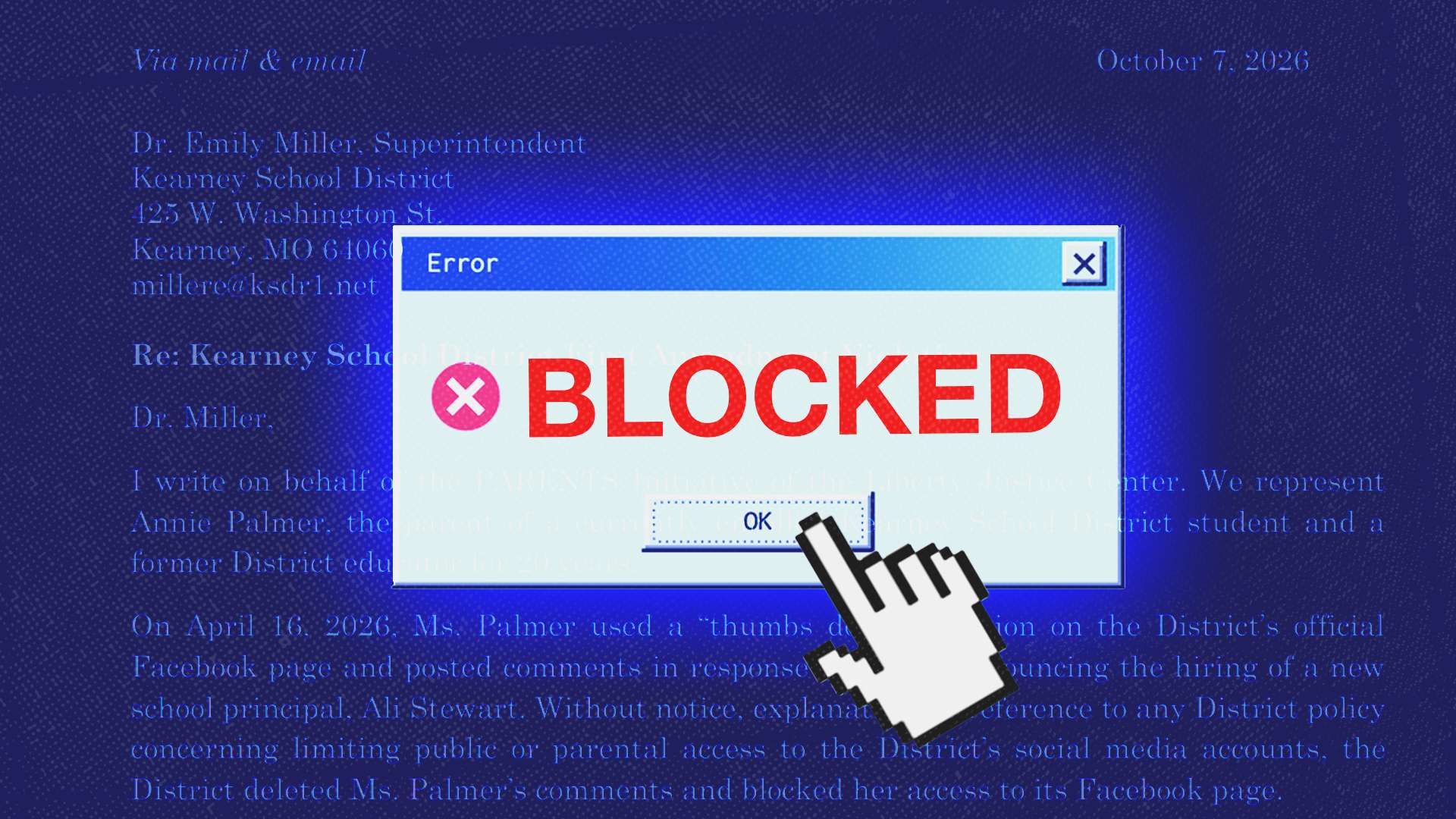
Annie Palmer found herself barred from the district’s Facebook page after she voiced her disagreement with the selection of a new elementary school principal.
In April, the Kearney School District in Missouri announced the appointment of a new principal for Southview Elementary School: Ali Stewart, who had served as the district’s director of curriculum and instruction since 2023. Palmer, a district parent and former teacher who had collaborated with Stewart, did not believe Stewart was the right fit for the role. When she saw the announcement on the district’s Facebook page, Palmer reacted with a thumbs-down symbol to express her disapproval.
Perhaps it was described as a “sad-face” by Ray Weikal, the district’s director of communications and community relations, in an email to Superintendent Emily Miller. We cannot be certain, because Weikal later deleted Palmer’s reply. He also removed her from the KSD Facebook page, seemingly unaware of the First Amendment implications of such action.
Timothy Snowball, senior counsel at the Liberty Justice Center’s PARENTS Initiative, underscored those implications in a letter he sent to Miller on Wednesday. He argues that “government officials violate the First Amendment when they restrict constituents’ access to official social media accounts” for opinions that may offend them. He also notes that the Eighth Circuit, which includes Missouri, has “acknowledged that blocking a constituent from a government-operated social media page based on the viewpoint expressed is unconstitutional.”
Weikal appeared not to grasp those considerations, opting to censor Palmer and penalize her for expressing a dissenting view. “I was with Ali,” KSD Data Coordinator Tami Thomas texted Weikal on April 16, according to a message Palmer obtained through a public records request. “and she mentioned that Annie Palmer put a sad face on the Facebook announcement. It was upsetting! Any way you can delete that???”
Weikal was eager to assist. “Of course!” he replied. “That pisses me off. I’ll probably ban her from the page for a while.” Later he shared an update with Thomas: “I had to delete the post and then block her. Now I will reshare it.”
Thomas thanked him. “Good job by you Ray Weikal!!!” she wrote. “I appreciate you!!!”
Palmer’s response, however, was different. Palmer “reached out because she could not access the district Facebook page,” Weikal reported in an August 18 email to Miller that Palmer obtained via the same public records request. “When I looked into it, I realized that I had previously blocked her account following a sad-face reaction she placed on our April 16 post announcing Ali Stewart as the new principal at Southview Elementary.”
When Palmer inquired, Weikal said he had “removed the restriction.” He explained that he had told her her account had been restricted after reacting to a district post and that, after reviewing the situation, he concluded the restriction had not been warranted. He conceded that “blocking her over that reaction was a judgment call I made at the time, and in retrospect it was the wrong call.”
From Weikal’s perspective, the mistake had already been corrected by restoring her access. Yet Palmer pressed for details: “which post and reaction led to the restriction, approximately when the restriction was placed, what district social media policy or moderation guideline was used to make the decision, and whether restricting someone based solely on a reaction to a district post is or was standard district practice.”
Snowball has similar questions. “By restricting Ms. Palmer’s access to an officially run social media page because a district employee took offense at a thumbs-down emoji—an evident and quintessential expression of a political view on a matter of public concern—the District violated the First Amendment,” he wrote in his letter. “This conclusion is supported by the District’s own written policies—or the absence thereof—which contain no explicit provision protecting the First Amendment rights of parents to access the District’s social media accounts.”
Snowball cites Lindke v. Freed, a 2024 Supreme Court decision in which the Court unanimously held that a government official who possesses actual authority to speak on the state’s behalf and who used social media in that capacity can be subject to First Amendment claims under 42 U.S.C. 1983 when he blocks a critic. Although the case involved a city manager’s Facebook page used for both personal and official purposes, which made applying the Court’s “state action” test tricky, the Court’s ruling suggested that censoring Palmer on a district’s official page constitutes state action.
Snowball also points to the Eighth Circuit’s 2024 ruling in Felts v. Green, which involved a critic who was blocked on Twitter by the president of the St. Louis Board of Aldermen; the appellate court upheld a district court’s decision granting declaratory relief, nominal damages, costs, and attorney’s fees.
In light of these precedents, Snowball maintains that the district should do more than merely restore Palmer’s access. “The District has offered no justification, no plan to adopt a policy to prevent this from happening to other parents, nor any pledge that it won’t recur if Ms. Palmer shares her views on the District’s Facebook page,” he writes.
Snowball seeks “a written assurance” that neither Palmer nor any other member of the public will be “restricted from accessing the District’s social media accounts on account of their viewpoint or protected expression.” He also urges the district to begin the process of adopting a written policy governing all district social media accounts that acknowledges the First Amendment rights of the public. He asserts that all district staff should be trained to respect those rights and warns that failing to address these issues promptly could invite legal action against the District.
What steps the district plans to take remain unclear. I tried contacting Weikal for comment and left messages, with the intention of updating this article if I receive a reply.
“Citizens should be free to express themselves about public officials for any reason, and an emoji certainly falls under expressive conduct,” Snowball wrote in an email. “If the district delegated the authority to block people from access to an official Facebook page, that is constitutionally troubling. If there is no policy or training informing employees about their legal duties, that is also troublesome.”
As of now, KSD parents have not been promised that such a scenario cannot recur. Snowball emphasizes that the aim is to compel the district to rectify these issues, primarily by clarifying and aligning its policies with the First Amendment and by ensuring that employees understand their duties. He notes that criticism of public officials occupies a foremost place in First Amendment protections.
