
A federal judge concluded that Montana’s limits on AI-generated political messaging probably infringe the First Amendment.
States’ efforts to regulate election deepfakes continue to collide with First Amendment protections.
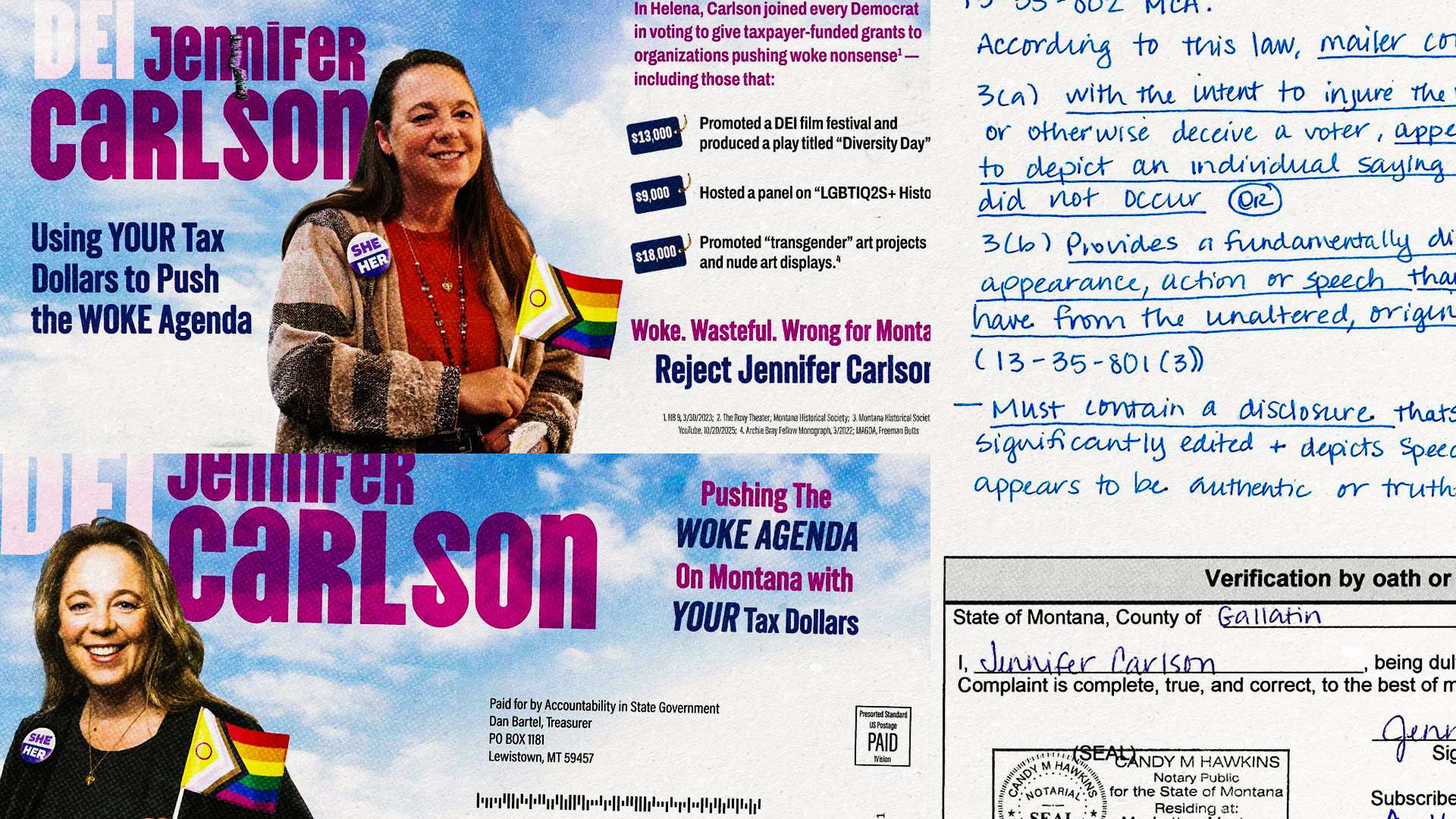
On Wednesday, U.S. District Judge Susan Watters issued a preliminary injunction blocking Montana from enforcing a 2025 statute that governs AI-produced political advertisements. The measure had been challenged by Accountability in State Government, a group led by former state legislator Dan Bartel; the organization had mailed pieces featuring doctored images of political figures alongside pride flags and pronoun badges.
Under Montana law, it is unlawful to sponsor or disseminate an election communication within 60 days of an election if you “knew or should have known [it] is a deepfake”—though “satire or parody” is exempt. Consequently, Bartel’s mailers prompted formal complaints. State Rep. Jennifer Carlson (R–Manhattan) said a mailer depicting her with an AI-generated pride flag was produced “with the aim of harming the candidate’s reputation or deceiving a voter.”
The complaints were dismissed on August 20, with Christopher Gallus, commissioner of political practices, ruling that the mailers were sufficiently “humorous or outlandish” to qualify as satire. The following morning, Watters heard arguments on Bartel’s bid to bar enforcement of the law entirely on First Amendment grounds.
This week, Watters determined that Bartel and his coalition are likely to prevail on their First Amendment challenge. Montana’s statute criminalizes synthetic media created “with the intent to injure the reputation” of a candidate or political party, meaning that, as Watters put it, the law “treats deceptive media differently based solely on whether its message is used to damage or to elevate a candidate.”
Adam Schulman—an attorney with the Hamilton Lincoln Law Institute, which represents Bartel in the case—argues that this is the law’s core flaw. “You could have AI deepfakes that are acceptable as long as they are flattering,” Schulman tells Reason. “You could have Donald Trump depicted in a Pittsburgh Steelers uniform via deepfake [and that would be] acceptable because it does not harm a candidate’s reputation.”
Schulman also contends that the statute requires regulators to make inherently subjective judgments about political imagery. Montana’s rule partly depends on how a “reasonable person” would interpret the material, a task that becomes tricky when satire and parody are involved. “People have a range of artistic sensibilities,” Schulman notes.
Montana is not unique in facing such challenges. Numerous states have attempted to curb AI-generated political speech and quickly confronted constitutional hurdles. After conservative YouTuber Christopher Kohls posted an AI-produced parody of then–Vice President Kamala Harris during the 2024 campaign, California passed Assembly Bill 2839, prohibiting the distribution of communications “that contain certain materially deceptive content” produced “with malice.” In 2025, a federal court ruled the law unconstitutional and permanently enjoined California from enforcing the statute.
Similarly, Hawaii enacted Act 191 in 2024, curbing “materially deceptive” election media. The Babylon Bee and Dawn O’Brien, a resident of Hawaii, challenged the measure as a breach of free speech. In January 2026, U.S. District Judge Shanlyn Park granted summary judgment declaring the statute “unconstitutionally vague,” in part because it relies on ambiguous and subjective standards.
As technology advances, calls for greater government oversight inevitably follow. Schulman notes that the impulse to curb AI-generated political speech echoes the early-2020s push to police “misinformation” during the pandemic era.
Montana has one month to appeal the ruling. Yet given outcomes in similar cases, pursuing an appeal may not be appealing. While the constitutional boundaries on regulating AI-generated political speech are not fully settled, the early rulings serve as a caution against attempts to restrict constitutionally protected political expression.
