
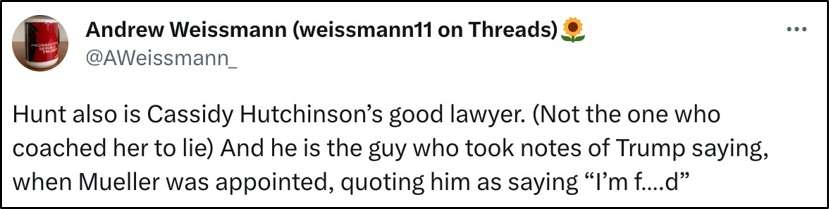
From today’s ruling by Judge Loren AliKhan of the D.D.C. in Passantino v. Weissmann (for an earlier ruling in the case, see here):
The plaintiff, Stefan Passantino, launches a defamation suit against Andrew Weissmann over a September 2023 social‑media post in which Weissmann labeled Passantino, a practicing attorney, as someone who coached a witness appearing before Congress to lie. …
In 2021, Congress formed a Select Committee to scrutinize the January 6, 2021 assault on the U.S. Capitol. As part of that inquiry, the Committee interviewed numerous witnesses, including Cassidy Hutchinson, a former special assistant to President Trump who had worked under White House Chief of Staff Mark Meadows on January 6, 2021.
Passantino, a former senior lawyer in the Trump administration, represented Hutchinson at her initial three closed‑door depositions before the Committee on February 23, March 7, and May 17, 2022. Shortly after the third deposition, Hutchinson dismissed Passantino and retained new counsel. She later provided a fourth deposition, televised on June 28, which drew substantial media attention.
Following the fourth deposition, Hutchinson sent a letter to the Select Committee indicating her intent to waive attorney‑client privilege with Passantino in order to share information with the Committee that was relevant to her prior testimony. The Committee scheduled a fifth, closed‑door deposition for September 14, 2022. Hutchinson has said she asked a friend to “back‑channel” to the committee to indicate a few topics she wished to discuss, without informing Passantino that she was doing so ….
At the fifth deposition, Hutchinson testified about the preparation she and Passantino undertook ahead of her first deposition. Specifically, she told the Committee that she and Passantino met for a couple of hours on February 16, 2022 to discuss her upcoming testimony. When Hutchinson suggested printing a calendar to ensure the dates and timelines were accurate, Passantino responded, “No, no, no.” He instructed that Hutchinson’s role should be minimized and that “the less you remember, the better.” When the topic of an incident inside the presidential limousine on January 6 was raised, Passantino said, “No, no, no, no, no. We don’t want to go there.”
Passantino told Hutchinson: “If you don’t 100 percent recall something, even if you don’t recall a date or someone who might have been in the room, ‘I don’t recall’ is an entirely fine answer, and we want you to use that response as much as you deem necessary.” Hutchinson asked whether she could still say “I don’t recall” if she remembered something but not every little detail, to which Passantino replied, “Yes.” On the morning of the first deposition, Passantino reminded Hutchinson to “downplay your position,” suggesting that her go‑to response would be “I don’t recall.”
Hutchinson also discussed questions from her initial deposition about the January 6 incident in the presidential limousine. She recounted that, during a break after facing repeated questions on the matter, she privately told Passantino, “I’m f[*****]. I just lied.” Passantino allegedly replied, “You didn’t lie… They don’t know what you know, Cassidy. They don’t know that you can recall some of these things. So you saying ‘I don’t recall’ is an entirely acceptable response to this.” He allegedly concluded, “You’re doing exactly what you should be doing.” Hutchinson explained that, in the moment, she felt she could not be fully forthcoming as she wished.” Id. 56:3–4.
Nevertheless, Hutchinson did state: “I want to make this clear to the Select Committee: Stefan Passantino never told me to lie.” She recalled him telling her that he did not want her to perjure herself, but that “I don’t recall” is not perjury and that the Committee did not know what she could or could not recall. Hutchinson then reiterated to the Committee that “he didn’t tell me to lie. He told me not to lie.” Passantino acknowledges that the deposition transcript accurately reflects Hutchinson’s statements at the fifth deposition, though he disputes the truth of her account beyond Hutchinson’s testimony that he instructed her not to lie.
During the Committee’s final public session on December 19, 2022, Representative Zoe Lofgren stated that the Committee had “obtained evidence” that “one lawyer told a witness the witness could, in certain circumstances, tell the Committee that she didn’t recall facts when she actually did recall them.” After the Committee released Hutchinson’s closed‑door deposition transcripts, multiple news outlets identified Passantino as the lawyer referenced by Lofgren.
Nine months later, Weissmann—formerly a prosecutor and later a political commentator for MSNBC—posted on X (formerly Twitter) in response to news that Mr. Hunt had received a subpoena in a separate case. Weissmann had roughly 320,000 followers at the time….
Passantino sued, but the court entered judgment for Weissmann:
The court determines that Passantino failed to plead the required degree of fault…. “If the plaintiff in a defamation action is a private figure, the applicable standard is negligence.” “But if the plaintiff is a public figure,” the plaintiff must show that the allegedly defamatory statement was made with “actual malice,” meaning knowledge of falsity or reckless disregard for truth.” Because the court concludes that Passantino did not plead facts establishing negligence, it proceeds on the assumption, without deciding, that Passantino is a private figure.
To plead negligence, a plaintiff must allege facts showing that the defendant failed “to exercise an ordinary degree of care in ascertaining the truth before publishing it to others.” …
Passantino contends that the transcripts of Hutchinson’s testimony “demonstrate that Passantino did nothing to obstruct or shape Hutchinson’s testimony and, in fact, show the opposite, since Hutchinson testified that ‘Stefan Passantino never told me to lie’ and that ‘he told me not to lie.’” The court accepts, for purposes of argument, Passantino’s assertion that he did nothing to obstruct Hutchinson’s testimony. …
Passantino’s verbatim excerpts from the transcript do not establish that Weissmann had reasonable notice that the statement was false. Passantino relies on Hutchinson’s statements emphasizing that “Stefan Passantino never told me to lie.” But even if those statements are true, the critical question remains: could a reasonable person in Weissmann’s position have concluded that Passantino had “coached” Hutchinson to lie?
To “coach” means to instruct, direct, or prompt. It is entirely possible to direct or prompt someone to lie without explicitly stating so. Weissmann acknowledges Hutchinson’s full account of Passantino’s remarks—including that he told her not to lie—but argues that Passantino nonetheless coached her to make false statements before the Committee by steering her toward saying she did not recall even when she did.
The court finds that Passantino’s characterizations of the transcript’s message are not only legally conclusory but also incorrect. The transcript actually supports Weissmann’s assertion. Hutchinson’s statements suggest that Passantino repeatedly urged Hutchinson to lie. For instance, Passantino advised Hutchinson that “Your go‑to, Cass, is ‘I don’t recall,’” even when she would be able to recall certain questions. When Hutchinson confessed, “I’m f—ed. I just lied,” Passantino allegedly said, “You didn’t lie…. They don’t know what you know, Cassidy. They don’t know that you can recall some of these things. So you saying ‘I don’t recall’ is an entirely acceptable response to this.” He concluded, “You’re doing exactly what you should be doing.” In short, the transcript shows that while Passantino nominally told Hutchinson not to lie, he repeatedly urged her to rely on “I don’t recall” as a strategy because that answer was uncheckable rather than true, including at times when she did recall relevant information.
Second, Passantino argues that Weissmann should have known Hutchinson had self‑serving, political motives to dissociate herself from prior testimony by casting blame on Passantino. Although Passantino characterizes certain aspects of Hutchinson’s testimony as inconsistent and unreliable, he does not present facts that would compel a reasonable reader to conduct further inquiry.
A reasonably careful reader may rely on sworn testimony without extra verification because a deponent speaks from personal knowledge and swears to tell the truth under penalty of perjury. Passantino maintains that many readers would interpret Hutchinson’s September 14 testimony as coming from someone who aimed to distance herself from earlier statements to disseminate inflammatory rumors and hearsay. The court rejects this speculative contention, which is not tethered to the facts pleaded in the complaint.
Moreover, the negligence standard does not hinge on whether “a reasonable reader could view Hutchinson’s testimony as consistent with” Passantino’s asserted truth; rather, it asks whether a reasonable reader should have known that Passantino’s asserted truth was not verifiable or at least should have prompted doubt and further inquiry. Even assuming the truth of Passantino’s allegations, Weissmann had reasonable grounds to believe that his statement was true.
There should be no doubt that a reasonable person trying to verify Weissmann’s assertion would uncover substantial corroboration. Lofgren publicly stated at a highly scrutinized congressional hearing that the Select Committee had “obtained evidence” that “one lawyer told a witness the witness could tell the Committee that she didn’t recall facts when she actually did recall them.” And numerous mainstream outlets quickly identified Passantino as the lawyer in question. Passantino contends there is no record showing Weissmann actually viewed or knew of these media reports. Nevertheless, Lofgren’s statement and the resulting reporting reflect the objective reasonableness of Weissmann’s assertion, given the broad audience and the journalistic standard applied by reporters who reached the same conclusion based on the same testimony.
While Passantino cites other media items suggesting that Hutchinson’s credibility was questioned, those pieces merely illustrate that reasonable observers could disagree on the issue. Passantino does not allege facts showing that a prudent reader should have sought out such articles to determine Weissmann’s liability, nor that those articles made the defendant negligent. The court thus concludes that Passantino fails to plead any facts that could support a finding of negligence on the part of Weissmann for purposes of his defamation claim. …
Meryl C. Governski and Linda E. Halfacre (Dunn Isaacson Rhee LLP), Jonathan I. Kravis (Munger, Tolles & Olson LLP), and Faith E. Gay, Corey Stoughton, and Rachel Slepoi (Selendy Gay PLLC) represent defendants.
