
The multilateral system, conceived after World War II as a shield against chaos and violence, is today living one of its worst existential crises. Designed to prevent conflicts, coordinate international cooperation, and promote sustainable development, it has, in many cases, become an ineffective, fragmented mechanism dominated by the interests of a few.
The current crises are painful reminders of this failure. In Palestine, the international community watches helplessly —and in many cases in silence— at what many experts describe as an ongoing genocide. In Ukraine, the war drags on without a multilateral political solution in sight. In parallel, climate commitments are weakening and official development assistance (ODA) is plummeting in many countries, while the UN and other international bodies show a troubling inability to respond.
This situation is not new, but it has worsened in recent years. The withdrawal of the United States from major multilateral frameworks —such as the Paris Agreement, UNESCO, or the WHO— together with cuts to USAID and the growing use of threats and unilateral sanctions as diplomatic instruments, have accelerated the disintegration of the rule-based international order. The replacement of a cooperation logic with a transactions logic has left many regions —especially in the Global South— even more vulnerable to health, climate, food, and security crises.
“Rather than funding peace, funding war”
The current multilateralism has proven to be costly, slow, technocratic, and, above all, ineffective. Strategic decisions are blocked by anachronistic mechanisms such as the veto on the Security Council. International summits become diplomatic rituals with no practical consequences. And countries with less political power are systematically excluded from decisions that directly affect their future.
And meanwhile, priorities are distorted. Rather than funding peace, funding war. NATO has proposed that its member states commit to spending up to 5% of their GDP on defence, a figure that starkly contrasts with the average spending on education (4.3%), health (6.6%) and, especially, with official development assistance, which barely reaches 0.37% of GDP in the OECD, far below the historical commitment of 0.7%.
Even worse, many Global South countries are trapped in a vicious debt cycle. Sub-Saharan Africa pays in debt service more than double what it receives in official development assistance. According to the UN and Oxfam, in 2022 African countries allocated more than $56 billion to service their external debt, while the aid received barely reached $29 billion. This asymmetry not only stalls development: it reverses it.
It is not only a question of scarce resources, but of deeply unfair rules.
“The annual financing gap to achieve the SDGs is estimated at more than four trillion dollars, equivalent to 4% of global GDP”
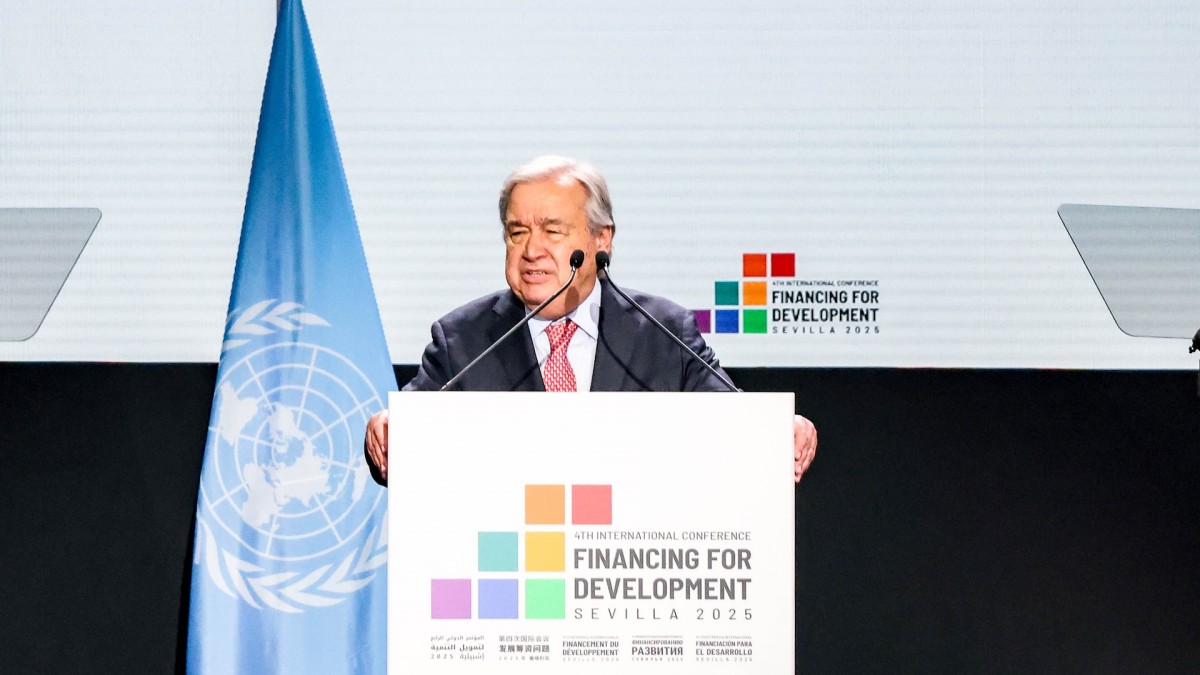
Yet, amid the collapse, glimmers of hope emerge. The recent United Nations Conference on the Ocean (UNOC3) has achieved concrete advances in marine governance. And at this very moment, the international community is gathering in Seville for the Fourth Financing for Development Conference (FF4D). This event represents a crucial opportunity to secure a firm political commitment that would redesign the global financial architecture and mobilize the resources needed to finance the Sustainable Development Goals (SDGs). Seville can and must become a turning point.
Because the challenge is immense: the annual financing gap to achieve the SDGs is estimated at more than four trillion dollars, equal to 4% of global GDP. This gap will not be closed with voluntary promises, nor with small symbolic contributions.
Una propuesta concreta: Tasa Global de Solidaridad (Global Solidarity Levy)
Facing this financial abyss, structural solutions are required. One of them is the Global Solidarity Levy: an international financing mechanism based on the principle of global fiscal justice. This levy —already proven in the realm of air transport to fund UNITAID— could be extended to other highly lucrative and lightly taxed economic activities, such as international financial transactions or the profits of large digital platforms.
“A 0.01% rate on international financial transactions would mobilize between $50 billion and $70 billion annually”
A 0.01% rate on international financial transactions (estimated at more than seven trillion dollars daily) would mobilize between $50 billion and $70 billion annually. A minimum contribution on the extraordinary profits of big tech, or on international flights and luxury goods, could generate tens of billions more. These sources would be stable, automatic, and would not depend on national political cycles or the goodwill of traditional donors.
Cambiar las reglas del juego: propuestas desde la sociedad civil
The crisis of multilateralism is not only institutional. It is deeply political. And that is why its solution will not come solely from governments, but from a bold mobilization of global civil society, which is already articulating proposals to transform the system. The demands are clear:
- Democratize global governance. Reform the UN, eliminate the veto right in the Security Council, and create binding mechanisms where global majorities count.
- The voice of the Global South, Indigenous peoples, youth, and women must occupy a central place in global decisions.
- Establish global fiscal justice. Create an international fiscal body under the UN umbrella to curb tax evasion and avoidance.
- Move toward a binding treaty on tax justice and financial transparency.
- Legalize development financing. Transform climate finance and development finance into a legal obligation, with an international treaty that sets binding targets and sanctions for noncompliance.
- Advance redistributive global taxes. Introduce global minimum taxes, taxes on financial transactions, on carbon, and on the extraordinary profits of multinationals, aimed at the global common good.
- Open the system to citizenship. Strengthen citizen participation in global decisions through international participatory budgeting, social audits, and real access to information and deliberation.
The multilateralism does not need cosmetic adjustments. It needs a reset. A re-foundation based on justice, equity, and solidarity. Seville can and must mark the start of that process. It is time to rewrite the rules of the world to come.
