
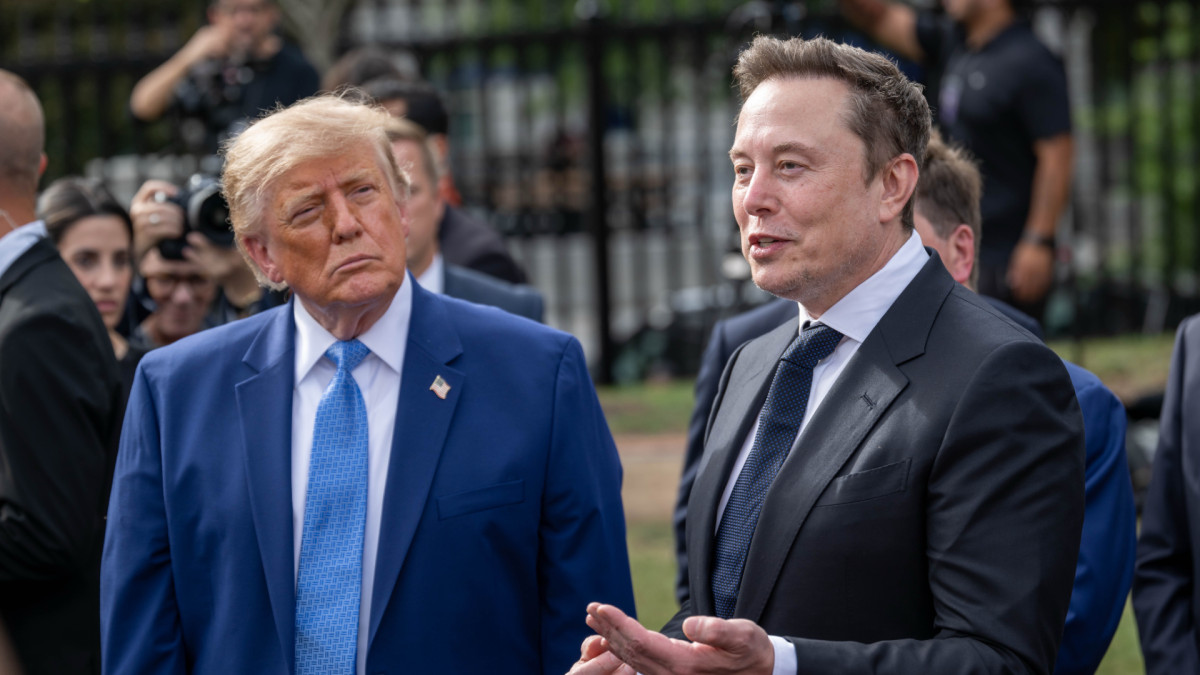
The night of November 3 marked a political loser by name: Elon Musk. The South African-born magnate had spent nearly $500 million supporting Republican candidates, and the Democrats took control of the Senate, the House of Representatives, and most of the governor’s races at stake. The outcomes in Texas —where much of his empire is rooted and where he had invested the most in campaign money— are the stark mirror of his defeat: he elected his first Democratic governor since 1990 and his first Democratic senator since 1988. In the two days following the election, Tesla’s shares fell more than 11% and SpaceX’s dropped more than 10%.
The blue wave represents a setback in Musk’s ideological battle against progressive options and a brake for some of his businesses, but not all. The Congress can hassle the oligarch with subpoenas, hearings, investigations into his federal contracts and his use of Dogecoin. The fate or scope of some of his Texas projects remains in the air, such as the aerospace complex in Boca Chica or the Terafab in Grimes. However, the result could help consolidate and strengthen SpaceX’s artificial intelligence business, the segment that generates the most revenue for the company.
The Impregnability of Elon Musk’s Data Centers Against Public Backlash
Local elections and referendums held in tandem with the midterms could slow the explosive rollout of data centers in the United States. Up to 45 resolutions on data centers were being voted on in municipalities and counties coinciding with the midterm elections. Only in one did the option to impose no restrictions on these facilities win. Democratic gubernatorial candidates favored a moratorium in three key deployment states —Texas, Ohio and Georgia— as well.
“The blue wave represents a setback in Musk’s ideological battle against progressive options and a brake for some of his businesses, but not all.”
The decisive factors are the deployment locations and the schedule, and both favor Musk’s infrastructure rollout. In January, SpaceX will already have nearly 1.4 million next-generation AI accelerators installed in its Colossus 1 and Colossus 2 data centers, in territories insulated from the blue wave. The two infrastructures, with an planned electrical capacity close to 2 GW, are located in Memphis (Tennessee), where Republican Marsha Blackburn has just won the governorship, and in Southaven, just across the Mississippi border, where the red party also governs.
The local opposition to Musk’s active data centers exists and is growing, but it arrives late. Memphis rejected by a six-to-zero vote a long moratorium and approved a 135-day pause, which does not affect Colossus because it already has its permits. In Southaven, the mayor estimates that xAI will contribute $60 million annually to the county by 2028. The fronts opened there are legal, such as the NAACP’s lawsuit over gas turbines installed without permits, not electoral.
Even the expansion of SpaceX’s AI infrastructure does not seem to be in jeopardy. Before the elections, the company was already planning a new data center in Cochise County (Arizona), with an expected consumption of 6 GW. There is local opposition, though it does not seem strong enough to derail the project. The Democratic governor, Katie Hobbs, has been reelected and now holds a majority in both state chambers. She is not in favor of a moratorium, but wants data centers to pay water usage like any family and lose their tax exemptions. Nor in the territory has there been any referendum promoted in November aimed at restricting the deployment of these infrastructures.
In contrast, the deployment plans of AI infrastructure for potential SpaceX competitors could be significantly altered. While projects with a planned start of operation in 2027 are unlikely to be affected by the election results, the 62 GW of computing capacity slated for 2028 could be changed. According to data from the consultancy SemiAnalysis, up to 30 GW have been exposed by the victory of candidates favoring a pause until new legislation is put in place. Who is Musk really competing against in AI?
The Quest for Domain Over the Leasing of AI Infrastructures
Musk has quietly redirected the aim of SpaceX’s AI division toward renting out infrastructure. Although the entrepreneur initially entered the frontier of language models with Grok, his data centers are by no means dedicated solely to the company’s internal use. The 230,000 Colossus 1 accelerators are leased to Anthropic for $1.25 billion per month, while Google rents 110,000 Colossus 2 accelerators for $920 million per month. Only the contract with Anthropic brought in $3.75 billion in the third quarter, half of the $7.56 billion that the AI division earned. With Google’s payments, which began in October, the rental will far exceed that half.
“Musk has quietly redirected the aim of SpaceX’s AI division toward leasing out infrastructures”
Musk admits that serving Grok carries an “unsustainably high” cost relative to his revenues and has set a goal of renting out half of its capacity to third parties; today he already rents almost a quarter of his GPUs. GPU leasing is enjoying a sweet moment: the H100 is rented about 30% more expensive than a year ago. The potential shortage arising from the rationalization of data-center deployments will only boost this business’s value.
Anthropic or Google are already more clients than rivals of Musk in AI. SpaceX’s competition lies elsewhere, in the so-called ‘neocloud‘: hundreds of mid-sized and small companies renting compute capacity. It is estimated that this market will reach $400 billion in revenue by 2031.
The economy and politics work against Musk’s competitors. The financing capacity of the three leading firms in this segment —Nebius, CoreWeave and IREN— has been questioned by the markets. The Neocloud ETF (NCLD), in which they collectively hold over 50% of the weight, fell by more than 40% in October. Additionally, the three have a substantial portion of their infrastructure deployment dependent on political and administrative decisions, mainly in Texas and Ohio, though Nebius, based in Finland, is less exposed. Musk himself has fed doubts about the sustainability of these companies by relying exclusively on revenues from AI deployment.
“The financing capacity of the three main companies in this segment —Nebius, CoreWeave and IREN— has been questioned by the markets”
Paradoxically, the deployment of data centers by large tech firms has triggered public anger that will slow the growth of their smaller competitors. Likewise, the massive investments of the tech oligarchs have raised reluctance toward new credit lines that affect smaller firms with less financial muscle. A political defeat does not necessarily entail a setback for business. Musk is the paradigmatic case: as long as compute is scarce, every data center slowed by public anger elsewhere increases the value of his own.
