
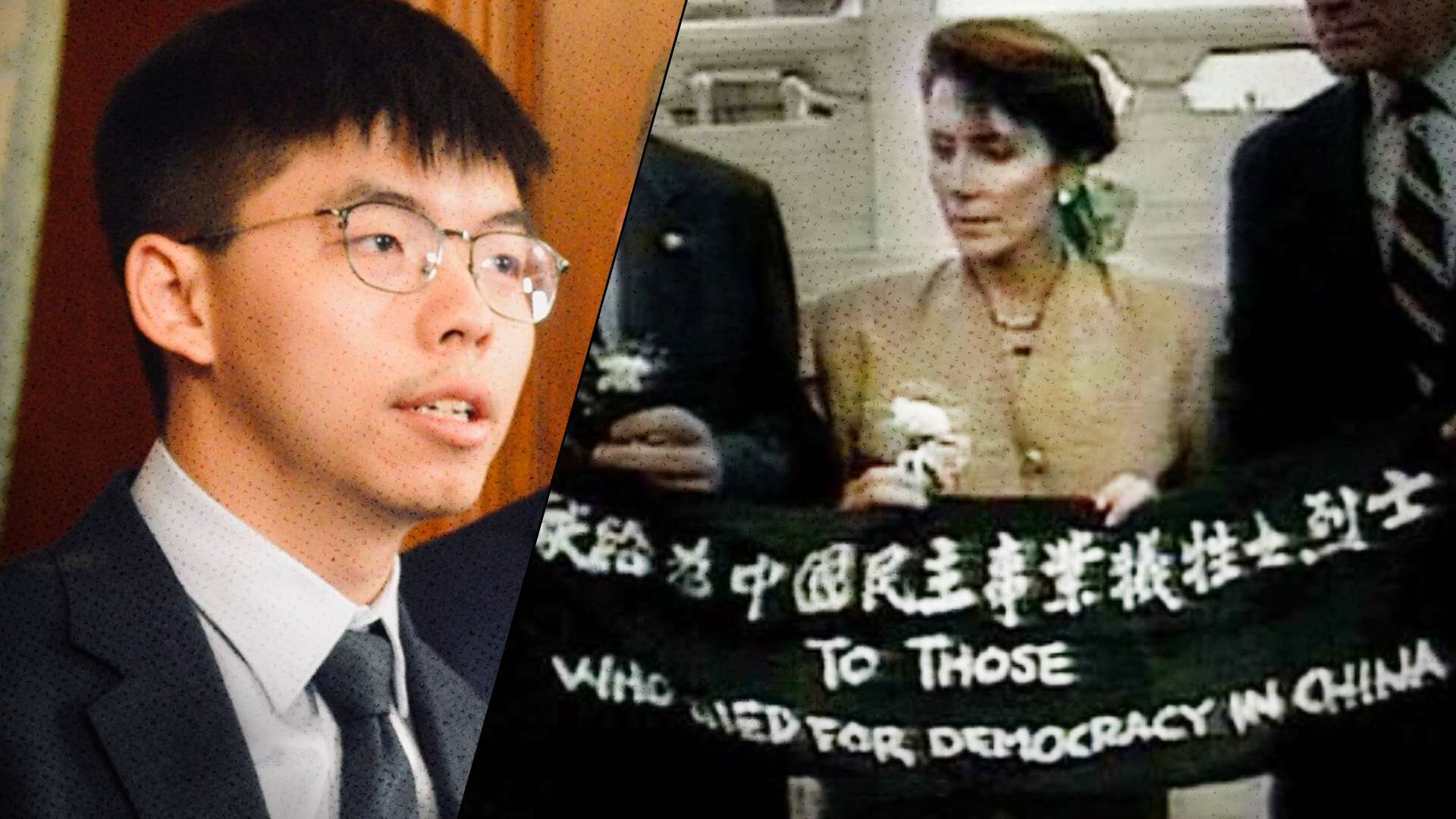
During what would become one of her final addresses on the floor, Representative Nancy Pelosi (D–Calif.) rose to draw attention to the situation in Hong Kong. She denounced the Chinese government for prosecuting protester Joshua Wong. Yet it was precisely that congressional focus that helped shape Wong’s fate from the outset. Just as in earlier episodes with Hmong militias and Kurdish fighters, Hong Kong’s leadership in the protest movement formed a one‑sided alliance with American politicians that could not be or be met with reciprocity, ultimately drawing a lethal line of attack against them.
At the core of this arc, culminating in Wong’s prosecution, stands Pelosi herself. She has positioned herself at the heart of every major China debate since the end of the Cold War, and early in her career she took risks to defend hawkish positions toward Beijing. But boldness does not automatically equal courage. Over decades she squandered political capital on ventures that lacked substance, achieving little by way of real victories, while the costs borne by people caught between Beijing and Washington may far exceed any risk Pelosi undertook.
The trajectory began in 1991, when Pelosi traveled to Beijing as part of an official congressional trade delegation. Just days into the trip, Pelosi quietly slipped out of her hotel—without Chinese authorization—accompanied by a small entourage. Her destination was Tiananmen Square, the scene of the 1989 crackdown two years earlier.
When Pelosi reached the square with two fellow lawmakers, they unfurled a banner bearing the message, “To those who died for democracy in China.” The banner was printed in both English and Chinese, signaling that its intended audience encompassed both American constituents and Chinese hosts. Upon discovering the impromptu gesture, local police chased Pelosi and her colleagues from the square, while onlookers and journalists were shoved, corralled, and detained for filming.
Her colleague John Miller (R–Wash.) revealed that the stunt had been planned from the outset on a bipartisan basis. “We had one principal aim in going to Beijing,” Miller told reporters, “to deliver a forceful message to the Chinese leadership that Americans and the American Congress have not forgotten Tiananmen Square.”
Pelosi herself later acknowledged that nothing else was accomplished. The trip did not secure the release of prominent dissidents or secure assurances of human rights improvements, and relations between the two nations deteriorated further. Yet Pelosi and Miller’s third colleague, Rep. Ben Jones (D–Ga.), described their Tiananmen visit as a “special moment” for them. It was certainly special for them—ignoring the bystanders who were roughed up by police during the episode.
A Progressive Hawk Flies to Taiwan
In mid-2022, Pelosi, by then Speaker of the House but still a figure deemed unwelcome by the mainland, undertook another high‑stakes gesture with potentially far-reaching consequences. She became the first top U.S. official in more than a generation to meet with leaders on Taiwan, the self‑governing island that Beijing claims as part of its territory.
The announcement of the trip elicited intense backlash from the American establishment. The New York Times’ Thomas Friedman, hardly a friend of Beijing, called Pelosi’s plan “utterly reckless, dangerous and irresponsible.” Intelligence officials warned that a purely symbolic visit could appear as though a military operation to the Chinese government, regardless of its intentions.
Echoing Deng Xiaoping’s caution that the main obstacle to improving U.S.–China relations lay in treating Taiwan as a U.S. aircraft carrier, Pelosi’s visit was followed by a Chinese military display in the form of live-fire exercises and missile tests in the Taiwan Strait.
President Joe Biden openly cautioned Pelosi. Nevertheless, Pelosi—labeled by Politico as a “progressive hawk”—pressed on. In one press conference, she even noted that American military officials had warned she might be shot down or something similar.
Yet she enjoyed strong support from the Republican side. House Minority Leader Kevin McCarthy (R–Calif.) voiced backing, arguing that “America should always speak with one voice.” Senate Minority Leader Mitch McConnell (R–Ky.) contended that Pelosi, independently of White House concerns, had every right to visit Taiwan. Former Defense Secretary Mark Esper and former Secretary of State Mike Pompeo also gave enthusiastic support. “Nancy, I’ll go with you,” Pompeo wrote on Twitter, “I’m banned in China, but not freedom-loving Taiwan.”
And, as with the Tiananmen episode, Pelosi’s Taiwan visit accomplished little that was tangible. No deals were struck, no formal agreements signed. As Shelley Rigger, a Taiwan scholar quoted in The New Yorker during Pelosi’s trip, observed, the trip did not benefit Taiwan and may have harmed Taiwan’s security, while further straining U.S.–China relations that had already deteriorated.
A month after Pelosi’s departure, Pompeo—then in Taiwan on a separate visit—told reporters that local coverage had labeled the speaker’s trip as “provocative” and “threatening.” He dismissed such claims, insisting that the real threat did not come from Taiwan or the United States, but from the Chinese Communist Party itself.
The nuclear option
Resisting accountability for the wider consequences of American policy in East Asia is, of course, not a novel impulse. But in Joshua Wong’s case, the fallout from American hubris is unusually bitter. Washington’s politicians thrust Wong into the limelight while nurturing hopes for a rescue that never arrived.
Wong first gained international notoriety in 2014 as a leading organizer of Hong Kong’s Umbrella Movement, which brought together student groups like Wong’s Scholarism and major civil society organizations in a campaign against government authority. Under a 1997 handover agreement, Hong Kong was promised fifty years of political, legal, and economic autonomy under Beijing’s “one country, two systems.” Over time, however, that promised autonomy has been eroded. On August 31, 2014, the Standing Committee of China’s National People’s Congress declared that candidates running in Hong Kong’s upcoming elections must “love the country” (i.e., China) and “love Hong Kong,” and that they would face Beijing screening before they could contest elections.
That stance proved unacceptable to many in Hong Kong, including Wong, who had already drawn the attention of classmates and local authorities with his resistance to mainland interference. Wong had led a successful student movement against a 2012 curriculum change pushed by the Chinese government.
Although the 2014 protests failed to prevent the new election law, Wong attracted the notice of American supporters. He appeared on the cover of TIME magazine as “The Face of Protest” and was named among the magazine’s 25 Most Influential Teens. Other outlets described him as the “next tank man,” a reference to the iconic Associated Press image from the 1989 Tiananmen Square protests. When the U.S. government offered only guarded support for the 2014 protests, The Wall Street Journal used Wong’s case to criticize then‑President Obama. Wong explained that Hong Kong needed more than a few words from Obama.
Like Wong, many U.S. lawmakers sought more than words from the White House. Rep. Christopher Smith (R–N.J.), co‑chair of the Congressional‑Executive Commission on China, drafted the Hong Kong Human Rights and Democracy Act. It would impose economic sanctions that Steve Tsang, director of SOAS China Institute at the University of London, described as “the nuclear option” because they would sever Hong Kong’s central ties to the global financial system.
Meanwhile, Pelosi began meeting with the now‑famed Wong for the first time in 2015, again in 2016, and once more in 2019. That final meeting drew particular attention from Beijing, culminating in Wong’s most serious trial to date.
That year, Beijing proposed another legislative change seen by many in Hong Kong as destructive to the “one country, two systems” arrangement: an amendment to the Fugitive Offenders Ordinance that would permit extradition of suspects to mainland China and other jurisdictions. Western human rights groups, including Amnesty International and Human Rights Watch, warned that the proposed changes would threaten anyone in Hong Kong who engaged in work related to the Mainland—human rights defenders, journalists, NGO workers, and social workers. Smith revived his stalled 2014 sanctions bill.
To prevent the bill from stalling, Wong and other activists were invited to speak before the Congressional-Executive Commission on China. Having previously addressed the group in 2017 and having recently been released from prison in June, Wong pressed forward with the same argument: “Beijing cannot have it both ways—reaping the economic benefits of Hong Kong’s standing while erasing our sociopolitical identity.” He asserted that the sanctions bill enjoyed broad support from Hong Kong’s civil society, a point he wanted every member of Congress to note.
The media event continued at a Pelosi-hosted gathering, where the bill’s title was displayed on a large placard behind Wong as he spoke. “We stand united,” he told reporters. When Smith said the bill “requires the President to identify and sanction individuals, including using the Magnitsky Act, in Hong Kong and in Mainland China,” Wong was seen nodding nearby. After four failed attempts, the bill ultimately passed.
Breaking an Egg Against an American Wall
The twenty‑two-year‑old Wong had evolved from a local student leader into a figure whom the Chinese government labeled as “colluding” with U.S. officials in a broader economic confrontation against his homeland. This stigma, and the notoriety that came with it, became a severe problem for Wong in 2020 when Beijing imposed a sweeping national security law for Hong Kong that carried life imprisonment for collusion with foreign powers.
Wong reasoned that if his notoriety could be leveraged to his advantage, it might serve as a way out. He noted that his Hong Kong passport had been confiscated and suggested he might seek asylum in the United States. He emailed Pompeo directly, appealing for help: “There is real danger that I become a prime target for arrest and detention. I request U.S. protection so that I may apply for asylum, including, if necessary, traveling to the U.S. to pursue asylum.”
There were possibilities for the State Department to aid Wong’s exit from Hong Kong, including covert actions. President Donald Trump himself was reportedly sympathetic to rescuing Hong Kong dissidents through mass immigration, remarking to an aide, “They’ll be industrious. They’ll make great Americans.”
But political adviser Stephen Miller swiftly blocked the idea of mass immigration, and Pompeo concluded that the State Department could not intervene in Wong’s case. “You balance national interest with personal interest, and ultimately, at the end of the day, national interest wins,” an official told authors McLaughlin and Mahtani.
It was in the U.S. government’s interest to involve itself enough to put Wong at risk by allowing him to speak before Congress, but not to save him. The same logic that led to recruiting the Hmong into Vietnam, only to abandon them in the jungle when rescue proved too difficult, also underpinned efforts to mobilize Kurdish forces in Iraq only to witness their massacre. In Wong’s case, the aim was to project influence rather than secure an outcome.
As anticipated, Chinese authorities charged Wong with collusion in June 2025. Last month, he pleaded guilty to that charge. And how could he plead otherwise? Congress had provided the case against him on a silver platter. The Hong Kong Free Press reported that Wong was accused of conducting international lobbying for sanctions against the Hong Kong Special Administrative Region and the central government, requesting that the United States push the Hong Kong Human Rights and Democracy Act in 2019 and urging other Western nations to adopt Magnitsky-style sanctions programs.
Wong has not yet been sentenced.
During the height of Wong’s advocacy, he repeatedly quoted Japanese author Haruki Murakami: “If there exists a tall, imposing wall and an egg meets it, regardless of the wall’s righteousness or the egg’s weakness, I will stand on the side of the egg.” Wong remains as devoted to that principle today as when he began opposing the authorities in 2011. Whether the U.S. government provided the final nudge or not, history shows that American hubris too often pushes both good and bad eggs against unyielding barriers.
