
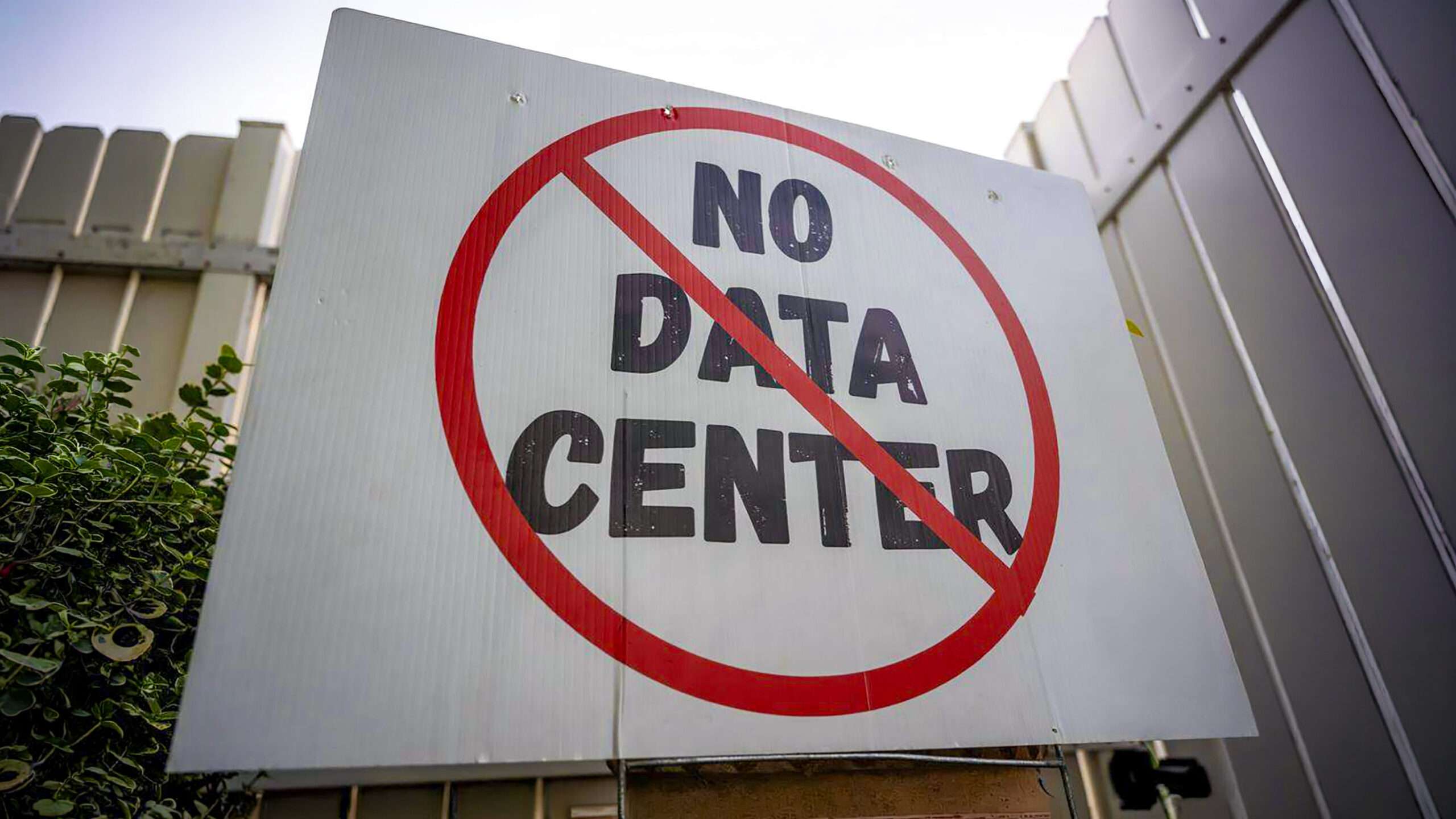
From Texas to Ohio, political contenders are echoing voters’ flawed arguments against data centers.
Americans aren’t fond of data centers in general.
A Heatmap Pro survey found that roughly three quarters of Americans would oppose a new data center being built near their homes. And a March Gallup poll shows that those opposed to these facilities tend to point to noise, environmental concerns, and potential declines in nearby property values. Additional worries frequently cited include the substantial water and electricity demands of data centers.
These would be reasonable objections if they were grounded in solid facts. Instead, as is often the case, politicians are eager to ride the wave of public anger, even when it isn’t backed by evidence.
On Sunday, Texas Governor Greg Abbott, a Republican, appeared on ABC News’ This Week with George Stephanopoulos to explain why he had placed a hold on new data center construction in the state. After touting Texas as a major center for AI development last year, Abbott has recently shifted to slow down expansion in his own state. In June, he directed the Public Utility Commission (PUC) and the Electric Reliability Council of Texas (ERCOT) to take steps to shield Texas residents from the costs associated with data center growth. In August, Abbott intensified the effort, ordering the PUC and ERCOT to audit every data center connected to the electricity grid and to pause all new builds until the audit is finished.
Abbott argued that the public backlash is understandable because data centers “suddenly appear in places nobody had heard of before, until construction begins.” If the reasons cited for opposing data centers are taken at face value, raw rural locations might seem the most sensible choice for siting one.
Abbott also charged developers with failing to collaborate with state authorities or local governments, suggesting they “dug their own grave” by skipping essential engagement. He argued that the combination of zoning laws, environmental impact requirements, and the capital needed for large infrastructure projects makes it difficult to imagine a data center going up without some level of government cooperation.
In Texas, Temple is home to five data centers either approved or under construction. Each project has undergone Temple’s review processes, including zoning, engineering, utility, fire safety, building codes, and public input. The city’s current approval framework also requires developers to spell out project-specific standards addressing issues such as noise, lighting, landscaping, buffering, traffic, and site design.
If navigating every state and local regulatory hurdle isn’t enough of a collaboration, it’s unclear what else Abbott believes data center developers should do to win public approval. Beyond the capital they invest in the facilities themselves, developers have also invested in the communities where they build.
Meta has pledged $1.7 million to support local school districts and nonprofits in the Temple region and has invested $8 million in local infrastructure improvements. Google, which has several data center projects in the state, launched a $10 million Texas Water Impact Fund to offset the water usage of its data centers and has committed to replenishing more water than its operations use by 2030. The benefits of data centers to communities aren’t confined to Texas alone: in Loudoun County, Virginia—the world’s data center capital—property taxes have fallen by almost 30 percent over the last decade. In Richland Parish, Louisiana, some teachers will receive bonuses of up to $50,000 thanks to a Meta data center still under construction.
Abbott isn’t the lone governor adjusting to public sentiment. Recently, Pennsylvania Democratic Governor Josh Shapiro signed an executive order creating guardrails that effectively block new data center development in the state—a stark shift from July of last year, when Shapiro highlighted Pennsylvania’s AI-readiness. And last month, New York Democratic Governor Kathy Hochul signed a first-in-the-nation, one-year moratorium on data centers.
The public outcry over data center development is shaping political campaigns from Ohio’s Senate race to Florida’s gubernatorial contest, according to The New York Times. In Texas, Attorney General Ken Paxton, who is seeking a Senate seat, unveiled a sweeping four-point plan to regulate the sector that would make data centers criminally liable for the products created by their AI customers.
Meanwhile, the Trump administration has been unequivocal in its support for data centers. In July, the Environmental Protection Agency proposed changes to rules under the Clean Air Act that would make it easier for data centers to add backup generators. The EPA argues this would give states and local authorities more discretion regarding when and how much public participation is required to meet the law’s objectives. In an interview with Punchbowl News, President Donald Trump suggested the developments could be “bigger than oil.”
All signs point to widespread unpopularity for data centers. Yet embracing the critics’ flawed arguments and enacting restrictive laws to ban the technology would amount to endorsing mob rule.
