
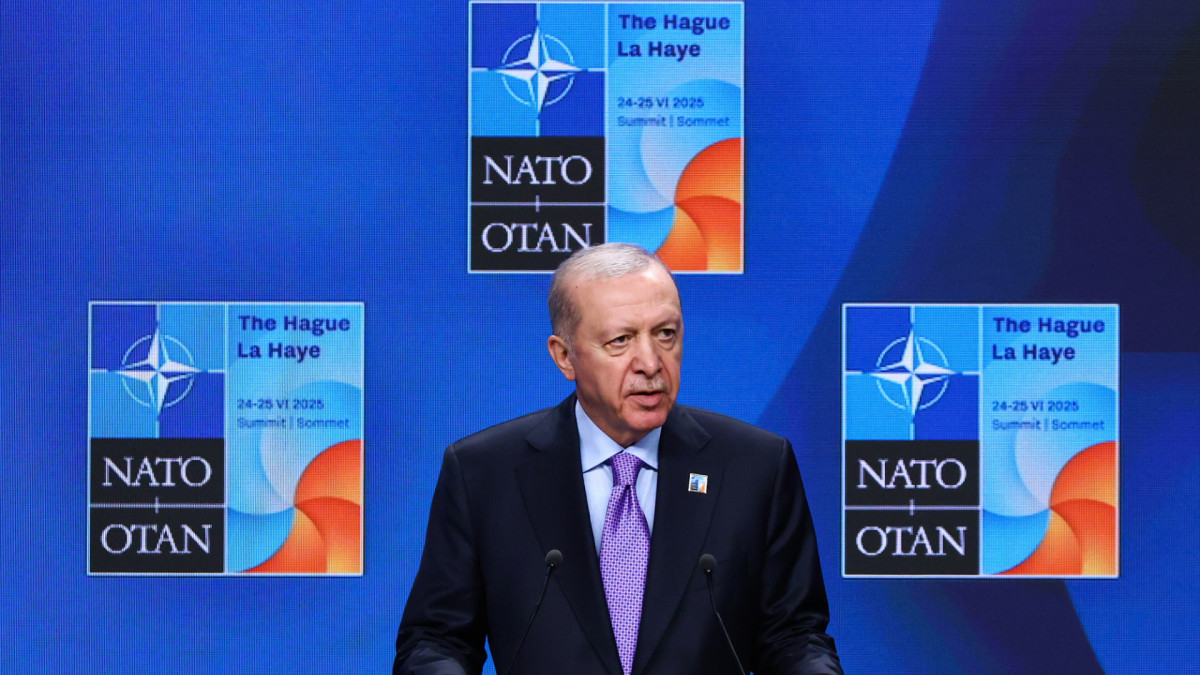
On July 7, 2026, the leaders of the 32 NATO member countries will meet at the Beştepe Presidential Complex in Ankara. It will not be a routine summit. Mark Rutte, NATO Secretary General, warned after the Istanbul nuclear symposium in April: “Crucial decisions will have to be taken, including how the Alliance’s nuclear posture should further adapt to the deterioration of the security environment,” he said at the time. The Turkish president, Recep Tayyip Erdoğan, host of the meeting, added that the Iran war has driven the region to a “geostrategic deadlock”, a declaration that, coming from the leader of the only NATO member with direct borders to that conflict, makes Ankara the most geopolitically tense stage the Alliance has hosted in decades.
The NATO arrives at its summer summit with three simultaneous transformation processes underway: the gradual withdrawal of the American strategic umbrella, the emergence of an embryonic European defense pillar, and the redefinition of its own institutional purpose in a multipolar world. None of the three has resolution in Ankara, but what is decided in Ankara could map the power landscape of Western defense for the next ten years.
“This abandonment represents a fifteen-year trend that Trump has accelerated and verbalized”
The first of these processes is the most visible and the least understood. The discussion about spending 5% of GDP (which dominated the news cycle since The Hague 2025) is, in fact, a transactional pressure tool of the Trump Administration, not a coherent strategic metric. The Hudson Institute’s own analysts, one of the think tanks closest to the Pentagon, acknowledged in April 2026 that the Alliance needs concrete results in Ankara to be credible, pushing macroeconomic percentages into the background. The 2026 National Defense Strategy of the United States is explicit about Washington’s priorities: Golden Dome, Arctic, and Indo-Pacific. Europe, in that strategic map, is a secondary theater that must finance its own security.
This abandonment represents a fifteen-year trend that Trump has accelerated and verbalized. The meeting between Rutte and Trump at the White House on April 8, where the explicit possibility of the United States leaving NATO was discussed, was the clearest signal that Rutte went to Washington not to strengthen the Alliance, but to gauge how much it can concede before the building creaks. Three days later, in Madrid, Pedro Sánchez answered: “We are not going to do things that are harmful to the world and contrary to our values and interests for fear of anyone’s retaliation.” In this statement lies the articulation of a position that several southern and central European allies privately share without formalizing it.
Under that diplomatic noise operates the most important technical mechanism: the NATO Defence Planning Process (NDPP), which is the real battleground of Ankara. This technical process assigns military capability targets to each ally on a bilateral basis, without the logic of a European-wide package. The result favors the US: 63% of non-European defense purchases by allies go to the North American market. While governments negotiate GDP percentages publicly, in the offices of the Atlantic Council several European allies circulate non-papers proposing linking the NDPP with EU instruments (the European Defence Fund, PESCO projects, or the newly created EDIP). If that linkage prospers, the architecture of European defense procurement changes irreversibly. If it does not prosper, Europe will continue buying separately and fragmenting its buying power in the face of Washington. It is the most important decision that is not being publicly debated, precisely because reforming the NDPP would require acknowledging that the NATO and EU bureaucracies have operated for twenty years with incompatible planning processes that neither institution wants to reform.
Spain facing the new European pillar of defense
Spain arrives in Ankara in a position that oscillates between visibility and hostility at the same time. The bilateral agreement negotiated by Sánchez in The Hague 2025 (commitment only to 2.1% of GDP while NATO sets the collective target at 5%) was presented as a defeat in several international media outlets.
“Sánchez’s stance is politically coherent for the domestic electorate, but risks leaving Spain out of the room where the real European defense architecture is designed”
The correct reading is the opposite: Spain secured by written exception, something several allies (Italy, Belgium, Portugal) failed to articulate and which since then they study as a model to replicate. But that tactical victory carries a strategic cost: Sánchez’s position is politically coherent for the domestic electorate, but risks leaving Spain out of the room where the real European defense architecture is designed. Because that architecture is not being designed at public summits, but in the Coalition of Volunteers for Ukraine (where Spain has just announced its adhesion) and in the technical working groups of Eurocorps and the NDPP, where the so-called “Eurogroup of five” (France, Germany, United Kingdom, Italy, and Poland) is consolidating a de facto board. If Spain does not project real operational presence in those mechanisms before July, Ankara will confirm its status as a peripheral partner in the emergent European pillar. The Spanish Navy has minehunters in operation that NATO needs for the possible mission in the Strait of Hormuz; the Rota Headquarters controls the Atlantic approaches to the Mediterranean; the Air Force participates in the allied air defense architecture in the Baltic states. They are real assets. The question is whether Spain’s defense diplomacy can monetize them as leverage of influence or if it will continue using them as a defensive argument to justify not spending more.
However, the best-positioned actor to emerge strengthened in Ankara is not any Western power, but Turkey. Erdoğan is not a passive host: he has the second-largest army in the Alliance, controls the Bosporus and the Dardanelles, shares a border with Iran in active conflict, and is actively pushing for the participation of Qatar, Kuwait, the United Arab Emirates, and Bahrain in the summit as partners of the Istanbul Cooperation Initiative. The April 22 meeting between Rutte and Erdoğan was not a logistics coordination meeting; it was the negotiation of the real agenda. Turkey wants Ankara to produce three things: the integration of Gulf partners into the Alliance orbit, the relaunch of its industrial relationship with NATO, and the explicit recognition of the southern flank as a strategic priority of equal rank to the eastern flank. The three objectives are legitimate and the three would structurally benefit Spain, which is the other major power on the southern flank, if Madrid had the wit to coordinate with Ankara on the margins of the summit. An alliance, in short, that does not originate in Ankara, but that arrives in Ankara with twenty years of shared history behind it: co-founders of the Alliance of Civilizations, expanding trading partners, and two southern flank powers that share the same interest in turning the Mediterranean and the Gulf from the periphery of the Atlantic agenda into its center.
“NATO did not arise as a private security contract. It was born in April 1949 on the premise that collective security was indivisible”
There is a question that Ankara will not resolve, but that it will begin to pose: can a democratic military alliance function when its most powerful member treats it as a subscription service? NATO did not arise as a private security contract. It was born in April 1949 on the premise that collective security was indivisible, that an attack on one was an attack on all, regardless of how much that “one” had contributed to the common budget. Turning that principle into a pay-per-use clause erodes the alliance’s deterrent credibility vis-à-vis its challengers, who watch every Atlantic crack with great interest. But above all it damages the founding principle that makes NATO qualitatively different from a coalition of convenience. Rutte said in August 2025, when announcing the Ankara seat, that the aim is to make NATO a “stronger, fairer, and more lethal” alliance. The three words are revealing: “stronger” points to capacities, “more lethal” to deterrence, but “more fair” points to the real problem, the problem that none of the other two can solve.
The justice that NATO needs in Ankara is not distributive (it is not about distributing the burden of spending more fairly), but constitutive: it is about deciding what kind of alliance it wants to be. One in which the collective bond has intrinsic value, regardless of what each member brings to the table. Or one in which that bond is renegotiated every time the strongest member needs a domestic political win. That distinction does not appear in any communiqué, is not voted on in the North Atlantic Council, and is not resolved by any GDP percentage. But it is the only question that matters in Ankara. Because in the end, alliances do not die from a single blow. They die the way Hemingway described bankruptcy: gradually, and then all at once. Every percentage of GDP negotiated downward, every closed-door meeting where the dominant partner imposes the terms, every communiqué that dodges the hard question is one more step in that slow process. Ankara is not the precipice, but it can be the moment when the Alliance decides whether it wants to keep walking toward it or whether it still remembers why it started walking in the opposite direction.
