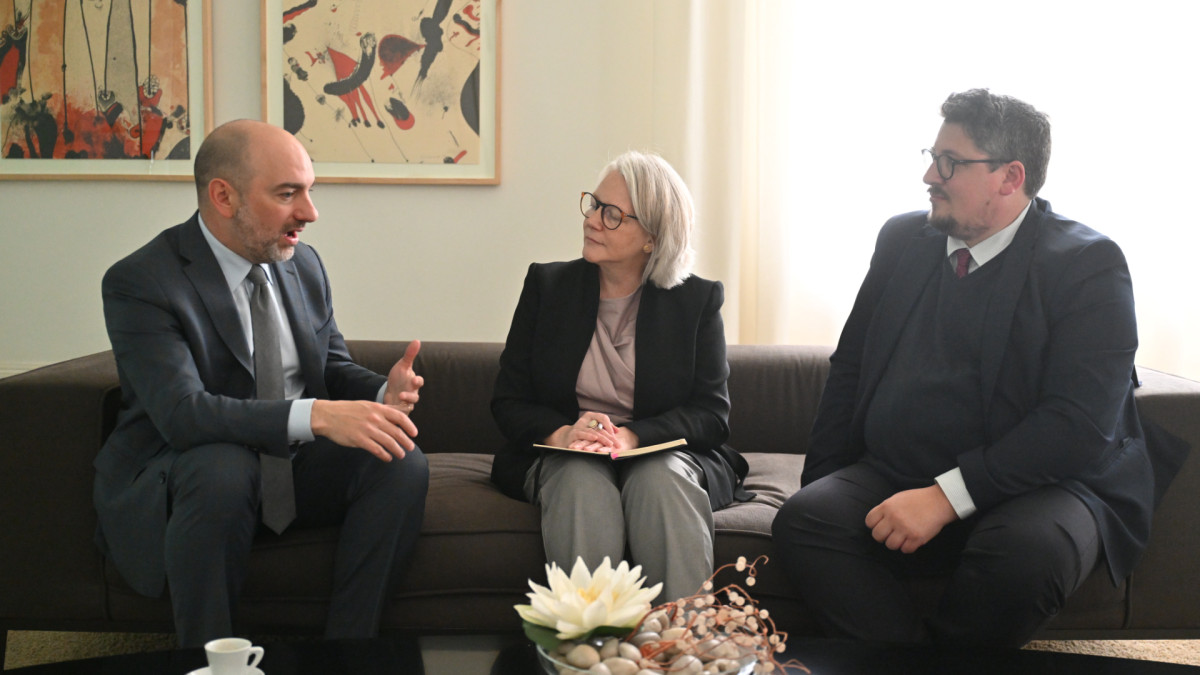
Since Russia decided to invade Ukraine in 2022, the conversation about European security and defense has accelerated. Yet as challenges have evolved, the sense that a decades-long trend of change was under way also progressed. To explore this idea, at the latest edition of CIDOB’s international conference War and Peace in the 21st Century, Carme Colomina, a senior researcher and editor at CIDOB, sits down with Daniel Fiott, director of the Defense and Statecraft program at the Brussels School of Governance, and Max Bergmann, director of the Europe, Russia and Eurasia program at the Center for Strategic and International Studies (CSIS). In their dialogue, they analyze and examine that era shift.
Both share a diagnostic: a Europe distant from the United States and facing different fronts. Bergmann explains it: “For the first time in the history of the Atlantic alliance, the United States and Europe are focused on different threats”. Fiott, for his part, warns that Europe faces a challenge in terms of its own decision-making, since “in every major political issue it has been extremely difficult for Europeans to stay on the same page”.
In the conversation, Colomina guides the analysts to explore the contradictions accumulated in earlier periods: Washington urged Europe to spend more, but blocked attempts to build a truly European defense; European governments raise their budgets, but “more money does not mean more Europe”. In short, a dialogue about defense, but also about power, dependence, and the urgency of building European autonomy that must step forward urgently but with careful organization.
Bergmann, Colomina and Fiott dialog during CIDOB’s celebration of the ‘War and Peace in the 21st century’. Photo: CIDOB
We find ourselves at a crucial moment: a lot has happened since Russia’s invasion of Ukraine. European defense is undergoing a real transformation. The concept of security itself has changed, and at the same time new layers of vulnerability keep surfacing: the transatlantic gap, Greenland, Iran. The sense of vulnerability does not retreat; it grows. How do you view what has happened in these past years? How solid is this pivot, and where do you see its weaknesses?
Max Bergmann (M. B.): To start, it’s both structural and temporal at once. Structural in the sense that we are in a different moment, a different era. For the first time in the history of the Atlantic alliance, the United States and Europe are focused on different threats. The United States should be focused on the Russian threat, but Washington’s principal focus — not only under the Trump Administration, but also under earlier administrations — has been China. In Europe, by contrast, the main threat is Russia.
There is also a growing sense in Washington that Europe must take charge of its own security, and that tendency will continue. In a sense, the Biden Administration was an anomaly, a return to the past. The point we are at now suggests that any future administration will want Europe to shoulder responsibility for its own security.
“Europeans have to realize that they are on their own. The United States will not be there for them under this administration”
Max Bergmann – Director of the Europe, Russia and Eurasia program at CSIS
A continuation of the disruption caused by Donald Trump: Greenland, Iran, his attacks on Europe as a culture, his attacks on the European Union. We are in a very different place. Europeans have to realize that they are on their own. The United States will not be there for them under this administration. And if, somehow, it is there, what will be the price? Because that is the nature of this administration.
Daniel Fiott (D. F.): I don’t dispute the core of Max’s point. We are facing unprecedented crises. In a way, even the pandemic helped broaden this discussion toward areas of European security that we might not have considered before, such as supply chains and critical infrastructure. They are now part of everyday discussions within the European Union and NATO.
There is clearly a structural shift underway in the transatlantic relationship. What worries me is that Europeans keep treating President Trump as an outlier in the system. They should also consider the possibility that the situation in the American political landscape could worsen. There is a lot of evidence that President Trump is, in many respects, an opportunist. He likes chaos because he sees opportunities in it. He also likes crises because they allow him to expose Europe’s weaknesses very clearly.
But let’s look ahead. If one of his so-called anointed successors comes to power as the next president, it could be more ideological than Trump himself. That is particularly troubling for Europe, because parts of Washington’s political elite already display a kind of visceral and inexplicable hostility toward Europe. It’s hard to pinpoint where it comes from, but it’s there.
So, as Max said, whatever the future holds, Europeans must plan their own defense. The mindset should be: we are really on our own. I understand why NATO politicians don’t want to be remembered as the ones who lit the NATO on fire and ended it. But, carefully and discreetly, they should be planning for a world in which the United States won’t be there. That entails investing in defense and security in ways that haven’t been done before.
Analyzing this pivot, we often start with Ukraine. But you were already pointing to longer-term shifts in the American approach. Barack Obama spoke of free riders and leading from behind. The signals were there. Perhaps Europeans failed to read them, and that’s what made them vulnerable. How can Europe address this situation now, especially when there remains a strong internal split within the EU about how to relate to the United States? For Russia is a challenge, China is another, but now the United States itself has become a third layer of challenge, and also a source of division among member states.
M. B.: When I look at the state of European defense and European security, the United States bears a substantial portion of responsibility. Over the last thirty years, we have not stopped telling Europeans to step up and spend more on defense. But whenever there was an attempt for the European Union to do something in defense, we said: no, don’t do that.
It happened with Clinton, with Bush, with Obama and with Biden: it has been continuous. Why? Because the United States had more influence in Europe than in any other region of the world. The situation suited them. Why upset NATO? Why upset the statu quo? If the EU began to enter defense, Europeans might not need the United States as much.
So the United States had its own confusion. On the one hand, those focused on NATO wanted things to stay the same, with the United States in charge. On the other, those who didn’t pay much attention to Europe and NATO wondered why Europe wasn’t stronger. That confusion has now been absorbed into today’s structure, in which, for some reason, EU defense is still seen as competing with NATO. Why? Because the United States said twenty-eight years ago that it was a duplication. It didn’t have a clear strategy. It wanted the status quo, but it was unhappy with the status quo.
D. F.: And it’s not just a theory. After the first invasion of Ukraine in 2014, there was a lot of ambition and a strong awareness among European leaders that Europe had to take on more responsibility. The problem was that, every time Europe tried to move in that direction, Washington would call, saying: hold on, maybe we’d prefer you to issue statements about defense before you actually do something.
That is changing now. The mindset has shifted significantly. And if, in the future, someone occupies the White House with a more constructive view of Europe, and by then Europe is more independent in defense — with the capabilities and political agency to exercise its power in the world — the United States might come to view that as a positive outcome.
But Europe has been stuck in that post–Cold War dynamic, where Europeans were seen as the weaker side, the free riders, and then, whenever they tried to do something about it, were told to stop. That cycle is broken now.
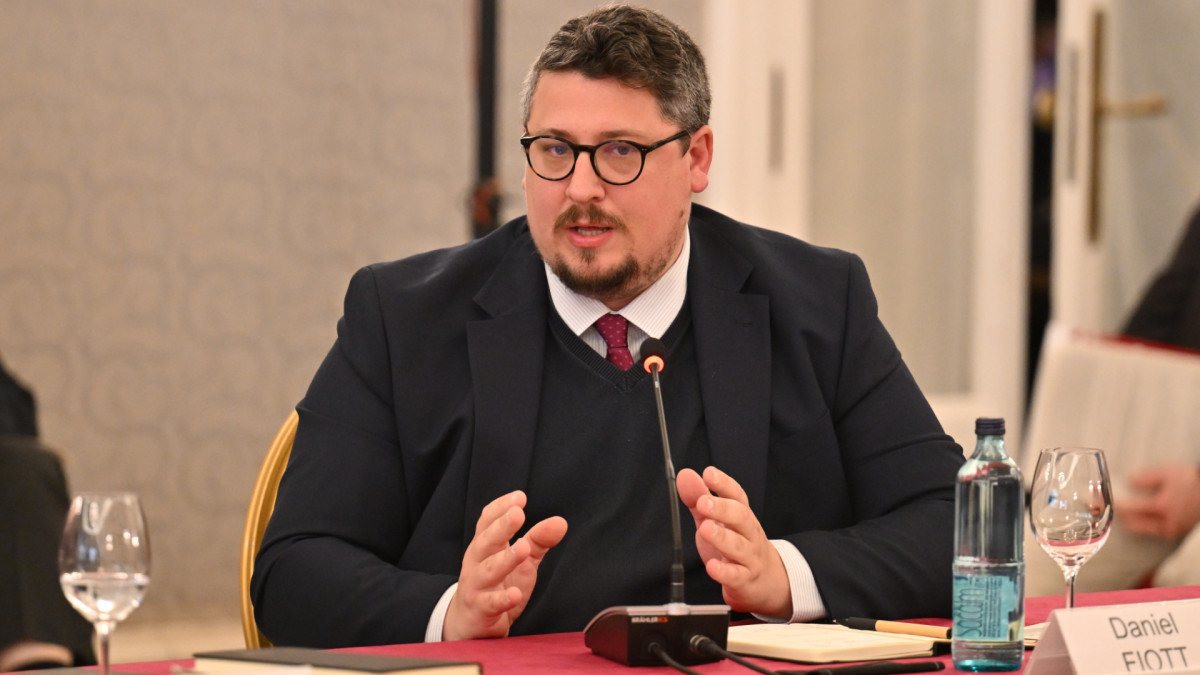
Daniel Fiott during his speech at CIDOB’s international conference. Photo: CIDOB
There is also a widely accepted narrative that Europeans do not spend enough, but in recent years they have spent much more. So, is the real problem the amount of spending, or the manner of spending? And what does that mean in practice? Does more spending translate into a stronger Europe, or simply a more heavily rearmed Europe that isn’t necessarily stronger?
D. F.: It’s a very good question, because there are several things to untangle. The first is that more money does not automatically mean more Europe. In fact, when governments have more money in the treasury, there is a tendency to invest it in national priorities.
“There has to be a European level to that investment, especially in those defense capabilities that no single member state can provide on its own”
Now, we must be careful with that argument, because many European governments start almost from a blank slate when it comes to defense. So insisting that there should be no national investments isn’t realistic. Part of national investment is inevitable, both to build the industrial base and to rally public opinion. In today’s climate — rising food prices, cuts to health and education budgets, an energy crisis — governments find it even harder to defend defense spending. They have to show citizens that this money is also being reinvested in their own economies.
However, that should not become the defining feature of investment. There must be a European dimension to that investment, especially in those defense capabilities that no single member state can provide on its own. Otherwise, it’s simply money wasted: spraying funds like a sprinkler and ending up with no real military capabilities.
The second issue is political. Imagine a future where Europeans do have the capabilities, the industrial base, the innovation, well-trained and equipped armies. Even then, a major political problem would remain: our lack of unity as Europeans. We cannot act together coherently. In every major political issue, it has been extremely difficult for Europeans to stay on the same page. Just look at the war in Iran right now. Where is Europe’s moral authority? It seems to be with the Pope or with Pedro Sánchez, and with no one else. That is the kind of disunity I’m talking about, and it’s very problematic.
M. B.: Two quick points, partly to disagree with Daniel. I do not see European disunity in how Europe views the world, in how it wants to act, or in the broad lines of European foreign policy. There, Europe is fairly united.
The problem is structural. In foreign policy there must be disagreement. There is never total unity in the United States about what its world-facing approach should be. There are two parties, there are disagreements, and there are different positions. The problem in Europe is that, to have a common foreign policy, everyone must agree. That means Europe only agrees on the easy things, on things that don’t matter too much.
So there is a huge structural problem in how Europe presents itself on the world stage. It’s not that there are no shared interests or visions. It’s that there is no single voice, no one person, and no real foreign policy mechanism capable of expressing them effectively.
The second hurdle is this idea of sovereignty, national sovereignty. Europeans have not been sovereign in defense since 1945 — perhaps Spain in a somewhat different form, but certainly Western Europe. Instead of working together and integrating defense efforts, as the original European project through a European Defense Community had intended, Europeans failed. The United States had strongly supported that idea because it did not want to stay in Europe forever. That was never the plan after World War II.
The well-known NATO motto — keep the Americans in, the Russians out, and the Germans down — is a British phrase. The Americans did not want to stay. The plan was to go, and the way to go was to build a common European army. Eisenhower backed that idea strongly when he was Supreme Allied Commander Europe and later as president. But when that failed because the French rejected it, the United States faced a terrible choice: the Europeans could not defend themselves, so what do we do? And the U.S. stayed.
“Europe outsourced its defense to a foreign power, and that foreign power no longer wants to do it or wants a lot in return”
That gave Europeans the illusion that they were sovereign in defense. But where is sovereignty? The United States can withdraw, and then what? Europeans have to bow to keep the Americans in. Mark Rutte has to kneel to try it. National armies do not make Europe sovereign. In fact, they are probably an obstacle to Europe becoming truly sovereign. Europe outsourced its defense to a foreign power, and that foreign power no longer wants to do it or wants a lot in return.
D. F.: And it could be even worse if Greenland is added to the equation. Then we are not just talking about breaking a dependency; it would be an act of hostile control of European territory.
Ultimately, the European Union has always described itself as a peace project, but it was a peace project armed, and the weapons came from the United States. That part was never really explained. At the same time, sometimes I feel Europe should also tell Washington: beware what you wish for. Because if Europeans really did everything Washington now says it wants —spending 5% on defense, taking the lead, and becoming fully independent in security— NATO could stop being useful or attractive to the United States.
M. B.: I disagree. If we go back to John F. Kennedy’s Philadelphia speech on July 4, 1962, about transatlantic interdependence, the idea was that the United States of America and the United States of Europe would work together. What the United States should want is a true partner.
Yes, those who work in NATO love the influence the United States obtains through it. But what it should want is a Europe capable of defending the same values we hope it still shares: stability, rule of law, democracy, freedom. And that it can help promote those values around the world. That is what it should seek.
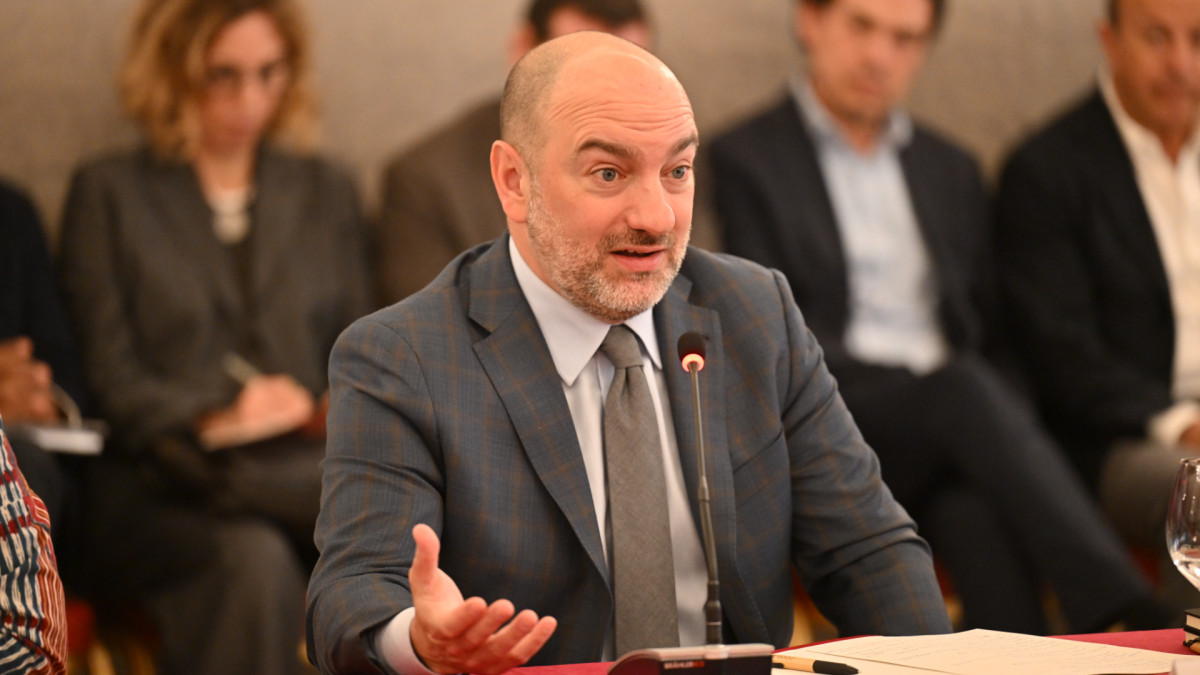
Max Bergmann, during his presentation at CIDOB’s ‘War and Peace’ conference as well
And perhaps that is what the European Union now feels it defends with greater resolve than the United States itself.
M. B.: Indeed. But then it becomes a question of Europe truly standing up and promoting those values around the world, rather than simply kneeling before Washington.
Let me close with this, Daniel. If everyone is calling for a stronger European pillar within NATO, who should lead that pillar?
D. F.: It’s a very tough question. I hear a lot, even now, about the Europeanization of NATO. But I still struggle to understand what that would really mean in practice. If we faced a scenario where the United States decides tomorrow that it no longer wants to be in NATO, then it is not really the North Atlantic Treaty Organization anymore. What does it become? A European Treaty Organization? More Canada, Turkey, and the United Kingdom, which of course presents its own challenges.
“The worst-case scenario is that Europe Europeanises NATO in a way that it simply imports into NATO all the things it dislikes about the EU”
Daniel Fiott
So I understand why governments might want to toy with the idea of Europeanising NATO. In their minds, NATO already has command structures and so on. But what they overlook is the deterrence power that the United States has historically provided. The United States has a very clear decision-making capacity that Europeans cannot easily replicate. I often use this with my students: who should be the European SACEUR [Supreme Allied Commander Europe]? And you immediately see what kinds of conflicts would emerge just by choosing the person.
In a European defense organization, there must be a very solid decision-making structure. Otherwise, adversaries will not take you seriously. The worst-case scenario is that Europe Europeanises NATO in such a way that it simply imports into NATO all the things it dislikes about the EU. That would be a grave mistake.
So Europe needs to think very carefully, not only about the capabilities and forces it needs — which are critical — but also about decision-making processes. And for that, governments have to stop acting as they have for many years: relying on the United States or avoiding making decisions on their own.
Thank you very much.
In partnership with