
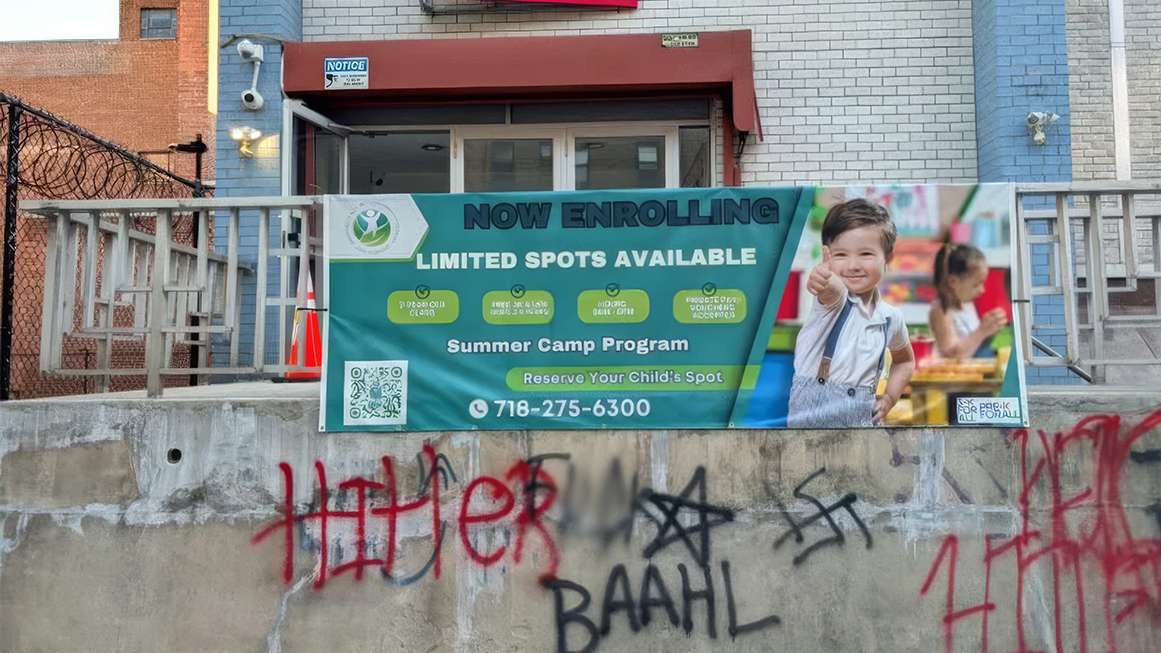
Graffiti vandals are now being treated as potential hate-crime suspects.
The phrase hate crime may conjure images of a bigot striking a Jewish person or a prejudiced individual shoving an Asian woman onto subway tracks. Yet in New York, hate crimes can encompass more than violent acts against people; they can also target property.
In New York, certain graffiti actions can qualify as aggravated harassment in the first degree under a contentious statute that some say tests free-speech protections.
“A person is guilty of aggravated harassment in the first degree” when they commit a range of offenses “with the intent to harass, annoy, threaten or alarm another person” based on that individual’s identity, including “race, color, national origin, ancestry, gender,” or religious affiliation. The statute covers anyone who “etches, draws, paints,” or otherwise places a swastika on public or private property.
The aggravated-harassment provision obliges law enforcement to make subjective judgments. Officials must determine whether an act, such as drawing a swastika, was intended to harass a particular religious group. Last year, when anti–Elon Musk protesters in Brooklyn and Manhattan vandalized Teslas with swastikas, The New York Times noted that it was “clear that the vandals…were using the swastikas to attack” Musk, Tesla’s CEO and a leading Trump administration adviser—”not to broadcast their own support of Nazism.” Yet those incidents were treated as hate crimes in the investigations.
In June, a student who raised a flag bearing two swastikas and a Star of David above a New York University building was charged with aggravated harassment and other hate-crime counts. The student admitted the act but entered a not-guilty plea to the hate-crime and aggravated-harassment charges. According to the New York Post, he raised the banner because “he was upset with how NYU handled political issues around Israel.” Is it a crime to critique a school’s handling of Israel-related politics? In New York, law enforcement makes that determination.
Supporters of the First Amendment have previously scrutinized the provision. In 2018, a SUNY Purchase student faced aggravated-harassment charges after posting posters around a campus building displaying Adolf Hitler, a swastika, and a quote from Mel Brooks’ film The Producers. Eugene Volokh, a fellow at the Hoover Institution, characterized the prosecution as unconstitutional, arguing that the government “can’t target for special criminal punishment racist signs.”
Referring to R.A.V. v. City of St. Paul (1992), he asserted that “a ban on racist ‘fighting words’ is unconstitutional even if a ban on ‘fighting words’ generally is constitutional, so a ban on unauthorized signs that display a swastika is unconstitutional even if a ban on unauthorized signs generally is not.” In other words, the state cannot prohibit a particular expression of speech. While New Yorkers may rightly condemn swastikas, the proper course is to prosecute criminals for illegal actions, not to criminalize the ideologies behind them.
