
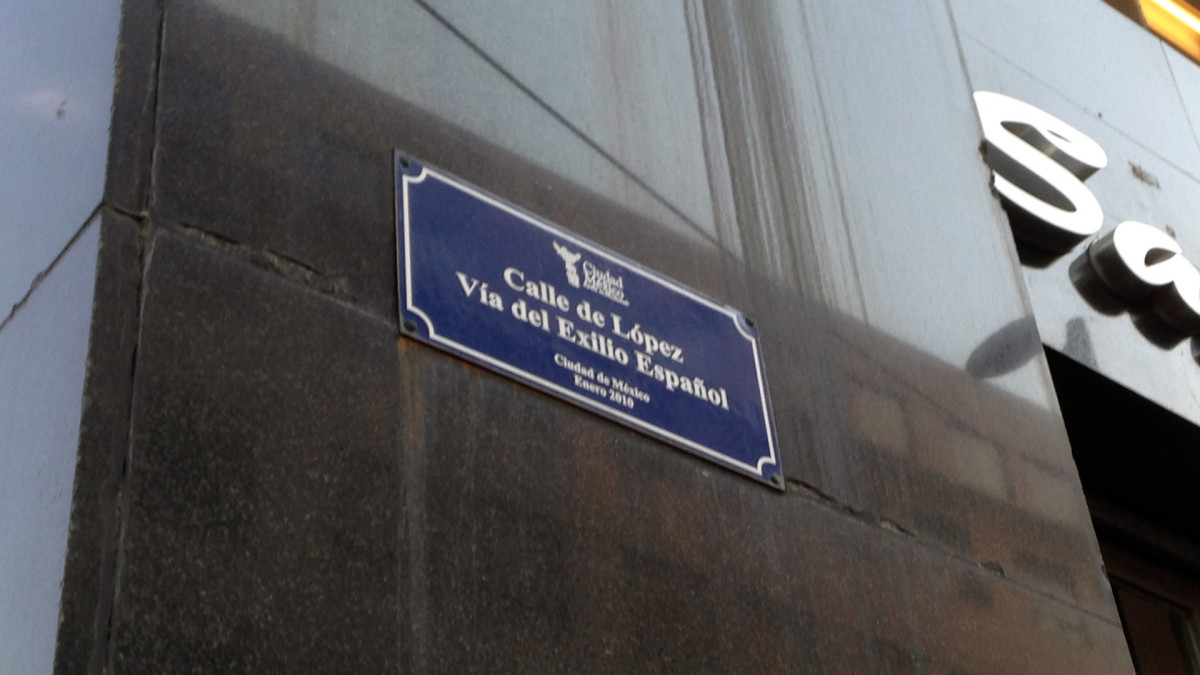
The day of the greatest fear in his life occurred on that journey from France to Mexico: a German submarine shadowed the ship carrying him and his family as they sought to reinvent themselves ten thousand kilometers from their native Catalonia. And on that same day, Allied airplanes flew over the vessel. The crew — including him, a boy of barely five years old, clutching his father’s hand — stayed with life jackets on, ready to leap into the sea at any moment. Yet that fear remained fear. But the memory hardened into trauma. The Spanish Civil War was already devastating in Barcelona; nevertheless, Durán, the protagonist of this story, had just escaped barbarity, along with his parents and siblings, taking refuge near Montpellier; now it was time to sail toward the Mexican coast of Veracruz. The war was about to end; the persecution, not.
His father, a high official of the Second Republic, had already been targeted by the Nationalist side. Durán recalls that, when the teachers at his school asked what his father did, at home he’d been taught to answer: “He’s a firefighter”. On the other hand, one of his uncles was killed by a bomb in his own home, while Francoist troops yelled in the streets “¡Viva Franco!” To save his life, the only way out was to leave the country. First they went to France and, from there, they turned toward Mexico, because the order of Mexican President Lázaro Cárdenas was to receive, recognize —the Government and the currency of the Second Republic— and grant political asylum to all Spaniards who wished to escape the desolation and devastation the war had left at home. Like Durán —who shared his testimony a few years ago with the journalist who writes these lines—, more than 30,000 Spaniards had the opportunity to reinvent themselves in Mexico (according to historians such as Enrique Moradiellos or Dolores Pla Brugat, more than half a million Spaniards left for exile).
All of this happened exactly ninety years ago, after months of conspiracy, General Mola (and other officers) rose up in Melilla, confirming the coup d’État, days after José Calvo Sotelo was shot in the nape of the neck. The wounds of that conflict seem not to have fully healed. The war photographer Gervasio Sánchez often says that wars do not end when Wikipedia says so, but when their echoes are no longer heard. And the republican exile in Mexico is one of those echoes.
“In a world closing in on fascist advance, Mexico opened its doors and became a kind of laboratory where the hybrid identity between the two nations was strengthened”
Mexico was more than a safe harbor: it was a kind of broken mirror where, at the same time, the internal defeat of Spain and the hope of a promising Mexican future reflected. Then, Cárdenas understood that welcoming the losers of that war, one of the most uncivil wars of the twentieth century, was not only a humanitarian gesture but an opportunity to receive the best of a brotherly country. That, of course, without ignoring the political gesture embodied by exile itself: in a world closing in on the advance of fascism, Mexico opened its doors and became a kind of laboratory where the hybrid identity between both nations was strengthened, an identity that remains very present today in universities, cultural centers, and publishing houses founded by those republicans who were able to escape to save their lives. Seen this way, the republican exile was not merely a diaspora: it was a seed that germinated in the intellectual, democratic, and cultural life of the host country.
Now, why rescue the memory and history of people like Durán, when almost a century has passed since then? The answer to that question has many arguments —besides countless testimonies and documents—, but one of them, undoubtedly, is that the history of Mexico was also written —and continues to be written— thanks to the work and efforts of those who were defeated in Spain, which split the country, painfully, in two. And remembering that historical passage, in times when geopolitics is reshaped by the caprices of Washington at dizzying speeds, is worthy and even necessary, because it forces us to reflect on what it means to welcome and what it means to expel. That episode reminds us that borders are not just lines on a map: they are decisions that alter the fate of peoples.
“The history of the republican exile in Mexico becomes a mirror that also reflects the present”
We speak of the ninety years that have passed since the outbreak of the Spanish Civil War, but today we continue to witness exiles that multiply: Syria, Venezuela, Ukraine or Sudan. And in this way, the history of the republican exile in Mexico becomes a mirror that also reflects the present. What are we doing with those who arrive on our shores, at our airports, with a tear of blood in one eye and a tear of hope in the other? Do we live in such dizzying times that we have reduced people to numbers on papers and bureaucracy, to lists of potential voters, to dispensable tokens on the cruel board of incendiary politics? These are uncomfortable questions that, more than exact answers, constitute an invitation not only to rethink the compliance with the legal norms regarding asylum, but also to define what our responses are to people who literally save lives after fleeing the barbarities that in countries like Spain already appear more as fiction than as a reality — or, better said, a truth that hurts us too much to remember and admit.
That exercise, that reflection on how we react to forced displacement, on our role as a receiving country, is not a static thing nor does it deserve a suffocating answer; it is something that deserves consideration as much as democracy itself, that is, to take it into account as a daily practice.
The Silent Pain of the Exiled: A Wound and an Opportunity
When we speak of this phenomenon, there is a key figure: León Felipe. He was born as Felipe Camino Galicia (Tábara, Zamora, 1884- Mexico City, 1968) and arrived in Mexico in 1939 with the republic’s defeat on his shoulders, turning his wound into a scar in the shape of a word.
“The exiled not only loses the land, he also loses the obedience of things, the possibility to govern over his own destiny”
For him, the chance to reinvent himself on the other shore also carried another angle: precisely, that of the wound; and a very deep one. His gaze was raw and at the service of the pain of those who knew firsthand what dispossession and exile meant. In Español del éxodo y del llanto (1939), he wrote harshly the following: “Dust and tears. Our great treasure.” That was the realization that exile was becoming, day by day, a present and a memory that moved inevitably within the limits of pain. In that way, his poetry was a lament and a warning: the exile not only loses the land (and the sense of belonging to it), he also loses the obedience of things, the possibility to command his own destiny. Nevertheless, he never stopped thanking the country that saved his life. “Spaniards of exile and of tears, Mexico will someday give you a bed like mine”.
Of course, he was not the only intellectual of that migratory phenomenon. The list is long. Figures such as the Asturian José Gaos, who transformed the Casa de España into the present-day Colegio de México —one of the country’s most prestigious academic centers—, and the Andalusian Adolfo Sánchez Vázquez, who gave a turn to philosophical studies from UNAM —considered the country’s esteemed “home of studies”—, shaped the intellectual course of the nation. Together with them, the Barcelonese Pedro Bosch Gimpera advanced modern anthropology and the creation of INAH (the National Institute of Anthropology and History). On the other hand, the Madrid-born Félix Candela revolutionized architecture with his renowned concrete shells. In the cultural realm, Luis Buñuel and Carlos Velo gave new life to Mexican cinema, and critics like Enrique Díez-Canedo strengthened publishing houses such as the Fondo de Cultura Económica. Their arrival undeniably marked a before and after in the country’s cultural, university, publishing and intellectual life.
And what was the echo of that migratory phenomenon? Obviously, the impact of that powerful cultural movement resonated in the next generation: the children of those Spaniards, who were Mexican and Spanish of a second generation at the same time. One of them, without a doubt, is Juan Villoro, son of Luis Villoro, a Catalan philosopher who became one of Mexico’s most influential intellectuals. Juan inherited that memory, but from another angle. In The Figure of the World he recalls his father as a man who turned exile into a political commitment. “How far can we recover someone else’s memory? Being a son means to descend, to alter time, to create a mismatch that is remedied with pedagogy, sometimes with affection,” he wrote. For him, who is considered one of the great chroniclers of today’s Mexico, the concept of exile also became a kind of permanent foreignness.
“Exile is not a concept defined at the port of arrival, but a long and complex process of constant self-recognition”
Exile, permanence, absence and a constant uncertainty about belonging. Both León Felipe and Juan Villoro agree that exile is not a concept defined at the port of arrival, but a long and complex process of constant self-recognition. The Zamoran spoke of dust and tears as treasure; Villoro, however, approached the topic from the effort his father made to become Mexican: “You don’t know the work it takes to be Mexican,” his father, Luis, told him when he proposed reclaiming Spanish nationality. What is exile? Perhaps, in a very simple sense, the experience of each person compelled to reinvent themselves in another land, in another time.
Nostalgia. Very few peoples have understood the longing for land — and all that it implies — when one is far from it as the Galicians. They even invented a term that, though we all understand, no one else can use: morriña. It is nothing other than a profound longing for Galicia in the life of any Galician who reinvents himself overseas. And it is not that one is from elsewhere, or that one misses another land; no, it only applies to Galicia and the Galicians. But for the purposes of this piece, and of this reflection, perhaps the closest to that feeling of loss mixed with distance and conditioning, to that emptiness of what is familiar, to that lament for having been torn away by the force of birth, is exile: that strange way of continuing to walk the world, in a different place, trying to be the same, even knowing that after every step, identity, like everything else in life, changes without remedy. On the basis of all the above, in some way, the Mexico of today is also a child of that exile, as well as of many others in its history.
