
The ruling stands as a significant statement about how courts review the president’s use of emergency powers to mobilize the military for domestic policing.
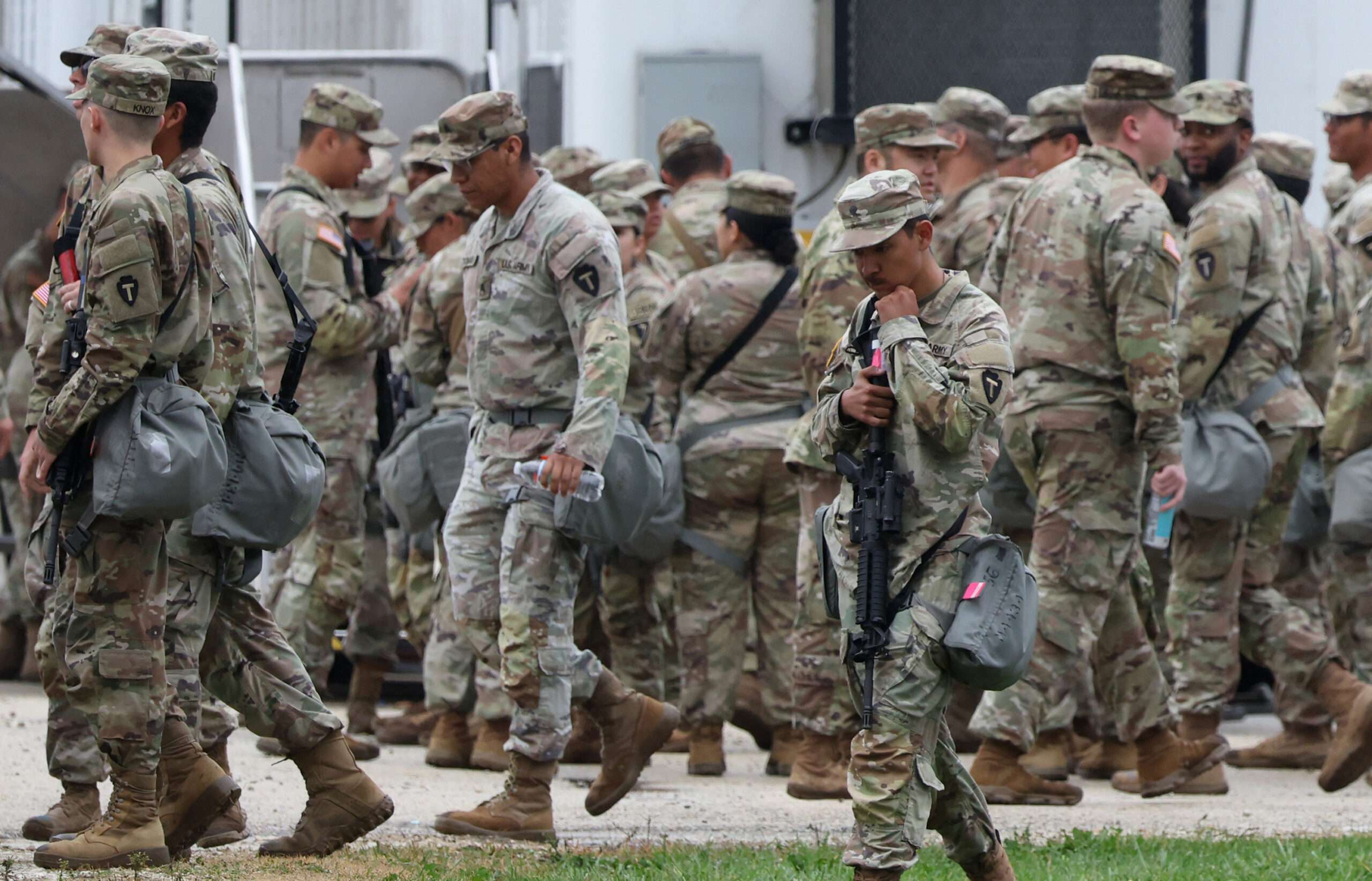
A visual caption in news coverage from the time shows Texas National Guard personnel stationed in Illinois. On October 23, in Newsom v. Trump, the United States Court of Appeals for the Ninth Circuit concluded that Donald Trump’s June 2025 move to federalize the National Guard in Los Angeles likely exceeded legal authority. While the decision does not immediately shift facts—because the Guard was already withdrawn months earlier after the Supreme Court ruled against Trump in a related Illinois case—it carries substantial implications for how courts scrutinize executive decisions to deploy the military inside the United States. In particular, it reinforces that such actions are subject to judicial review and that presidents deserve only limited deference when invoking extraordinary emergency powers. It also adopts a tightly constrained understanding of what constitutes a “rebellion,” one of the triggers that might justify federalizing state forces.
Trump’s federalization was a response to anti-immigration enforcement protests directed at immigration authorities. The district court had found the action unlawful and issued an injunction blocking it. The Ninth Circuit, however, lifted that injunction, a step I criticized when it happened. The statute at issue, 10 U.S.C. Section 12406, authorizes federalization of state forces only in particular circumstances: first, if the United States or its Commonwealths or possessions faces invasion or the threat of invasion by a foreign power; second, if there is a rebellion or a danger of rebellion against the U.S. Government; or third, if the president cannot carry out federal law using the regular armed forces. Last year the Ninth Circuit suggested that Trump’s action might fit Subsection 3: a scenario in which the president cannot enforce the laws with the usual federal troops. Yet the Supreme Court’s December decision in Trump v. Illinois undermined that reasoning: Subsection 3 may be invoked only when the president is authorized to deploy regular federal troops to enforce the law and those troops are inadequate. That framework does not apply to anti-ICE protests in Los Angeles and Chicago.
With Subsection 3 effectively off the table for this case, the Ninth Circuit turned to Subsection 2, which authorizes federalization when “there is a rebellion or danger of a rebellion against the authority of the Government of the United States.” The court’s majority, led by Judge Jennifer Sung, held that whether a rebellion exists is a question that courts may review and can overturn if the finding does not reflect a colorable assessment within the bounds of reasonable judgment. I regard this level of deference as too generous. In a previous piece I argued that when the executive resorts to extraordinary emergency powers, the judiciary should offer little to no deference. Nonetheless, the Ninth Circuit’s stance is not a blanket approval; it remains capable of striking down executive actions when the claim of rebellion is glaringly unfounded—as it was in this instance.
In determining what counts as a “rebellion,” the court defined it as “a violent, armed, organized, open, and avowed uprising against the government as a whole.” This definition aims to draw a clear line between major upheavals and episodic violence or other unlawful acts by protesters. The Ninth Circuit backed this interpretation with a survey of historical precedents. It also concluded that the events in Los Angeles did not approach the standard for a rebellion. There were violations of law and some low-level violence, but there was no coordinated, systemic effort to overthrow the government or to pose a serious challenge to federal authority.
The opinion drawn by Judge Sung, while lauded by some as a pragmatic application of legal standards, is noteworthy for its cross-ideological appeal: Judge Sung is a liberal appointee of President Biden, yet her opinion was joined by Judge Eric Miller, a conservative appointee of President Trump who previously clerked for Supreme Court Justice Clarence Thomas. This bipartisan alignment hints that the issue transcends simple ideological divides. Judge Mark Bennett, another Trump appointee, dissented from the majority, though his objections were largely procedural. He did, however, challenge the majority’s conclusion that if Trump’s attempt to federalize the National Guard went beyond statutory authority, it would also violate the Tenth Amendment by commandeering state power.
Bennett’s dissent framed the argument around the Constitution’s Calling Forth Clause, which grants Congress the power to mobilize the militia to enforce federal laws, quell insurrections, and repel invasions. He contends that, in circumstances where Congress has not exercised that power, states retain complete control over their militia—and that this sovereignty is protected by the Tenth Amendment. In such scenarios, overriding state authority without a proper constitutional basis would amount to unconstitutional commandeering of state government forces. The majority, for its part, explains that the federal government—whether acting through the president or Congress—violates the Tenth Amendment by commandeering state personnel to enforce or administer federal law. The court notes that California National Guard members are state personnel unless and until correctly federalized. If the federalization orders had been valid, the Guard would have been functioning as federal officers in Los Angeles, and there would have been no commandeering of state personnel. But because the court found no valid basis to federalize the California National Guard in this situation, the orders were invalid, and the Guard members remained state personnel. Consequently, the challenged executive orders compelled those state officers to assist federal officers in enforcing federal immigration laws, which the court found violated the Tenth Amendment.
In sum, the majority’s opinion and the dissent engage with a range of procedural and doctrinal considerations, some of which I may discuss further in future writings. For the moment, this decision does not produce immediate changes on the ground. Yet it establishes a meaningful precedent: it reinforces the possibility of judicial review when the executive invokes emergency powers, and it clarifies the meaning of “rebellion” within the framework of 10 U.S.C. Section 12406.
