
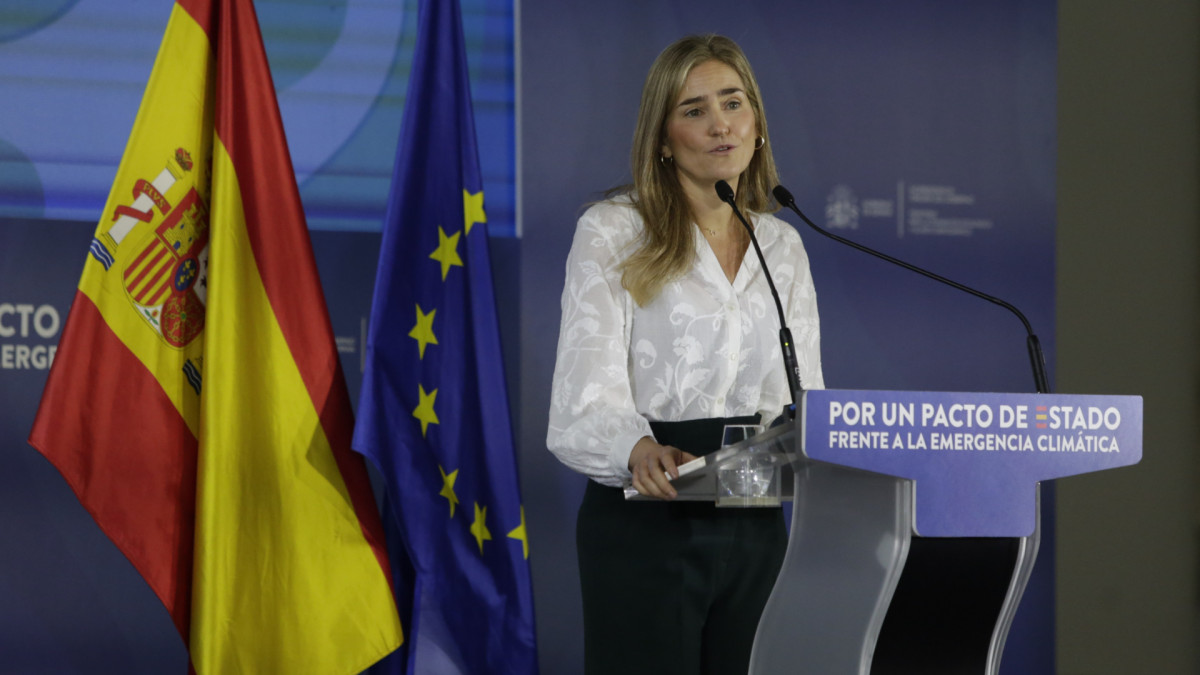
The first Convention of the State Pact in response to the climate emergency held in Ponferrada marks a symbolic and politically significant moment. This city, in the heart of León province, represents both the past and the future of the ecological transition. For decades it was a coal hub, and today it is a territory struck by massive fires, recurrent droughts and the loss of rural population. There, in an old thermal power plant converted into a cultural center, the idea of reaching a grand national pact that responds to the greatest threat of our time: climate and environmental collapse.
“The idea was launched to reach a grand national pact that responds to the greatest threat of our time: climate and environmental collapse”
The presence of prominent government members shows that the issue has entered the political agenda at the highest level. However, the absence of key ministers, of political forces and of social and economic actors whose involvement is essential for a true country-wide agreement was also evident.
The climate emergency is here
Spain can no longer speak of climate change as something abstract. The latest report on climate impacts is alarming. Heat waves have multiplied, turning summer into a public health threat. In just the last decade, more than 11,000 people have died from extreme temperatures. Spain has lost more than 20% of its available water resources compared to the historical average, and 75% of the territory suffers water stress or desertification risk. Droughts affect agriculture, tourism and urban supply. Forest fires have reached unprecedented scales: 400,000 hectares burned in 2025, surpassing the 2022 record.
These impacts have enormous economic consequences: agricultural losses, damaged infrastructures, halted production, evacuations and rebuilding. But they are also social and territorial: internal climate migration, regional inequalities, rural depopulation, loss of biodiversity and deterioration of health. The European Environment Agency does not hesitate to state that Spain is the most climate-vulnerable country in the entire European Union. Facing this reality, the climate emergency is not only environmental. It is economic, social, territorial, health-related and even political. And therefore, it requires an urgent national pact.
Lessons from big agreements
Spain is not immune to major national agreements. In fact, some of the most decisive moments of recent history have been built on broad pacts. The Pactos de la Moncloa (1977) were born during the democratic transition. The Pacto de Toledo (1995) on pensions emerged to guarantee the sustainability of the welfare state. The Pacto contra la Violencia de Género (2017) was a cross-party political commitment. These pacts have common elements: long-term vision, multisectoral participation, shared governance, adequate resources and transparent monitoring.
“Spain is not unfamiliar with major national agreements such as the Moncloa Pacts, the Toledo Pact or the Pact against Gender Violence: all of them are cross-cutting political commitments”
Climate change is not solved by laws alone. It requires a deep cultural, economic and territorial transformation. It must involve the central government as guarantor of national security, but also the autonomous communities with competencies in water, energy, agriculture or land-use planning; municipalities, who are on the front line of floods, fires and heat waves. Companies, large and small, must transform their production systems, and unions must accompany the employment of the future. Young people, citizens and rural communities demand a future where one can live. Environmental and social entities and the scientific community already propose alternatives.
A pact for the 21st century
The pact must build the country’s economic, social and environmental resilience. Spain needs the ability to respond immediately to increasingly frequent extreme events, but also structural transformation in the medium and long term.
Therefore, the pact must be transversal. Climate is not a sectoral policy: it affects the economy, taxation, health, housing, urban planning, security and innovation. It cannot remain confined to the Ministry for Ecological Transition; it must become the axis of the country’s economic and social model.
The agreement must be multilevel. Spain is a decentralized country and climate does not respect administrative boundaries. The pact must bring together the State, autonomous communities, municipalities and local communities, with real mechanisms of cooperation, funding and shared responsibility.
“A national pact must align with international environmental, political and economic commitments, positioning Spain as a leader of the ecological transition in Europe”
The pact must promote the climate justice. Not all territories suffer or contribute equally to the climate crisis. Rural, island, coastal or energy-transition zones need specific support. There should be a climate cohesion fund that repairs inequalities and guarantees opportunities for all. A national pact must align with international environmental, political and economic commitments, positioning Spain as a leader of the ecological transition in Europe and the Mediterranean. Climate action also contributes to national security, geopolitical interests and to defense and civil protection.
Finally, the pact must place people at the center. We are not only talking about CO₂ emissions, but about health, employment, water, housing, food and rights. A green transition without social justice will have no legitimacy. Climate resilience must also be economic and community resilience.
From the climate emergency to a new social contract
The pact must go beyond mitigation and also address the environmental emergency: biodiversity loss, soil erosion, air and water pollution. Nature is not a luxury, it is vital infrastructure. Restoring ecosystems is investing in prevention and stability. Every euro spent on adaptation saves between four and ten euros in future damages.
Spain has the capacity to lead a profound transformation. It possesses exceptional natural resources, scientific talent, innovative companies, an informed citizenry and a strategic position in Europe and the Mediterranean. What is missing is long-term vision, stability and real collaboration among actors. An ambitious climate pact could become a new green social contract for the 21st century: modernizing, fair and sustainable.
“The success will depend on understanding that in the 21st century the true state policy is the one that protects people from climate, social and economic crises”
The Ponferrada Convention is a necessary first step, but insufficient without continuity. The pact would be reduced to a symbolic document or an institutional photo. To avoid that, it must move from discourse to the design of a governance framework, with roadmaps, funding and binding participation. The success will not depend on what parties sign in a day, but on the ability to build a shared and time-honed vision. Understanding that in the 21st century the true state policy is the one that protects people from climate, social and economic crises.
Spain is already paying the cost of inaction. Each year of delay means more fires, more drought, more energy poverty, more territorial inequality and more emergency spending. The citizenry knows it. Companies know it. The territories live it. Science warns it. The only thing missing is that politics acts at the appropriate level.
A climate pact is not a choice. It is a historical obligation. It is not about saving the planet, but about guaranteeing the life, well-being and safety of our society. The climate does not understand ideologies or legislation. It demands responsibility, generosity and a national vision.
Ponferrada has sent the signal. Now it is up to us to build, together, a true national pact in the face of the climate and environmental emergency. Because only with a collective, fair, transversal and ambitious response can we confront the greatest challenge of the century and turn it into an opportunity for a new model of society that is more resilient, sustainable and solidarity-based.
