
“Artificial intelligence can be used by bad people to do bad things, such as manipulating voters, breaking into bank accounts, eroding trust in the media and in institutions, and other similar actions. Hoaxes and fake news are currently routine in what we see online.”
— Francis Fukuyama, In the Realm of the Last Man.
The present article is an aporia —a reasoning that presents an insuperable logical difficulty, a contradiction, or a rational dead end—. The aim is not to debate the results of the general elections of November 29, 2026 in Spain, but precisely to analyze the situation the following day. After the elections, what matters are the decisions to be made and the distribution of power. Then there will have to be an analysis —after the first hundred days of the new Government— of what has been done with that power. That topic, in due course, will be the object of another article. The most probable scenario is assumed, following the polls and electoral surveys that are being published.
“After the elections, what matters are the decisions to be taken and the distribution of power. Then there will be to analyze what has been done with that power”
The modern political sociology helps to predict the political future. The closer to the present, the better. The future —by definition— is uncertain; even as a trap for lions. But regarding the general elections of November 29, it is already possible to define variables and trends with some validity. Data and theories accumulate and scholarly intuitions persist. Counterintuitive ideas are sometimes the best and most fruitful. The important thing is to try, as I do here. What will happen on November 30, 2026?
The shift to the right in Spain coincides with the advance and consolidation of the radical right in several countries and regions around the world. Politics polarizes. The radical right breaks the “red lines” and isolation in many of those countries and launches itself to occupy central positions, including the government after general elections. This hard right seeks to surpass the classical right, as is happening in other countries. It is nicknamed the “soft right” (the original text uses “derechita cobarde,” often translated as the cowardly right). On the other hand, the left fractures. This creates “a wave of reaction.” As noted by the political science professor Mariano Torcal in his book Voting with Hatred: Elections and Hostility in Spain, “we no longer vote for our own people, we vote against the others”.
“The shift to the right in Spain coincides with the advance and consolidation of the radical right in several countries and regions around the world”
The experience of general elections in Spain is limited. Since the 1978 Constitution there have been fifteen general elections. The 2026 elections are the sixteenth. Before, for example, in the general elections of 1886 suffrage was censitary. Universal male suffrage for those over twenty-five was restored in 1890 and applied in the general elections of 1891. Currently, Spanish nationals of eighteen years or older who are registered in the electoral census can vote.
After the 1978 Constitution, the Prime Ministers of Spain have been Suárez (briefly Calvo-Sotelo), González, Aznar, Rodríguez, Rajoy and Sánchez. Adolfo Suárez González consolidates in the 1979 general elections, but then briefly Leopoldo Calvo-Sotelo Bustelo governs. Felipe González Márquez wins general elections in 1982, 1986, 1989 and 1993 —a long period. Then José M. Aznar López has impact in the general elections of 1996 and 2000. He is followed by José L. Rodríguez Zapatero in the 2004 and 2008 elections. Mariano Rajoy Brey experiences three general elections, in 2011, 2015 and 2016. Pedro Sánchez Pérez-Castejón is —so far— the last Prime Minister since June 2018, with general elections in April and November 2019 and in 2023. He reaches 2026, when he decides (after the failure of two housing decree-laws) to call elections for November 29, 2026.
This November 29, in the evening, the results of the general elections in Spain will be known. The country currently has 49.8 million inhabitants and the electoral census is composed of 38.7 million people. In other words, 78% of the inhabitants can vote. Seven percent (2.8 million) are registered in the overseas electoral roll. This year there are 1.6 million new voters. In the end, the known “grandson law” for these general elections does not apply, which concerns the vote of more than 163,000 people. The Supreme Court considered it a right subordinated to “general interests”, among them, “the preservation of truthfulness and the absence of irregularities in the electoral roll” (sic). Recipients of this law who live in Spain may vote.
The investiture of Feijóo and Vox’s negotiating power
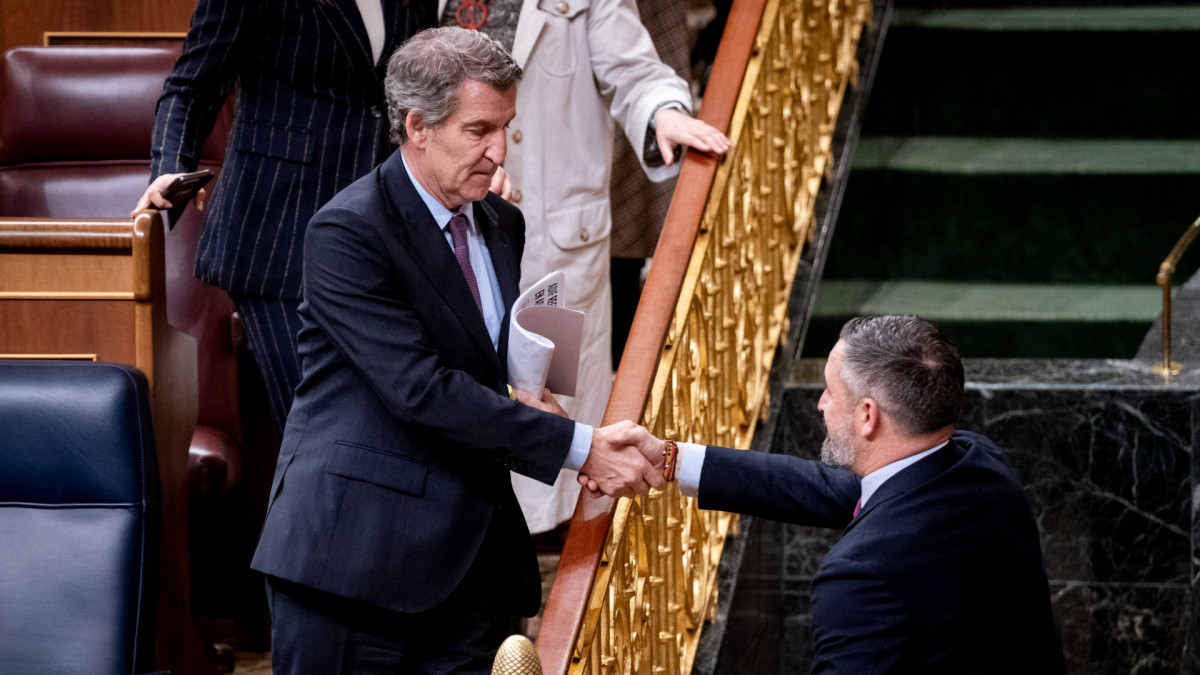
According to various sources, the most probable scenario is that the Partido Popular (PP) will win the elections but will not obtain an absolute majority (which requires half the chamber plus one, i.e., 176 seats, which are many). It is, therefore, likely that it will need the support of Vox to achieve the investiture of Alberto Núñez Feijóo (age sixty-five), and surely also to govern. Much will depend on the leadership of Santiago Abascal Conde (fifty) representing the Vox political party in a hypothetical coalition of, at least, these two parties (PP-Vox). Other polls, such as the official ones from the Centro de Investigaciones Sociológicas (CIS), dependent on the Government Presidency —whose polls almost always err—, put the PSOE as the winner (with 34% of the votes).
Two months before the general elections, Feijóo already prefers a coalition government with Vox. This follows the prior pattern of PP with Vox in the autonomous communities of Extremadura, Castilla y León, Aragón and Andalucía. In the program El hormiguero, Feijóo clarifies with reference to Abascal: “We will sit down and form a coalition government in accordance with the basic principles of our parties, seeking a series of red lines that I [Feijóo] am not willing to cross”. He never clarifies what those red lines are. It is also fashionable to speak of being or not being “on the right side of history” (without clarifying which side or why). They are political crutches to avoid explaining anything.
Taking into account the majority of the electoral polls, we will assume that the PP obtains 132 seats and Vox 66. That is approximately what several surveys suggest. With 132 seats, the PP cannot achieve Feijóo’s investiture in the first vote by itself. But with Vox’s seats added, reaching 198, that would be an absolute majority (12% more than the 176 seats needed for investiture in the first round), and then they would govern comfortably for four years. Hence the importance of Vox. The media in these days suggest that this coalition could even “approach 200 seats”.
Coalition talks for the investiture
The investiture process for the head of the Spanish Government requires an absolute majority in the first vote or a simple majority in the second. In our law and country they say “presidente del Gobierno,” but it is in fact a prime minister. A fellow academic ran this article through AI once finished. The AI hints that “supporting an investiture does not require joining the Government.” I am following here the pattern already carried out in previous regional elections, which points toward a coalition.
Already on November 30, the day after the elections, Feijóo is likely to send an envoy —probably Elías Bendodo Benasayag (as the current deputy secretary-general of the PP)— to Bambú, 12, Vox’s national headquarters (in Madrid, 28036) with the aim of beginning the “negotiations” with Abascal.
But that first move will likely have little success. The most probable is that Shanti Abascal —alluding to Las inquietudes de Shanti Andía, by Pío Baroja— will summon Alberto Núñez Feijóo for a private meeting, in Bambú, to talk face to face. But to commit to guaranteeing Feijóo’s investiture as president of the Government —and then operationalize Spain’s governance for four years— the two must reach several important prior agreements. Let us analyze these possible agreements.
What ministries could Vox demand in a coalition government?
First vice-president
Feijóo will likely offer Vox a vice-presidency (not necessarily to Abascal, although that seems most probable), implying that it could be a second or even a third vice-presidency. Perhaps without specifying. Or even none.
But Abascal will demand the first vice-presidency, along with the post of Minister of Finance. Or else nothing. So the cards, from that Monday, November 30, are already dealt and laid out.
Ministries
Before the general elections there are in Spain twenty-two ministries. They are important, for they imply the appointment —by name— of about 1,715 people among senior officials and advisers, primarily at the central government. If the Government changes —which is most likely— these posts and people will change. But there is talk also of returning to a classic structure of fewer ministries, as in Mariano Rajoy’s era, with thirteen ministries (or “portfolios”). Thus, some of these ministries will surely disappear, possibly starting with:
- Ministry for the Ecological Transition and the Demographic Challenge
- Ministry of Social Rights, Consumption and the 2030 Agenda
- Ministry of Equality
>The ecological transition, the demographic challenge, social rights and the 2030 Agenda, in addition to equality, are not topics that a PP-Vox coalition will develop and to which they will be willing to dedicate a ministry. Perhaps another ministry will disappear. Others will simply change a bit in their naming, especially shortening or simplifying the title, such as:
- Ministry of Transport
- Ministry of Labour and Economy
- Ministry of Territorial Policy
- Ministry of Education and Sports
- Ministry of Social Security
- Ministry of Youth
There will surely be new ministries to complete the series. Simply, as possible examples, they could be:
- Ministry of Migrations
- Ministry of Family and Childhood
- Ministry of Religion and Ecclesiastical Institutions
Therefore, it is possible that the current number of ministries is maintained. They are many to make effective operational decisions in a Council of Ministers at La Moncloa; but experience shows that it is difficult to reduce the number of ministries. More often the number expands, because society is increasingly complex. The Council of Ministers at La Moncloa will have to widen. In any case, they may change in overall structure and denominations. It should also be noted that Vox has already suggested several times reducing the total number of ministries. We shall see, then.
Ministries that Vox will surely demand
It is likely there will be a discussion between Feijóo and Abascal about the number of ministries and their terminology. It is possible that Vox suggests other ministerial innovations. Since they will not easily agree on the number of ministries nor which ones for each party, they will likely have to assume the proportion of seats each holds within the future coalition. It can be assumed that the coalition as such will not include UPN or Se Acabó la Fiesta.
If this prediction crystallizes, Vox would represent approximately a third of the coalition’s seats. Translated into the distribution of the current twenty-two ministries, that proportion would amount to seven or eight portfolios for Vox, in addition to a possible vice-presidency. Logically, these calculations will vary according to the final distribution of seats and ministries. A Feijóo workaround would be to offer two or three ministries to Vox, without stating how many ministries there will be later.
“Vox would represent approximately one third of the coalition’s seats. That proportion would mean seven or eight portfolios for Vox, in addition to a possible vice-presidency”
In Table 1 one can see the estimated differences between the total vote share and the number of seats according to three recent and important polls. Spain’s rightward shift is evident. The PP and Vox would sum between 49.6% and 51% of the votes. Vox would obtain around 37% of the votes of that bloc.
However, the results of these three polls from October 2026 are strangely equal. One can assume (or even suspect) that they are copying one another. Thus, if they fail, they all fail together. Read Alma Ruiz’s thorough analysis, titled “The Mirage of the PP-Vox Two Hundred Seats” in Agenda Pública. She considers this hypothesis probable.
Table 1.
Vote estimates for the probable PP-Vox coalition according to the polls of three newspapers around October 12, 2026
| Newspaper | Party or bloc | % of votes | Seats or % of coalition seats |
|---|---|---|---|
| ABC | PP | 31.4% | 133 |
| Vox | 18.2% | 65 | |
| The coalition | 49.6% | 198 | |
| Vox’s weight within the coalition | 36.7% | 32.8% | |
| The Guardian | PP | 31.9% | 132 |
| Vox | 18.9% | 66 | |
| The coalition | 50.8% | 198 | |
| Weight of Vox inside the coalition | 37.2% | 33.3% | |
| El País | PP | 31.9% | 132 |
| Vox | 18.9% | 66 | |
| The coalition | 50.8% | 198 | |
| Weight of Vox inside the coalition | 37.2% | 33.3% | |
| El Mundo | PP | 31.9% | 135 |
| Vox | 19.1% | 68 | |
| The coalition | 51.0% | 203 | |
| Weight of Vox inside the coalition | 37.4% | 33.5% |
The dates of the three polls are: ABC, from October 6 to 8, 2026; El País, from October 7 to 8; and El Mundo, from October 1 to 8, 2026.
Unos días después, El Mundo slightly corrects (really very little) the national results of the first poll: the PP obtains a vote percentage of 31.5% and Vox 19.5%. In other words, the PP loses some votes to Vox, but balances by gaining votes to the left. So the PP remains relatively stable, but slightly down. The party that climbs the most is Vox, attracting votes even from the PP. Vox is considered “the far right” and also “the hard right.” It is estimated that in these 2026 elections Vox will capture votes from PSOE, Sumar and PP, in a magnitude roughly equivalent to twelve, eight and seven seats, respectively.
But the methodology of these polls (or electoral surveys) is highly doubtful. The last poll of El Mundo, published on October 19, 2026, presents the distribution of seats by provinces and in the two autonomous cities (Ceuta and Melilla) and by party. This seat calculation (not only votes) is performed with a mixed system of 3,007 interviews, by telephone and through a panel (not described), with quotas by sex and age group. This implies, on average, fifty-eight interviews per province. But in small provinces this is likely less than that average, perhaps twenty interviews (telephone or panel by quotas, by sex and age group). With this base, the poll estimates the distribution of votes of all parties (to one decimal) and then calculates the seat distribution. This is simply impossible. It also asserts that the margin of error is ±2.1% with a 95.5% confidence level. It is not credible.
The ambition of this newspaper and polling company is infinite. It presents the results on double-page spreads in full color. The data and maps can create sensational impact among readers and institutions, but the accuracy is minimal and the method is not adequate. These provincial data cannot be trusted. Spain cannot continue producing and publishing polls that are not valid. The publication of these polls obviously influences voters, but they are not ethically valid given the method and sample size used. The average is fifty-eight cases per province!
“Spain cannot continue producing and publishing polls that are not valid. The publication of these polls obviously influences voters, but it is ethically invalid given the method and sample size used”
Not all polls agree. The Center for Sociological Research (CIS), a public body dependent on the Government Presidency, releases on October 14 the results of the latest October Barometer with a designed sample of 4,000 and 4,029 actual samples (sic), in 1,180 Spanish municipalities. Fieldwork runs from October 1 to 7. It calculates that the PP will obtain 22.2% of the votes and Vox 17.1%. This sums 39.3% of the votes, a percentage that, according to this scenario, would not guarantee a parliamentary majority. If the parties Se Acabó la Fiesta (1.8%) and UPN (0.1%) are added, the right bloc would reach 41.2% of total votes. In addition, Vox’s weight in that possible PP-Vox coalition would be even higher, 44%. It is, then, a coalition almost halfway between PP and Vox.
This CIS poll follows the bidimensional inertia-uncertainty model by Alaminos-Tezanos “which is used as a reference for measuring cyclical electoral support for political parties”. I have read this model carefully, line by line. It is a model that almost nobody understands; in any case it is wrong. It publishes extremely small margins of error (1.6% global error with a 95% confidence interval), which are not credible. See Natalia Junquera’s article “Why do so many sociologists not believe the CIS poll,” in El País. Interview with eminent sociology specialists such as María Ángeles Durán, Belén Barreiro, Ignacio Urquizu, Félix Requena, Francisco Llera and others. There is widespread skepticism about the CIS electoral polls during Tezanos’s tenure. One says: “Tezanos increasingly biases his samples.” The editorial of El País is titled “Tezanos, again. The systematic bias of the CIS in electoral polls is harmful to the institution and politically useless.” The technical capacity of the institution is questioned. The politicization is largely attributable to Tezanos’s figure. Interestingly, this opinion is shared by both left and right press.
According to data from various electoral polls —on the proportions of votes in the table— it is possible that Feijóo initially tries to get Vox to support his investiture as president of the Government without entering the Executive. But, given Abascal’s insistence, it is possible he will offer Vox ministries such as Health, Transport, Youth, Social Security… Not mentioning the proportion of ministries for Vox. But Vox will propose (or demand?) seven among the other more basic ministries (or those that better fit their ideas) such as:
- Finance
- Defense
- Interior
- Foreign Affairs
- Territorial Policy
Possible names for some ministries
It is complex to assign concrete names to specific ministries at this point. It is like selling the bear’s skin before hunting it. But it is worth guessing a few. The PP pool is very broad, as it has more than 600 members in the PP’s National Executive Committee. However, the Vox National Executive Committee (CEN) has only nineteen members. In addition, they have purged several. But it is possible to imagine which people could ideally occupy ministerial posts. For example, these are some possibilities (the lists are, of course, incomplete):
From PP:
- Presidency, Justice and Relations with the Cortes (Miguel Tellado Filgueira).
- Family and Childhood (María Concepción [Cuca] Gamarra Ruiz Clavijo).
- Housing and Urban Agenda (Elías Bendodo Benasayag).
- Education and Sports (Ester Muñoz de la Iglesia).
- Culture (Cayetana Álvarez de Toledo Peralta Ramos).
- Science, Innovation and Universities (eurodeputy Pilar del Castillo Vera).
- Industry and Tourism (Javier Arenas Bocanegra).
From Vox:
- Finance (for Santiago Abascal Conde, together with the first vice-presidency).
- Defense (Pepa Millán Parro).
- Interior (Ignacio Garriga Vaz de Conceição).
- Foreign Affairs (Jorge Buxadé Villalba).
- Territorial Policy (for José M. Figaredo Álvarez-Sala).
Other important posts
Presidency of the Congress and the Senate. For the presidency of the Congress it is possible that Borja Sémper Pascual is proposed, whom is considered the cleverest in the Génova 13 clique. The presidency of the Senate would logically go to a Vox senator. Also important is the presidency of RTVE. There are other posts that must be negotiated from the start.
Centre for Sociological Research (CIS)
If everything develops as the October polls calculate, on Monday morning, November 30, the sociology professor José F. Tezanos — current president of the CIS— will have already resigned. According to Miguel López in ABC on October 19, 2026, the PP has insisted that Tezanos’s dismissal will be “one of the first swift dismissals” by Núñez Feijóo if he reaches La Moncloa. In the editorial “Tezanos, again” of El País it is stated: “The CIS provides a necessary public service and for that reason it should be able to carry out its task under technical leadership and be outside political contention.”
As new president of the CIS one would require someone who knows a lot about polls, international research and political sociology. The ideal person —with political experience as a Secretary of State— would be Julio Iglesias de Ussel Ordis, a professor of Sociology at the Complutense University of Madrid (and a real academic of number in the Real Academia de Ciencias Morales y Políticas). He would be the first candidate.
A high-quality institution that produces researchers of quality in Spain is the Consejo Superior de Investigaciones Científicas (CSIC). Two alternative candidates to occupy the CIS presidency could be Héctor Cebolla Boado or Luis M. Miller Moya. Of the former, read his article “The ‘Tezanos CIS’ and the statistical junk,” published in El Mundo on October 19, 2026. The summary is that “In the coming years there will have to be a choice between continuing with the statistical nonsense or finally laying the foundations of a CIS useful for a deep understanding of our social problems.”
From Miller, read his recent article: “Sánchez needs the polls to fail too much,” published in El Mundo on October 12, 2026, where he states that “The key is Vox.” He is right. See also his article “Can Pedro Sánchez win the elections?” published in the same newspaper on October 19, 2026. Everything will depend on the clash between PP and Vox. He writes: “The contest between PP and Vox will be decisive. We will see a clamp between PSOE and Vox on issues that split the PP: both can set firm positions while the Popular try to hold a more diverse electorate.”
The political differences between PP and Vox
Vox’s minimum program
To form a coalition —two parties— to invest Feijóo as president and to permit subsequent governance, one must first agree on the distribution of political responsibilities (starting with ministries and vice presidencies), but also on the coalition’s minimum ideas. A starting point is Vox’s party’s ideology summarized by Abascal in three corners of Vox’s strategy:
National priority, remigration and deregulation.
These principles are supposed to be discussed and approved —or at least tacitly accepted— by the coalition before agreeing on the investiture. More globally, Vox would present other essential principles such as protecting private property, ensuring educational freedom, public safety, and even “good education.” It would also propose patriotism as a principle, the reduction of the autonomy of social institutions and the control of cultural initiatives. They imply a project for society that must be taken seriously.
Future coalition debates
A partir de las navidades de 2026, empezará seguramente el debate dentro del nuevo Gobierno (de PP-Vox) sobre algunos temas importantes. A fecha de 20 de octubre de 2026, todavía no se habían presentado los programas electorales oficiales de los partidos políticos. Pero ya hay posiciones públicas conocidas. Por ejemplo, en el PP ya se incluyen las siguientes políticas de su agenda pública, en diversos sectores del Estado:
- A favor de la permanencia de España en la UE y en la OTAN.
- En educación, devolver la autoridad al profesorado.
- Mantener las aulas al margen de consignas ideológicas.
- Proteger la enseñanza concertada (i.e., privada).
- Derecho a estudiar en español en todas las etapas educativas.
- Aumentar en un 15% las plantillas actuales de médicos.
- Construir un millón de viviendas en cuatro años.
- Ley antiokupación con desalojos en 24 horas. Luego corrige a 48 horas.
- Prórroga de las centrales nucleares.
- Las políticas verdes perjudican a agricultores, ganaderos y pescadores.
- Rechazar la financiación singular para Catalunya.
- Uso únicamente del castellano en el Congreso.
- Plan Nacional para una Inmigración Legal, Ordenada y Mutuamente Beneficiosa.
- En inmigración, puntuará a favor el hecho de pertenecer a la hispanidad (sic).
- Fin a todas las regularizaciones generalizadas.
- La reagrupación familiar sería excepcional.
- Que los jueces elijan a los jueces.
- Derogación de la ley trans.
- En defensa, cumplir los compromisos de inversión de la OTAN.
- Derecho a la vida y limitación del aborto.
- Bajar impuestos a las familias y al consumo.
- En las bajas laborales, las mutuas pueden dar el alta.
- Sustituir la LOMLOE por una nueva ley.
- Nueva ley del suelo.
- Eliminar las “zonas tensionadas” y sus topes al alquiler.
- Plan Nacional del Agua.
- Nueva ley de extranjería.
- Escuela gratuita de cero a tres años.
Recojo aquí también algunos de los compromisos que tiene Vox pendientes. No duplican exactamente las políticas del PP. A veces son opuestos:
- Defender un Estado unitario, suprimiendo el modelo autonómico y reforzando el nacionalismo español.
- Ilegalizar los partidos políticos que persigan romper la unidad de España.
- Devolver al Estado las competencias en educación, sanidad, seguridad y justicia.
- Crítica a la integración europea en la Unión Europea.
- Derecho a estudiar en español en todo el territorio.
- Supresión de los programas de lengua árabe y su cultura.
- La escasez de vivienda deriva de la llegada de inmigrantes.
- Negar las crisis climáticas y reducir o eliminar la política ambiental.
- Se alargará la vida de las centrales nucleares.
- Derogar la Ley de Amnistía y la Ley de Memoria Democrática.
- Eliminación de todas las políticas de identidad y de feminismo institucional.
- Establecer y formalizar la “prioridad nacional” (españoles frente a extranjeros).
- Remigración, participando de la idea (francesa) del “gran reemplazo”: expulsar inmigrantes de forma masiva, incluso si son ya residentes.
- En sanidad, más conciertos con la sanidad privada.
- Limitar la atención sanitaria a los inmigrantes irregulares a urgencias.
- Recentralizar la educación con una ley nacional.
- Derogar la Ley por el Derecho a la Vivienda.
- Derogar la Ley de Cambio Climático y Transición Energética.
- Frenar las medidas del Pacto Verde Europeo.
- Rebajar a doce años de edad la responsabilidad penal.
- Rechazo a acoger menores no acompañados.
- Revisar la nacionalidad por nacimiento.
- Suprimir el Ministerio de Igualdad.
- Derogar las cuotas por género.
- Derogar la ley del solo sí es sí, las leyes de salud sexual y reproductiva, la ley del aborto y la ley de eutanasia.
- Replantear la política de violencia de género (contra las mujeres).
- Reformar el sistema de pensiones hacia un sistema mixto (público y privado).
- Nueva Ley de Familia.
- Suprimir los planes de igualdad obligatorios.
- Presionar para recuperar Gibraltar.
- Proponer una Unión Europea de Estados soberanos.
- Y, en resumen, acentuar la identidad nacional católica e imperial de España.
The Se Acabó la Fiesta party runs for the first time in a general election (2026). It is not clear whether its program will be taken into account in the PP-Vox coalition, but it is interesting to enumerate here some programmatic ideas detailed in their statements and political proposals. I do not think it will form part of the coalition, but their policies and proposals come very close to Vox’s… perhaps a little more extreme. In any case, they are interesting to understand the right-wing radical trend.
- Eliminate all sex-change operations and treatments.
- Bilingualism is a pedagogical failure.
- End spending on pseudo-research ideological in the University.
- All land will be buildable with tax advantages for those who build.
- Anti-occupation law with police eviction in less than 24 hours.
- For the occupation, immediate imprisonment and eviction without delay.
- Opposition to Amnesty Law and critique of the king for sanctioning it.
- Construction of the largest prison in Europe on the outskirts of Madrid.
- Implement the largest plan of deportation of illegal immigrants.
- Referendum on Spain’s remaining in the European Union.
- Against a resolution of support to Ukraine.
- Not a single drop of Spanish blood to defend EU interests.
Electoral programs
To understand relations inside the coalition (PP-Vox) it is necessary to develop —and publish— more exact, positive, feasible, and above all global programs. Although it is not usually a reading that attracts the general public. Programs tend to be full of clichés and false promises.
As the excellent essayist Joaquín Estefanía states in “El triunfo de las promesas rotas,” published in Ideas, the supplement of El País: “Electoral programs, increasingly visible to all in a digital world, are increasingly porous, general, and ambiguous“. They are indeed.
The PP —which in recent years has devoted itself only to a frontal opposition to the progressive government— really has no global electoral program defined. It summarizes everything in a possible “plan of national reconstruction” rather ambiguous. Or a “project for Spain.” The electoral campaign remains highly polarized. The debates and contradictions of the PP-Vox coalition are several:
Repeal laws: eliminating much of the legislation enacted in the last eight years will entail a substantial effort and wear.
In this way, they propose a “reconstruction of Spain.” Feijóo details: “Reconstruction is not returning to what we were before; it is raising what was destroyed and building it better.” He does not explain what he means by “what we were before”; is he referring to the Franco dictatorship? He calls this Contract with Spain, or zero kilometer (aludiendo a Madrid) of his country project, to heal and “shield” the institutions. This contract with Spain is supposed to be the founding act of the new era that begins on November 29 (using his exact words). And Feijóo adds: “I do not propose only a change of Government, I propose a change of era, a new time.” Interestingly he speaks in the first person as if the course of action is up to him. It is really intended to sweep away everything achieved by the current progressive government. The objective for Feijóo is to “protect Spain from another Pedro Sánchez.” There is something disturbing in these statements, or even personal revenge.
There is no sense in discussing all this —so important— in the first person. But these words and objectives are Feijóo’s, not the coalition’s with Vox. He will have to negotiate everything with the rest of the PP (parliamentary group and electorate) and, of course, with Abascal and Vox.
Opposing positions: perhaps the most important. There are key issues on which the PP and Vox’s positions are opposed. Three basic topics should be considered:
(1) Relationship with the European Union. The PP is decidedly pro-European, while Vox is Euro-skeptic. Se Acabó la Fiesta even proposes a referendum on Spain’s integration into the European Union. There is no easy middle ground.
(2) Centralization of the State. The PP favors some decentralization, with an organization of the autonomous communities, while Vox seriously contemplates abolishing them and centralizing the State, presumably in Madrid. The PP rejects ceding competences to the autonomous communities.
“The PP is in favor of a certain decentralization, with the organization of the autonomous communities, while Vox seriously contemplates abolishing them and centralizing the State, presumably in Madrid”
(3) Attitude toward Felipe VI and the head of state is very different. In general, this issue tends to be taboo. The right-wing coalition will have to clarify or reconcile these positions at some point. Data from the August 2026 Cluster17 survey can be considered. We lack CIS monarchy ratings since those questions were not included in government polls. See Francisco Beltrán Adell’s article, “Monarchy, republic and public opinion: a reading of the Cluster17 survey,” in Agenda Pública, October 12, 2026. According to that survey, 62% of the Spanish population prefers to keep the monarchy. Twenty-four percent are in favor of a republic. Vox supports the monarchy, but at the same time holds a very low evaluation of King Felipe VI as sovereign (unlike the PSOE). Both positions are possible. The survey question is: “In Spain’s current context, how would you rate the way King Felipe VI is performing his functions as head of state?” 58% respond that this is very good or good. For PP voters, this rises to 85%. But for Vox, only one third (34%) consider it very good or good. The reality is that 54% of Vox’s electorate view it as bad or very bad. This percentage is even higher than Sumar’s (only 36% think it’s bad or very bad). In other words, PP and Vox’s views on the current monarchy are discordant, and that will require an agreement or debate within the coalition. Often, the most important problems are those that do not appear in electoral programs. Notably, on October 12 — the national holiday — Abascal did not attend the Madrid celebration (neither the parade nor the royal reception). On this debate one should also carefully read the excellent article by Professor Mauro F. Guillén Rodríguez (University of Pennsylvania) on “Symbolic unity, dynastic continuity, and countervailing power: Monarchies, republics, and the economy” in the journal Social Forces.
These are three topics of enormous importance for Spain that pose special difficulties within the coalition. As they are policies clearly opposed and of great consequence, a middle-ground agreement may be required or perhaps simply to ignore them for a while.
“The opinions of PP and Vox on the current monarchy in Spain are dissonant, and that will require agreement or debate within the coalition”
One particularly controversial issue has been the pension system. The PP initially stated that “the system as it stands does not work and is going to burst” (sic). According to Vox, “the pension system is a zombie” (sic). Then the PP immediately renounced a major pension reform plan due to swift social criticism. But Vox continues to propose a mixed public-private pension system, i.e., a dual PAYG and funded model.
Policies that are impossible to carry out: All the right-wing parties, and thus the PP-Vox coalition, propose that education be studied and taught in Spanish (“Castilian”) at all levels and across all territories of the country. They attempt to recover instruction in Spanish throughout Spain. It is difficult to achieve, for instance, in the Basque ikastolas or in the Catalan escoles. A cross-party agreement on this, even in Congress, would paralyze education systems in large parts of Spain.
Another policy that is currently impossible to implement is the control and repression of the LGTBI+ community, which both the PP and Vox initially considered. In view of the general elections, both PP and Vox temper their harsh rhetoric against homosexuals and women.
Inaccurate data: The PP proposes increasing the number of medical professionals by 15%. That makes little sense, as internationally Spain already has many medical personnel (and many medical students). There are many pharmacists (and pharmacies), but few hospital beds and nurses. There are 322,787 medical professionals in Spain (55% women and 40% under 45). Since 1955 they have increased tenfold. Internationally, the rate is 4.4 doctors per thousand inhabitants, while the OECD average is 3.9. The same rate in France. In the UK there are 3.4 doctors per thousand. In my view, these data do not justify a general expansion of medical staff in Spain. But there is a shortage of hospital beds (2.9 per thousand, while the OECD average is 4.2). In Spain there are 5.9 nurses per thousand inhabitants, while the OECD average is 9.2. It is true that medical personnel actively defend their own statutory framework, supported by the right, but proposing to expand their numbers is misguided. I do not know Vox’s position on this, but I assume it would be similar.
Need: A mechanism is needed to make Vox and PP’s essential policies compatible within the coalition. That requires frameworks for debate and agreements to bring positions closer, often diametrically opposed.
Unsolved issues
How would life be in Spain with the changes in sight? This question will be resolved in a later article. Obviously, in the next four years (if the PP-Vox coalition achieves government) there will be many further decisions on Spanish policy. Now it is not possible to establish them or summarize them all, but as an example, there is already one that can be predicted.
The most important debate will be between the coalition members, between PP and Vox; and not so much between PP-Vox and the Socialist opposition. The writer Ignacio Peyró (director of the Instituto Cervantes in Rome) writes “The race is between PP and Vox” in El País. He states that “The worry for the right is less about victory than the proportion of PP and Vox that such victory affords… The hard right grows and grows in the polls, whereas the traditional right does not gain, if anything it slightly declines… It is easy to foresee that the PP-Vox coexistence will be more stormy than the mild control that Pedro Sánchez has exercised over its left.” The reason is that there are different visions of politics and society, as well as on the “red lines” between both parties.
“The most important debate will be between the members of the coalition, between PP and Vox; and not so much PP-Vox with the Socialist opposition”
But perhaps the most complex debate will be about the so-called remigration principle of Abascal, since Vox does not define it clearly. Will migrants be hunted and expelled as in the United States? It will be specified after the elections and PP and Vox will come to an agreement. There are many other debates and agreements that will need to be reached in the next four years when a global and serious government policy is outlined.
All general elections are important. But these of 2026 seem vital. Pedro Sánchez Pérez-Castejón plays to remain as president for another four years, despite painful losses in his ranks. Alberto Núñez Feijóo either wins this time or disappears. Santiago Abascal Conde will make the definitive assault on the Iberian stage. In these four years Carles Puigdemont Casamajó will return to the dream (and sometimes nightmare) of Catalan independence. Felipe VI of Spain will seek to maintain usefulness as head of state in the face of republican tendencies on the left and the radical right. The immigrant population will resist expulsion, choosing instead to embrace mestizaje. The general population will resist trends of inequality and, especially, the accelerated privatization of key aspects of daily life (such as housing, education, health, pensions…). I myself —now transplanted— will use this time to demonstrate that fifty years of international formation equip me to analyze (correctly) the complex Spanish society. To do this is a duty for those who study the social sciences.
“To the oppressed, once every few years, the representatives of the ruling class who will repress them are allowed to choose.”
Karl Marx
“Better to stay silent and look stupid than to speak and clarify all doubts.”
Groucho Marx
Many thanks to José L. de Miguel, professor at the Polytechnic University of Madrid, for his sharp and excellent ideas. Also to Pau Marí-Klose (professor at the University of Zaragoza); to Enrique Granda, a good writer and pharmacist; to Ramiro Cibrián, former ambassador and PhD in Political Science from Yale University; to Pedro Riera, from Carlos III University of Madrid, and to Guzmán Carles Martí, alter ego. Also thanks to several colleagues with interesting suggestions, but who prefer to remain anonymous.
