
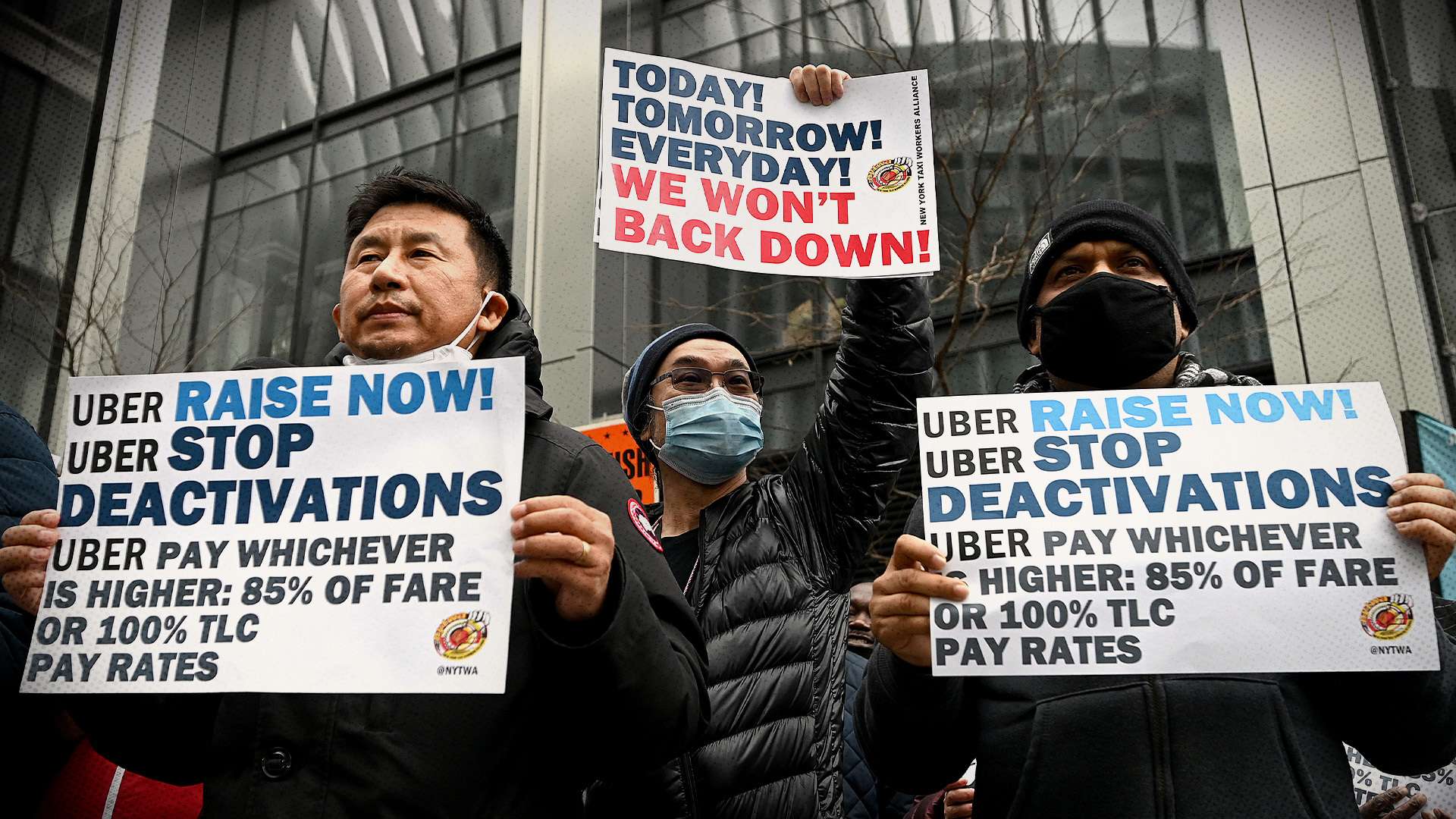
A federal judge temporarily blocked the NYC measure from taking effect. But the legal battle continues.
Last month, a federal judge issued a preliminary injunction to pause a New York City ordinance that would strip rideshare platforms of the power to deactivate drivers unless they could demonstrate “just cause.” The injunction is only temporary. Nevertheless, the city would do well to reconsider the approach anyway.
Under the proposed “just cause” framework, Uber and Lyft would have been prohibited from removing drivers without giving a 14-day notice and proving either “just cause” or a bona fide economic justification. What counts as a bona fide economic reason? The statute left that point murkily defined, describing it only as a “proportionate reduction in volume of sales or profit” from the prior quarter, without clarifying what that meant in practical terms.
Drivers who were deactivated could appeal either to the city’s Department of Consumer and Worker Protection (DCWP) or through the courts. The law also carried a seven-year lookback, applying to deactivations dating back to 2019. Its reach was limited to a “high-volume for-hire vehicle service,” a label intended to pertain solely to Uber and Lyft.
In response to the law’s passage, Uber filed suit, arguing that it violated the Contracts Clause of the U.S. Constitution, among other objections. The Contracts Clause bars states and localities from enacting laws that impair the obligations of contracts. Although the clause has been narrowed by the Supreme Court over time, any legislative curtailment of contracts must still serve a legitimate and substantial public purpose.
The U.S. District Court for the Southern District of New York held that NYC had not met this standard. In a ruling authored by Judge Gregory H. Woods—an appointee of President Barack Obama—the court found that the law largely benefited a small subset of drivers and targeted the two major rideshare companies.
Woods noted that Uber deactivated only about 1 percent of its drivers. If Lyft deactivated drivers at a similar rate, the figure would come in at just under 900 individuals, roughly 0.01 percent of New York City’s population. Considering that some of these drivers were likely dismissed for particularly serious misconduct, such as assaulting a rider, the pool of drivers who could be wrongly deactivated would be exceedingly small.
As Uber highlighted in its complaint, the 14-day notice requirement would mean potentially dangerous drivers would remain on the road for two weeks before the platform could deactivate them and commence the “just cause” proceedings. While the law includes an exception for “egregious conduct,” it defines this as “imminent danger to others.” (The City Council rejected a proposal to replace the language with “conduct that endangers others,” arguing that it would be too broad.)
Judge Woods’ decision blocked the law six days before it was due to take effect, and it also halted the city’s plan to establish a $73.4 million DCWP compliance office that would have housed hundreds of staff and attorneys assigned to enforcing the measure.
The gig economy has long functioned on at-will employment, where either workers or platforms can terminate the relationship at any time and for any reason. Yet in recent years, the left has sought to reclassify gig workers from independent contractors into full-time employees.
Although that broader effort has largely stalled, extending “just cause” protections to these workers represents a form of workplace safeguard typically associated with more traditional employment. In other words, what progressives have failed to secure outright, they are attempting to achieve piecemeal through such measures.
Flexibility is a hallmark of the gig economy. Drivers choose when to work and often operate across multiple platforms, with labor supply expected to adjust dynamically to demand. Imposing additional rules on driver deactivation will inevitably raise labor costs as platforms become less able to weed out troublesome workers. In the end, the very flexibility that drivers prize in gig work could be eroded as firms respond to the regulations by potentially limiting the number of drivers allowed on the platform.
The gig platforms, for their part, have not shown outright resistance to protecting drivers who have been improperly deactivated. A companion “just cause” bill for food-delivery drivers recently passed in New York and drew little opposition from platforms like Uber, likely because it did not impose the onerous 14‑day notice requirement seen in the rideshare measure.
It remains unclear whether NYC will pursue an appeal or instead accept that the law needs rewriting. A more prudent path might be to discard the misguided concept altogether.
