
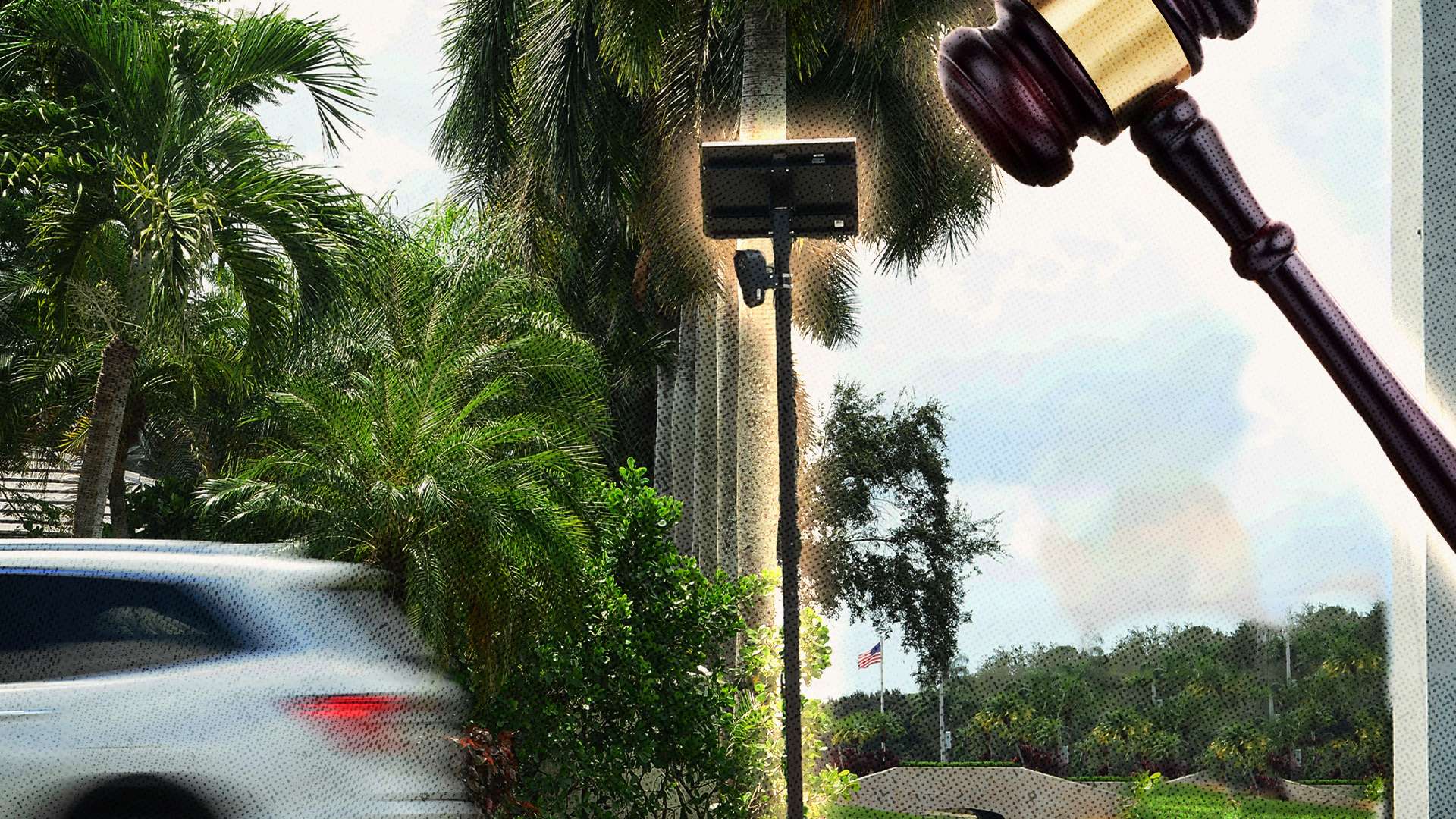
State and federal courts have almost uniformly held that searches of ALPR databases do not implicate the Fourth Amendment.
Recently, a federal judge in Oklahoma decided that querying a records store created by automated license plate readers (ALPRs) constitutes a Fourth Amendment search. As Reason‘s Elizabeth Nolan Brown pointed out, this ruling was welcome to critics who contend that warrantless access to ALPR data threatens the privacy of innocent drivers nationwide. Yet a California judge’s ruling the following day—which dismissed a lawsuit arguing that San Jose’s ALPR network violates the state constitution—illustrates the more common trajectory of litigation in this area, which has largely not succeeded.
The stark contrast between these two rulings highlights the hurdles such lawsuits face as judges weigh the implications of Supreme Court precedents on cellphone location data. Even though the relevance of those precedents may seem straightforward, state and federal courts have generally identified meaningful distinctions between cellphone tracking and police use of roadside cameras that capture images of vehicles in transit.
The Oklahoma matter, United States v. Kyle, grew out of Tulsa County Deputy Sheriff Freddie Alaniz’s examination of a database maintained by Flock Safety, the leading ALPR vendor. Alaniz retrieved historical location information for a car with California plates, which was the only basis for suspecting criminal activity at that moment. As pretexts for the search, Alaniz entered terms like “traffic violation” and “investigation,” which gives a sense of how flimsy the justification for accessing ALPR data can be: when he typed those words, he had neither witnessed a traffic violation nor gathered any evidence that would support a criminal inquiry.
In essence, the database search rested on at best a hunch and likely closer to idle curiosity. It did not meet the standard of reasonable suspicion, much less the probable cause required for a warrant.
In ruling that the ALPR query violated the Fourth Amendment, U.S. District Judge Sara E. Hill drew on the Supreme Court’s 2018 decision in Carpenter v. United States, which concerned location data collected by cell towers, and its 2026 ruling in Chatrie v. United States, which dealt with information gathered via Google Location History. In both decisions, the Court identified a “search” under the Fourth Amendment and carved out an exception to the “third-party” doctrine, which holds that people generally lack a reasonable expectation of privacy for information they voluntarily share with others.
Alaniz’s query produced “fifty sightings across several states,” Hill noted. While “this is not the same precisely targeted level of detail that something like a cell phone can reveal about a person’s entire movements,” she said, “Alaniz and other officers using these systems can access a continuously updated location history for all vehicles captured by ALPR cameras within the network. This constitutes a form of broad, indiscriminate mass surveillance. It is not directed at a single individual, as in Carpenter. It is a tool that gathers data about every vehicle that passes any network-connected camera at all times, and it makes that information available to law enforcement on demand.”
From Hill’s perspective, ALPR networks thus represent an intrusion beyond the data demand at issue in Carpenter. “Freedom from persistent, dragnet-style monitoring in public is not a foreign concept in our society, and it is a reasonable expectation that society already accepts,” she wrote. “This is the same privacy expectation that the Supreme Court has continued to recognize in cases like Carpenter and Chatrie.”
Just as cars and cellphones travel through public spaces where visibility is compulsory, Hill observed. “But it becomes constitutionally problematic when law enforcement can indiscriminately and passively catalog your whereabouts over extended periods and then use that information for any purpose whenever convenient.”
Last Friday in SIREN v. Joseph, Santa Clara County Superior Court Judge Jeffrey B. El-Hajj reached a notably different conclusion about San Jose’s ALPR network. In that matter, the American Civil Liberties Union (ACLU) of Northern California and the Electronic Frontier Foundation (EFF) argued that “San Jose’s warrantless ALPR database searches violate the California Constitution, which protects the people from unreasonable searches and seizures as well as their inalienable right to privacy.”
The lawsuit, filed in November 2025, noted that San Jose “has blanketed its roads with nearly 500 ALPRs,” enabling “location surveillance of all residents” that is “especially pervasive in both time and space.” Invoking Carpenter, the ACLU and the EFF contended that “location information showing people’s long-term physical movements, even in public spaces, deserves constitutional protection under the Fourth Amendment.” Since Carpenter established that people possess a reasonable expectation of privacy regarding their overall movements, they argued, San Jose’s ALPR network breaches Article I, Section 13 of the California Constitution, which also bars “unreasonable seizures and searches.”
El-Hajj disagreed. He noted that in the 2024 case People v. Cartwright, the California Court of Appeal’s Fifth District held that San Diego police did not require a warrant to review video footage captured by a streetlight camera. The appellate court concluded that the defendant’s incriminating statements from that footage showed he did not have a reasonably objective expectation of privacy when he traveled along a public street in downtown San Diego in the middle of a workday. It believed that decision aligned with Carpenter, which explicitly stated its ruling was narrow and not intended to extend to “conventional surveillance techniques and tools, such as security cameras.”
Cartwright involved footage shot in a single afternoon by one camera in one location, unlike San Jose’s network, which collects images for months from numerous cameras spread across the city. The ACLU and EFF argued that San Jose’s system yields “extensive information about a driver’s precise whereabouts at precise times, dozens of times daily, covering at least the last year.” They asserted that San Jose’s setup is “far more privacy-invasive” than the limited number of conventional cameras in Cartwright.
El-Hajj did not deem the distinction decisive. “This court is bound by Cartwright,” he stated. The plaintiffs had not shown sufficient facts to establish a constitutional violation because there is no reasonable privacy expectation in license plate data collected from cameras aimed at public streets.
El-Hajj admitted that “the scope of the Defendants’ system is broader than that in Cartwright.” But he concluded that the case is not so factually different from Cartwright as to permit ignoring that binding appellate precedent. He added that recording license plate information from fixed cameras on public streets over time is less invasive than the continuous cell-site location data at issue in Carpenter.
El-Hajj’s ruling does not resolve the matter for good, since an appeals court could disagree with his analysis. And a federal lawsuit challenging San Jose’s ALPR system, filed by the Institute for Justice last April, remains before the U.S. District Court for the Northern District of California.
For now, however, Hill’s decision stands out as an exception. “It appears that nearly every court that has examined the issue to date has concluded that ALPR technology use does not constitute a search under the Fourth Amendment because people have no reasonable expectation of privacy in their movements on public streets,” she observed.
In the preceding month, a federal judge in the Central District of California likewise determined that ALPR database searches are “clearly distinguishable from and less extensive than the near-perfect surveillance” represented by the historical cell-site data discussed in Carpenter and the Google Location History data in Chatrie. The near-consensus Hill described also includes the U.S. District Court for the Eastern District of Virginia, where the Institute for Justice challenged Norfolk’s Flock camera network in October 2024.
Although U.S. District Judge Mark S. Davis found the Fourth Amendment argument in that case plausible enough to allow the lawsuit to proceed, he ultimately did not accept it. “Federal and state courts evaluating ALPR claims have almost uniformly concluded that neither photographing a vehicle’s license plate on a public road nor maintaining and querying a database of ALPR images constitutes a warrantless ‘search,’” he wrote in January when ruling in the city’s favor.
“It is well-established that police pole cameras or security cameras that photograph or record public areas do not violate any objectively reasonable expectation of privacy,” Davis stated. As for the resulting database, he noted that the plaintiffs had not shown that Norfolk’s ALPR system was capable of tracking a person’s entire movements. The city’s police chief had conceded that “it would be difficult to drive anywhere [for] any distance without encountering a camera somewhere.” But Davis also observed that the cameras were “grouped into 75 clusters in Norfolk rather than spread across 176 isolated sites around the city.”
While the data captured by those cameras could be more precise than the cell-site data at issue in Carpenter, Davis argued that it was less comprehensive and collected less often. Yet, like other judges facing similar matters, Davis acknowledged the possibility that “the constitutional balance could tilt the other way” as “the number and capabilities of ALPR cameras expand.”
Despite the slow pushback against unrestricted ALPR use, the number of cameras cataloged by the DeFlock website—exceeding 144,000 as of today—continues to climb. The capabilities of these devices grow with each software update from companies like Flock, and they could be enhanced by new features such as Bluetooth detectors. At some point, perhaps, the courts will intervene. But it remains unclear whether Hill’s ruling marks the turning point that Davis anticipated.
