
There are surveys that capture a mood at a particular moment. On other occasions, polls detect a shift in an era. The latest survey by the European Council on Foreign Relations (ECFR) is placed in this second category. The data show that Europeans distrust the United States, but that was already known. What’s interesting is that citizens have processed that distrust with a strategic maturity broader than that of their own governments. European public opinion, in this sense and on several fronts, is ahead of its leaders.
“NATO, as a perceived guarantee, already operates in Europeans’ imagination without the piece that for seven decades has been the protagonist”
The headline does the moment justice: only 11% of Europeans currently regard the United States as an ally. The decline is significant compared with 22% in November 2024 and 16% from just half a year ago. Moreover, one in four already views Washington as a rival or adversary, and half describe it as a “necessary partner” with whom to cooperate—out of pragmatism, not affinity. The erosion is cross-cutting: among all the electorates analyzed, only voters for radical-right parties such as Law and Justice (PiS) in Poland, and Reform UK, continue to see Washington as an ally. In every country surveyed, majorities believe the United States would not come to their defense if they were attacked. NATO, as a perceived guarantee, already functions in Europeans’ imagination without the piece that for seven decades has been the protagonist.
However, the barometer detects, instead of a rupture, a recalibration. Most Europeans believe the transatlantic relationship will improve when Donald Trump leaves the White House. There is a clear intention not to burn all bridges because there is a need for autonomy that does not rely on the United States. That is why there is no majority to replace NATO with an exclusively European defensive organization: 29% support it, 28% oppose it, and the rest abstain. The average European is not disruptive nor nostalgic. He is pragmatic.
Paying for One’s Own Defense
That realism translates into budgets. Majorities across Europe back increasing defense spending, buying European arms rather than American — only in Poland does the option of buying more weapons from Washington gain ground —, developing European nuclear deterrence that does not depend on the United States and, most significantly, financing all of this with common debt. That voters from the governing parties in Austria, Denmark, Germany, the Netherlands, and Sweden —the core of fiscal orthodoxy— predominantly support joint borrowing for defense would have been unthinkable four years ago. The Ukraine war shattered the energy taboo; Trump has shattered the fiscal one.
“The European voter accepts strategic autonomy as a principle and as a debt; not necessarily as a cut to the welfare state”
Now, when the question forces a choice between defense and other public spending, ambiguity surfaces: a plurality of Europeans rejects that sacrifice, with majorities opposed in Germany, Italy, and Spain. The European voter accepts strategic autonomy as a principle and as a debt; not necessarily as a cut to the welfare state. There lies the real political limit that governments will have to manage.
Ukraine: Yes to Support, No to Commitment
The second finding dismantles the two frames through which European chancelleries think about Ukraine. Europeans maintain a positive view of the country — in almost all countries polled, more favorable than the United States — but oppose sending peace troops after a potential agreement, with majorities against in Germany, France, and Poland, the three military pillars of the EU.
There is also no consensus for Ukrainian accession “in the current context,” not even among its geographic neighbors. It is not a rejection of enlargement per se: expansion to the west generates far more sympathy. It is a rejection of the risk of a country betting its own sovereignty.
“The window of support for Kyiv remains open, but it is not guaranteed in the medium term”
The report adds a relevant warning: electorates of Europe’s radical right — FPÖ, AfD, Konfederacja, Fidesz — already perceive Ukraine as a rival or adversary, and that sentiment is electoral ammunition available for the coming cycles, especially if it intersects with fatigue from a “permanent war” and with the anxiety about the cost of living. The window of support for Kyiv remains open, but not guaranteed in the medium term.
The Spanish Case: a Significant Increase
In Spain support for increasing defense spending has grown between November 2025 and May 2026 by 15 points — rising from +1 to +16 points. It is also one of the few countries — alongside Portugal, Sweden, and the United Kingdom — where sending peace troops to Ukraine has a positive balance (+25). And PSOE voters stand out across Europe among those who directly view the United States as an adversary, aligned with the logic of the government led by Pedro Sánchez.
Moreover, 68% of these same socialist voters believe the transatlantic relationship will improve after Trump. The electorate that sustains Europe’s more discordant diplomacy with Washington has not overturned the Atlantic relationship; it has amended it toward Trump. Sánchez’s defiant stance does not yet reflect the European moyenne, although the course of the movement has put him a step ahead of it.
“The Spanish voter combines the greatest willingness to bear the burden with the greatest fear of its consequences”
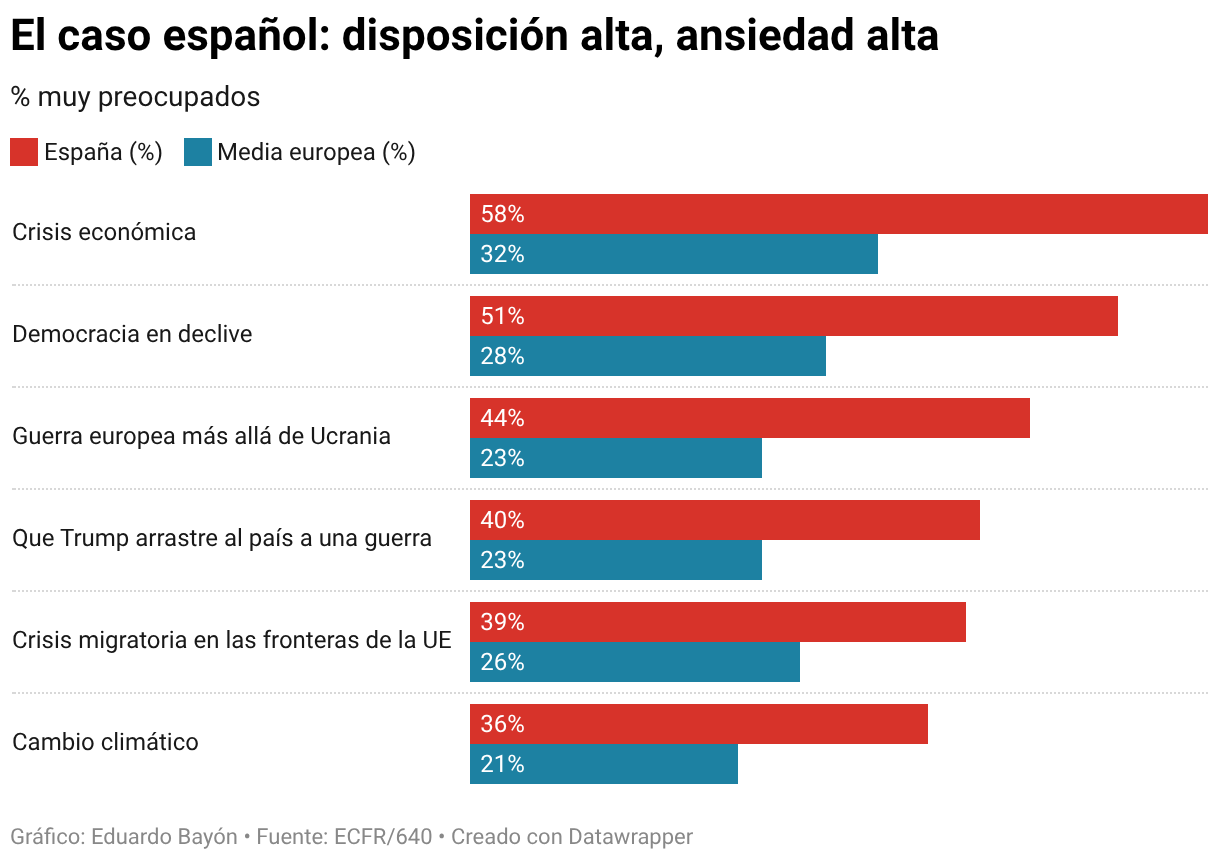
The flip side of Spain’s data is anxiety. Spaniards lead concerns about an economic crisis — 58% describe themselves as very worried, compared to a European average of 32% — and about the possibility that Trump could drag the country into a war (40%). The Spanish voter combines the greatest willingness to bear the burden with the greatest fear of its consequences. That tension is manageable, but not indefinitely.
The License to Operate Has an Expiration Date
European leaders now enjoy public backing for three things that were previously politically costly: pursuing strategic autonomy without needing to wave a finger at Trump, seeking new mechanisms to support Ukraine that do not hinge on immediate accession or troops on the ground, and accelerating energy sovereignty without fearing that the anti-Russia consensus will collapse. Only in Bulgaria, Hungary, and Italy is there meaningful appetite to reopen the gas taps from Russia; majorities in almost every country, including a large share of radical-right voters, prioritize renewables.
“If the system does not protect people’s wallets, the voter will withdraw the trust they currently place in everything else”
But that backing is a window, not a blank check. Two data points constrain it. First: Europeans’ main concern is not Russia or Trump, but an economic crisis. Second: although the majority blame the United States for the price rise caused by the Iran war, many — notably in Estonia and Germany — also blame their own governments. If the system does not protect the wallet, the voter will withdraw the trust they currently place in everything else. In this sense, the calendar tightens: from Sweden to France, from Poland to Italy and Spain, the sequence of elections arriving in the next two years provides fertile ground for those challenging a self-sufficient Europe.
Europeans have learned to set traps at home while waiting for the American cousin to return. The question this survey leaves is whether European governments will know how to use their societies’ goodwill before it expires.
